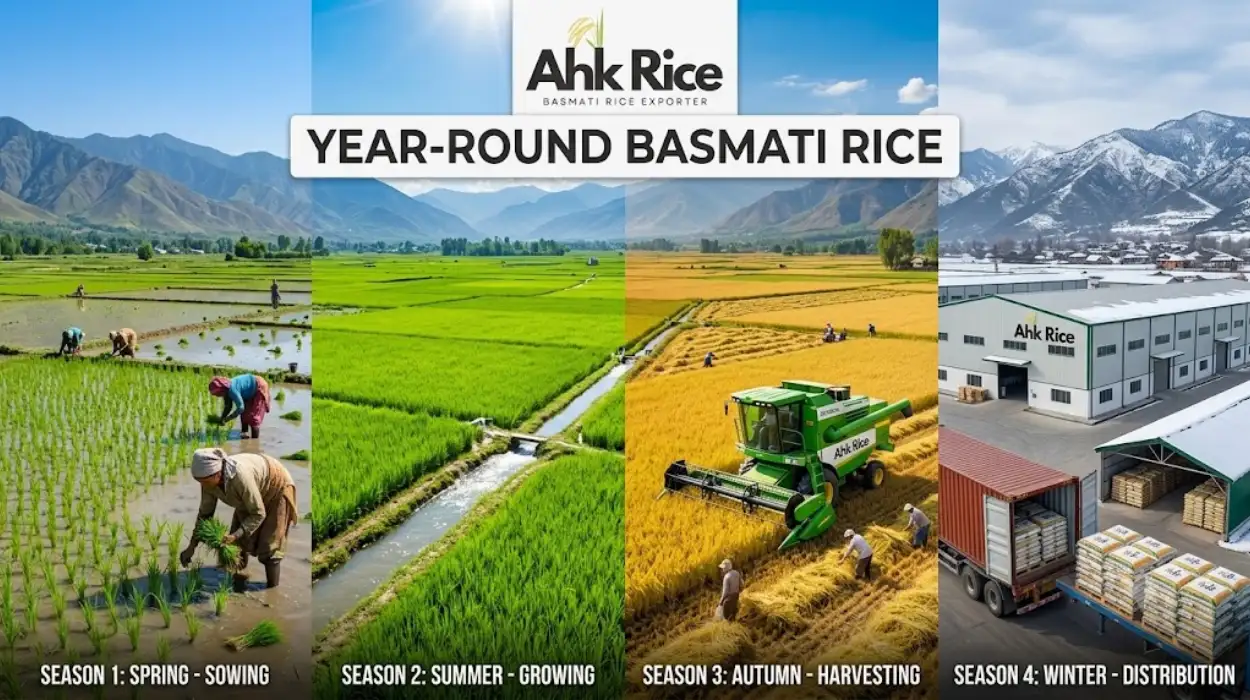
How Does Production Capacity Support Consistent Year-Round Rice Supply?
Production capacity is the foundation of consistent year-round rice supply. Here is why: exporters with large procurement networks, controlled milling capacity, adequate storage, and integrated logistics can maintain uninterrupted shipments across seasons, reduce stock shortages, and stabilize quality specifications throughout the year.
Global rice buyers depend on predictable supply chains. Importers in the UK, Middle East, and Europe require fixed specifications, scheduled deliveries, and consistent grain quality. Production capacity connects cultivation, processing, storage, grading, packaging, and export operations into one system. AHK Rice supports this model through integrated sourcing, milling, grading, packaging, and export management across Punjab, Pakistan.
Buyers evaluating long-term sourcing strategies often begin by understanding how production systems work before selecting suppliers. This detailed guide on Why Should Scottish Buyers Evaluate Rice Production Capacity Carefully the journey of Basmati rice from cultivation to export markets explains the production chain that supports dependable international supply.
What Does Production Capacity Mean in Rice Export Operations?
Production capacity combines paddy procurement, milling throughput, storage availability, quality control systems, and export logistics to maintain uninterrupted supply throughout the year.
Production capacity measures the total volume an exporter can source, process, store, and dispatch within a defined period. Capacity is not limited to farming output. Capacity includes every stage between harvest and final delivery.
Rice exporters operate within seasonal harvest cycles. Pakistan harvests Basmati rice mainly between September and November. Import demand continues throughout all twelve months. Exporters bridge this gap through inventory planning and controlled storage systems.
Production capacity consists of five connected components:
- Procuring paddy from cultivation regions
- Milling harvested rice
- Grading and sorting rice
- Storing finished inventory
- Shipping export orders
An exporter with strong capacity maintains stable supply despite fluctuations in harvest timing, shipping schedules, and regional demand.
With production capacity defined, the next question is which solutions help exporters maintain year-round availability.
What Are the Available Solutions for Maintaining Year-Round Rice Supply?
Integrated production systems, strategic inventory management, contract farming, warehouse expansion, and diversified sourcing provide the most reliable year-round supply solutions.
Different exporters use different approaches to maintain stock availability. Each solution offers distinct advantages depending on market requirements.
Strategic Inventory Storage
Strategic inventory storage allows exporters to hold rice after harvest and release inventory gradually throughout the year.
Rice remains stable under controlled temperature and moisture conditions. Properly stored Basmati rice can maintain export quality for extended periods.
Multi-Region Paddy Procurement
Multi-region procurement reduces dependency on a single cultivation area.
Procurement teams source paddy from multiple districts across Punjab. This strategy reduces risks from localized weather events.
Integrated Processing Facilities
Integrated facilities combine milling, grading, sorting, polishing, packaging, and warehousing.
Integrated operations reduce delays between processing stages. Faster processing increases shipment readiness.
Contract Farming Programs
Contract farming establishes agreements between exporters and growers.
Contracted cultivation improves production forecasting. Buyers gain greater confidence in future supply commitments.
Demand Forecasting Systems
Forecasting systems analyze customer purchase cycles.
Historical sales data helps exporters prepare inventory before seasonal demand increases.
The available solutions differ significantly in cost, scalability, and reliability. The next section compares them directly.
How Do Different Production Capacity Approaches Compare
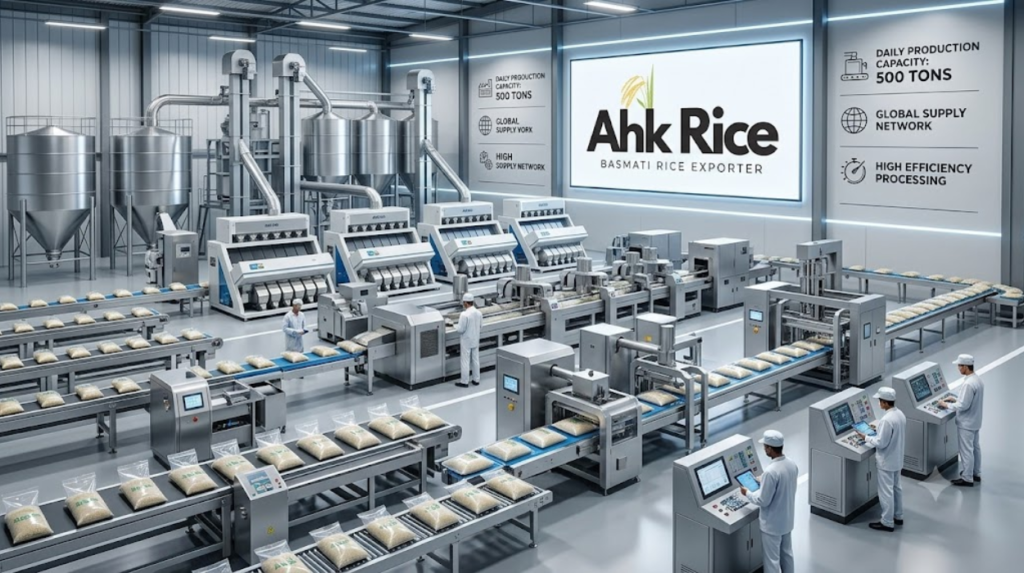
Integrated production systems deliver the highest reliability, while standalone storage and procurement strategies offer partial supply protection.
H3: Production Capacity Comparison Table
| Attribute | Integrated Production System | Inventory Storage Only | Contract Farming Only | Multi-Region Procurement |
|---|---|---|---|---|
| Supply Reliability | Very High | High | Medium | High |
| Quality Consistency | Very High | Medium | High | Medium |
| Inventory Visibility | Excellent | Good | Limited | Moderate |
| Processing Control | Full Control | Limited | Limited | Limited |
| Response to Demand Spikes | Fast | Moderate | Slow | Moderate |
| Export Scheduling | Highly Predictable | Predictable | Variable | Variable |
| Long-Term Scalability | Excellent | Moderate | High | High |
Integrated systems create the strongest supply chain because procurement, processing, and logistics remain under coordinated management.
Inventory-only models protect against shortages but cannot guarantee processing flexibility.
Contract farming improves raw material availability but does not guarantee milling capacity.
Multi-region procurement reduces agricultural risk but may create quality variation between sourcing regions.
Comparison becomes more meaningful when viewed through regional buyer requirements.
How Do Market Regions Differ in Their Rice Grade Preferences?
The UK prefers premium aged Basmati grades, while Middle Eastern buyers prioritize volume-oriented grades with strong cooking performance.
Regional preferences directly influence production planning.
United Kingdom Market Preferences
UK importers typically focus on premium retail and ethnic food sectors.
Preferred grades include:
- 1121 Steam Basmati Rice
- Super Kernel Basmati Rice
- 1121 White Basmati Rice
UK buyers prioritize grain length, aroma retention, and retail presentation.
Premium specifications often require tighter sorting standards and lower broken percentages.
Middle East Market Preferences
Middle Eastern buyers focus on catering, hospitality, and wholesale distribution.
Preferred grades include:
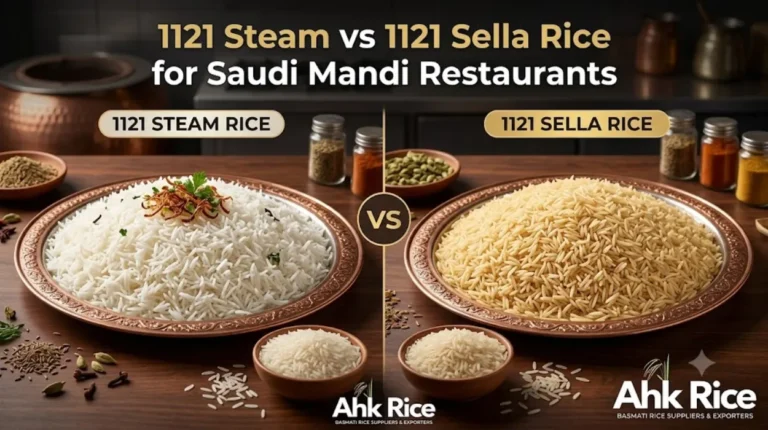
- 1121 Golden Sella Basmati Rice
- 1509 Golden Sella Rice
- Super Kernel Sella Rice
Golden Sella grades perform well under large-scale cooking conditions.
Hospitality operators value grain elongation and shelf stability.
Regional demand patterns influence procurement and inventory planning strategies.
Understanding preferences leads directly to pricing considerations.
How Does Production Capacity Affect Price Stability Per Metric Ton?
Large production capacity improves price stability by reducing procurement pressure, minimizing shortages, and optimizing inventory turnover.
Price volatility often occurs when exporters lack sufficient inventory.
Large-capacity exporters purchase paddy during harvest periods when availability is highest. This strategy lowers procurement costs.
Smaller operators frequently purchase during peak demand periods. Higher procurement costs increase export prices.
Indicative Price Comparison by Supply Model
| Supply Model | Average Price Stability | Procurement Risk |
|---|---|---|
| High-Capacity Integrated Exporter | Very Stable | Low |
| Medium Storage Exporter | Stable | Medium |
| Seasonal Trader | Variable | High |
Example scenarios illustrate the difference.
High-capacity exporters can continue supplying orders during temporary market shortages.
Seasonal traders often pause shipments until new inventory becomes available.
Price stability directly affects long-term procurement contracts.
Beyond pricing, buyers also evaluate shelf-life performance.
How Does Production Capacity Influence Shelf Life and Inventory Quality?
Strong production systems preserve quality through controlled storage, moisture management, and inventory rotation programs.
Shelf life depends on processing standards and storage conditions.
Production capacity supports proper inventory rotation.
Shelf Life Comparison
| Rice Type | Typical Shelf Life |
|---|---|
| 1121 White Basmati | 12–18 Months |
| Super Kernel Basmati | 12–18 Months |
| 1121 Steam Basmati | 18–24 Months |
| 1121 Golden Sella | 24 Months+ |
Golden Sella lasts longer than Steam grades.
In hot Gulf warehouses, Golden Sella maintains quality for longer storage periods.
In retail-focused UK distribution centers, aged White and Steam Basmati remain preferred options.
Storage quality affects both appearance and cooking performance.
The next step is identifying which production strategy fits specific buyer situations.
Which Production Capacity Method Works Best for Different Cases?
Integrated capacity works best for large importers, while inventory-focused models suit smaller seasonal buyers.
Decision Framework Table
| Buyer Situation | Recommended Approach |
|---|---|
| National Retail Chains | Integrated Production Capacity |
| Foodservice Distributors | Integrated Production Capacity |
| Seasonal Import Programs | Inventory Storage Strategy |
| Government Tenders | Integrated Production Capacity |
| Small Spot Purchases | Multi-Region Procurement Model |
National retailers require predictable replenishment schedules.
Integrated systems support consistent specification compliance.
Foodservice distributors need uninterrupted inventory.
Government tenders require capacity verification and shipment certainty.
Spot buyers focus on short-term availability rather than annual planning.
Decision frameworks become clearer when advantages and disadvantages are evaluated directly.
What Are the Pros and Cons of Large Production Capacity?
Large production capacity improves consistency and scalability but requires greater investment in infrastructure and inventory management.
Advantages
- Consistent year-round supply
- Stable product specifications
- Faster shipment readiness
- Improved inventory planning
- Stronger export reliability
Large operations reduce supply interruptions.
Large operations improve shipment scheduling accuracy.
Large operations support long-term buyer agreements.Disadvantages
- Higher warehouse investment
- Greater inventory carrying costs
- More complex planning requirements
- Increased quality monitoring obligations
Infrastructure investment increases operating expenses.
Inventory management requires continuous monitoring.
Despite these considerations, capacity remains a major competitive advantage in global rice trade.
With advantages and limitations evaluated, the final consideration involves selecting the right sourcing partner.
What Factors Should Buyers Evaluate Before Choosing a Rice Exporter?
Processing capacity, storage infrastructure, procurement capability, quality controls, and export experience are the most important decision factors.
Buyers should verify processing throughput.
Buyers should verify warehouse capacity.
Buyers should verify quality inspection procedures.
Buyers should verify export documentation processes.
Buyers should verify shipment scheduling performance.
AHK Rice supports international buyers through integrated procurement, milling, grading, packaging, storage, and export coordination across Punjab.
Production capacity ultimately determines whether supply commitments remain reliable throughout the year.
How does production capacity reduce rice supply disruptions?
Production capacity reduces disruptions by maintaining sufficient inventory, processing flexibility, and shipment readiness. Exporters with larger capacity continue supplying customers during seasonal fluctuations and temporary market shortages.
Why is storage capacity important in rice exports?
Storage capacity preserves inventory between harvest periods and export schedules. Controlled storage protects grain quality, maintains moisture levels, and supports year-round product availability.
Which Basmati rice grade is most suitable for long-term storage?
1121 Golden Sella Basmati Rice offers the longest shelf life. The parboiling process improves grain stability and supports storage periods exceeding 24 months under proper conditions.
Why do UK importers prefer premium Basmati grades?
UK buyers focus on aroma, grain length, and retail presentation. Premium grades such as 1121 Steam and Super Kernel Basmati align with these market requirements.
How can buyers assess an exporter’s production capacity?
Buyers should evaluate procurement networks, milling facilities, warehouse infrastructure, quality control systems, packaging capabilities, and export performance records before selecting a supplier.