Why Is Moisture Content Critical for Imported Basmati Rice Quality?
Moisture content is one of the most important quality measurements for imported Basmati rice because it determines grain stability, cooking performance, storage safety, transportation reliability, and commercial value. In 2026, international buyers, food manufacturers, wholesalers, retailers, and government inspection authorities evaluate moisture before approving rice shipments since it directly influences shelf life, aroma preservation, grain integrity, and compliance with importing country regulations.
Pakistani Basmati rice is recognized worldwide for its extra-long grain, natural aroma, and superior elongation after cooking. Those characteristics remain stable only when moisture stays within the correct range throughout harvesting, milling, grading, storage, packaging, and ocean transportation. Every stage in the supply chain is designed to maintain a controlled moisture percentage so the rice reaches buyers in the same condition in which it left the processing facility.
Understanding how moisture behaves before and after export also makes it easier to understand how storage conditions influence long-term quality. A detailed explanation of warehouse management, packaging performance, and storage stability is covered in our article about:
What Is Moisture Content in Imported Basmati Rice?
Moisture content is the percentage of water naturally present inside each rice grain. International laboratories measure this percentage because it determines grain durability, milling quality, storage safety, cooking performance, aroma preservation, and export compliance throughout the complete international supply chain.
Moisture content refers to the amount of water contained within a rice kernel before packaging or shipment. The value is expressed as a percentage of the grain’s total weight.
For example:
- 12% moisture means every 100 kilograms of rice contains 12 kilograms of water.
- 13% moisture means every 100 kilograms contains 13 kilograms of water.
- 14% moisture means every 100 kilograms contains 14 kilograms of water.
These percentages appear small, but they significantly affect product quality.
International rice standards use moisture as one of the primary inspection criteria because excess water accelerates deterioration, while excessively dry rice becomes brittle during processing.
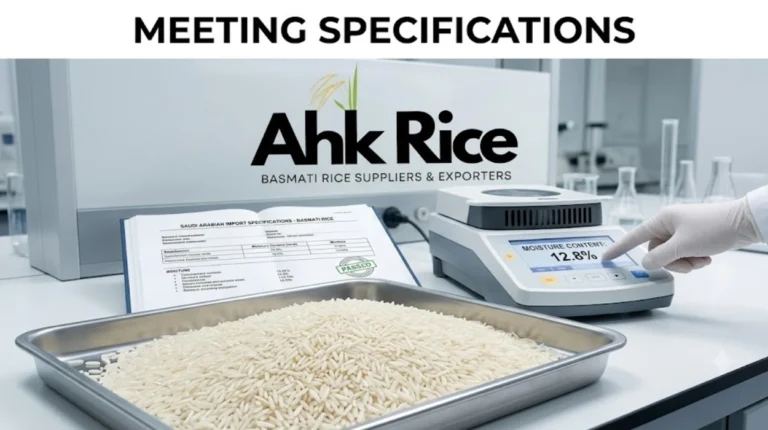
Modern export mills use calibrated digital moisture meters and laboratory oven testing to verify readings before shipment.
Why Is Moisture Measured Before Export?
Every export shipment passes through quality inspection.
Moisture testing verifies that the rice remains stable during:
- Inland transportation
- Container loading
- Ocean freight
- Customs clearance
- Warehouse storage
- Retail distribution
Importers depend on verified moisture reports before approving large commercial purchases.
How Does Moisture Content Affect Imported Basmati Rice Quality?
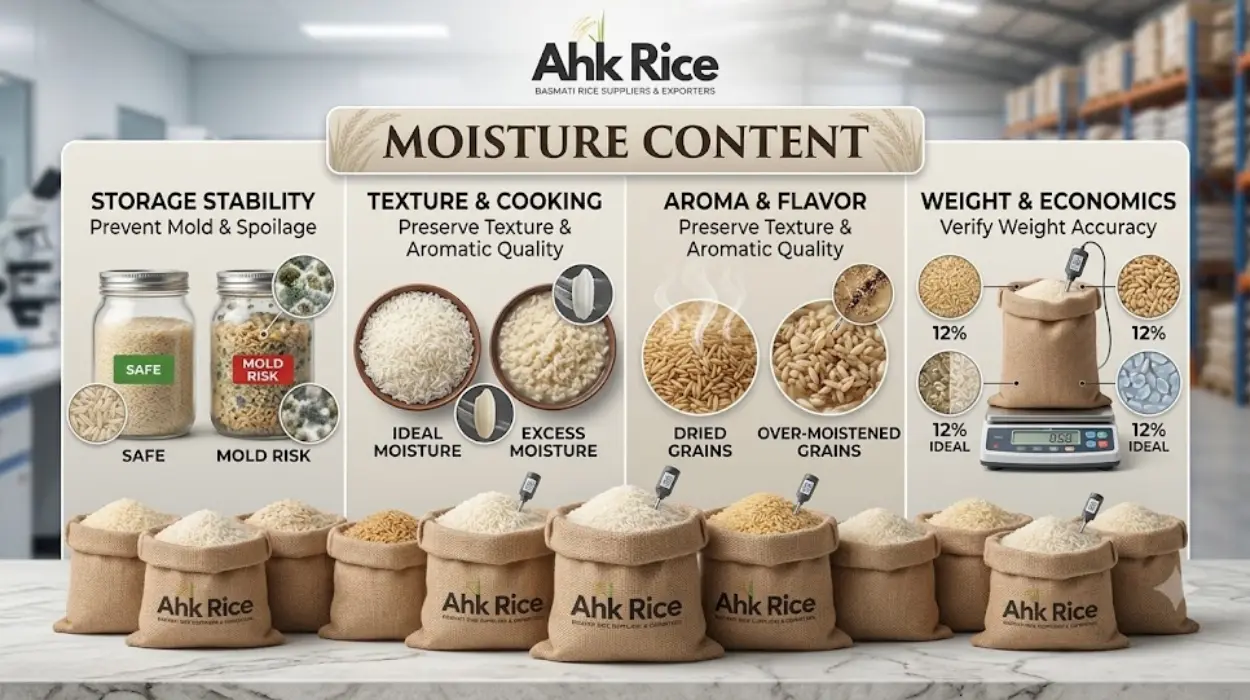
Moisture influences nearly every quality characteristic of imported Basmati rice, including grain strength, aroma retention, cooking consistency, storage stability, milling recovery, insect resistance, fungal protection, and overall commercial acceptance in international food markets throughout 2026.
Water inside the grain determines how rice reacts to pressure, temperature, and humidity.
When moisture stays within the recommended export range, grains remain firm and stable.
When moisture rises excessively, biological activity increases.
Higher biological activity creates favorable conditions for:
- Mold growth
- Fungal contamination
- Bacterial development
- Insect infestation
- Heat generation inside storage stacks
Conversely, moisture levels that are too low increase grain brittleness.
Broken kernels reduce commercial value because buyers pay premium prices for whole extra-long grains.
Moisture therefore balances physical durability and biological stability simultaneously.
How Does Moisture Move Through the Basmati Rice Processing Chain?
Moisture changes gradually during harvesting, drying, storage, milling, polishing, grading, packaging, container loading, and international transportation. Every processing stage carefully controls moisture because stable grain condition depends on consistent environmental management rather than a single inspection.
Moisture management begins before milling starts.
Harvesting
Farmers harvest mature Basmati paddy after the grain reaches physiological maturity.
Freshly harvested paddy contains significantly higher moisture than export-ready rice.
Controlled drying starts immediately after harvesting.
Drying
Drying reduces excess internal water.
Modern drying systems lower moisture uniformly to prevent stress cracks.
Uniform drying protects grain strength.
Storage
Dried paddy enters ventilated storage.
Warehouse humidity remains controlled to prevent moisture reabsorption.
Temperature monitoring protects grain quality.
Milling
The husk is removed.
The bran layer is polished according to product specifications.
Milling creates friction, so processors continuously monitor grain temperature.
Grading
Machines separate rice according to:
- Grain length
- Broken percentage
- Thickness
- Purity
- Foreign matter
Uniform grading improves packaging consistency.
Packaging
Rice is packed inside moisture-resistant packaging materials.
Packaging minimizes moisture exchange with surrounding air.
Shipping
Export containers remain clean and dry before loading.
Proper ventilation and container inspection reduce condensation risks during ocean transport.
What Components Help Maintain Proper Moisture Levels?
Effective moisture control depends on several connected systems, including harvesting practices, drying technology, warehouse management, laboratory testing, packaging materials, container preparation, and continuous quality inspections before export documentation is finalized.
Moisture management is not controlled by one machine.
Multiple systems work together.
Controlled Drying Equipment
Modern drying equipment removes water gradually.
Gradual drying reduces internal grain stress.
Uniform kernels produce higher milling yields.
Laboratory Testing
Quality laboratories verify moisture before shipment.
Digital moisture analyzers provide rapid results.
Oven testing validates laboratory accuracy.
Climate-Controlled Warehouses
Warehouses reduce moisture fluctuation.
Proper airflow limits condensation.
Regular inspections maintain grain condition.
Moisture-Resistant Packaging
Common export packaging includes:
- Laminated PP bags
- BOPP laminated bags
- Multi-wall paper bags
- Vacuum packaging
- Retail laminated pouches
These materials reduce environmental moisture absorption.
Container Inspection
Containers receive inspection before loading.
Inspectors verify:
- Dry flooring
- Clean walls
- No roof leaks
- No odors
- No previous contamination
Container condition directly affects shipment quality.
What Benefits Does Proper Moisture Control Provide?
Maintaining correct moisture preserves grain appearance, cooking quality, shelf stability, aroma, export compliance, transportation safety, processing efficiency, and consumer satisfaction while reducing commercial losses across the international rice supply chain.
Proper moisture creates measurable quality improvements.
Better Cooking Performance
Rice absorbs water uniformly during cooking.
Grains elongate evenly.
Texture remains separate instead of sticky.
Improved Aroma Preservation
Natural aromatic compounds remain more stable.
Consumers receive authentic Basmati fragrance.
Reduced Grain Breakage
Balanced moisture improves kernel strength.
Long grains survive milling more effectively.
Export grades contain fewer broken kernels.
Longer Shelf Life
Controlled moisture slows biological deterioration.
Storage quality remains consistent over extended distribution periods.
Greater Food Safety
Stable moisture discourages mold development.
Lower biological activity supports safer food storage.
Where Is Moisture Management Most Important?
Moisture control is essential wherever imported Basmati rice experiences storage, transportation, processing, or distribution because environmental humidity continuously affects grain condition from farm production until final consumer packaging.
Many industries depend on moisture-controlled rice.
Examples include:
- Retail supermarkets
- Restaurant distributors
- Hotel suppliers
- Food manufacturers
- Catering companies
- Government food procurement agencies
Each industry stores rice differently.
Stable moisture protects quality regardless of storage duration.
International Import Markets
Pakistani Basmati rice reaches numerous importing regions.
Examples include:
- United States
- Canada
- United Kingdom
- Germany
- Saudi Arabia
- United Arab Emirates
- Qatar
- Kuwait
- Oman
- Australia
- Malaysia
- Singapore
Every importing market applies food safety and quality inspection requirements before commercial distribution.
Which Grades of Pakistani Basmati Rice Require Moisture Control?
Every grade of Pakistani Basmati rice requires controlled moisture because premium quality depends on stable grain condition regardless of grain length, milling process, polishing level, or intended international market.
Pakistani exporters process several major Basmati grades.
Examples include:
1121 Basmati Rice
Known for extra-long grain length.
Produces exceptional elongation after cooking.
Super Kernel Basmati Rice
Recognized for traditional aroma.
Popular across premium retail markets.
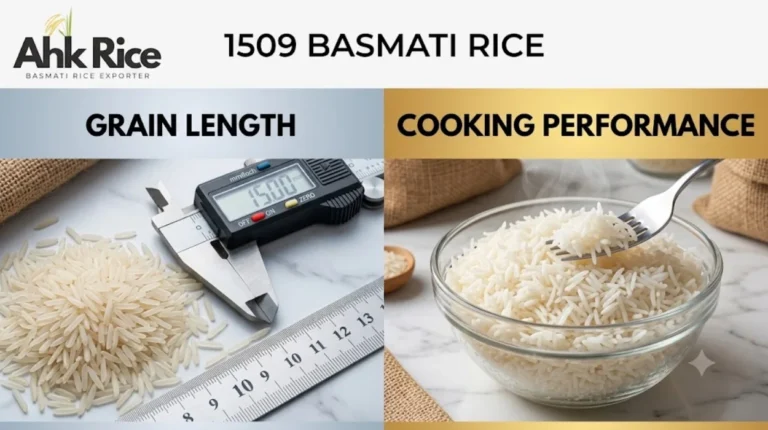
1509 Basmati Rice
Offers excellent grain length and high cooking recovery.
Increasingly imported by foodservice buyers.
Each variety follows moisture verification before export.
Which Certifications Include Moisture Evaluation?
International food quality systems include moisture verification as part of broader inspection programs covering food safety, processing standards, laboratory quality assurance, export documentation, and regulatory compliance during international trade.
Moisture reports support several certification systems used throughout global rice exports.
Examples include:
- ISO 22000 Food Safety Management
- HACCP
- GMP
- FSSC 22000
- Phytosanitary Certification
- Certificate of Origin
- Quality Inspection Reports
- Laboratory Analysis Reports
Import authorities review these documents before commercial release.
Laboratory reports often include additional measurements such as:
- Broken percentage
- Chalkiness
- Foreign matter
- Damaged kernels
- Purity
- Grain length
Moisture remains one of the primary reported values.
What Misconceptions Exist About Moisture Content?
Several common misunderstandings confuse moisture with freshness, cooking quality, or grain weight, yet moisture simply measures internal water content and must remain balanced to preserve overall product quality during international trade.
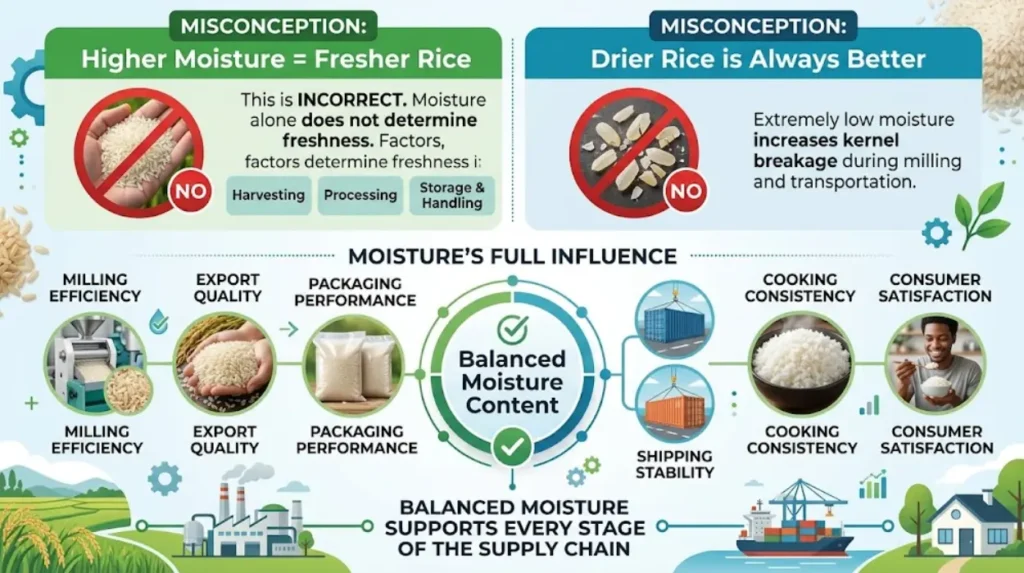
Many buyers assume higher moisture means fresher rice.
This is incorrect.
Freshness depends on harvesting, processing, storage, and handling.
Moisture alone does not determine freshness.
Another misconception states that drier rice always performs better.
Extremely low moisture increases kernel breakage during milling and transportation.
Some believe moisture affects only storage.
In reality, moisture influences:
- Milling efficiency
- Export quality
- Packaging performance
- Shipping stability
- Cooking consistency
- Consumer satisfaction
Balanced moisture supports every stage of the supply chain.
Why Does Moisture Remain a Critical Quality Indicator in 2026?
Moisture continues to be one of the most trusted scientific quality indicators because it directly influences food safety, physical grain integrity, commercial grading, export compliance, cooking performance, and long-term storage stability across international Basmati rice markets.
Modern global food supply chains require measurable quality standards.
Moisture is one of the easiest characteristics to verify accurately.
Laboratory instruments provide repeatable results.
International buyers compare moisture reports alongside grain length, purity, broken percentage, and defect levels before accepting shipments.
As worldwide demand for premium Pakistani Basmati rice continues to grow in 2026, moisture management remains one of the essential quality controls that protects the product from harvest through international delivery.
Frequently Asked Questions
How is moisture content measured in imported Basmati rice?
Moisture content is measured using calibrated digital moisture meters and laboratory oven-drying methods. Export laboratories verify the percentage before shipment to ensure the rice meets international quality and food safety requirements.
What is the ideal moisture content for exported Basmati rice?
Most international buyers and exporters accept Basmati rice with a moisture content of around 12% to 14%, depending on the importing country’s standards and the specific rice grade.
Why does high moisture reduce Basmati rice quality?
High moisture encourages mold growth, insect activity, grain discoloration, unpleasant odors, and faster deterioration during storage and ocean transportation, reducing both food safety and commercial value.
Does moisture content affect the cooking performance of Basmati rice?
Yes. Proper moisture helps rice cook evenly, maintain separate grains, preserve its natural aroma, and achieve the characteristic elongation expected from premium Basmati varieties.
Can moisture content cause broken rice during processing?
Yes. Rice that is too dry becomes brittle during milling and handling, increasing the percentage of broken kernels and lowering the overall export grade.
Which Pakistani Basmati rice varieties require moisture testing?
All major export varieties, including 1121 Basmati, Super Kernel Basmati, and 1509 Basmati, undergo moisture testing before shipment to ensure consistent quality.
Why do importers request moisture analysis reports?
Importers use moisture reports to verify storage stability, transportation safety, product quality, and compliance with international import regulations before accepting commercial shipments.