Why Are Private Label Basmati Rice Brands Expanding in the USA?
Private label Basmati rice brands are expanding in the USA because store-brand demand is rising, retailers want greater control over product specifications and pricing, and Basmati provides a recognizable premium rice category for supermarkets, ethnic retailers, club stores, foodservice distributors, and online grocery channels. U.S. store-brand sales reached $282.8 billion in 2025, up 3.3% from 2024, while national-brand sales increased 1.2%. Store brands also reached a record 23.5% unit share.
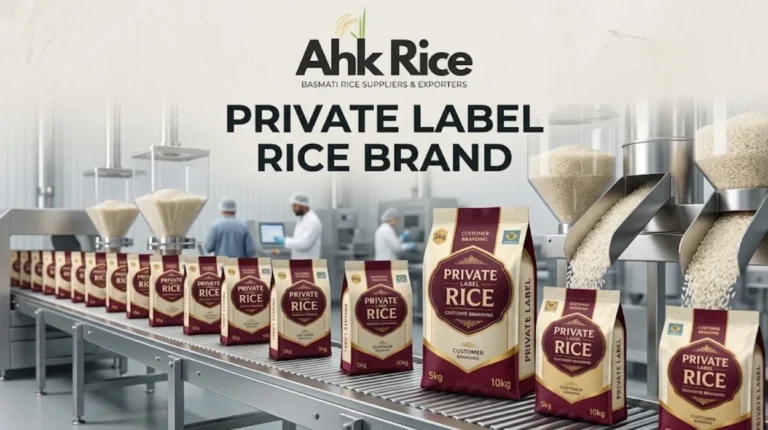
For Basmati rice, private labeling separates the product identity from the processor or exporter. The retailer, distributor, importer, or food company owns the consumer-facing brand. The overseas rice processor supplies the specified rice variety, processing grade, packaging format, documentation, and shipment. This structure gives U.S. businesses control over how Basmati is positioned, packaged, priced, and distributed.
What Is Private Label Basmati Rice?
Private label Basmati rice is rice imported and packaged for sale under a retailer or distributor’s brand rather than the processor’s consumer brand, with specifications covering variety, processing, grade, packaging, labeling, and compliance. The brand owner controls the market identity while the supplier fulfills the agreed product specification.
Basmati is an aromatic long-grain rice traditionally associated with the Himalayan foothill region of the Indian subcontinent. Pakistani Basmati is primarily cultivated in Punjab, where soil, irrigation, climate, and seasonal conditions support the development of its characteristic aroma and grain structure.
Private label Basmati therefore involves two separate entities. The first is the brand owner, such as a supermarket, importer, distributor, restaurant supplier, or food company. The second is the foreign supplier, which handles agricultural sourcing, milling, processing, quality control, packaging, and export preparation.
The distinction matters because the consumer sees the private label brand, not necessarily the foreign processor. The product specification must therefore remain consistent across production lots.
The U.S. market provides a strong environment for this model. PLMA reported that store-brand unit share reached 23.8% during the first half of 2026, while store-brand units increased 0.2% and national-brand units declined 0.5% during the same period.
Basmati fits private-label programs because the category supports several differentiated specifications. A retailer can sell extra-long grain white Basmati, steam Basmati, parboiled Sella Basmati, creamy Sella Basmati, or brown Basmati under separate packaging and positioning.
Why Are U.S. Retailers Expanding Private Label Basmati Rice?
U.S. retailers are expanding private label Basmati because store brands provide control over price, specifications, packaging, positioning, and assortment while Basmati offers a recognizable premium rice category. The combination supports differentiated products for mainstream, ethnic, specialty, club, foodservice, and online grocery channels.
The first driver is retailer control. A store does not need to sell an imported rice product under the supplier’s consumer brand. It can establish its own name, package design, serving information, cooking instructions, and product positioning.
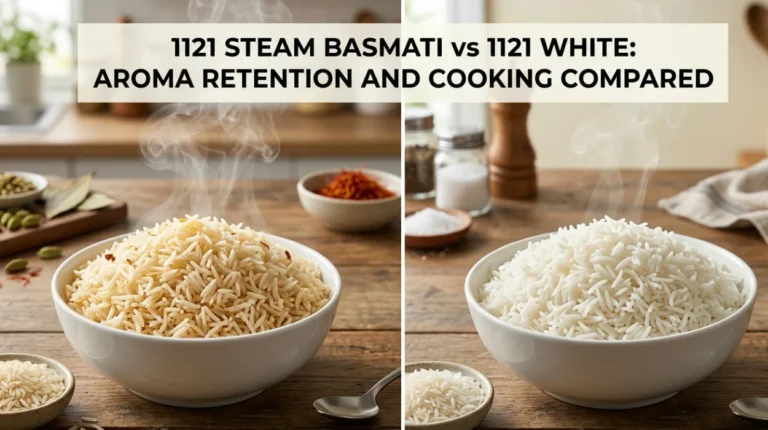
The second driver is category differentiation. Basmati can be divided into multiple products instead of one generic rice SKU. For example, a retailer can offer 1121 Steam Basmati for long-grain presentation, Super Kernel White Rice for traditional Basmati positioning, and 1509 Steam Basmati for a separate price-performance segment.
The third driver is packaging flexibility. Private label programs can use 2 lb, 5 lb, 10 lb, 20 lb, or larger commercial formats depending on the distribution channel. A supermarket can use a consumer-facing 5 lb bag, while a foodservice distributor can use a 20 lb or 40 lb format.
The fourth driver is retailer margin management. Private label removes some brand-building costs associated with national consumer brands. Retailers control the relationship between procurement cost, packaging cost, logistics cost, wholesale price, and shelf price.
The fifth driver is the wider strength of private brands. In 2025, U.S. store-brand dollar sales increased 3.3% compared with 1.2% for national brands. General Food store-brand dollar sales also increased 1.6% during the year.
This broader private-label expansion creates an established commercial structure for imported staple foods. Basmati enters that structure as a differentiated rice product rather than simply as a commodity.
How Does a Private Label Basmati Rice Program Work?
A private label Basmati program begins with product specification, continues through variety selection, milling, processing, laboratory testing, packaging, labeling, export documentation, U.S. import compliance, and distribution. Each stage converts agricultural rice into a controlled retail product with defined commercial and regulatory characteristics.
The process begins with product definition. The buyer establishes the rice variety, processing type, grain length, broken percentage, moisture specification, milling quality, packaging size, country of origin, and intended market.
The second stage is paddy sourcing. Paddy rice is purchased from suitable growing regions and separated according to variety and quality characteristics. Variety identity matters because mixing varieties changes grain appearance, cooking behavior, aroma, and market positioning.
The third stage is cleaning and milling. Foreign material, stones, dust, husk, immature grains, and other unwanted material are removed. Milling separates the husk and bran layers according to the required rice type.
The fourth stage is grading and sorting. Rice passes through equipment that separates grains according to size and quality. Optical sorting removes selected discolored or defective grains. Grading controls broken percentage and improves visual uniformity.
The fifth stage is processing. White Basmati follows conventional milling. Steam Basmati receives controlled steaming before drying and milling. Sella Basmati is parboiled and dried before milling. Brown Basmati retains the bran layer.
The sixth stage is laboratory verification. Typical quality checks include moisture, broken percentage, grain length, foreign material, damaged grains, chalky grains, milling yield, and microbiological or chemical tests required by the buyer or applicable food-safety program.
The seventh stage is packaging. The approved rice is filled into the agreed retail or foodservice format. Packaging must contain accurate product information and comply with applicable U.S. labeling requirements.
The final stage is export and import clearance. Imported food entering the United States is subject to FDA requirements, including prior notice, food facility registration where applicable, food safety requirements, and truthful English-language labeling.
For an importer, the Foreign Supplier Verification Program is also important. FSVP requires covered U.S. importers to evaluate hazards, assess foreign suppliers, conduct verification activities, maintain records, and take corrective actions where required.
Which Basmati Varieties and Grades Are Used for Private Label Programs?
Private label programs can use multiple Basmati varieties and processing grades, including 1121, Super Kernel, and 1509, with white, steam, Sella, creamy Sella, and brown processing formats. Selection depends on grain length, cooking performance, visual appearance, target consumer, retail price, and intended use.
A variety identifies the rice genetics and agricultural type. A processing grade identifies how that rice is processed after harvesting. These terms should not be treated as interchangeable.
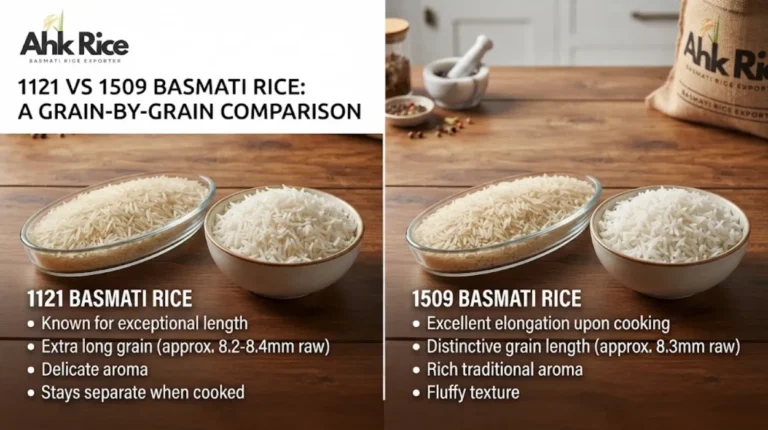
1121 Basmati is an extra-long grain variety widely used where long cooked grain presentation is important. It is available in white, steam, and other processing formats depending on the supplier specification.
Super Kernel Basmati is a premium Pakistani Basmati type recognized for its long slender grain, aroma, and cooking characteristics. It is commonly positioned for retail, foodservice, and traditional South Asian cuisine.
1509 Basmati is another long-grain Pakistani variety used for commercial and retail applications. It is processed as white, steam, Sella, or creamy Sella according to the product specification.
The major processing grades include:
| Processing grade | Main characteristic | Typical private-label use |
|---|---|---|
| White Basmati | Conventional milled rice | Mainstream retail |
| Steam Basmati | Steam-treated before milling | Long-grain retail and foodservice |
| Sella Basmati | Parboiled and dried | High-yield commercial applications |
| Creamy Sella | Cream-colored parboiled rice | Premium ethnic retail |
| Brown Basmati | Bran layer retained | Whole-grain positioning |
Quality grades can also be defined through measurable specifications. These include average grain length, broken percentage, moisture, foreign material, damaged kernels, chalky kernels, color, milling degree, and grain uniformity.
A private-label buyer should therefore avoid selecting rice only by a variety name. A complete specification describes the variety, processing method, measurable tolerances, packaging, and testing requirements.
Where Is Pakistani Basmati Rice Grown and How Is It Processed?
Pakistani Basmati is principally associated with Punjab’s irrigated rice-growing areas, where suitable climate, soil, water availability, and seasonal conditions support aromatic long-grain production. After harvest, paddy undergoes cleaning, drying, milling, grading, sorting, testing, and packaging before export.
Punjab provides the agricultural base for Pakistan’s Basmati supply. The crop moves through a controlled chain from paddy procurement to finished rice.
Harvested paddy first undergoes cleaning to remove field contaminants. Moisture is controlled through drying because excessive moisture affects storage stability and milling performance.
The dried paddy enters milling equipment. Husk removal produces brown rice. Further milling removes the bran and produces white rice. The processing sequence changes when the product specification calls for steam or parboiled rice.
Steam processing uses controlled heat and moisture before milling. Parboiling also uses heat and water but follows a defined soaking, steaming, drying, and milling sequence. These treatments alter the physical structure of the grain and influence cooking performance.
After milling, grading equipment separates whole kernels and broken rice. Optical sorting then removes selected grains based on visual defects. Laboratory testing verifies the finished batch against the agreed specification.
This processing sequence is especially important for private label because packaging creates a consumer promise. If the label describes extra-long grain, premium Basmati, or a particular processing method, the physical product must match the stated specification.
Which U.S. Markets Use Private Label Basmati Rice?
Private label Basmati rice serves supermarkets, ethnic grocery chains, club stores, specialty retailers, foodservice distributors, restaurants, wholesalers, and e-commerce sellers across the United States. Each channel requires different pack sizes, product specifications, pricing structures, cooking information, and distribution requirements.
Mainstream supermarkets use private label rice to build differentiated store-brand assortments. These programs often prioritize familiar pack sizes, clear cooking instructions, consistent appearance, and repeatable quality.
South Asian and Middle Eastern grocery stores require products aligned with established consumer preferences. Examples include 1121 Steam, Super Kernel White, 1509 Steam, and Sella Basmati.
Club stores require larger pack formats and high inventory turnover. A 10 lb or larger consumer pack can serve households that purchase staple foods in bulk.
Foodservice distributors require commercial pack sizes, stable cooking performance, and specifications suitable for restaurants, caterers, cafeterias, and institutional kitchens.
E-commerce sellers require packaging that withstands handling and shipping. Product pages also need accurate descriptions, ingredient information, country-of-origin details, preparation instructions, and compliant labeling.
Private label importers and wholesalers can distribute the same core specification through several channels. The brand owner can therefore create multiple package sizes while maintaining the same underlying rice specification.
This channel flexibility explains why Basmati fits private-label programs. The same agricultural variety can be processed and packaged into different commercial products without changing its fundamental identity.
What Certifications and Documents Apply to Private Label Basmati Rice?
U.S. private label Basmati programs require regulatory compliance rather than one universal “Basmati certification.” Applicable documentation includes FDA facility registration, FSVP records, prior notice, compliant labeling, shipment documents, certificates of analysis, and additional certifications such as organic or halal when claims require them.
FDA food facility registration applies to facilities that manufacture, process, pack, or hold food intended for consumption in the United States, subject to regulatory exemptions. Foreign facilities also require a U.S. agent as part of registration.
FSVP documentation applies to covered U.S. importers. It establishes a supplier-verification system based on hazard analysis, supplier evaluation, verification activities, corrective actions, and recordkeeping.
Prior Notice is required before food is offered for import into the United States. FDA uses the information to identify and evaluate imported food shipments.
Certificate of Analysis (COA) provides laboratory results for a shipment or production lot. Typical parameters include moisture, broken percentage, grain dimensions, foreign material, pesticide residues, microbiological parameters, or other buyer-defined tests.
Phytosanitary documentation can apply according to the commodity and U.S. entry requirements. The applicable requirements should be confirmed for the specific shipment and commodity classification.
Organic certification applies when a product is marketed with an organic claim governed by USDA organic regulations. A supplier cannot treat ordinary quality certification as a substitute for organic certification.
Halal certification applies when the private-label brand makes a halal claim and the buyer requires third-party verification.
Other voluntary food-safety certifications include HACCP, ISO 22000, BRCGS, and FSSC 22000. These are management or food-safety certifications rather than substitutes for U.S. import law.
The key distinction is between legal requirements and commercial requirements. FDA registration and import rules are regulatory obligations. HACCP, BRCGS, ISO 22000, halal, and organic certification apply according to the product claim, buyer specification, certification scope, or commercial program.
What Are the Main Benefits and Common Problems of Private Label Basmati Rice?
Private labeling gives U.S. businesses control over brand identity, packaging, product differentiation, and assortment, but successful programs depend on specification control. Common failures include variety mixing, inconsistent grain quality, inaccurate labels, weak documentation, unsuitable packaging, and misunderstanding regulatory versus voluntary certifications.
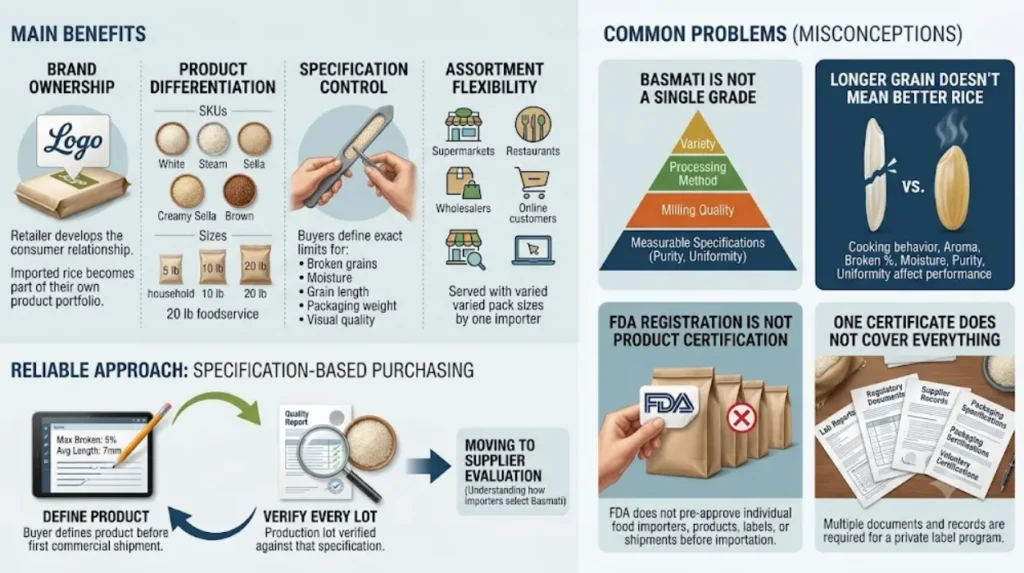
The main benefit is brand ownership. The retailer develops the consumer relationship while the imported rice becomes part of its own product portfolio.
The second benefit is product differentiation. A company can create separate SKUs for white, steam, Sella, creamy Sella, or brown Basmati. Examples include a 5 lb household pack, a 10 lb family pack, and a 20 lb foodservice pack.
The third benefit is specification control. Buyers can define exact limits for broken grains, moisture, grain length, packaging weight, and visual quality.
The fourth benefit is assortment flexibility. One importer can serve supermarkets, restaurants, wholesalers, and online customers through different pack sizes.
Several misconceptions create problems.
One misconception is that Basmati is a single grade. It is not. Variety, processing method, milling quality, and measurable specifications all influence the finished product.
Another misconception is that longer grain automatically means better rice. Grain length matters, but cooking behavior, aroma, broken percentage, moisture, purity, and uniformity also affect commercial performance.
A third misconception is that FDA registration equals product certification. FDA states that it does not pre-approve individual food importers, products, labels, or shipments before importation. Importers and suppliers remain responsible for meeting applicable requirements.
A fourth misconception is that one certificate covers every requirement. Private-label programs often involve multiple regulatory documents, laboratory reports, supplier records, packaging specifications, and voluntary certifications.
The most reliable approach is specification-based purchasing. The buyer defines the product before the first commercial shipment, then verifies every production lot against that specification.
For readers moving from market education into supplier evaluation, the next stage is understanding:
How importers select Basmati rice for private label programs, including the criteria used to compare varieties, processing grades, quality reports, packaging, supplier documentation, and commercial suitability.
Frequently Asked Questions
Why are private label Basmati rice brands expanding in the USA?
Private label Basmati brands are expanding because retailers want greater control over pricing, packaging, product specifications, and brand positioning. Basmati also provides a premium rice category suitable for supermarkets, ethnic stores, foodservice, and e-commerce.
What is private label Basmati rice?
Private label Basmati rice is rice produced, processed, and packaged for sale under a retailer, importer, distributor, or food company’s brand rather than the supplier’s consumer brand.
Which Pakistani Basmati varieties are used for private label programs?
Common Pakistani varieties include 1121 Basmati, Super Kernel Basmati, and 1509 Basmati. Each variety can be supplied in different processing formats, including white, steam, Sella, creamy Sella, and brown rice.
Where is Pakistani Basmati rice grown?
Pakistani Basmati rice is primarily grown in Punjab. The region provides suitable soil, irrigation, climate, and seasonal conditions for producing aromatic long-grain rice.
How is Basmati rice processed before export?
The process generally includes paddy cleaning, drying, husk removal, milling, grading, optical sorting, quality testing, and packaging. Steam and Sella varieties include additional heat and moisture processing before final milling.
What grades of Basmati rice are available?
Common processing grades include White Basmati, Steam Basmati, Sella Basmati, Creamy Sella Basmati, and Brown Basmati. Commercial specifications also define grain length, broken percentage, moisture, purity, and other quality parameters.
What certifications apply to Basmati rice imported into the USA?
U.S. imports must meet applicable FDA requirements. Depending on the product and buyer, documentation can include FSVP records, prior notice, certificates of analysis, food-safety certifications, organic certification, halal certification, and other shipment documents.
Does FDA certification guarantee Basmati rice quality?
No. FDA compliance and commercial quality specifications are different. Buyers still define requirements for variety, grain length, broken percentage, moisture, purity, processing, packaging, and laboratory testing.
What should U.S. retailers consider when developing a private label Basmati rice product?
Retailers should consider rice variety, processing grade, grain specifications, cooking performance, moisture, broken percentage, packaging size, labeling, testing, certifications, import documentation, and target consumer segment.
Which U.S. businesses use private label Basmati rice?
Supermarkets, ethnic grocery chains, club stores, specialty retailers, foodservice distributors, wholesalers, restaurants, and e-commerce sellers can use private label Basmati rice programs.