How Do Buyers Compare Premium and Value Basmati Rice Segments?
Buyers compare premium and value Basmati rice most effectively by measuring grain length, broken percentage, processing quality, aroma, cooking performance, packaging, compliance, and total landed cost rather than judging price alone. Premium grades command higher prices because tighter specifications create stronger retail and food-service value.
The difference between premium and value positioning becomes clearer when buyers understand what creates a higher market price. The:
Reasons some Basmati rice varieties command premium market prices explain how grain characteristics, processing, demand, and perceived quality influence the commercial value of a shipment.
In 2026, Pakistan’s rice export market remains highly specification-driven. Pakistan exported more than 4.28 million metric tons of rice worth approximately $2.291 billion during FY2025–26. Basmati represents the higher-value segment of this export structure.
For importers, the central question is not whether premium rice is better. The question is whether its additional cost produces enough value in the target market to justify the higher purchase price.
What are the available solutions for buyers comparing Basmati rice segments?
The main solutions are premium long-grain Basmati, value-oriented Basmati, steam or parboiled grades, white rice grades, and specification-customized private-label products. Buyers should match each solution with retail positioning, food-service requirements, target consumers, and acceptable landed cost.
Premium Basmati normally emphasizes long grain, low broken percentage, strong appearance, aroma, cooking elongation, and consistent sorting. Pakistani 1121 Basmati and Super Kernel Basmati sit prominently in this segment.
Value Basmati focuses on achieving recognizable Basmati characteristics at a lower procurement cost. The buyer may accept a different grain profile, processing method, or specification to improve price competitiveness.
Steam Basmati is processed through steaming before milling. This treatment changes the grain structure and produces firmer cooked rice with good resistance to breakage during cooking.
Sella Basmati is parboiled rice. Parboiling improves grain strength and produces a firm cooked texture. Golden Sella adds a distinctive golden appearance created during the parboiling process.
White Basmati is milled without the parboiling step. It provides the traditional white appearance and aromatic cooking profile expected by many premium consumers.
The practical solution is therefore a specification rather than simply a variety name. A buyer ordering “1121 Basmati” still needs to define broken percentage, grain length, processing type, moisture, sortex quality, packing, crop, and documentation.
How do premium and value Basmati specifications compare?
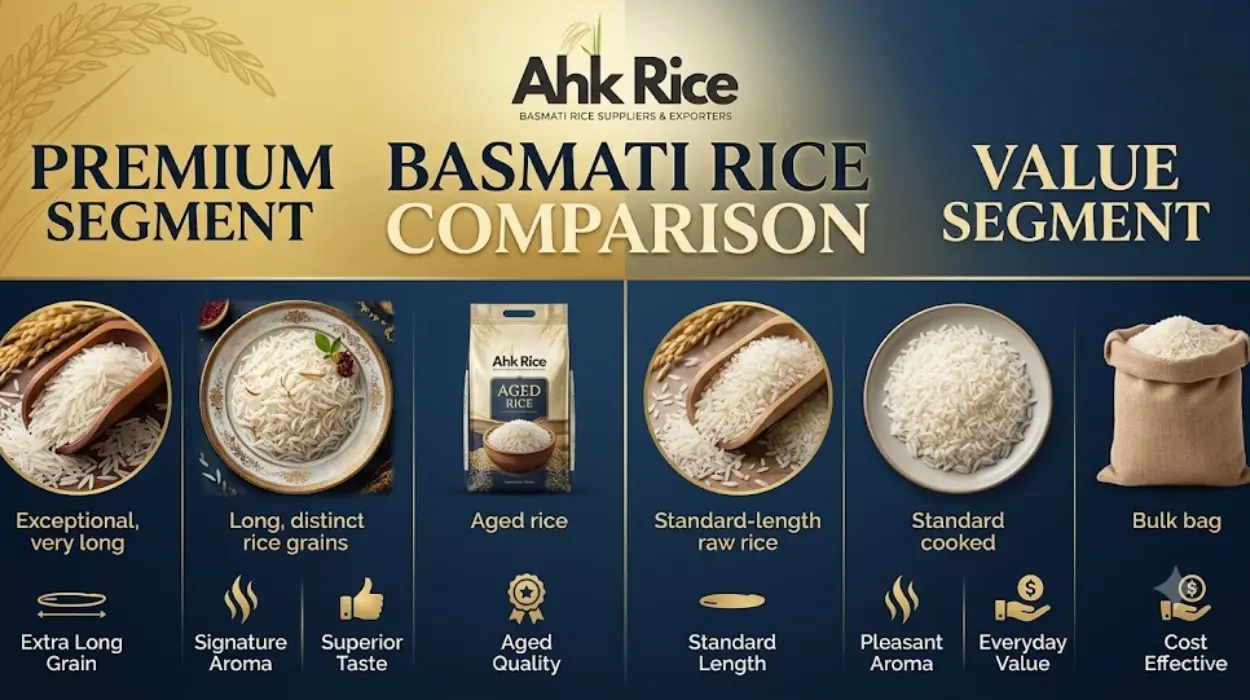
Premium Basmati normally carries stricter grain, purity, broken-percentage, appearance, and processing specifications than value-oriented rice. The price difference therefore reflects measurable product attributes and commercial positioning rather than the variety name alone.
| Attribute | Premium Basmati Segment | Value Basmati Segment |
|---|---|---|
| Typical varieties | 1121, Super Kernel | Selected 1509 and value-positioned Basmati |
| Grain profile | Extra-long, uniform grains | Long-grain profile with broader specification tolerance |
| Broken percentage | Commonly 0–2% for premium export specifications | Often 2–5% depending on contract |
| Processing | Double/silky polished, color sorted, tightly controlled | Standard milling and sorting matched to agreed specification |
| Appearance | High uniformity and clean translucent appearance | Good commercial appearance with greater tolerance |
| Cooking performance | Strong elongation, separation, aroma | Good cooking performance at lower procurement cost |
| Commercial positioning | Premium retail, restaurants, private label | Mainstream retail, food service, price-sensitive distribution |
Current August 2026 indicative FOB Karachi listings show the price effect of tighter specifications. 1121 Basmati Sella is listed around $1,135–$1,175 per MT, 1121 Steam around $1,160–$1,200, and 1121 White around $1,165–$1,205. Super Kernel Basmati is also listed around $1,165–$1,205 per MT with 0–2% broken specifications.
These figures are FOB Karachi indicators, not fixed international transaction prices. Freight, insurance, packaging, destination charges, currency movement, inspection requirements, crop year, and order size change the final landed cost.
This distinction matters because a $1,200 per MT FOB price cannot be compared directly with a retail price or a delivered container price. Buyers should compare products on the same Incoterm and specification.
Which factors create the premium price difference?
Premium pricing comes from measurable quality attributes that improve consumer perception, cooking consistency, yield, presentation, and brand positioning. Grain length and low broken percentage matter, but processing, sorting, purity, packaging, documentation, and repeatability also influence commercial value.
Grain length is one of the most visible premium attributes. Extra-long grains create a stronger visual proposition after cooking because the rice expands while retaining its recognizable shape.
Broken percentage is another important variable. A 0–2% broken specification gives the buyer a higher proportion of whole grains than a product allowing a higher broken percentage.
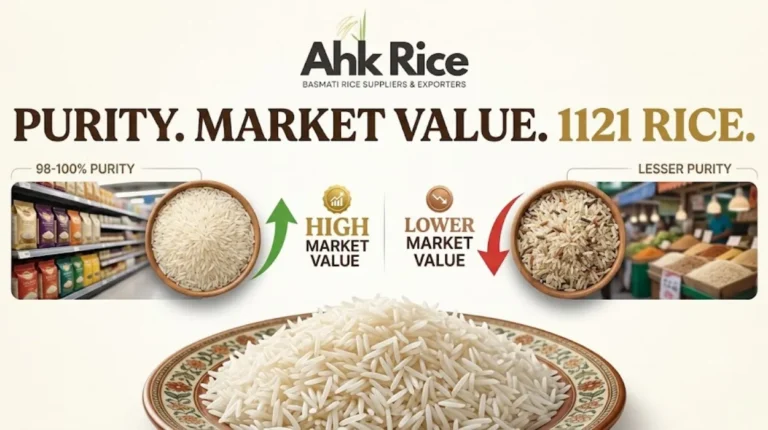
Purity also affects market value. A buyer selling premium Basmati needs confidence that the shipment represents the contracted variety rather than a mixed product.
Color sorting improves visual uniformity. Modern optical sorting systems identify and remove discolored, damaged, or foreign grains.
Processing affects cooking performance. White, Steam, Sella, and Golden Sella products can serve different consumer preferences even when the underlying variety is similar.
Packaging adds another layer of value. A 25 kg commercial bag serves a different buyer from a 1 kg private-label retail pack. Packaging therefore changes the economics without changing the underlying rice variety.
Consistency is equally important. A distributor purchasing ten containers does not evaluate only the first shipment. The buyer evaluates whether the same specification can be reproduced across subsequent shipments.
AHK Rice operates from Punjab and supplies 1121, Super Kernel, and 1509 varieties with end-to-end processing, custom packaging, and export coordination. This type of specification-based supply model allows buyers to evaluate the product according to measurable commercial requirements rather than relying only on a variety name.
How do USA and Gulf-region buyers compare Basmati grades?
USA buyers generally place greater emphasis on premium appearance, long-grain cooking performance, labeling, food-safety compliance, and private-label consistency, while Gulf buyers strongly value aromatic Basmati, Sella and Steam formats, visual presentation, cooking stability, and competitive delivered cost.
USA market
The USA market supports premium Basmati through South Asian, Middle Eastern, restaurant, specialty grocery, and private-label channels.
Premium 1121 Steam, 1121 White, 1121 Sella, and Super Kernel can fit higher-value retail and restaurant positioning when specifications are consistent.
U.S. importers must also consider FDA requirements. Imported food must comply with U.S. safety and labeling requirements, while facilities handling imported food must meet applicable FDA requirements. U.S. importers also have Foreign Supplier Verification Program obligations under FSMA.
A current July 2026 market listing placed indicative FOB Karachi 1121 Basmati prices between approximately $1,135 and $1,205 per MT, depending on processing type.
For a premium U.S. brand, paying more for a lower-broken, more uniform grade can make sense when the product is sold at a premium retail or restaurant price.
Gulf region
Saudi Arabia and the UAE represent major Gulf destinations where Basmati is strongly associated with biryani, pulao, mandi, kabsa-style rice dishes, restaurants, catering, and household consumption.
Gulf buyers frequently evaluate Sella, Golden Sella, Steam, and White Basmati according to cooking texture, grain separation, appearance, aroma, and price.
Sella and Steam products can be particularly useful for food-service applications because firmer grains provide strong resistance to breakage during commercial cooking.
The Gulf buyer therefore often evaluates value through cooking yield and operational performance rather than retail appearance alone.
USA versus Gulf comparison
| Market region | Preferred premium positioning | Common grade focus | Indicative price logic | Shelf-life consideration |
| USA | Premium retail, restaurants, private label | 1121 White, 1121 Steam, Super Kernel | Higher specification supports premium positioning | White rice is commonly treated as a 2-year shelf-stable food under USDA guidance |
| Saudi Arabia/UAE | Retail, restaurants, catering | 1121 Sella, Golden Sella, Steam, White | Cooking performance and price competitiveness strongly influence selection | Dry white rice remains shelf-stable when kept cool and dry |
USDA FSIS lists rice and dried pasta at two years as a shelf-stable storage reference. Storage conditions can materially extend quality; Utah State University notes that properly sealed polished white rice can remain stable for much longer under controlled conditions.
Shelf life should therefore be treated as a specification and storage issue rather than a simple variety advantage. Packaging integrity, moisture control, temperature, humidity, pest protection, and warehouse conditions all influence practical shelf performance.
How do price differences affect the buying decision?
Price should be compared on a landed-cost-per-saleable-kilogram basis, not simply on FOB price. A higher-grade Basmati can create better margins when its additional cost is supported by retail pricing, restaurant demand, lower breakage, stronger presentation, or premium brand positioning.
Consider two simplified purchase decisions.
A distributor buys 100 MT of a premium product at $1,180 per MT. The rice purchase value is $118,000 before freight and other destination costs.
Another distributor buys 100 MT at $1,050 per MT. The initial difference is $13,000.
The cheaper shipment becomes commercially superior only if its lower procurement cost is not offset by weaker consumer acceptance, higher breakage, slower movement, lower retail pricing, or greater quality claims.
The premium shipment becomes commercially superior when the distributor can convert the higher specification into a higher selling price or stronger repeat demand.
This is why buyers should calculate contribution margin rather than simply comparing purchase prices.
Current August 2026 indicative Pakistani export prices also show that Basmati occupies a very different price tier from lower-cost non-Basmati rice. IRRI-6 White at 5% broken was listed around $400–$420 per MT, while 1121 Basmati grades were listed around $1,135–$1,205 per MT.
The comparison demonstrates the commercial difference between commodity-value positioning and premium Basmati positioning.
Which method works best for different buyer cases?
Premium 1121 and Super Kernel work best when buyers sell through premium retail, restaurants, private labels, or specialty channels. Value-oriented Basmati works better when price sensitivity dominates and consumers still require recognizable Basmati characteristics.
For premium supermarkets, a 1121 White or Super Kernel specification with 0–2% broken can support a higher-value product proposition.
For restaurants, 1121 Steam or Sella can provide a strong balance between grain appearance, cooking resilience, and cost.
For catering companies, Sella and Steam can become more attractive because large-volume cooking places greater emphasis on grain separation and resistance to breakage.
For mainstream retail distributors, a value-oriented 1509 specification can provide a useful middle position. It can retain long-grain Basmati characteristics while giving the buyer more room to manage shelf price.
For private-label brands, the correct solution is the grade that can be reproduced consistently. A slightly lower specification that remains stable across repeated shipments can create more value than a premium specification that cannot be reproduced.
What are the pros and cons of premium and value Basmati?
Premium rice provides stronger appearance, lower broken percentage, higher perceived quality, and better premium-brand positioning, but it requires greater procurement investment. Value rice reduces purchase cost and improves price competitiveness, but offers less room for premium retail positioning.
Premium Basmati
The major advantage is market differentiation. Long, uniform grains create immediate visual recognition.
Premium grades also provide stronger positioning for private labels and high-end restaurants.
The main disadvantage is higher procurement cost. The buyer must have a sales channel capable of recovering that investment.
For example, a specialty retailer selling premium 1121 White can justify a higher purchase price if consumers recognize and pay for long grain, aroma, and cooking performance.
Value Basmati
The main advantage is price flexibility. A distributor can target a larger consumer base without pushing the retail price too high.
The disadvantage is weaker differentiation. If several suppliers offer similar value grades, price becomes a stronger competitive factor.
For example, a mainstream grocery distributor may prefer a competitively priced 1509 product when its customers prioritize affordability over maximum grain length.
What five decision factors should buyers use before selecting a segment?
Buyers should evaluate product specification, target-market demand, landed cost, shelf and warehouse performance, and supplier consistency. These five factors convert a general premium-versus-value comparison into a measurable purchasing decision based on commercial outcomes.
| Decision factor | Premium segment | Value segment |
| Target consumer | Premium household, restaurant, specialty buyer | Mainstream and price-sensitive consumer |
| Product specification | Tight tolerances | Cost-optimized tolerances |
| Margin strategy | Higher selling price | Higher volume and competitive pricing |
| Operational priority | Consistency and presentation | Cost efficiency and availability |
| Supplier requirement | Repeatable premium specification | Repeatable value specification |
The first factor is the target consumer. A buyer cannot select a grade correctly without knowing who will consume it.
The second factor is specification. Every quotation should identify variety, processing method, broken percentage, grain profile, moisture requirement, packaging, crop, and inspection terms.
The third factor is landed cost. FOB is only the starting point. Freight and destination costs must be included before comparing suppliers.
The fourth factor is storage. Rice is shelf-stable, but quality depends on proper handling. USDA identifies rice as a shelf-stable product with a two-year storage reference, while controlled storage can extend the usable quality period.
The fifth factor is supplier consistency. The supplier must reproduce the agreed specification across repeat shipments.
What should buyers choose when premium and value both appear commercially attractive?
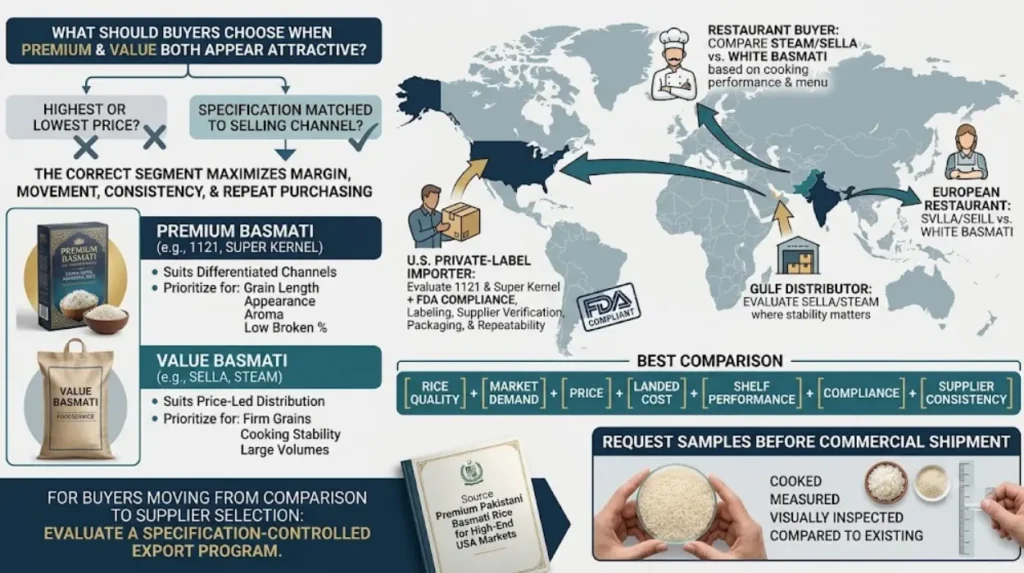
The strongest choice is a specification matched to the selling channel rather than the highest or lowest priced grade. Premium Basmati suits differentiated channels, while value Basmati suits price-led distribution. The correct segment maximizes margin, movement, consistency, and repeat purchasing.
A premium buyer should prioritize 1121 or Super Kernel when grain length, appearance, aroma, and low broken percentage directly support the selling proposition.
A restaurant buyer should compare Steam and Sella against White Basmati based on cooking performance and menu requirements.
A Gulf food-service distributor should evaluate Sella and Steam where firm grains and cooking stability matter.
A U.S. private-label importer should evaluate premium 1121 and Super Kernel alongside FDA compliance, labeling, supplier verification, packaging, and repeatability. FDA requires imported food to meet U.S. safety and labeling requirements, making documentation part of the commercial specification rather than an administrative afterthought.
The best comparison therefore combines rice quality + market demand + price + landed cost + shelf performance + compliance + supplier consistency.
Buyers should request samples against the exact proposed specification before confirming a commercial shipment. The sample should be cooked, measured, visually inspected, and compared with the buyer’s existing product.
For buyers moving from comparison into supplier selection, the next stage is to evaluate a specification-controlled export program. A useful decision resource is:
Source Premium Pakistani Basmati Rice for High-End USA Markets, which addresses the commercial requirements of sourcing premium Pakistani Basmati for the U.S. market.
The premium-versus-value decision is ultimately a margin decision. A premium grade is valuable when its additional specification produces additional commercial value. A value grade is valuable when its lower purchase cost improves market competitiveness without compromising the product characteristics customers expect.
For 2026 procurement, buyers should therefore compare every offer using the same variety, processing method, broken percentage, packing, Incoterm, shipment quantity, documentation, and delivery basis. This creates an apples-to-apples comparison and prevents a low headline price from hiding a weaker commercial specification.
Frequently Asked Questions
What is the difference between premium and value Basmati rice?
Premium Basmati rice generally offers longer, more uniform grains, lower broken percentages, stronger aroma, better appearance, and tighter quality specifications. Value Basmati focuses on competitive pricing while maintaining commercially acceptable Basmati characteristics.
Which Basmati rice varieties are considered premium?
1121 Basmati and Super Kernel are commonly positioned in premium segments because of their long grain, cooking elongation, aroma, and visual appeal. The final grade depends on specifications such as broken percentage, processing, purity, and grain uniformity.
Why does premium Basmati rice cost more?
Premium Basmati costs more because buyers are paying for measurable quality attributes, including longer grains, lower broken percentage, better sorting, higher purity, consistent processing, and stronger cooking performance. Premium positioning also reflects market demand and brand value.
Which Basmati rice is suitable for U.S. buyers?
U.S. buyers can consider 1121 White, 1121 Steam, and Super Kernel for premium retail, restaurant, and private-label applications. The appropriate grade depends on target consumers, retail positioning, cooking requirements, packaging, and required compliance documentation.
Which Basmati grades are preferred in Saudi Arabia and the UAE?
Saudi Arabian and UAE buyers commonly evaluate 1121 Sella, Golden Sella, Steam, and White Basmati according to cooking performance, aroma, grain appearance, and price. Sella and Steam grades are particularly useful for food-service applications requiring firm, separate grains.
How much does premium Basmati rice cost per metric ton?
Indicative 2026 FOB Karachi prices for premium Pakistani Basmati can vary around $1,100–$1,200+ per MT depending on variety, processing method, broken percentage, packaging, crop, and contract specifications. Actual quotations change with market and shipment conditions.
Does lower-priced Basmati rice always provide better value?
No. Lower purchase cost does not automatically produce higher commercial value. Buyers should compare landed cost, selling price, cooking performance, consumer acceptance, breakage, shelf performance, and repeat-supply consistency before selecting a lower-priced grade.
How should buyers compare Basmati rice suppliers?
Buyers should compare the exact variety, processing method, grain length, broken percentage, moisture specification, purity, packaging, certifications, Incoterm, shipment quantity, documentation, and delivery terms. Samples should also be tested against the agreed commercial specification.
How long can Basmati rice be stored?
Properly packaged and stored white rice is highly shelf-stable. USDA provides a two-year storage reference for shelf-stable rice, while actual quality depends on moisture, packaging integrity, temperature, humidity, pest control, and warehouse conditions.
Is 1121 Basmati better than 1509 Basmati?
Neither variety is universally better. 1121 is often selected for premium positioning because of its extra-long grain and strong visual appeal, while 1509 can provide a more cost-competitive option for buyers seeking long-grain Basmati characteristics.
Is Steam Basmati better than White Basmati?
The better option depends on the application. Steam Basmati generally provides firmer grains and strong cooking stability, while White Basmati provides the traditional white appearance and aromatic cooking profile. Restaurants and food-service buyers should compare both against their cooking requirements.
What should buyers check before importing premium Basmati rice?
Buyers should confirm variety, grain length, broken percentage, moisture, purity, processing type, crop, packaging, food-safety documentation, inspection requirements, price basis, shipment schedule, and sample performance before confirming a commercial order.