Source Premium Pakistani Basmati Rice for High-End USA Markets
For high-end U.S. markets, the strongest sourcing solution is premium Pakistani Basmati with controlled grain specifications, documented quality, compliant export preparation, predictable ocean logistics, and repeatable pricing—not simply the lowest FOB offer. Buyers need consistency across every commercial shipment.
Premium rice buyers should evaluate the complete supply chain before approving an exporter. The decision starts with variety, grain length, broken percentage, moisture, purity, milling condition, packaging, documentation, and shipment planning. The broader market context is explained in:
Why some Basmati varieties command premium market prices, while this guide focuses on the commercial decision of sourcing from Pakistan for demanding U.S. buyers.
What is the best solution for sourcing premium Pakistani Basmati rice?
The best solution is a specification-controlled export program that matches rice grade, packaging, documentation, inspection, container planning, and delivery timing to the buyer’s U.S. distribution requirements before commercial production begins and continues through every repeat shipment cycle.
A high-end U.S. importer should not purchase Basmati rice only on the basis of a product name. “Premium Basmati” can represent materially different specifications. A restaurant distributor may prioritize cooked elongation and aroma, while a specialty retailer may prioritize appearance, purity, packaging, and consistent shelf presentation.
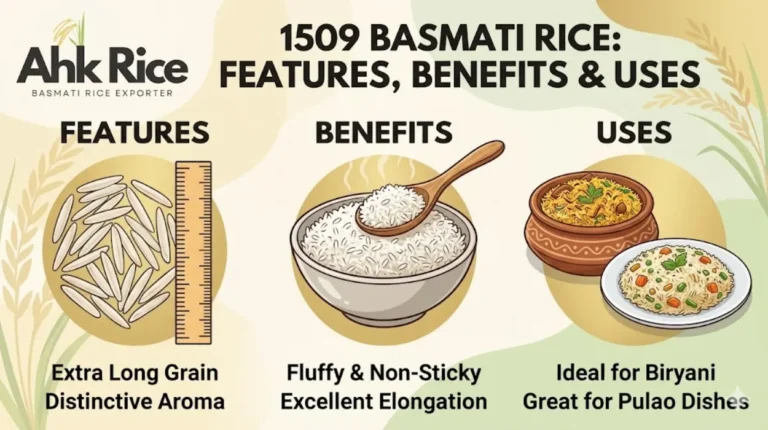
For Pakistani Basmati, 1121 is commonly positioned toward premium retail and foodservice applications because of its extra-long grain profile and cooking presentation. Super Kernel can provide a strong balance between long-grain appearance, aroma, and commercial pricing. 1509 can be useful when a buyer wants long-grain performance with a different price-to-volume position.
AHK Rice supplies 1121, Super Kernel, and 1509 varieties and describes its export process as covering sourcing, processing, grading, color sorting, packaging, documentation, and container loading.
For a U.S. buyer, the practical solution is to freeze the specification before production. A purchase specification can state variety, average grain length, broken percentage, moisture limit, purity, foreign matter, crop year, milling grade, packaging weight, bag material, labeling requirements, inspection requirements, and destination port.
This approach gives AHK Rice and the buyer the same technical reference point. It also reduces disputes caused by descriptions such as “extra premium,” “restaurant quality,” or “best quality” that lack measurable commercial definitions.
Why choose the USA service from AHK Rice?
The USA export service is designed for importers needing Pakistani Basmati from specification confirmation through milling, inspection, documentation, container loading, ocean shipment, and destination coordination, creating one controlled process instead of fragmented supplier management.
AHK Rice operates from Punjab and supplies U.S. importers with Pakistani Basmati varieties including 1121 and Super Kernel. Its published USA specifications emphasize controlled moisture, low broken grain levels, purity, packaging flexibility, and export documentation.
The value of this structure is operational rather than promotional. A buyer can specify the target product once and then coordinate milling, grading, packing, inspection, and shipment against the same commercial requirement.
For high-end markets, this matters because a supplier substitution or uncontrolled blending can change the cooked result even when the label remains “Basmati.” AHK Rice uses grading and length sorting to separate rice by size and quality, while its export operation supports customized packaging and third-party inspection.
U.S. food import compliance must also be considered before dispatch. FDA states that imported food is subject to U.S. requirements, including food facility registration, prior notice, and applicable labeling and safety obligations. FDA may inspect or detain food offered for import when it does not comply with requirements.
AHK Rice can therefore be evaluated on more than rice quality. The buyer should assess whether the exporter can produce the requested grade, provide the required documents, coordinate inspection, prepare the shipment correctly, and communicate container status throughout the export cycle.
How should U.S. buyers compare premium Pakistani Basmati grades?
U.S. buyers should compare Basmati grades using measurable commercial specifications, intended application, landed-cost tolerance, cooking performance, packaging requirements, and repeat-supply capability rather than selecting a variety solely because its advertised grain length or price appears attractive.
| Specification | Premium 1121 | Super Kernel | 1509 |
|---|---|---|---|
| Primary positioning | High-end retail and foodservice | Premium-value wholesale | Premium-value long grain |
| Grain presentation | Extra-long | Long and slender | Long and slender |
| Aroma | Strong | Pleasant | Mild to moderate |
| Cooking use | Biryani, premium foodservice, specialty retail | Restaurants, retail, wholesale | Restaurants, foodservice, value-premium retail |
| Commercial advantage | Premium presentation | Balance of quality and price | Cost-efficient long-grain positioning |
| Packaging | Private label or bulk | Private label or bulk | Private label or bulk |
| Best buyer profile | Premium distributor | Broadline importer | Price-sensitive premium buyer |
The right grade depends on the final customer. A luxury grocery chain may accept a higher rice cost because grain appearance and cooking performance support a higher retail price. A foodservice distributor serving hundreds of restaurants may need a tighter landed-cost target and therefore select a grade that preserves cooking quality without carrying the highest raw-material premium.
AHK Rice lists Basmati 1121 as an extra-long grain product with premium aroma and cooking characteristics. Its USA product information also states that 1121 can be supplied in white, golden, and steam forms with custom packaging.
The comparison should continue beyond the initial purchase. Buyers should assess how the same grade performs across two or three production lots. This is where supplier consistency becomes commercially important.
The previously published comparison framework on:
Premium and value Basmati rice segments can help buyers understand how product positioning affects procurement decisions, but a commercial order should ultimately be based on an approved specification and sample.
What shipping days should U.S. buyers expect from Pakistan?
For 2026 planning, Pakistani Basmati shipped by ocean typically requires about 20–28 days to U.S. West Coast ports and roughly 25–35 days to East Coast ports after vessel departure, with booking, port handling, congestion, routing, and customs potentially extending total door-to-door time.
The actual commercial schedule begins before vessel departure. A buyer should separate production time, container booking, port handling, ocean transit, customs clearance, and inland delivery rather than treating “shipping time” as one number.
For West Coast destinations such as Los Angeles, current AHK Rice guidance places ocean transit broadly around 20–28 days. East Coast destinations such as New York and New Jersey are generally around 25–35 days. These are planning ranges rather than guaranteed arrival dates.
A practical planning model is:
| Stage | Typical planning window |
| Specification and quotation | 1–3 business days |
| Sample approval | 3–10 days depending on courier |
| Production and packing | 7–15 days |
| Vessel booking and port handling | 3–10 days |
| West Coast ocean transit | 20–28 days |
| East Coast ocean transit | 25–35 days |
| U.S. clearance and inland delivery | Variable |
The 2026 freight environment also requires contingency planning. Global container costs and surcharges remain sensitive to geopolitical disruptions, routing changes, fuel costs, and carrier capacity. Recent reporting indicates that U.S. container freight conditions remain affected by elevated shipping costs and supply-chain uncertainty.
AHK Rice should therefore be judged on its ability to provide a shipment schedule linked to the buyer’s selected port rather than a generic “fast delivery” promise. A buyer ordering for a holiday retail program should work backward from the required warehouse date and reserve additional time for inspection, customs, and inland transportation.
What does the full rice sample process cost?
A practical sample process begins with specification confirmation, followed by sample preparation, courier dispatch, buyer testing, approval, commercial quotation, and production; AHK Rice states that samples up to 20 kg can be supplied without rice cost while courier and phytosanitary expenses remain buyer responsibilities.
The sample should represent the commercial product. Before requesting it, the buyer should specify the variety, processing grade, grain requirement, moisture target, broken percentage, purity requirement, packaging format, and intended application.
AHK Rice states that up to 20 kg of Basmati rice can be provided as a free sample, while the client covers sample shipping costs. Its USA service information also notes that the buyer pays the phytosanitary certificate cost for the sample.
The cost structure therefore has several components:
| Sample cost | Who normally pays? |
| Rice sample up to stated allowance | AHK Rice |
| International courier | Buyer |
| Phytosanitary certificate | Buyer |
| Laboratory testing requested by buyer | Buyer, if applicable |
| Commercial production sample | Agreed case-by-case |
| Final commercial shipment | Quoted separately |
A buyer can reduce unnecessary sample costs by sending a courier account number. The sample should then be evaluated using the same tests that will govern the commercial shipment.
The testing stage should include visual inspection, grain length, broken percentage, moisture, purity, cooking performance, aroma, color, and packaging condition. If the product is intended for premium foodservice, the buyer should also test cooked expansion, separation, texture, and holding performance.
AHK Rice’s published USA product information gives examples of commercial parameters such as moisture below 14 percent, broken grains below 2 percent, and purity above 95 percent for selected products. These figures should not automatically be treated as universal specifications for every variety; the final purchase contract should define the exact grade.
What factors determine the final Pakistani Basmati rice price?
The final price depends on rice variety, processing grade, crop and market conditions, purity, grain specifications, packaging, order quantity, inspection requirements, Incoterm, destination port, freight conditions, and currency exposure rather than the rice grade alone.
FOB pricing is useful for comparing exporters at the Pakistan port level. A landed-cost decision is more complete because it adds ocean freight, insurance where applicable, destination charges, customs brokerage, duties or fees where applicable, inland transportation, warehousing, and other buyer-side costs.
AHK Rice has published USA product pricing examples around $1,100 per metric ton FOB Karachi for selected 1121 and Super Kernel products, but this should be treated as a reference point rather than a fixed August 2026 quotation. Actual prices change with grade, packaging, quantity, crop availability, freight, and commercial terms.
For example, a buyer ordering 100 MT of premium 1121 in custom retail packaging will not necessarily receive the same per-MT price as a buyer ordering several hundred metric tons in standard bulk bags. Packaging materials, printing, production planning, and container utilization all influence the commercial calculation.
The best procurement method is therefore to request a specification-based quotation. AHK Rice’s quotation process asks buyers to provide destination port, product, packing, quantity, and Incoterm.
This creates a comparable commercial offer. The buyer can then evaluate FOB price, estimated freight, shipment schedule, documentation, inspection, packaging, and landed cost together.
What results can U.S. buyers expect from a controlled supply program?
A controlled supply program should deliver repeatable rice specifications, clearer landed-cost planning, fewer quality surprises, stronger documentation control, more predictable container scheduling, and a consistent product profile that U.S. distributors can confidently sell across repeated purchase cycles.
The first result is specification consistency. If the buyer approves 1121 with a defined grain profile, moisture limit, broken percentage, purity, and cooking standard, subsequent production can be measured against the same commercial baseline.
The second result is better inventory planning. A distributor can schedule purchase orders around expected vessel departures and destination-port arrivals rather than relying on uncertain spot purchases.
The third result is stronger compliance preparation. FDA requires prior notice for imported human food, and food facilities involved in producing, storing, or handling imported food must meet applicable registration requirements.
AHK Rice supports export documentation and inspection processes, while its published USA service model includes commercial sampling, packaging options, phytosanitary documentation, and export coordination.
For premium U.S. buyers, the commercial outcome is not simply receiving one container. The objective is creating a repeatable supply lane in which the same specification, packaging format, documentation process, and quality-control procedure can be reproduced.
That is especially important for private-label brands. A consumer who purchases a premium Basmati product expects the second bag to cook similarly to the first. Supplier consistency therefore protects both the buyer’s margin and the retailer’s customer experience.
How should a U.S. importer decide whether AHK Rice is the right supplier?
A U.S. importer should select AHK Rice when its required grade, quality specifications, packaging, documentation, sample performance, production capacity, shipment schedule, and commercial price are all acceptable against the buyer’s written procurement requirements and repeat-order expectations.
The decision should be evidence-based. Start with the product specification and sample. Confirm the sample against the intended application. Then request the commercial quotation using the actual destination port, quantity, packaging, and Incoterm.
Use this five-point decision framework:
| Decision factor | Buyer should verify |
| Product consistency | Approved sample matches production specification |
| Quality control | Moisture, purity, broken percentage and grain profile are documented |
| Compliance | Required U.S. food-import documentation is prepared correctly |
| Logistics | Vessel schedule and destination-port timeline meet inventory requirements |
| Commercial value | Landed cost supports the target wholesale or retail margin |
AHK Rice’s integrated operation is relevant because the company states that it manages paddy procurement, processing, grading, sorting, packaging, documentation, and container loading.
AHK Rice also reports third-party inspection availability through organizations such as SGS and Bureau Veritas. For a high-value commercial order, independent inspection can give the importer additional evidence that the shipment conforms to the agreed specification.
The final decision should not depend on the lowest quotation. A supplier offering a slightly lower FOB price can become more expensive if the product varies between lots, documentation is incomplete, shipment timing is unreliable, or the buyer must spend additional resources correcting quality problems.
AHK Rice is therefore best evaluated as a supply-chain partner rather than only a rice seller. Its value increases when the buyer requires repeatable grades, customized packaging, controlled processing, export documentation, inspection, and coordinated shipment execution.
How can a U.S. importer get started?
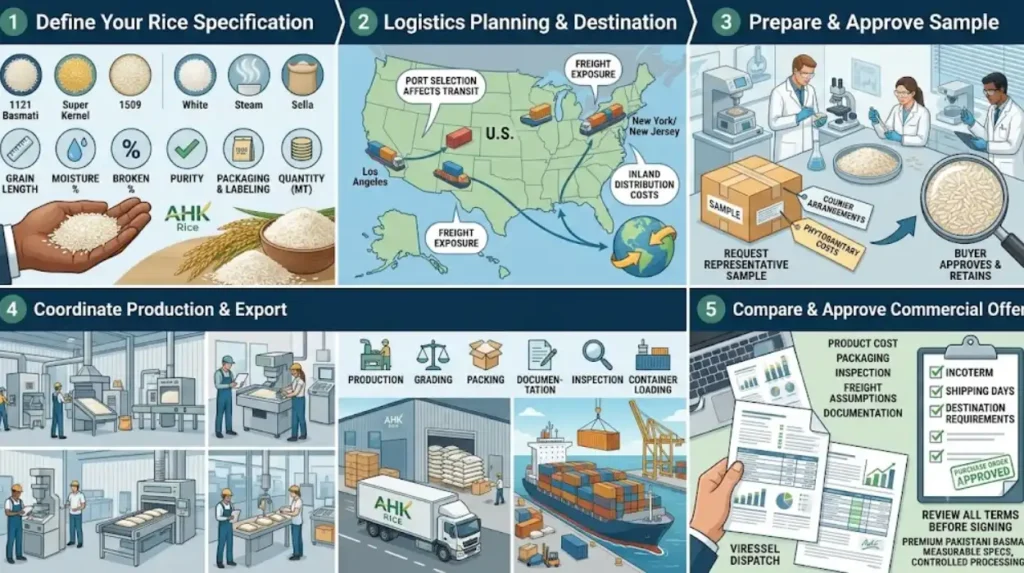
The fastest practical starting point is to submit the exact rice specification, required quantity, packaging format, destination port, preferred Incoterm, and target delivery window, then approve a representative sample before confirming commercial production and container scheduling.
Start by defining the product. State whether the requirement is 1121, Super Kernel, or 1509, and identify white, steam, Sella, or another required processing form. Add grain length, moisture, broken percentage, purity, packaging, labeling, and quantity.
Next, provide the destination port and delivery target. A buyer shipping to Los Angeles should not use the same planning assumption as a buyer shipping to New York or New Jersey. Port selection changes transit planning, freight exposure, and inland distribution costs.
Then complete the sample stage. AHK Rice can prepare the requested sample, while the buyer arranges courier and applicable phytosanitary costs. Once approved, the same specifications should be written into the commercial order.
AHK Rice can then coordinate production, grading, packing, documentation, inspection, container loading, and vessel dispatch. The buyer should retain the approved sample and specification as the quality reference for repeat shipments.
Finally, compare the complete commercial offer. Review product cost, packaging, inspection, freight assumptions, documentation, Incoterm, expected shipping days, and destination requirements before approving the purchase order.
For U.S. buyers seeking premium Pakistani Basmati, AHK Rice provides the strongest value when the purchasing decision is based on measurable specifications, controlled processing, documented compliance, and repeatable export execution rather than price alone.
To begin a specification-based commercial discussion with AHK Rice, request a customized rice quotation.
Frequently Asked Questions
What Pakistani Basmati rice is best for high-end U.S. markets?
1121 Basmati is often suitable for high-end U.S. retail, restaurants, and foodservice because of its extra-long grain appearance, aroma, and cooking performance. Super Kernel and 1509 can provide alternative premium-value positions.
How much does Pakistani Basmati rice cost per metric ton in the USA market?
Pricing depends on variety, grade, quantity, packaging, crop conditions, freight, and Incoterm. Buyers should request a specification-based quotation because FOB and landed prices can change with market conditions.
How long does Pakistani Basmati rice take to ship to the USA?
Ocean transit is commonly around 20–28 days to West Coast ports and approximately 25–35 days to East Coast ports. Production, port handling, customs clearance, and inland delivery require additional planning time.
Can U.S. buyers receive Basmati rice samples before ordering?
Yes. AHK Rice can provide product samples for evaluation. Sample rice may be supplied within the stated sample allowance, while international courier and applicable phytosanitary costs are generally handled by the buyer.
What specifications should U.S. importers check before buying Basmati rice?
Buyers should confirm variety, grain length, broken percentage, moisture, purity, foreign matter, processing type, crop year, packaging, labeling, inspection requirements, and required export documentation.
Does AHK Rice provide custom packaging for U.S. buyers?
Yes. AHK Rice supports customized packaging options for export orders, including formats suitable for wholesale, foodservice, retail, and private-label requirements, subject to the agreed commercial specification.
What documents are required to import Pakistani rice into the USA?
Depending on the shipment and applicable requirements, documentation can include commercial invoices, packing lists, shipping documents, certificates, phytosanitary documentation, and U.S. food-import compliance information. Buyers should confirm current FDA and customs requirements.
Can AHK Rice arrange third-party inspection?
Yes. AHK Rice states that third-party inspection can be arranged through inspection organizations such as SGS and Bureau Veritas when required by the buyer or commercial agreement.
What determines the landed cost of Pakistani Basmati rice?
Landed cost can include the rice price, packaging, inspection, ocean freight, insurance where applicable, destination charges, customs-related costs, inland transportation, and other logistics expenses. The destination port and Incoterm significantly affect the final cost.
Why should U.S. buyers choose AHK Rice for premium Pakistani Basmati?
AHK Rice combines Pakistani-origin sourcing with processing, grading, sorting, packaging, documentation, inspection coordination, and export shipment management. This integrated approach can help U.S. importers maintain consistent specifications across repeat orders.