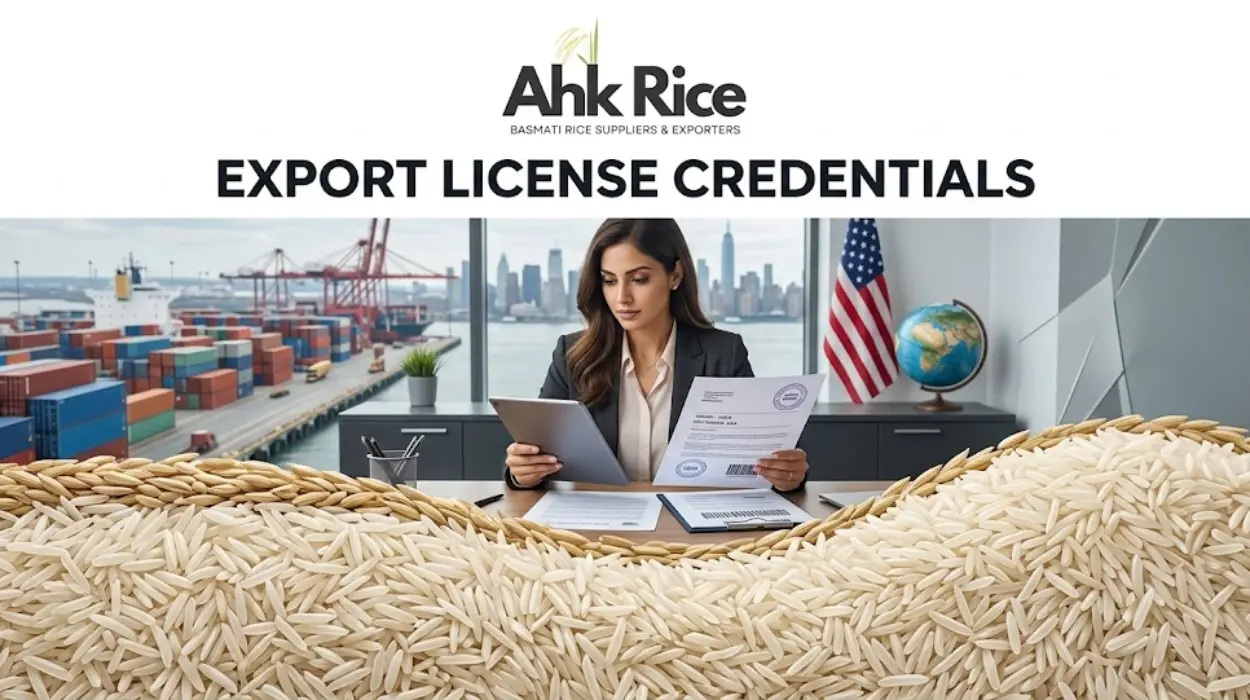
Why Do New Jersey Importers Review Export License Credentials?
New Jersey rice importers review export license credentials because a rice shipment depends on more than product quality. The importer needs evidence that the overseas seller is legally established, registered for customs activity, able to prepare export documents, and capable of meeting plant-health and food-safety requirements.
For Pakistani Basmati rice, the review starts with the exporter’s legal identity and customs registration. Pakistan’s Federal Board of Revenue (FBR) identifies commercial exporters within its WeBOC registration framework. WeBOC, or Web-Based One Customs, is Pakistan’s electronic customs system for submitting and processing export declarations. FBR registration records include business information, tax registration, bank details, and other supporting documents.
New Jersey buyers also operate within the United States food-import system. FDA states that imported food must meet the same applicable legal requirements as food produced domestically. Food importers remain responsible for supplier verification, compliant labeling, facility registration requirements, and Prior Notice procedures.
What are export license credentials in international rice trade?
Export license credentials are the legal and documentary records showing that a rice exporter is established, registered, tax-compliant, customs-enabled, and authorized to conduct export transactions under applicable Pakistani and destination-country requirements.
The phrase “export license” often creates confusion because international rice trade does not depend on one universal document called an export license. Credentials form a documentation chain.
For a Pakistani rice exporter, that chain includes several identifiable elements:
- Business registration and legal identity
- National Tax Number (NTN)
- Sales tax registration where applicable
- Active taxpayer status
- WeBOC registration and user access
- Commercial exporter classification
- Customs export documentation
- Product-specific certificates
- Phytosanitary documentation
- Commercial invoice and packing list
- Certificate of Origin
- Transport and shipping documents
FBR lists commercial exporter registration within its trader categories and requires information such as NTN, sales tax documentation, business details, bank information, and other records for customs registration.
This distinction matters because an importer reviewing a supplier should not ask only, “Where is your export license?” The better question is, “Which legal, customs, product, and shipment credentials support this export transaction?”
Why do New Jersey importers examine exporter registration?
New Jersey importers examine exporter registration to establish supplier identity, confirm customs capability, reduce documentation errors, support food-import compliance, and create a traceable commercial record before committing money to recurring rice shipments.
A New Jersey importer buying Pakistani Basmati rice enters a cross-border transaction involving two regulatory systems.
Pakistan controls the export side. The United States controls the import side. The importer therefore needs information from the exporter that supports customs clearance and supplier verification.
New Jersey is also an important entry and distribution location for imported food. FDA maintains import operations covering the New York/Newark area and several New Jersey ports, including Perth Amboy, Paulsboro, Camden, Gloucester City, and Atlantic City Airport.
Registration review also helps distinguish a manufacturer, manufacturer-exporter, commercial exporter, broker, and unrelated trading intermediary. FBR’s WeBOC framework specifically recognizes commercial exporters and manufacturer-cum-exporters as trader categories.
A buyer therefore reviews credentials before evaluating shipment performance. The sequence is logical:
Legal identity → customs registration → product compliance → shipment documentation → import clearance.
How does Pakistan’s export registration system work?
Pakistan’s export registration process connects the exporter’s legal identity and tax records with customs operations through WeBOC, allowing registered traders to submit export information and complete customs procedures electronically.
WeBOC is administered through Pakistan Customs under the FBR. FBR states that a person must register with the Federal Board of Revenue to access the WeBOC customs portal. The registration process includes submission of an application and supporting documents, personal verification, biometric procedures, and approval before login credentials are issued.
The system connects several pieces of commercial information. These include the exporter’s NTN, sales tax registration where applicable, business name, address, contact details, bank information, and customs-related registration information.
This matters for rice trade because an export transaction needs a traceable declaration. The exporter does not simply place bags into a container and hand them to a shipping line. The shipment passes through documentation, customs declaration, inspection where applicable, and export clearance.
For an importer, WeBOC registration therefore represents an important part of the exporter’s operational identity.
What documents should a New Jersey importer review?
A New Jersey importer should review business registration, tax identification, customs registration, commercial documents, product certificates, phytosanitary records, origin documents, and shipment records that collectively establish the exporter’s legal and operational capacity.
The exact document set changes according to the product, shipment structure, destination requirements, buyer agreement, and applicable regulations.
A practical review covers the following document groups:
| Document group | What it establishes |
|---|---|
| Business registration | Legal existence of the supplier |
| NTN and tax records | Tax identity and registration |
| WeBOC credentials | Customs registration and export capability |
| Commercial invoice | Seller, buyer, quantity, value, and trade terms |
| Packing list | Package count, weights, and packing details |
| Certificate of Origin | Country of origin of the rice |
| Phytosanitary certificate | Plant-health compliance |
| Bill of lading | Ocean transportation and shipment record |
| Laboratory report | Tested product characteristics |
| Food-safety records | Controls relevant to the imported food |
FBR’s published customs registration requirements show why tax, business, bank, and identification records form part of the exporter verification process.
New Jersey importers should separate exporter credentials from shipment-specific certificates. A company registration document proves the identity of the business. A phytosanitary certificate relates to a particular plant-product shipment and its applicable plant-health requirements.
What role does a phytosanitary certificate play in Pakistani rice exports?
A phytosanitary certificate documents plant-health compliance for exported rice and is issued through Pakistan’s plant-protection system according to requirements established by the importing country’s National Plant Protection Organization.
Rice is an agricultural commodity. Plant-health controls therefore form part of international trade.
Pakistan’s export policy documentation identifies Basmati rice under HS heading 1006 and specifies export conditions involving an import permit where required by the destination country and a phytosanitary certificate issued by the Department of Plant Protection according to importing-country requirements.
A phytosanitary certificate is not the same document as an exporter registration certificate. It addresses the plant-health status of the exported commodity.
This distinction is important for procurement teams. A supplier can have valid business and customs credentials while still needing shipment-specific certificates for an agricultural commodity.
The importer should therefore review both categories:
- Exporter credentials — Who is legally exporting?
- Product credentials — What evidence supports this particular rice shipment?
How do export credentials connect with U.S. food-import requirements?
Export credentials support the supplier-verification side of U.S. food imports, while U.S. requirements separately govern food facility registration, Prior Notice, labeling, admissibility, and importer responsibilities under applicable FDA rules.
The United States does not treat an overseas export credential as an automatic FDA approval.
FDA explicitly states that it does not approve or license individual food importers, products, labels, or shipments before importation. Imported food still has to satisfy applicable U.S. requirements, and FDA inspects food offered for import.
FDA also requires Prior Notice before food is offered for import. Imported human food must meet requirements covering safety, sanitary production, and truthful English labeling.
The importer therefore has two connected but separate responsibilities.
The Pakistani exporter provides evidence supporting lawful export and product documentation. The U.S. importer manages the U.S. entry process and its applicable compliance obligations.
This separation prevents a common misconception: a Pakistani export registration does not replace U.S. import compliance.
What are the key components of export credential verification?
Effective verification examines identity, customs registration, tax status, product certification, shipment documentation, and regulatory consistency rather than treating one certificate as proof of complete export compliance.
1. Legal identity
The importer verifies the exporter’s registered business name and associated commercial information.
2. Customs registration
The importer confirms that the exporter operates within Pakistan’s customs framework. WeBOC is central to this process.
3. Tax registration
NTN and applicable sales tax information establish the exporter’s tax identity.
4. Product documentation
Rice requires documentation that corresponds to its agricultural and food characteristics.
5. Phytosanitary compliance
The phytosanitary certificate addresses plant-health requirements applicable to the destination.
6. Shipment documentation
The invoice, packing list, certificate of origin, bill of lading, and related documents connect the physical cargo with the commercial transaction.
7. Regulatory consistency
Names, addresses, quantities, HS classifications, product descriptions, package counts, and other data should remain consistent across documents.
What benefits does credential review provide to rice importers?
Credential review gives importers stronger supplier identification, clearer documentation trails, better customs preparation, improved compliance control, and a structured basis for evaluating overseas rice suppliers before large commercial shipments.
The first benefit is identity verification. The importer knows which legal entity appears in the transaction.
The second benefit is documentation control. Consistent records reduce avoidable discrepancies between commercial invoices, packing lists, customs declarations, and shipping documents.
The third benefit is supplier due diligence. Credential review becomes part of a broader procurement process that also examines specifications, laboratory results, packaging, production capacity, and shipment history.
The fourth benefit is regulatory coordination. The importer can identify which documents belong to Pakistan’s export process and which requirements belong to the U.S. import process.
The fifth benefit is repeat-order control. A recurring rice program needs the same supplier identity, product specification, documentation structure, and shipment process across multiple containers.
Which rice trade situations require credential review?
Credential review applies to first-time supplier qualification, recurring container programs, private-label rice imports, wholesale distribution, food-service supply, retail packaging, and transactions where customs or food-safety documentation requires detailed supplier verification.
A first container receives close scrutiny because the importer has no established supplier history.
A recurring container program requires the same review to remain current. Supplier information, registration status, product specifications, and certification documents require periodic checking.
Private-label programs require additional attention because the exporter’s documentation must align with the importer’s packaging and labeling requirements.
Wholesale distributors also need traceability because imported rice enters downstream commercial channels.
Food-service buyers need consistent specifications because cooking performance depends on characteristics such as variety, grain length, moisture, milling quality, and purity.
The same principle applies to Pakistani Basmati varieties such as 1121, Super Kernel, and 1509. Product identity and exporter identity remain separate verification subjects.
What common misconceptions exist about rice export licenses?
The most common misconception is that one export license proves complete compliance. International rice trade uses a connected set of registrations, certificates, customs records, and shipment documents, with separate obligations applying to exporters and U.S. importers.
One misconception is that a certificate of origin proves exporter authorization. It establishes origin information, not the complete legal status of the seller.
Another misconception is that WeBOC registration itself proves food safety. WeBOC relates to customs processes. Food safety requires separate controls and applicable documentation.
A third misconception is that FDA approval applies to every imported rice shipment before arrival. FDA states that it does not pre-approve individual food importers, products, labels, or shipments. FDA evaluates admissibility under U.S. requirements when food is offered for import.
A fourth misconception is that an exporter credential replaces the U.S. importer’s responsibilities. FDA places responsibility on U.S. food importers for applicable import requirements, including supplier verification under the Foreign Supplier Verification Program.
A fifth misconception is that certificates are interchangeable. Business registration, customs registration, phytosanitary certification, laboratory testing, origin documentation, and shipping records serve different purposes.
How should New Jersey importers structure an exporter credential review?
New Jersey importers should verify the exporter’s legal identity first, customs registration second, product certificates third, shipment documents fourth, and U.S. import requirements fifth before approving a Pakistani rice supplier for commercial purchasing.
A structured review creates a repeatable procurement procedure.
Step 1: Verify the business.
Match the legal business name, address, tax identity, and commercial contact information.
Step 2: Verify customs capability.
Confirm the exporter’s customs registration and WeBOC status.
Step 3: Verify the product.
Match the rice variety, grade, milling type, packaging, and agreed specification.
Step 4: Verify certificates.
Review phytosanitary documentation and other certificates required for the shipment and destination.
Step 5: Verify commercial documents.
Check the invoice, packing list, certificate of origin, and transport documentation.
Step 6: Verify U.S. compliance.
Confirm applicable FDA requirements, Prior Notice procedures, food facility registration, labeling, and importer responsibilities.
For New Jersey shipments, this final stage is especially important because FDA maintains import operations covering New Jersey entry points and the wider New York/Newark area.
What should importers understand before evaluating export credentials?
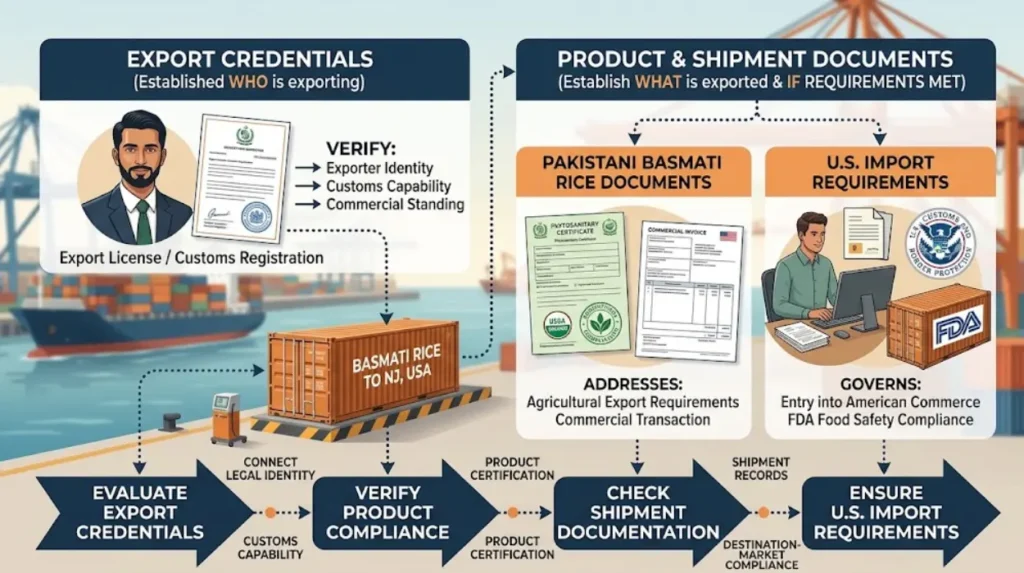
Export credentials are one part of a larger international rice trade control system. New Jersey importers should use them to verify exporter identity and customs capability, then evaluate product compliance, shipment documentation, and U.S. food-import requirements separately.
The central principle is simple: an export credential establishes who is exporting, while product and shipment certificates establish what is being exported and whether the transaction satisfies applicable requirements.
For Pakistani Basmati rice, this distinction creates a clearer verification framework. Pakistan’s customs registration establishes the exporter’s commercial standing within the customs system. Plant-health documentation addresses agricultural export requirements. Commercial documents establish the transaction. U.S. import procedures govern entry into American commerce.
New Jersey importers therefore review export license credentials because reliable international rice trade requires traceability from the registered exporter to the physical container. A complete review connects legal identity, customs capability, product certification, shipment records, and destination-market compliance.
For readers moving from basic supplier verification into a deeper assessment of trade reliability, the next article should explain:
How export licenses support reliable international rice trade and how those credentials connect with repeat shipments, documentation control, and cross-border supply continuity.
Frequently Asked Questions
Why do New Jersey importers review export license credentials?
New Jersey importers review export credentials to verify a supplier’s legal identity, customs registration, documentation capability, and readiness to support compliant international rice shipments.
Is an export license required to export rice from Pakistan?
Rice exporters must meet applicable Pakistani customs, tax, trade, and product documentation requirements. Export authorization is supported through registrations and customs procedures rather than one universal document.
What is WeBOC in Pakistan’s rice export process?
WeBOC is Pakistan Customs’ electronic system used by registered traders to complete customs-related processes. It connects exporter information with electronic customs declarations and clearance procedures.
Which documents should a New Jersey rice importer request from an exporter?
Common documents include business and tax registration information, customs credentials, commercial invoices, packing lists, certificates of origin, phytosanitary certificates, laboratory reports, and shipping documents.
Does a Pakistani export license guarantee U.S. import approval?
No. Pakistani export credentials support the export side of the transaction. The U.S. importer must separately meet applicable FDA, customs, labeling, Prior Notice, and other U.S. import requirements.