Choose AHK Rice for Audited Basmati Rice Supply in Virginia, USA
For Virginia rice importers, the strongest sourcing decision is not simply choosing the lowest FOB price; it is selecting an exporter that can demonstrate documented factory controls, consistent specifications, inspection evidence, export documentation, controlled sampling, and a realistic shipment schedule. AHK Rice combines these requirements into an export workflow designed for commercial Basmati rice buyers that need repeatable supply rather than a one-time transaction.
Before approving a supplier, buyers should understand:
Why factory compliance standards matter to rice importers because an audit-ready supplier reduces uncertainty before production, loading, customs entry, and distribution. This is particularly important for Virginia wholesalers, distributors, ethnic retailers, restaurant suppliers, and private-label buyers purchasing Pakistani Basmati rice for the U.S. market.
What is the best solution for audited Basmati rice supply to Virginia?
The best solution is a supplier-selection process based on documented factory controls, product specifications, sample approval, inspection evidence, export documentation, and shipment execution rather than price alone. For Virginia buyers, this approach reduces quality, compliance, and delivery risks.
An audited rice supply program should begin before the purchase order. The buyer should define the required variety, grain length, broken percentage, moisture, purity, milling level, packaging, quantity, tolerance, and destination port. The exporter should then demonstrate how its processing facility controls those specifications from paddy intake through container loading.
For Pakistani Basmati rice, typical commercial specifications can include moisture limits, grain length, broken percentage, foreign matter, damaged grains, purity, color, milling finish, and cooking characteristics. The exact specification must be agreed in the sales contract because different grades and buyer programs require different tolerances.
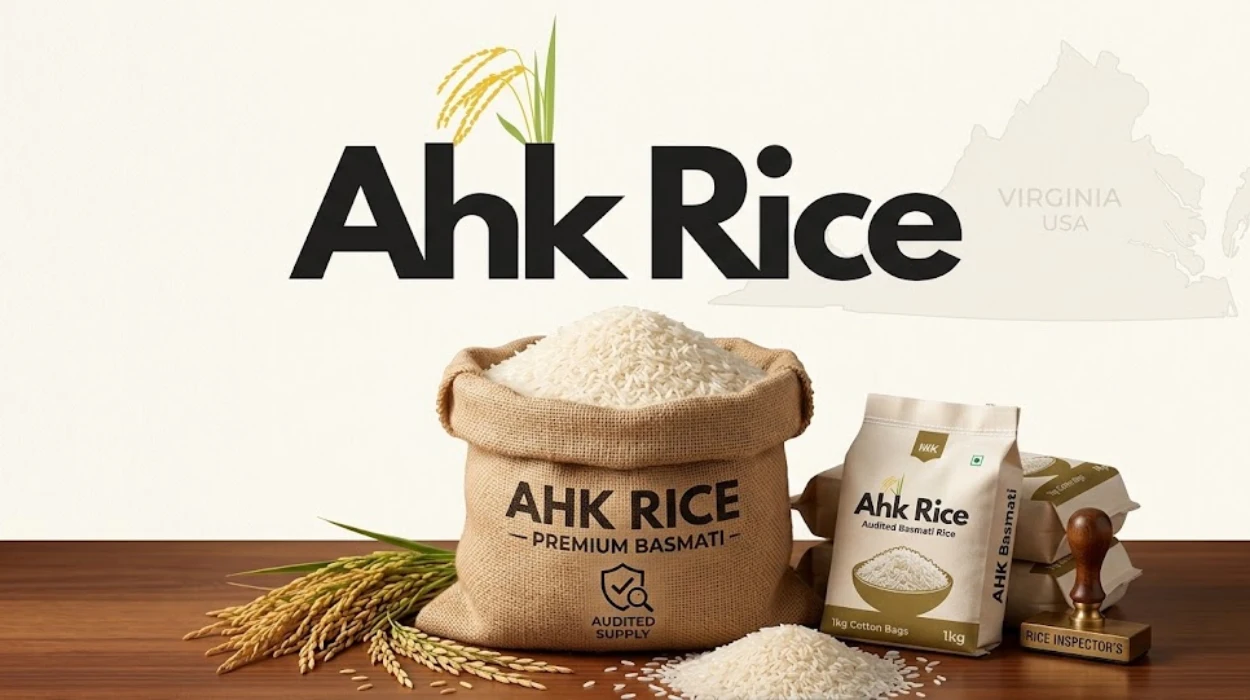
AHK Rice supports this process through sourcing, milling, grading, color sorting, packaging, inspection coordination, and export documentation. Its published USA export program covers varieties including 1121, Super Kernel, and 1509 Basmati rice.
A practical Virginia sourcing specification may look like this:
| Attribute | Commercial buying requirement |
|---|---|
| Product | Pakistani Basmati rice |
| Variety | 1121, Super Kernel, 1509, or buyer-approved grade |
| Moisture | Contract-specific maximum |
| Broken grains | Contract-specific tolerance |
| Purity | Buyer-defined purity percentage |
| Packaging | 5 kg, 10 kg, 20 kg, 25 kg, 40 kg, 50 kg, or private label |
| Inspection | Pre-shipment inspection or third-party verification when required |
The important point is that an audit report is not a substitute for a product specification. It is evidence that the supplier has systems and controls supporting the specification.
Why should Virginia buyers choose the USA export service?
Virginia buyers benefit from a USA-focused export service because product specifications, sampling, documentation, port planning, packaging, and shipment coordination can be handled within one commercial workflow instead of being managed through disconnected suppliers and intermediaries.
The Virginia market is well positioned for import programs using East Coast gateways. A buyer receiving cargo through the Port of Virginia can coordinate ocean arrival with inland trucking to warehouses across Virginia, Maryland, Washington, D.C., Pennsylvania, and surrounding distribution markets.
AHK Rice provides direct shipment arrangements from Karachi to U.S. ports and presents a structured process covering inquiry, quotation, sample approval, contract, deposit, production, and shipment. Its USA program states that air-courier samples can reach U.S. buyers in approximately 5–7 days, while bulk shipments follow ocean schedules.
For commercial planning, buyers should distinguish between sample transit time, ocean transit time, port clearance, and inland delivery. They are separate stages and should not be combined into one promised delivery number.
A practical 2026 planning range from Pakistan can be:
| U.S. market | Typical ocean planning range* | Main consideration |
| Virginia / Mid-Atlantic | 30–40 days | East Coast vessel schedule and port handling |
| Northeast | 30–40 days | Port congestion and inland trucking |
| Southeast | 30–40 days | Port routing and final-mile capacity |
| Gulf Coast | 35–45 days | Longer routing and transshipment variables |
| West Coast | 40–50 days | Longer ocean distance and routing |
*These are planning ranges, not guaranteed transit times. Vessel availability, transshipment, weather, port congestion, customs processing, and inland trucking can change the final delivery date.
This distinction matters because a Virginia importer planning a 20-MT or containerized order needs inventory coverage for the entire supply cycle. AHK Rice can quote against the buyer’s destination port, quantity, packaging, Incoterm, and product specification rather than using a generic export price.
How do audit reports prove that the rice factory is suitable?
An audit report demonstrates supplier suitability when it provides identifiable evidence about facility hygiene, processing controls, equipment, traceability, quality testing, corrective actions, documentation, and production practices that correspond with the buyer’s commercial and food-safety requirements.
The buyer should review the audit report as evidence rather than treating an audit certificate as an automatic guarantee of product quality.
Useful audit evidence can include facility identification, audit date, scope, production areas reviewed, processing observations, sanitation controls, pest-control procedures, storage practices, traceability systems, quality-control records, laboratory testing, nonconformities, corrective actions, and follow-up status.
This is where an importer should compare the audit evidence with the product requirements. A factory may have good general hygiene controls but still require additional verification for a specific Basmati specification.
For a deeper evaluation, buyers can also review:
How audit reports demonstrate rice processing quality controls alongside the commercial specification. The comparison should focus on whether the documented controls support the actual product being purchased.
U.S. importers also need to consider their own regulatory responsibilities. Under the Foreign Supplier Verification Program, covered importers must conduct risk-based activities to verify that imported food is produced in a manner providing the required level of public-health protection and is not adulterated or misbranded. FDA continues to enforce these requirements in 2026, including through FSVP inspections and warning letters.
This makes supplier documentation commercially important. A Virginia importer should be able to organize supplier records, product specifications, verification activities, test results, and supporting documentation in a way that can be reviewed when required.
AHK Rice can support the supplier-documentation side of the transaction by providing relevant export and quality documents according to the agreed order and destination requirements. The importer remains responsible for its own U.S. compliance obligations.
What should the full Basmati rice sample process look like?
A controlled sample process should move from specification confirmation to sample selection, packing, documentation, courier dispatch, buyer testing, approval, commercial quotation, and bulk-production confirmation before the importer commits to container volume.
The first step is specification collection. The Virginia buyer should provide the required variety, grade, grain length, broken percentage, moisture requirement, packing format, quantity, destination port, and intended application.
The second step is sample selection. AHK Rice can prepare a representative sample corresponding to the commercial grade rather than sending an unrelated premium sample. This distinction is important because the approved sample should become the reference for the bulk shipment.
The third step is sample packing and dispatch. AHK Rice’s USA program states that samples of up to 20 kg can be supplied without a product charge, while the client covers courier and phytosanitary certificate costs. Buyers may also use their own courier account.
The fourth step is laboratory or commercial testing. The buyer can evaluate moisture, grain appearance, broken percentage, purity, aroma, cooking performance, elongation, texture, and packaging suitability. If the buyer requires third-party laboratory analysis, that cost should be added separately to the procurement budget.
The fifth step is approval. The buyer confirms the sample against the agreed specification. If changes are required, the exporter adjusts the specification before commercial production.
A practical 2026 sample budget should therefore be treated as:
| Sample cost component | Buyer budget treatment |
| Rice sample up to agreed quantity | May be supplied without product charge |
| International courier | Buyer pays actual courier charge |
| Phytosanitary documentation | Buyer pays applicable certificate cost |
| Independent laboratory test | Buyer pays if requested |
| Third-party inspection | Added only when requested or contracted |
| Bulk production | Quoted separately after approval |
There is no reliable universal courier or inspection price because destination ZIP code, sample weight, service level, certificate requirements, and inspection scope change the cost. A professional quotation should therefore show actual or current quoted charges rather than hiding them inside the rice price.
What results can Virginia buyers expect from an audited supplier?
Virginia buyers should expect clearer specifications, stronger supplier verification, better sample-to-bulk alignment, more predictable documentation, improved shipment planning, and fewer avoidable quality disputes when audit evidence is combined with contractual inspection and specification controls.
Consider a Virginia distributor preparing a seasonal retail program. A low-cost supplier may offer an attractive FOB number but provide limited evidence about processing controls. If the shipment later differs from the approved specification, the apparent price advantage can disappear through rejected inventory, relabeling, customer complaints, delayed distribution, or additional inspection.
An audit-ready sourcing model changes the decision. The buyer first approves the product specification, then evaluates supplier controls, approves the sample, agrees commercial terms, confirms documentation, and establishes the inspection process before loading.
AHK Rice also gives buyers access to customized packaging and end-to-end export handling, which can be important for private-label programs where packaging specifications must remain consistent between purchase orders.
The expected result is not a guarantee that every shipment will be identical without verification. The result is a stronger control system that makes deviations easier to identify before the cargo reaches the U.S. market.
For repeat Virginia purchasing, this creates a useful supplier-performance record. Each shipment can be compared against the approved specification, inspection findings, shipping documents, arrival condition, and buyer feedback.
What factors determine the final price of audited Basmati rice?
Final pricing depends on rice variety and grade, specification, quantity, crop conditions, milling requirements, packaging, inspection, documentation, freight, Incoterm, destination port, and current market conditions, so an audited supply program should be quoted against the complete purchase specification.
FOB Karachi pricing is only one component of the buyer’s landed-cost calculation. A Virginia importer should also consider ocean freight, marine insurance when applicable, customs-related charges, terminal costs, customs brokerage, inspection, inland trucking, warehouse receiving, and any required compliance services.
The rice itself can change in price according to variety and grade. 1121 Basmati, Super Kernel, and 1509 Basmati do not have identical market values because grain characteristics, demand, processing requirements, and availability differ.
Quantity also matters. A full-container program can produce a different per-MT cost from a smaller shipment because fixed logistics and documentation costs are distributed differently.
Packaging creates another variable. Standard commercial bags may have a different cost from printed private-label packaging, customized artwork, special materials, or smaller retail units.
AHK Rice publishes USA product programs with quantity, packaging, and quotation variables rather than presenting one universal delivered price.
U.S. entry costs must also be confirmed against the actual tariff classification and current import requirements. CBP advises importers to identify the applicable tariff classification, duty rate, measurement unit, and any special requirements for formal entries.
This is why Virginia buyers should request a specification-based quotation rather than comparing two suppliers using only an FOB-per-MT headline number.
How should buyers decide whether AHK Rice is the right supplier?
Buyers should select AHK Rice when its documented factory controls, approved product sample, agreed specification, inspection arrangements, export documentation, pricing structure, and delivery plan collectively satisfy the commercial requirements of the Virginia import program.
A practical decision framework is:
| Decision factor | What Virginia buyer should verify |
| Product consistency | Sample matches contracted commercial specification |
| Factory controls | Audit evidence supports processing and hygiene controls |
| Documentation | Export and quality documents are available as agreed |
| Inspection | Pre-shipment or third-party inspection defined where required |
| Logistics | Port, vessel schedule, transit range, and inland delivery planned |
| Commercial terms | Price, quantity, packaging, Incoterm, and payment terms documented |
AHK Rice is particularly relevant when the buyer wants one supplier to coordinate sourcing, processing, grading, color sorting, packaging, documentation, and shipment preparation instead of coordinating each stage independently.
The supplier’s USA program also supports multiple Basmati categories, allowing buyers to compare grades against their retail, foodservice, wholesale, or private-label requirements.
For a Virginia buyer, the strongest purchasing decision is therefore not “Which exporter has the cheapest rice?” It is “Which exporter can provide the required rice specification with evidence, documentation, inspection discipline, and a workable supply schedule at an acceptable landed cost?”
How can a Virginia importer get started with AHK Rice?
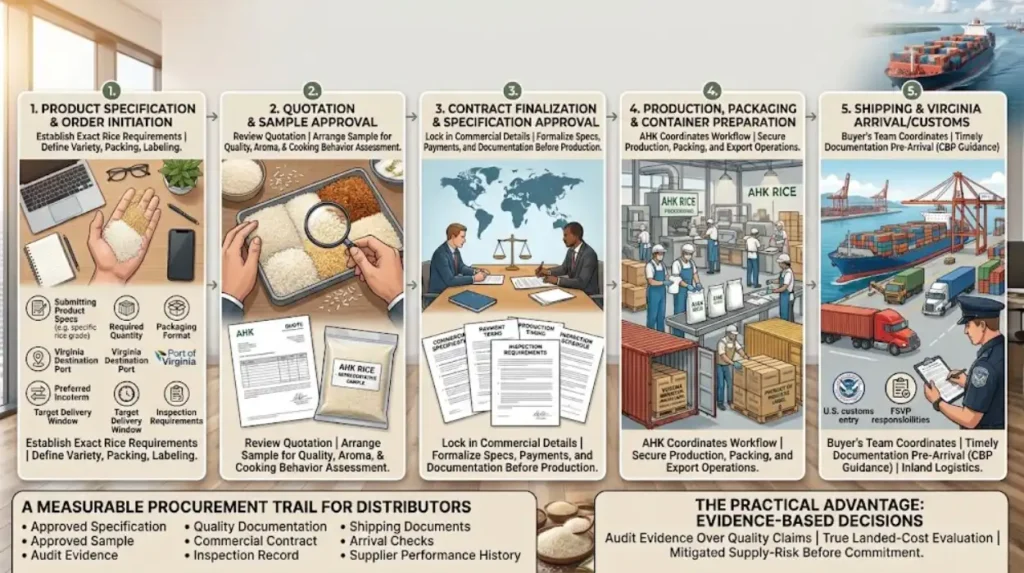
Start by submitting the product specification, required quantity, packaging format, Virginia destination port, preferred Incoterm, target delivery window, and inspection requirements; then review the quotation, approve the sample, finalize specifications, and proceed to production and shipment.
The first commercial discussion should establish the exact rice requirement. Buyers should identify whether they need 1121, Super Kernel, 1509, white, steam, parboiled, or another defined grade. They should also state the required packaging and whether the shipment will carry the buyer’s private label.
The next stage is sample approval. AHK Rice can arrange a representative sample so the buyer can assess appearance, aroma, cooking behavior, and other agreed characteristics before placing the bulk order.
After approval, the buyer and exporter finalize the commercial specification and contract. Payment terms, production timing, inspection requirements, documentation, shipping schedule, and destination port should be recorded before production begins.
The final stage is container preparation and export. AHK Rice coordinates the production and export workflow, while the buyer’s U.S. team coordinates its importer-side requirements, customs entry, FSVP responsibilities where applicable, and final inland distribution.
For U.S. imports, documentation should be prepared before arrival rather than treated as an afterthought. CBP’s current guidance states that cargo release and entry-summary filings follow defined post-arrival deadlines, making timely document coordination an important part of import planning.
For a Virginia distributor, this process creates a measurable procurement trail: approved specification, approved sample, audit evidence, quality documentation, commercial contract, inspection record, shipping documents, arrival checks, and supplier-performance history.
That is the practical advantage of choosing AHK Rice for an audited Basmati rice program: the decision is based on documented controls and commercial evidence rather than an unsupported quality claim. AHK Rice can then quote the required product against the buyer’s actual quantity, packaging, destination, and trade terms, allowing the importer to evaluate the true landed-cost and supply-risk position before committing.
Virginia buyers ready to define their Basmati rice specification, quantity, packaging, destination port, and required inspection terms can submit the requirements through the AHK Rice request-a-quote process.
Frequently Asked Questions
Why should Virginia buyers choose an audited Basmati rice supplier?
Virginia buyers should choose an audited supplier because documented factory controls provide evidence of processing hygiene, quality management, traceability, and production consistency before bulk rice is shipped to the USA.
What Basmati rice varieties does AHK Rice supply to Virginia?
AHK Rice supplies Pakistani Basmati varieties including 1121, Super Kernel, and 1509. Buyers can select the appropriate grade, processing type, packaging, and specification for wholesale, retail, foodservice, or private-label requirements.
What documents should Virginia rice importers request from an exporter?
Importers should request commercial invoices, packing lists, shipping documents, product specifications, relevant quality or laboratory reports, inspection documentation when applicable, and other certificates required for the specific shipment and U.S. import process.
How does an audit report help Virginia rice importers?
An audit report provides evidence about factory hygiene, processing controls, storage, traceability, quality procedures, equipment, corrective actions, and other operational controls. Buyers should evaluate the report alongside product samples and contractual specifications.
How long does Basmati rice shipping from Pakistan to Virginia take?
Ocean transit from Pakistan to Virginia should generally be planned around 30–40 days, but actual timing can vary because of vessel schedules, transshipment, weather, port congestion, customs clearance, and inland transportation.
What affects the price of Basmati rice imported into Virginia?
Price depends on rice variety, grade, quantity, crop and market conditions, milling requirements, packaging, inspection, documentation, freight, Incoterm, destination port, and other import-related charges.
Does AHK Rice provide Basmati rice samples before bulk orders?
Yes. AHK Rice can arrange product samples so buyers can evaluate characteristics such as grain appearance, aroma, cooking performance, and other agreed specifications before approving a commercial order.