AHK Rice Supports Welsh Distribution Networks with Premium Basmati Varieties
AHK Rice provides Welsh distributors with specification-controlled 1121, Super Kernel, and 1509 Basmati rice, supported by processing, packaging, inspection, documentation, and export logistics. Here is why: Welsh distributors need consistent grades, predictable landed costs, and reliable replenishment rather than one-off rice shipments.
Welsh distributors are expanding premium rice categories as consumers, restaurants, caterers, and independent retailers demand consistent long-grain Basmati. Pakistan exported 808,643 MT of Basmati worth about US$830.6 million in FY2024–25, showing the scale of Pakistan’s premium rice export sector. (source: REAP export data, FY2024–25)
For background, distributors can first review why Welsh distributors are expanding premium Basmati rice categories before making a supplier decision. The commercial decision then depends on grade, specification, sampling, packaging, shipping route, compliance, and repeat-order capability.
What is the best solution for Welsh distributors sourcing premium Basmati?
The best solution is specification-controlled Pakistani Basmati supplied against agreed grade, moisture, broken percentage, purity, packaging, inspection, documentation, and shipment requirements for repeatable Welsh distribution.
Welsh distributors should avoid purchasing only against the phrase “premium Basmati.” That description does not define grain length, broken percentage, moisture, crop year, packaging, or inspection requirements.
1121 Basmati suits premium retail, restaurant, hospitality, and private-label programmes requiring extra-long grains and strong presentation. AHK Rice describes 1121 as a premium export variety with long grains, aroma, and fluffy cooking performance.
Super Kernel Basmati suits buyers seeking traditional Pakistani Basmati aroma with competitive commercial positioning. The variety can serve foodservice, wholesale, and retail distribution where cooking consistency matters.
1509 Basmati provides another commercial option where distributors need long-grain characteristics while controlling procurement costs. AHK Rice lists 1509 in multiple processing grades for wholesale and international distribution.
The practical specification should identify the exact grade before pricing begins. This prevents a cheaper quotation from being compared against a materially different product.
With the product choice established, the next decision is whether the exporter can control the complete supply process.
Why choose AHK Rice for Welsh Basmati distribution?
AHK Rice connects Pakistani Basmati processing, grading, sorting, packaging, inspection, documentation, and container loading within one export workflow, reducing coordination gaps between product approval and shipment.
AHK Rice operates from Punjab and supplies 1121, Super Kernel, and 1509 Basmati varieties to international buyers. Its stated export workflow covers paddy sourcing through processing, grading, colour sorting, customised packaging, documentation, and container loading.
Quality control becomes especially important for Welsh distribution. A buyer may sell the same product through several retail or foodservice channels. Variation between containers can create customer complaints, repacking issues, and purchasing uncertainty.
AHK Rice states that shipments can undergo pre-shipment inspections through organisations such as SGS and Bureau Veritas. Its listed certifications include ISO 22000:2018, HACCP, ISO 9001:2015, GMP, and Halal.
Packaging control also supports distribution. A buyer can specify packaging material, weight, branding, and private-label requirements before production. AHK Rice states that it provides private-label packaging in different sizes and materials.
Documentation control matters because GB food imports must satisfy applicable food hygiene, labelling, packaging, safety, and licensing requirements. GOV.UK guidance specifically applies cereal import rules to England and Wales.
Current UK controls also identify specific restrictions affecting certain foodstuffs from Pakistan. The UK government updated its restrictions list in July 2026 to include rice contaminants such as aflatoxins and Ochratoxin A.
For buyers comparing supplier processes, how food distributors select imported rice brands for growth provides a useful procurement framework before final supplier approval.
With supplier capability established, shipping performance becomes the next commercial consideration.
How many shipping days should Welsh buyers plan for?
Welsh distributors should normally plan around 25–35 days for Pakistan-to-UK ocean movement, then add UK clearance and inland delivery time before promising warehouse arrival.
Current freight data shows substantial variation between UK gateways. A July 2026 Karachi–Southampton FCL benchmark showed approximately 19 days 4 hours on one carrier-led service. Other current freight data places Karachi–Southampton FCL closer to 28–34 days.
Karachi–Felixstowe currently shows an estimated 28–33 days for 40-foot FCL ocean freight. London Gateway routes can show approximately 24–28 days, depending on the selected service.
For Welsh inventory planning, the destination adds another stage after the UK port. Cardiff, Swansea, Newport, North Wales, and Mid Wales require different inland transport arrangements.
| Welsh distribution destination | Practical planning approach |
|---|---|
| South Wales | 30–38 days |
| Cardiff and Newport | 30–38 days |
| Swansea and West Wales | 31–40 days |
| Mid Wales | 32–42 days |
| North Wales | 33–43 days |
These are planning ranges, not guaranteed delivery commitments. Vessel schedules, port congestion, customs clearance, inspection, container availability, and inland haulage can change the final arrival date.
A distributor carrying several months of stock should therefore reorder before minimum inventory rather than waiting for the previous container to reach the warehouse.
The route decision leads directly to the sampling and approval process.
How does the AHK Rice sample process work and what does it cost?
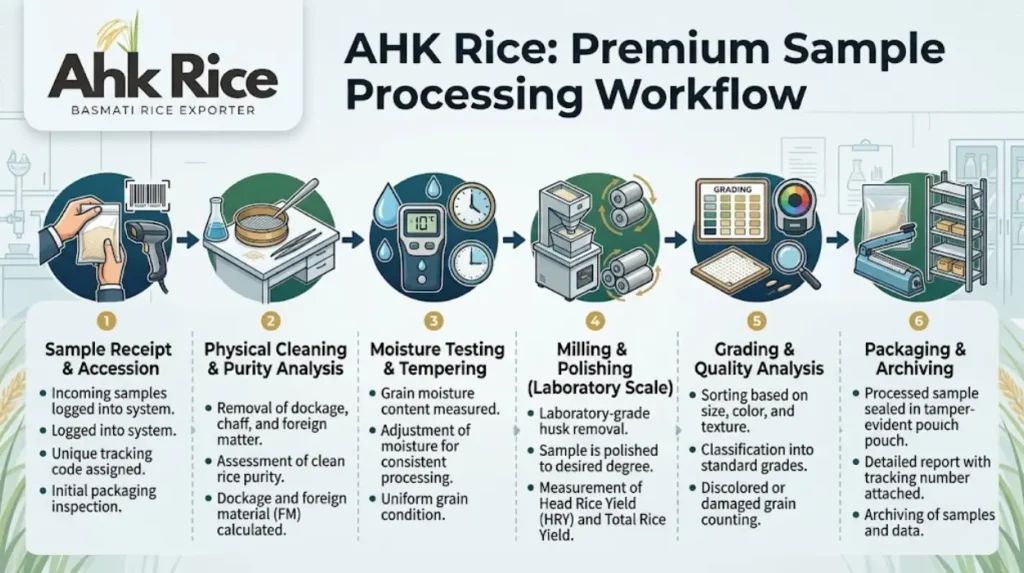
The sample process should verify dry-grain appearance, grain length, moisture, broken percentage, purity, cooking performance, packaging, and commercial suitability before bulk procurement.
Step 1 — Define the specification.
State the variety, processing grade, quantity, packaging, destination, target market, and preferred Incoterm.
Step 2 — Request the sample.
AHK Rice prepares the requested grade against the buyer’s specification. The buyer should confirm whether the sample represents the intended commercial batch.
Step 3 — Inspect the dry grain.
Check grain length, uniformity, colour, broken grains, foreign matter, and overall appearance.
Step 4 — Test cooking performance.
Cook the sample using a consistent method. Record aroma, elongation, separation, texture, and appearance.
Step 5 — Approve the specification.
Record the accepted grade, moisture, broken percentage, purity, packaging, crop information, and inspection requirements.
Step 6 — Confirm commercial terms.
Agree quantity, price basis, destination port, shipment window, documentation, and payment conditions.
Sample costs depend on the requested quantity, courier destination, packaging format, and testing requirements. The available AHK Rice material does not provide a fixed Welsh sample fee, so a fixed sample price should not be assumed.
The sample should therefore function as a specification approval rather than simply a free tasting exercise.
What results can Welsh distributors expect?
A specification-led supply programme can improve product consistency, purchasing control, inventory planning, retail presentation, and repeat-order reliability across Welsh distribution channels.
Retail consistency improves when each container follows the same approved grade and packaging specification. Lower variation supports more predictable shelf presentation and customer expectations.
Foodservice performance improves when grain length, texture, and cooking behaviour remain consistent. Restaurants and caterers can plan portions more reliably across larger cooking volumes.
Procurement control improves when buyers compare suppliers using measurable specifications. Price then becomes one factor within a wider landed-cost calculation.
Inventory planning also improves through defined shipping windows. A distributor can schedule replenishment around vessel movement, clearance, and inland delivery instead of reacting to stock shortages.
Compliance control becomes stronger when documentation and product specifications are prepared together. UK rice imports can involve licensing, quota, origin, and food-safety considerations. Current 2026 UK rice notices identify Pakistan specifically within the relevant milled-rice quota framework.
The commercial result is not simply a container of rice. The objective is a repeatable supply specification that Welsh distributors can reorder with fewer variables.
The final decision therefore depends on total cost rather than FOB price alone.
What factors affect the final price of Basmati rice for Wales?
Final cost depends on rice grade, crop year, processing, broken percentage, packaging, order quantity, inspection, freight, Incoterm, port charges, clearance, and inland delivery.
Rice grade is the first major variable. Premium 1121 specifications normally command a different price position from more cost-focused 1509 requirements.
Processing grade also affects cost. White, Steam, Golden Sella, Creamy Sella, and other processing formats require different processing workflows and commercial specifications.
Crop year influences price because aged rice can carry additional storage and inventory costs. Previous AHK Rice material identifies fresh, semi-aged, and fully aged rice as distinct commercial positions.
Packaging changes the quotation through bag material, printing, weight, private-label requirements, and packing configuration.
Freight changes according to vessel availability, route, container type, fuel conditions, and booking date. Current public freight benchmarks demonstrate significant variation between UK gateways.
UK import requirements can also affect the landed cost. Rice under CN code 1006 30 is covered by UK licensing and quota arrangements, with current notices specifying documentation and security requirements.
A serious distributor should therefore compare landed cost per MT, not only the supplier’s export price.
How can a Welsh distributor get started with AHK Rice?
Start with the exact rice specification, destination, quantity, packaging, and commercial target; then approve a sample before confirming the bulk shipment and shipping schedule.
Define the market. Identify retail, wholesale, restaurant, catering, or private-label requirements.
Select the grade. Compare 1121, Super Kernel, and 1509 against customer expectations.
Set specifications. Confirm grain length, moisture, broken percentage, purity, crop year, and processing grade.
Choose packaging. Confirm bag material, weight, artwork, labelling, and pallet requirements.
Approve the sample. Test dry appearance and cooked performance against the agreed specification.
Confirm the quotation. Compare rice cost, freight, inspection, documentation, and inland delivery.
Book the shipment. Confirm vessel schedule, destination port, clearance requirements, and delivery planning.
Repeat the specification. Use the approved commercial specification for future replenishment orders.
AHK Rice gives Welsh distributors a practical route from product selection to export shipment. The strongest decision is to approve measurable specifications before negotiating price.
For a specification-based quotation covering grade, quantity, packaging, destination, Incoterm, inspection, and shipping, request a customised AHK Rice export quote.
FAQs About AHK Rice and Welsh Basmati Distribution
Which Basmati variety is best for Welsh distributors?
1121 Basmati suits premium retail and foodservice programmes.
Super Kernel provides traditional aroma and commercial flexibility.
1509 can support more price-sensitive distribution programmes.
The correct grade depends on customer requirements and target pricing.
A sample should confirm cooking and visual performance before bulk approval.
How long does rice take from Pakistan to Wales?
Pakistan-to-UK ocean movement commonly requires several weeks.
Current 2026 benchmarks vary by port and carrier service.
Karachi-to-Southampton can range from roughly 19 to 34 days on published services.
Karachi-to-Felixstowe currently shows about 28–33 days on one FCL benchmark.
Welsh inland delivery and clearance must be added before final warehouse planning.
What should a Welsh distributor check in a rice sample?
Check grain length and visual uniformity first.
Measure moisture and inspect broken percentage against the agreed specification.
Check foreign matter, colour, purity, and packaging suitability.
Cook the sample using a consistent method.
Record aroma, elongation, separation, texture, and overall cooking performance.
Does AHK Rice offer private-label Basmati rice?
AHK Rice states that it provides private-label packaging options.
Packaging can be selected according to buyer requirements.
Available formats and weights should be confirmed for each order.
Artwork and labelling should be approved before production.
The final packaging specification should form part of the commercial contract.
What documents should UK rice importers consider?
UK importers should verify the applicable rice classification and licensing requirements.
Certificate-of-origin requirements can apply to specific rice quota arrangements.
Food-safety restrictions should also be checked before shipment.
Pakistan-origin rice currently appears in UK rice quota notices.
Importers should confirm current requirements before every commercial shipment.