Source Consistently Shipped Pakistani Basmati Rice for Indiana, USA Markets
Indiana rice importers should choose a Pakistani Basmati supplier that can control product specifications, production scheduling, documentation, container loading, and shipment coordination as one system. Consistency is more valuable than a low initial quotation when distributors, restaurants, wholesalers, and retailers depend on predictable inventory replenishment.
For Indiana buyers, understanding:
Why shipment consistency matters when monitoring suppliers provides the foundation for evaluating an exporter. The commercial decision then becomes more specific: Can the supplier repeatedly ship the same rice grade, quantity, packaging format, and specification within a predictable delivery window?
What is the best solution for consistently shipped Pakistani Basmati rice to Indiana?
The best solution is a scheduled export program linking rice specifications, production capacity, quality inspection, documentation, container booking, and Indiana delivery planning. This reduces stockout exposure while giving buyers measurable shipment milestones before cargo leaves Pakistan.
A consistent supply program starts before the container reaches Karachi. The exporter should confirm the rice variety, grade, grain length, moisture specification, broken percentage, packaging, quantity, and required inspection standards before production is scheduled.
For Pakistani Basmati rice, this is particularly important because different grades can have different commercial values and cooking characteristics. A buyer ordering 1121 Steam Basmati should not receive a shipment that has been substituted with another grade simply because availability changed.
AHK Rice approaches the supply program as a repeatable export process rather than a one-time container transaction. Production planning, milling, sorting, grading, packing, inspection, documentation, and loading should be coordinated against the purchase order.
The objective is not merely to make one shipment arrive in Indiana. The objective is to establish a repeatable cycle in which the buyer knows when the next shipment should be produced, booked, dispatched, cleared, and delivered.
This approach also supports inventory planning. A distributor can establish reorder points based on expected consumption and the agreed replenishment window rather than waiting until warehouse inventory becomes critically low.
Why choose the USA service for Indiana rice imports?
The USA service is suitable for Indiana buyers because commercial rice supply requires coordination between Pakistani production and U.S. import procedures, including product documentation, shipment records, food-import requirements, and delivery planning beyond the arrival port.
USA rice export service from AHK Rice
AHK Rice can structure Pakistani Basmati supply around the requirements of U.S. buyers instead of treating export preparation as a separate administrative stage.
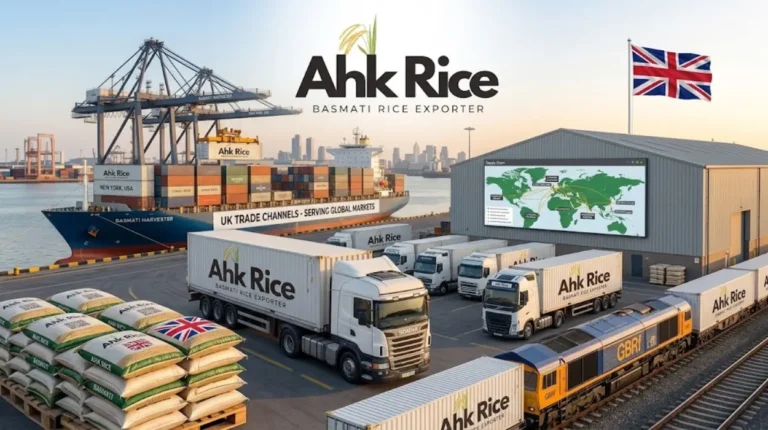
For Indiana customers, the relevant supply chain normally begins with production and packing in Pakistan, continues through port handling and ocean transportation, and ends with inland movement to the buyer’s warehouse or distribution location.
U.S. food imports must meet applicable FDA requirements. FDA states that imported food must meet the same legal requirements as domestically produced food, while facilities producing, storing, or handling the food may need FDA registration and imported food shipments require Prior Notice.
That makes documentation consistency part of shipment consistency. Commercial invoices, packing information, product descriptions, quantities, origin information, shipping records, and food-import information should correspond with the actual cargo.
AHK Rice can therefore be evaluated on more than its rice quotation. Indiana buyers should assess whether the exporter can maintain the same specification and documentation discipline across repeated shipments.
The supplier should also identify the responsible parties for freight booking, customs coordination, destination delivery, and any broker or importer requirements. These responsibilities should be established before the first commercial order.
How many shipping days should Indiana buyers expect from Pakistan?
Indiana buyers should plan around an overall ocean-to-warehouse window rather than a single port transit figure. Current 2026 market examples show Karachi-to-New York ocean transit near 27 days and Karachi-to-Houston near 36 days before inland delivery and clearance.
Current freight-market data provides useful benchmarks. A 2026 Karachi-to-New York 40-foot high-cube ocean service is listed at approximately 27 days estimated transit, while a Karachi-to-Houston service is listed at approximately 36 days. These are port-to-port estimates, not guaranteed Indiana warehouse delivery times.
For Indiana, the practical planning window should therefore include export preparation, port handling, ocean transit, U.S. customs clearance, inland transportation, and final delivery.
A reasonable commercial planning model is:
| Supply-chain stage | Planning range |
|---|---|
| Production, packing and export preparation | 7–14 days |
| Karachi to U.S. port ocean movement | 27–36 days |
| U.S. clearance and port handling | 3–7 days |
| Port to Indiana inland movement | 2–5 days |
| Commercial planning window | Approximately 39–62 days |
These ranges are planning estimates rather than guaranteed transit commitments. Vessel schedules, port congestion, inspections, documentation issues, weather, carrier changes, and inland capacity can alter the final delivery date.
Indiana buyers should therefore avoid calculating their reorder point from the ocean transit number alone. A better method is to use the complete expected replenishment cycle and maintain safety stock for demand and logistics variability.
For example, an Indiana distributor consuming 20 MT per month should not wait until only a few days of stock remain before placing the next order. The next shipment should enter production and shipping coordination while enough inventory remains to absorb normal transit variation.
AHK Rice can use the buyer’s expected monthly consumption to establish a shipment schedule instead of treating every container as an isolated transaction.
How does shipment consistency improve Indiana inventory planning?
Consistent shipments allow Indiana importers to connect purchase quantities with warehouse consumption, reorder points, safety stock, and expected arrival windows. The result is fewer emergency purchases, better warehouse utilization, and stronger control over landed inventory costs.
The central commercial benefit is predictability.
Suppose an Indiana food distributor sells 15–20 MT of Pakistani Basmati rice monthly. If shipments arrive unpredictably, the buyer may over-order to protect against shortages. That increases working-capital requirements and warehouse pressure.
If shipments follow a documented schedule, the buyer can align purchase orders with expected consumption. The inventory model becomes easier to manage because the next replenishment date has a defined planning basis.
The comparison between consistent and inconsistent shipping is therefore not simply about logistics. It affects purchasing, storage, cash flow, customer service, and sales continuity.
Buyers evaluating this issue can also compare:
How consistent shipping improves rice inventory planning before selecting a supplier.
For Indiana distributors, three indicators are especially useful:
- Shipment interval: How frequently can the exporter repeat the agreed shipment quantity?
- Specification consistency: Does every shipment maintain the approved grade and quality parameters?
- Delivery variance: How far do actual arrival dates move from the planned delivery window?
AHK Rice should be evaluated against these measurable indicators rather than a general promise of reliable supply.
What results can Indiana buyers expect from a consistent Pakistani rice program?
A properly managed supply program can provide more predictable replenishment, stable product specifications, fewer emergency purchasing decisions, improved warehouse planning, and clearer landed-cost forecasting across repeated Indiana shipments.
The first expected result is supply continuity. The buyer has a defined process for repeating orders instead of restarting supplier evaluation every time inventory falls.
The second result is specification control. A commercial contract can identify the approved variety, grade, moisture range, broken percentage, grain characteristics, packing format, and inspection requirements.
The third result is better purchasing visibility. When production and freight planning are connected, the buyer can identify the next shipment earlier and adjust inventory before a shortage develops.
The fourth result is better customer service. Restaurants, wholesalers, ethnic grocery distributors, and retailers are less exposed to sudden product shortages when replenishment is planned in advance.
A fifth benefit is stronger supplier accountability. When shipment milestones are documented, the buyer can review whether the exporter consistently met agreed production, dispatch, documentation, and delivery commitments.
AHK Rice can build this accountability into a repeat-order process by confirming specifications before production, maintaining quality controls during processing, and coordinating export documentation with shipment requirements.
No exporter can eliminate every external logistics risk. Ocean schedules, customs examinations, port congestion, and inland transportation can change after cargo has been dispatched. The commercial advantage comes from controlling the variables that the supplier can control and communicating changes early.
What does a complete rice sample process cost?
A commercial sample process should confirm the rice grade and physical characteristics before a large order. Buyers should budget separately for sample preparation, packaging, courier freight, documentation, and any destination charges rather than treating the sample as cost-free.
A practical sample process can begin with the buyer specifying the required product. For example, the request may identify 1121 Steam Basmati, Super Kernel White, or 1509 Steam Basmati together with the desired packing and quality requirements.
AHK Rice can then prepare a representative sample from the relevant production specification. The sample should be clearly identified by variety, grade, packing specification, and requested quality parameters.
For a small international sample, the actual courier charge should be quoted according to weight, dimensions, destination ZIP code, and service level. DHL Pakistan provides online international shipping quotations based on shipment details, and its 2026 guidance notes that international shipping rates depend on factors such as weight, dimensions, surcharges, and applicable duties or taxes.
A reasonable budgeting example for an Indiana buyer is:
| Sample cost component | Illustrative planning amount |
| 1–5 kg rice sample | Product-dependent |
| Export/sample preparation | $10–$30 |
| International courier | Approximately $70–$180 |
| Documentation/handling | $10–$30 |
| Estimated sample budget | Approximately $90–$240 |
These figures are planning allowances, not fixed AHK Rice charges. The actual courier quotation should be obtained at the time of shipment because carrier rates vary by package weight, dimensions, destination, fuel surcharge, service level, and account terms.
The sample should then be reviewed for appearance, aroma, grain length, broken grains, cooking performance, packaging condition, and conformity with the agreed specification.
If the sample is approved, the same specification should become the reference point for the commercial shipment. This prevents the sample from becoming a marketing exercise disconnected from the rice eventually loaded into the container.
What factors determine the landed cost of Pakistani Basmati rice in Indiana?
Indiana landed cost depends on rice grade, purchase quantity, packaging, processing requirements, freight, insurance, port charges, customs-related costs, inland transportation, exchange rates, and destination handling, so the lowest FOB price is not always the lowest delivered cost.
Rice grade is one of the first cost variables. Extra-long-grain Basmati specifications, steam processing, sella processing, sorting requirements, and purity expectations can change the product price.
Quantity also matters. A full-container commercial program normally has a different freight and handling structure from a small LCL shipment. Current freight-market examples show substantial differences by route and container configuration, reinforcing the need for a shipment-specific quotation.
Packaging can also affect cost. Private-label bags, retail-ready packaging, custom artwork, palletization, and special carton or bag specifications require additional preparation compared with standard export packing.
Freight is another variable. Carrier, port pair, container availability, sailing schedule, fuel-related charges, and market conditions can affect the final freight figure.
Finally, Indiana buyers should separate product price from total landed cost. A supplier with a slightly higher rice quotation may produce a better commercial result if its shipment consistency reduces stockouts, emergency freight, quality claims, or excess safety inventory.
How should Indiana buyers evaluate AHK Rice before placing a commercial order?
Indiana buyers should evaluate AHK Rice against product specification, sample conformity, production capacity, shipment planning, documentation control, communication, freight coordination, and repeat-order performance rather than relying only on the initial per-ton quotation.
Start with the product specification. Confirm the exact Basmati variety, grade, processing method, moisture requirement, broken percentage, grain characteristics, packaging, and quantity.
Next, review the sample. The approved sample should become a reference for the commercial order.
Then examine the supply schedule. Ask when production begins, when the cargo becomes ready, when the container is expected to depart, which port is used, and what delivery window is planned for Indiana.
AHK Rice should also provide clear communication around changes. If a vessel is rolled, a document requires correction, or inland delivery changes, the buyer should know before the issue becomes a warehouse shortage.
The buyer should also verify the export documentation process and U.S. food-import responsibilities. FDA confirms that imported foods are subject to U.S. food requirements and may be inspected at U.S. ports of entry.
Finally, evaluate the exporter over multiple shipments. One successful container demonstrates capability. Repeated shipments demonstrate consistency.
How can an Indiana buyer start a consistent Pakistani Basmati rice program?
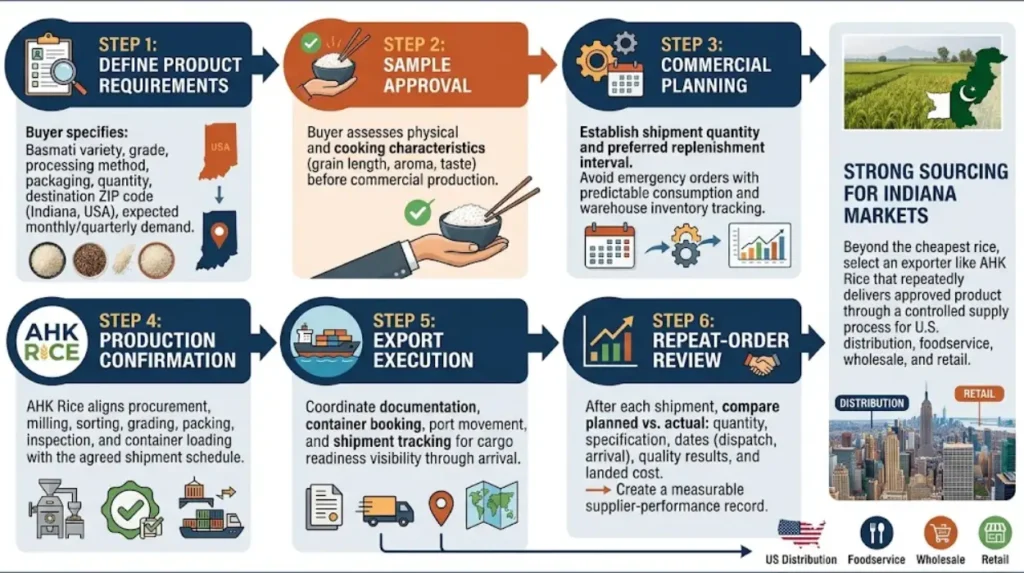
The process should begin with a defined product specification, sample approval, commercial quantity, target delivery window, packaging requirement, destination information, and shipment frequency, followed by quotation, production scheduling, quality verification, documentation, and freight booking.
The first step is to provide the exporter with the required product details. This should include the Basmati variety, grade, processing method, packaging, quantity, destination ZIP code, and expected monthly or quarterly demand.
The second step is sample approval. The buyer should assess the physical and cooking characteristics before approving commercial production.
The third step is commercial planning. The supplier and buyer should establish the required shipment quantity and preferred replenishment interval. A buyer with predictable monthly consumption can then avoid placing emergency orders when warehouse inventory becomes low.
The fourth step is production confirmation. AHK Rice should align procurement, milling, sorting, grading, packing, inspection, and container loading with the agreed shipment schedule.
The fifth step is export execution. Documentation, container booking, port movement, and shipment tracking should be coordinated so the buyer has visibility from cargo readiness through arrival.
The final step is repeat-order review. After each shipment, the buyer should compare planned versus actual quantity, specification, dispatch date, arrival date, quality results, and landed cost. This creates a measurable supplier-performance record.
For Indiana markets, the strongest sourcing decision is therefore not simply choosing the cheapest Pakistani rice. It is selecting an exporter that can repeatedly deliver the approved product through a controlled supply process.
AHK Rice is positioned for buyers seeking a structured Pakistani Basmati supply program for U.S. distribution, foodservice, wholesale, and retail requirements. A commercial program should begin with the specification and sample, then progress to shipment scheduling and repeat-order planning.
For Indiana buyers ready to define product specifications, sample requirements, shipment quantity, and delivery expectations, request a commercial quotation from AHK Rice.
Frequently Asked Questions
What Pakistani Basmati rice does AHK Rice supply to Indiana?
AHK Rice supplies Pakistani Basmati varieties including 1121, Super Kernel, and 1509, with options for white, steam, and sella processing depending on buyer requirements.
How long does Pakistani Basmati rice take to reach Indiana?
A practical Pakistan-to-Indiana planning window is approximately 39–62 days, including production, export preparation, ocean transit, U.S. clearance, port handling, and inland transportation. Actual timing depends on the shipping route and logistics conditions.
What affects the price of Pakistani Basmati rice delivered to Indiana?
The delivered cost depends on rice variety and grade, order quantity, packaging, processing requirements, freight, insurance, port charges, customs-related costs, inland transportation, and destination handling.
Can Indiana buyers request a rice sample before ordering?
Yes. Buyers can request a representative sample before placing a commercial order. The sample should be evaluated for grain appearance, aroma, broken percentage, cooking performance, packaging, and conformity with the required specification.
How much does a Pakistani Basmati rice sample cost?
A small international sample may require approximately $90–$240 as a planning budget, including preparation, courier, documentation, and handling. Actual costs vary according to sample weight, dimensions, destination, and courier rates.
How does AHK Rice maintain shipment consistency?
AHK Rice coordinates product specifications, production, milling, sorting, grading, packing, quality inspection, documentation, container loading, and shipment scheduling to support repeatable export programs.
What documents are important when importing rice into Indiana?
Commercial invoices, packing information, product specifications, shipping documents, origin information, and applicable U.S. food-import documentation should accurately correspond with the shipment. U.S. importers must also meet applicable FDA requirements.
Can AHK Rice supply regular shipments to Indiana?
Yes. AHK Rice can structure repeat-order programs around the buyer’s monthly or quarterly consumption, required quantity, product specification, and preferred replenishment schedule.
How should Indiana buyers evaluate a Pakistani rice exporter?
Buyers should evaluate product consistency, sample conformity, production capacity, quality controls, documentation accuracy, shipment scheduling, communication, freight coordination, and performance across repeated shipments rather than comparing price alone.