Why Do Packaging Standards Matter for Imported Basmati Rice?
Packaging standards matter for imported Basmati rice because packaging controls product protection, food safety, identification, handling, shelf stability, and regulatory compliance from the processing facility to the final market. A correct package keeps rice clean, dry, sealed, traceable, and commercially identifiable during storage and international distribution.
Basmati rice is a long-grain aromatic rice traditionally associated with the Indian subcontinent. Pakistan produces important Basmati varieties in Punjab, including 1121, Super Kernel, and 1509. These varieties differ in grain characteristics, processing formats, cooking behaviour, and commercial positioning. Export packaging must preserve these defined product characteristics rather than treating all rice as one commodity.
For an imported shipment, packaging is more than a retail bag. It includes the primary food-contact material, closure system, outer packaging, markings, labels, pallet configuration, and container-loading method. Each component performs a defined function. A 5 kg consumer bag and a 25 kg wholesale sack therefore have different handling requirements even when they contain the same rice variety.
What are packaging standards for imported Basmati rice?
Packaging standards are defined requirements for materials, construction, labeling, weight, closure, hygiene, identification, and handling that keep Basmati rice safe and accurately represented throughout export, transport, storage, and sale in the destination market.
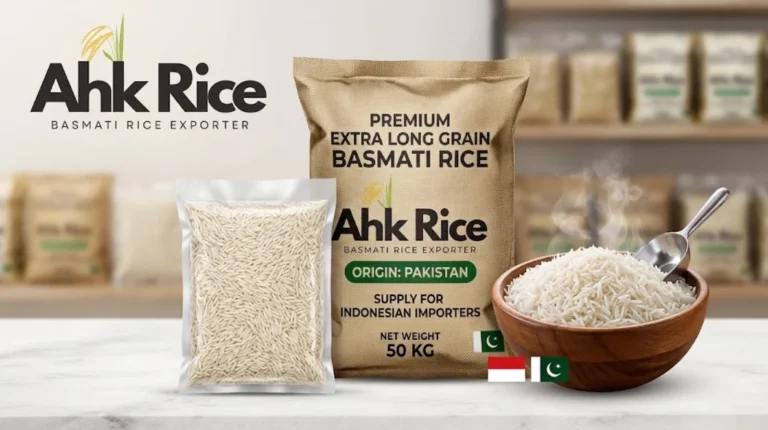
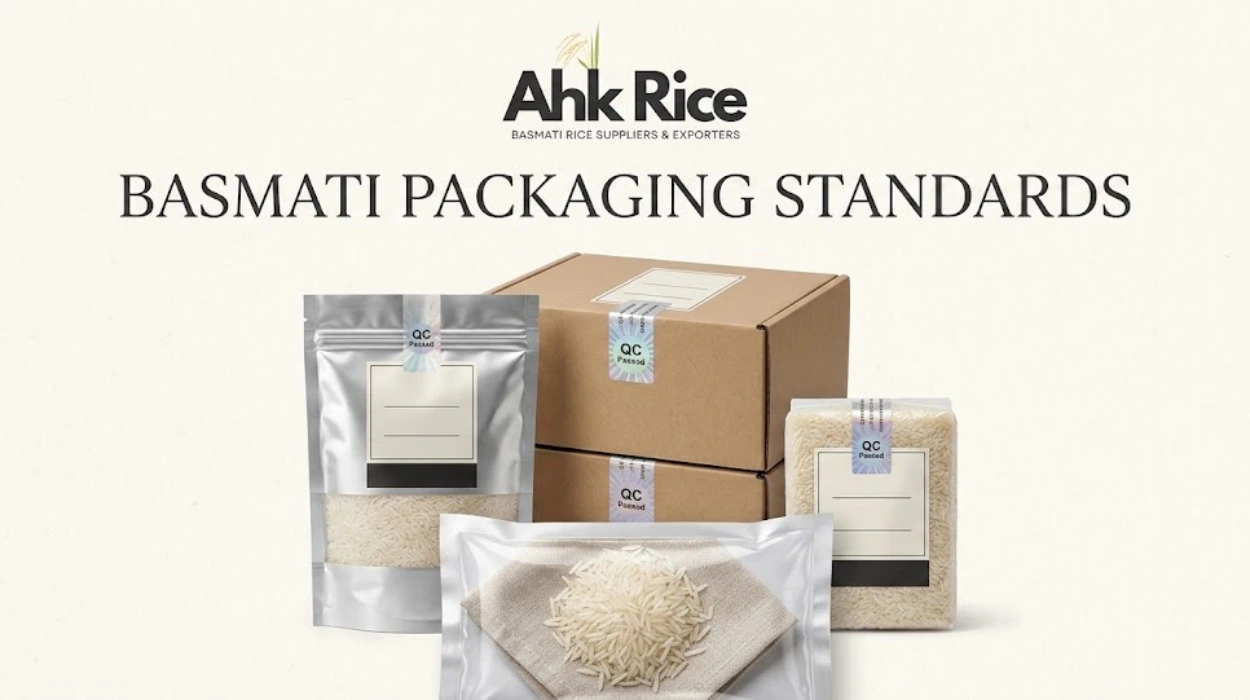
Packaging standards begin with the material that directly contains the rice. This is the primary package. Examples include woven polypropylene sacks with food-grade inner liners, laminated bags, and retail pouches.
The secondary package groups individual units for handling. Examples include cartons, bundled retail packs, and protective outer sacks. The tertiary system supports logistics. Examples include pallets, stretch wrapping, corner protection, and containerized loads.
The package must also communicate product information. Depending on the destination, this includes product name, rice variety, net weight, country of origin, lot or batch identification, packing information, importer information, and applicable storage instructions.
Codex provides an international reference framework for prepackaged-food labeling through CXS 1-1985, which was revised in 2024. Pakistan’s standards framework also lists PS CXS 1-2021 for the general labeling of prepackaged foods.
Packaging standards therefore connect physical protection with information control. A package that protects rice but carries incorrect product information is not commercially compliant packaging.
How does standardized packaging work from rice processing to import?
Standardized packaging works by matching the rice specification with a suitable food-contact package, filling the declared quantity, sealing each unit, applying traceable identification, checking package integrity, and preparing the finished units for controlled storage and international transport.
The process starts after milling, grading, sorting, and quality inspection. Rice is cleaned and separated according to the required specification. Broken grains, foreign material, discolored grains, and other nonconforming material are removed according to the applicable product specification.
The selected rice then enters the packing stage. The packaging format is determined by the buyer’s market, sales channel, shipment size, and handling requirements. A retail importer can require 1 kg, 2 kg, or 5 kg packs. A foodservice distributor can require 20 kg or 25 kg sacks.
The filling system controls quantity. A package marked 5 kg needs to contain the declared quantity according to applicable weights-and-measures requirements. Automated weighing reduces variation between packages.
The closure system then seals the package. Heat sealing, stitching, or another suitable closure method is selected according to the packaging material. The seal must remain intact during handling.
Identification follows filling and sealing. A lot or batch code links the finished package with the relevant production and packing records. This creates traceability between the consumer package and the processing operation.
The final stage is inspection. Quality teams check package weight, seal integrity, printing, labeling, stitching, cleanliness, and visible damage. Approved packages are then arranged for warehouse storage and container loading.
What are the key components of Basmati rice packaging standards?
The main components are food-contact material, package strength, moisture protection, closure integrity, accurate weight, product identification, labeling, traceability, storage instructions, and transport configuration. Each component addresses a specific physical, regulatory, or commercial risk.
Food-contact material
Food-contact material is any packaging component that directly touches the rice. FDA defines food-contact substances as materials that come into contact with food without being intended to produce a technical effect in the food. Packaging and packaging components fall within this category.
The material must be suitable for its intended food application. Examples include polymer liners, plastic films, laminated structures, and food-contact packaging components.
Moisture barrier
Rice is a dry agricultural product. Moisture exposure affects storage stability and product condition. Packaging therefore needs a barrier appropriate to the intended storage and transport environment.
A liner inside a woven sack provides an additional barrier between the rice and external humidity. A laminated retail pouch provides another controlled barrier structure.
Package strength
Package strength determines how well the unit withstands filling, stacking, lifting, warehouse movement, and container loading. Examples include woven sacks for bulk handling and laminated pouches for retail distribution.
A package that fails during stacking creates product loss and contamination risk even when the rice itself meets the specification.
Closure integrity
The closure prevents the package from opening during normal handling. A sealed retail pouch and a stitched bulk sack use different closure methods, but both require controlled integrity.
Label information
Labeling identifies the food and communicates information required by the destination market. Codex’s current General Standard for the Labelling of Pre-packaged Foods provides an international reference, while national regulations determine the legal requirements in each importing country.
For the United States, FDA states that imported foods must meet applicable U.S. food requirements and that labeling must be informative and truthful. Imported food is also subject to inspection at U.S. ports of entry.
Traceability
Traceability connects the package to a defined lot or batch. Examples include production date, packing date, lot number, and internal batch code.
This information supports stock control, complaint investigation, quality verification, and targeted product withdrawal when required.
What benefits do packaging standards provide for imported rice?
Packaging standards reduce physical damage, contamination exposure, labeling errors, quantity disputes, traceability failures, and handling losses. They also create consistent product presentation across shipments and help importers meet destination-market food and labeling requirements.
The first benefit is product protection. A sealed and appropriately constructed package reduces exposure to dust, handling contamination, moisture, pests, and physical damage.
The second benefit is inventory accuracy. Consistent package weights allow warehouses and distributors to calculate stock quantities more reliably. A shipment containing 1,000 correctly identified 25 kg sacks represents 25 metric tons before accounting for any shipment-specific tolerances or commercial conditions.
The third benefit is traceability. A batch code allows an importer to connect a package to production and packing records. This is important when multiple rice varieties, grades, or packing dates move through the same distribution network.
The fourth benefit is regulatory control. Importing countries apply their own food, labeling, packaging, and weights-and-measures requirements. Standardized packaging gives exporters a controlled format for implementing those requirements.
The fifth benefit is commercial consistency. A buyer ordering 1121 Basmati rice in repeated shipments expects the same declared variety, pack size, labeling structure, and package format unless a specification change is agreed.
Which Basmati rice products require packaging specifications?
All imported Basmati rice products require defined packaging specifications, but the exact package depends on variety, processing type, shipment quantity, sales channel, destination regulations, and expected storage and handling conditions.
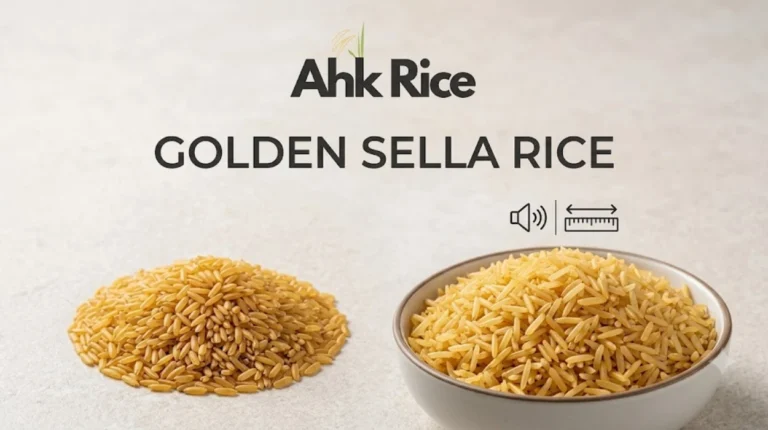
Pakistan’s export portfolio includes several Basmati formats. 1121 Basmati is widely traded in white and parboiled forms such as Steam and Sella. Super Kernel is another established Basmati category. 1509 Basmati is also traded in Steam and parboiled formats.
The package must identify the product correctly. A 1121 Steam package cannot simply use a generic “Basmati Rice” description when the commercial specification requires identification of the variety and processing type.
Grade also affects packaging decisions. Examples include premium extra-long-grain specifications, standard Basmati grades, and broken-rice categories. A broken-rice product requires labeling and commercial identification that accurately describes its composition.
Packaging format also changes according to the buyer. Retailers prioritize consumer-facing presentation and smaller pack sizes. Restaurants and foodservice distributors prioritize handling efficiency and larger sacks. Wholesalers often require durable bulk packaging for warehouse movement.
Which markets import Pakistani Basmati rice?
Pakistani Basmati rice enters markets across the Middle East, North America, Europe, Africa, and other regions, with packaging requirements determined by each destination’s food laws, labeling rules, buyer specifications, and distribution conditions.
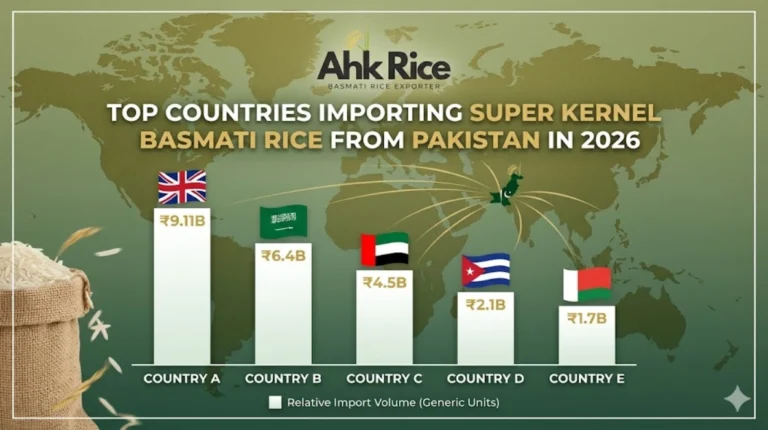
Saudi Arabia and the United Arab Emirates are important Middle Eastern destinations for Pakistani rice. The United States is another significant market where imported food must comply with FDA requirements.
European importers apply EU food and labeling rules. Gulf markets apply their own national requirements. African markets differ by country and importer. Packaging therefore cannot be treated as a universal template for every export destination.
The United States provides a clear example of why destination-specific packaging matters. FDA requires imported foods to comply with applicable U.S. requirements, including food labeling, facility registration where applicable, and Prior Notice procedures.
Packaging specifications should therefore be finalized against the destination market before production packing begins.
What certifications and standards apply to Basmati rice packaging?
Applicable certifications and standards depend on the destination and buyer specification. Common frameworks include Codex food and labeling standards, Pakistan’s national standards, food-safety management certifications, and destination-specific regulatory requirements for packaging and imported food.
Codex CXS 198-1995 is the international Standard for Rice and was listed as last modified in 2025. Codex CXS 1-1985 covers labeling of prepackaged foods and was revised in 2024.
Pakistan’s standards system lists PS 7301-2002 for rice specification and PS CXS 1-2021 for the general labeling of prepackaged foods.
Food-safety certifications such as ISO 22000, HACCP-based systems, and other recognized schemes can document food-safety controls within a processing and packing operation. Their relevance depends on the buyer, certification scope, and destination-market requirements.
A certification is not a universal substitute for legal compliance. A certified facility still has to meet the importing country’s packaging, labeling, food-safety, and documentation rules.
What are common packaging problems and misconceptions?
Common problems include incorrect labels, weak closures, unsuitable materials, inaccurate weights, missing lot identification, poor moisture protection, and using one package specification for every market. Packaging quality must be evaluated against product, transport, storage, and destination requirements.
One misconception is that packaging only protects rice from physical damage. In reality, packaging also controls product identification, traceability, food-contact safety, quantity declaration, and market compliance.
Another misconception is that a strong outer sack automatically provides adequate moisture protection. Strength and barrier performance are different properties. A sack can resist tearing while still requiring an inner liner for additional moisture control.
A third misconception is that one label works in every country. Import regulations differ. The United States, Saudi Arabia, the UAE, and European markets have different regulatory frameworks and language or labeling requirements.
A fourth misconception is that packaging starts after rice processing is complete. Packaging specification should be established earlier because the product grade, pack size, label, materials, filling system, and logistics configuration need to work as one controlled process.
A fifth misconception is that attractive retail packaging equals compliant packaging. Design does not replace correct food-contact materials, accurate declarations, traceability, and destination-market compliance.
How should packaging standards be evaluated before importing Basmati rice?
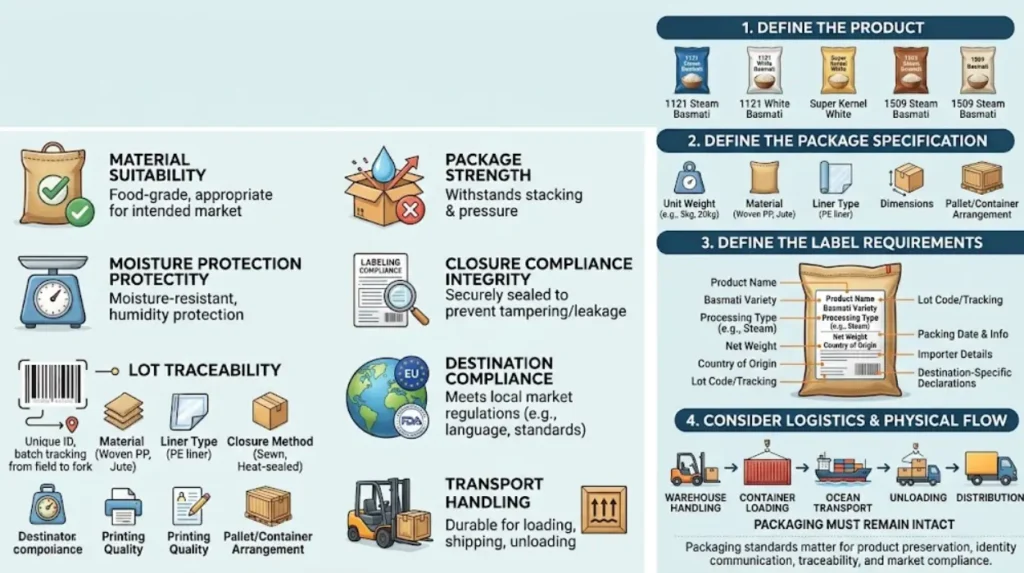
Importers should evaluate packaging against nine points: material suitability, package strength, moisture protection, closure integrity, declared weight, labeling, lot traceability, destination compliance, and transport handling. A documented specification should control every shipment.
The importer should first define the product. Examples include 1121 Steam Basmati, 1121 White Basmati, Super Kernel White, or 1509 Steam Basmati.
Next, define the package. Specify the unit weight, material, liner, dimensions, closure, printing, and pallet or container arrangement.
Then define the label. Confirm the product name, variety, processing type, net weight, origin, lot code, packing information, importer details, and destination-specific declarations.
The final check concerns logistics. Packaging must remain intact during warehouse handling, container loading, ocean transport, unloading, and distribution.
This approach creates a direct connection between product specification and transport performance. Readers comparing these requirements with ocean-shipping protection can continue to the related guide on:
How export packaging protects rice during ocean transport, which addresses the next stage of the packaging system.
AHK Rice operates within this broader export framework by supplying Pakistani Basmati varieties such as 1121, Super Kernel, and 1509, with processing, packaging, and export coordination forming connected stages of the supply process.
Packaging standards matter because imported rice passes through multiple physical and regulatory environments before reaching the buyer. A controlled package preserves the product, communicates its identity, supports traceability, and aligns the shipment with destination-market requirements.
Frequently Asked Questions
Why do packaging standards matter for imported Basmati rice?
Packaging standards protect Basmati rice from contamination, moisture, physical damage, and handling losses. They also ensure accurate labeling, weight declarations, traceability, and compliance with destination-market requirements.
What packaging materials are used for Basmati rice?
Common materials include woven polypropylene sacks, food-grade inner liners, laminated bags, plastic films, and retail pouches. The selected material depends on pack size, storage conditions, handling requirements, and destination regulations.
What information should appear on Basmati rice packaging?
Packaging commonly identifies the product name, rice variety, processing type, net weight, country of origin, lot or batch number, packing information, storage instructions, and importer details where required by the destination market.
How does packaging protect Basmati rice during storage?
Proper packaging limits exposure to moisture, dust, pests, contaminants, and physical damage. Suitable barriers and intact closures help maintain the rice’s condition throughout warehouse storage and distribution.
Does packaging affect Basmati rice shelf life?
Yes. Packaging influences exposure to moisture, oxygen, contamination, and environmental conditions. A suitable package helps maintain product quality during the declared storage period when combined with appropriate warehouse conditions.
What packaging sizes are available for imported Basmati rice?
Common commercial sizes include 1 kg, 2 kg, 5 kg, 10 kg, 20 kg, and 25 kg packs. Exact sizes depend on the importer, retail channel, foodservice requirements, and destination-market preferences.
What is the difference between primary and secondary packaging?
Primary packaging directly contacts the rice, such as a food-grade liner or retail pouch. Secondary packaging groups primary units for handling, such as cartons or outer sacks.