AHK Rice Provides Traceable Basmati Rice Supply for Wisconsin, USA
Wisconsin rice importers need more than a low FOB price. They need a traceable Basmati supply with defined specifications, documented processing, quality verification, compliant export records, and predictable ocean logistics. AHK Rice provides Pakistani Basmati rice from Punjab through a controlled sourcing and export process designed for U.S. wholesalers, distributors, retailers, restaurants, and foodservice buyers.
Product traceability connects the physical rice with its source, production batch, inspection records, packaging, container, and shipment documentation. For background, buyers can review the guide on
Why Is Product Traceability Important in International Rice Trade?
The U.S. regulatory framework also places food-import responsibilities on the U.S. importer, including applicable FDA requirements and Foreign Supplier Verification Program (FSVP) obligations. FDA states that imported food must meet U.S. legal requirements, facilities must be registered where applicable, and Prior Notice requirements apply.
For a Wisconsin buyer, the practical purchasing decision is therefore specification-led: select the rice, approve a representative sample, verify quality, confirm documentation, establish the destination port, and then release the commercial shipment. AHK Rice manages the Pakistan-side sourcing, processing, packing, inspection coordination, and export documentation required to execute that sequence.
What is the best solution for traceable Basmati rice supply to Wisconsin?
The best solution is a documented farm-to-shipment supply chain covering rice origin, variety, processing, testing, packing, inspection, container identification, export documents, and destination requirements. This structure gives Wisconsin buyers measurable product control before commercial cargo leaves Pakistan.
Wisconsin is an inland U.S. market, so the purchasing plan needs two logistics stages. The first stage moves Pakistani Basmati from Punjab to Karachi for export. The second stage moves the container from the U.S. port to Wisconsin by truck, rail, or an intermodal combination.
The product specification needs to be fixed before sampling. A commercial specification normally identifies:
- Basmati variety
- Processing grade
- Average grain length
- Broken grain percentage
- Moisture limit
- Foreign matter limit
- Purity requirement
- Crop or production reference
- Packaging material
- Bag weight
- Private-label requirements
- Required certificates and inspection documents
AHK Rice supplies Pakistani Basmati varieties including 1121, Super Kernel, and 1509. The company operates from Bucheki, Nankana Sahib, Punjab, and describes its processing chain as covering paddy procurement, cleaning, dehusking, polishing, grading, sorting, packaging, and container loading.
The traceability record starts when the paddy enters the controlled supply chain. The production reference then connects processing and quality records with the finished rice. Packing records connect the approved batch with individual bags and the export container.
This structure matters when a Wisconsin distributor receives a shipment and needs to identify exactly which production batch entered the warehouse. It also gives procurement teams a documented basis for comparing the approved sample with the commercial shipment.
For buyers comparing sourcing methods, the related consideration-stage resource on:
How rice exporters track products from farm to shipment provides the broader farm-to-container framework.
Why choose the USA service from AHK Rice?
The USA service combines Pakistani Basmati sourcing, specification control, processing, sampling, packaging, inspection coordination, export documentation, and shipment support. Wisconsin buyers receive one commercial process instead of coordinating separate sourcing, milling, quality, and export suppliers. AHK Rice USA export service
The USA program is designed for importers purchasing container-scale Pakistani Basmati. AHK Rice lists 1121 Basmati, Super Kernel, and other export grades for U.S. buyers, with packaging and product specifications structured around commercial requirements.
The primary advantage is control at origin. The rice is processed in Pakistan before container loading. Cleaning removes unwanted material. Dehusking removes the outer husk. Whitening and polishing produce the specified finished rice. Grading separates kernels according to size and quality. Optical sorting supports uniformity before packing.
For a Wisconsin wholesaler, this process reduces dependence on an unidentified intermediary shipment. The buyer can approve a defined product before production and receive documentation tied to the commercial order.
AHK Rice also provides private-label packaging options. The official USA service page identifies custom packing, sample procedures, shipping support, and container-scale ordering as part of its U.S. export process.
The U.S. importer still carries its own regulatory responsibilities. FDA states that the importer is responsible for ensuring imported food is safe, sanitary, and properly labeled. FSVP requirements require covered importers to establish and maintain supplier-verification procedures.
This distinction is important. AHK Rice provides origin-side documentation and supplier support. The Wisconsin importer remains responsible for its U.S. import compliance program, customs arrangements, and FSVP responsibilities.
What results can a Wisconsin importer expect from this supply model?
A Wisconsin importer can expect clearer product specifications, documented batch identity, controlled sampling, stronger pre-shipment verification, coordinated export documentation, and a predictable logistics plan from Pakistan to a U.S. port and onward to Wisconsin.
The commercial result starts with sample approval. The buyer does not approve a generic Basmati category. The buyer approves a defined grade.
For example, a Wisconsin South Asian food distributor can specify 1121 White Basmati with a defined grain-length range, maximum broken percentage, moisture limit, packaging size, and private-label artwork. The same specification then becomes the reference for production and inspection.
The second result is documentation continuity. The batch reference can connect the production lot to laboratory records, packing details, container number, seal number, commercial invoice, packing list, and bill of lading.
The third result is logistics visibility. AHK Rice states that U.S. buyers can receive shipment tracking from loading through delivery and work with major international carriers.
The fourth result is supply flexibility. Buyers can source standard export packaging or establish private-label packaging. The appropriate format depends on whether the Wisconsin buyer is supplying wholesale customers, grocery retailers, restaurants, or foodservice distributors.
The fifth result is stronger procurement control. When the sample, specification, inspection, and shipment documents use the same commercial reference, a buyer has objective records for evaluating conformity.
That matters because FDA entry review requires imported FDA-regulated products to comply with U.S. standards, and FDA can refuse entry when products violate applicable requirements.
How long does shipping from Pakistan to Wisconsin take?
For Wisconsin, plan approximately 28–42 days for the complete ocean-and-inland logistics cycle, with the exact schedule determined by the U.S. port, vessel connection, port handling, customs clearance, and inland rail or truck movement to the Wisconsin delivery point.
A practical 2026 planning schedule is:
| Wisconsin delivery route | Planning transit range | Main logistics route |
|---|---|---|
| Wisconsin via New York/New Jersey | 28–40 days | Karachi → East Coast → Midwest |
| Wisconsin via Baltimore | 30–42 days | Karachi → Baltimore → Midwest |
| Wisconsin via Houston | 32–45 days | Karachi → Gulf Coast → Midwest |
| Wisconsin via Los Angeles/Long Beach | 30–42 days | Karachi → West Coast → Midwest |
| U.S. port arrival only | 25–35 days | Karachi → major U.S. port |
These are planning ranges rather than guaranteed arrival dates. A current Pakistan-to-U.S. commercial reference lists approximately 24–40 days of sailing time from Karachi to New York or Los Angeles, while AHK Rice’s USA service states an approximately 25–35-day door-to-door planning range for major U.S. destinations.
Wisconsin buyers often benefit from comparing the total inland cost rather than selecting the cheapest ocean route. A lower ocean freight rate can lose its advantage when inland rail, trucking, transloading, or port congestion increases the final delivered cost.
Baltimore is one relevant East Coast option for Midwest-bound cargo. Current August 2026 freight data for the reverse Baltimore–Karachi lane shows ocean transit ranges around 42–49 days, demonstrating that carrier, routing, and sailing conditions materially affect schedules.
The final delivery plan therefore needs to be quoted against the actual destination, container type, shipment date, and carrier schedule.
What is the full Basmati rice sample process and cost?
The sample process starts with the buyer’s specification, followed by sample preparation, courier dispatch, physical and laboratory evaluation, written approval, production, pre-shipment inspection, and container loading. Sample product can be supplied up to 20 kg, while courier and required certificate costs remain buyer expenses.
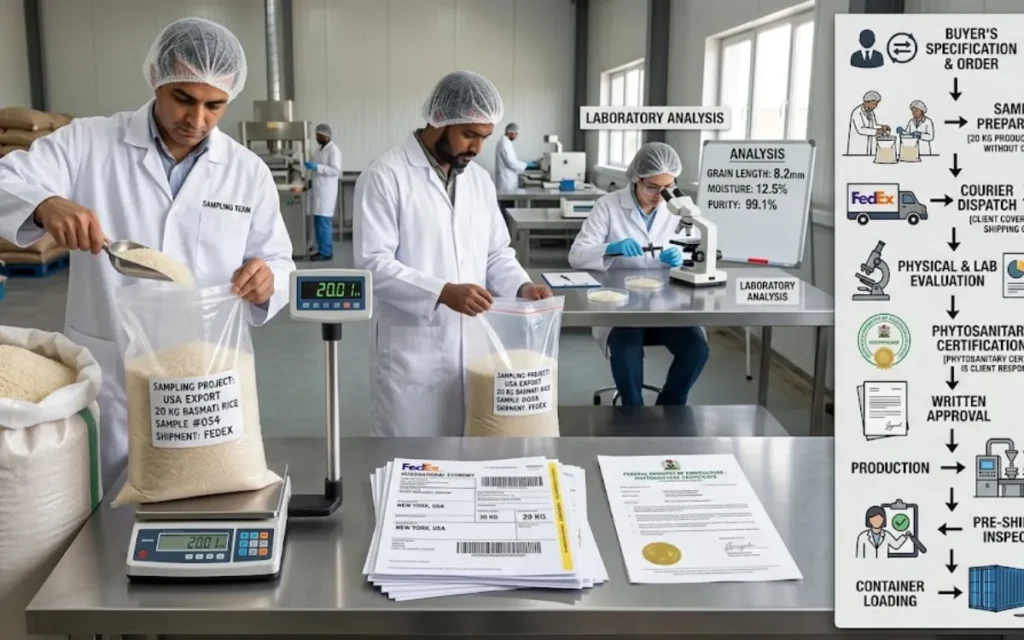
AHK Rice states on its USA service page that up to 20 kg of Basmati rice can be supplied as a product sample without a product charge, while the client covers sample shipping costs. The page also identifies phytosanitary certificate costs as a client responsibility for samples.
A Wisconsin buyer can use the following process:
1. Define the specification
State the variety, processing grade, grain characteristics, broken percentage, moisture, packaging, and intended application.
2. Request the representative sample
AHK Rice prepares the sample against the requested commercial specification rather than sending an unrelated retail product.
3. Confirm sample packaging
The sample is packed for international courier movement. The buyer can provide packaging requirements or use the exporter’s standard sample packaging.
4. Dispatch the sample
The buyer pays international courier charges. The final amount depends on origin, destination, package weight, courier account, and service level.
5. Conduct buyer evaluation
The buyer checks appearance, aroma, grain length, cooking behavior, elongation, texture, and breakage against the purchasing specification.
6. Order independent testing when required
Laboratory testing can cover moisture, pesticide residues, mycotoxins, foreign matter, microbiological parameters, or other buyer-defined criteria. Testing costs depend on the laboratory and analytical package.
7. Approve the commercial specification
The buyer provides written approval of the sample and agreed specification. This becomes the production reference.
8. Produce and inspect
AHK Rice processes and packs the commercial order. Pre-shipment inspection can then verify the finished product against the agreed specification.
9. Load and document the container
The final stage connects the approved batch with the container, seal, shipping documents, and export records.
For budgeting, a Wisconsin importer can reserve approximately $50–$150 for a small international sample courier movement and $100–$300 for an independent laboratory testing package. These are planning allowances, not fixed AHK Rice charges. The actual sample quotation depends on sample weight, destination, requested tests, and courier method.
The important cost distinction is that sample approval and commercial production are separate decisions. Spending a modest amount on representative testing is more controlled than committing container capital before verifying the product.
What factors determine the final rice supply price?
The final commercial price depends on rice variety, processing grade, quality specification, order quantity, packaging, private-label requirements, inspection, export documentation, Incoterm, ocean freight, destination port, and inland delivery to Wisconsin.
A Wisconsin importer requesting a 20 MT trial shipment receives a different cost structure from a distributor ordering repeated FCL volumes. Quantity affects production planning, container utilization, packaging procurement, and freight allocation.
Variety also changes pricing. 1121 Basmati, Super Kernel, and 1509 have different commercial positioning and specification requirements. Processing adds another variable. White, Steam, Sella, Golden Sella, and other grades require different processing routes.
Packaging affects both product cost and logistics. A 5 kg private-label retail bag has different material, printing, filling, palletization, and handling requirements from a 40 kg wholesale PP bag.
Freight is another major variable. Ocean rates change according to carrier, equipment availability, route, season, fuel-related charges, port congestion, and booking date. The destination also matters because Wisconsin is inland.
The trade term must therefore be defined before comparing supplier prices. FOB Karachi, CFR/CNF, CIF, and other arrangements allocate freight, insurance, and risk differently.
For a decision-stage purchase, the strongest comparison is not simply “price per metric ton.” It is:
| Decision factor | Buyer requirement |
| Product | Exact Basmati variety and grade |
| Quality | Written measurable specification |
| Sample | Approved before commercial production |
| Compliance | U.S. import requirements reviewed |
| Freight | Destination-specific quotation |
| Inland delivery | Wisconsin warehouse or nominated location |
| Documentation | Complete export and shipment file |
AHK Rice can build the quotation around these inputs instead of giving a generic rice price disconnected from the buyer’s actual requirements.
How can a Wisconsin importer get started with AHK Rice?
Start by submitting the product grade, required quantity, quality specification, packaging format, Wisconsin delivery point, preferred Incoterm, and documentation requirements. AHK Rice can then structure the sample, quotation, production, inspection, and export process around those specifications.
The first step is product selection. Most Wisconsin commercial buyers start with 1121 Basmati, Super Kernel, or 1509 depending on retail positioning, restaurant requirements, and target price.
The second step is specification confirmation. Define grain length, broken percentage, moisture, purity, packaging, and processing type before requesting the sample.
The third step is logistics planning. Select the preferred U.S. port and confirm the inland route to Wisconsin. New York/New Jersey, Baltimore, Houston, and Los Angeles/Long Beach represent different freight and inland cost structures.
The fourth step is regulatory coordination. The U.S. importer confirms FDA facility and entry requirements, Prior Notice procedures, FSVP responsibilities, customs-broker requirements, and any commodity-specific controls. FDA identifies FSVP as a continuing importer responsibility for covered foods and foreign suppliers.
The fifth step is sample approval. AHK Rice provides the representative product sample, the buyer evaluates it, and the approved specification becomes the reference for production.
The sixth step is commercial execution. The exporter confirms production, packaging, inspection, container loading, export documents, vessel booking, and shipment tracking.
The final decision should focus on traceability and execution rather than price alone. A supplier that connects sourcing, processing, quality verification, documentation, and logistics gives a Wisconsin importer a stronger basis for repeat procurement.
AHK Rice provides that structured Pakistan-to-USA supply model for buyers requiring traceable Basmati rice, documented quality controls, and coordinated export execution.
To start the specification and commercial quotation process, request a quote from AHK Rice.
Frequently Asked Questions
What Basmati rice varieties does AHK Rice supply to Wisconsin?
AHK Rice supplies Pakistani Basmati varieties including 1121, Super Kernel, and 1509, with specifications tailored to wholesale, retail, restaurant, and foodservice requirements.
How does AHK Rice provide traceability for Wisconsin rice buyers?
AHK Rice connects rice origin, processing, quality checks, packaging, batch information, container details, and export documentation to create a documented supply chain.
Can Wisconsin buyers receive a Basmati rice sample before ordering?
Yes. AHK Rice offers product samples for evaluation. Its USA service states that samples up to 20 kg can be provided, while the buyer covers applicable shipping and certificate costs.
How much does a Basmati rice sample cost?
The rice sample itself can be supplied without a product charge under the stated sample policy. Courier, phytosanitary certification, and optional laboratory testing costs depend on the shipment and testing requirements.
How long does shipping from Pakistan to Wisconsin take?
A practical planning range is approximately 28–42 days for ocean and inland logistics, depending on the U.S. port, vessel schedule, customs clearance, and transportation from the port to Wisconsin.
Which U.S. ports can serve Wisconsin rice imports?
Wisconsin-bound cargo can use ports such as New York/New Jersey, Baltimore, Houston, and Los Angeles/Long Beach. The best option depends on freight rates, sailing schedules, and inland transportation costs.