Partner with AHK Rice for Minnesota Basmati Rice Procurement
Minnesota Basmati rice procurement is best managed through a supplier that can control product specifications, sampling, processing, documentation, shipping, and repeat-order consistency rather than competing only on the lowest FOB price. For importers, distributors, wholesalers, retailers, and foodservice businesses, AHK Rice provides a Pakistan-origin sourcing model built around specification-based procurement and U.S. export coordination. Minnesota buyers should first understand:
Why evaluating rice suppliers beyond price matters rather than treating the lowest quotation as the complete purchasing decision.
The procurement objective is straightforward: receive the approved Basmati specification at a predictable landed cost, within a workable delivery window, with documentation suitable for U.S. food import requirements. AHK Rice supplies Pakistani 1121, Super Kernel, and 1509 Basmati varieties and manages processing, grading, sorting, packaging, inspection, documentation, and container loading from Punjab. Its USA export program is designed for wholesalers, distributors, retailers, restaurants, and private-label buyers.
What is the best solution for Minnesota Basmati rice procurement?
The strongest solution is a specification-controlled export program linking approved samples, commercial quality standards, production planning, inspection, export documentation, ocean freight, U.S. clearance, and inland delivery into one purchasing workflow that protects Minnesota inventory continuity.
Minnesota buyers should define the purchase before requesting a price. The specification should identify variety, processing grade, grain characteristics, broken percentage, moisture requirement, purity, packaging, quantity, destination, intended application, and required certifications or inspection documents.
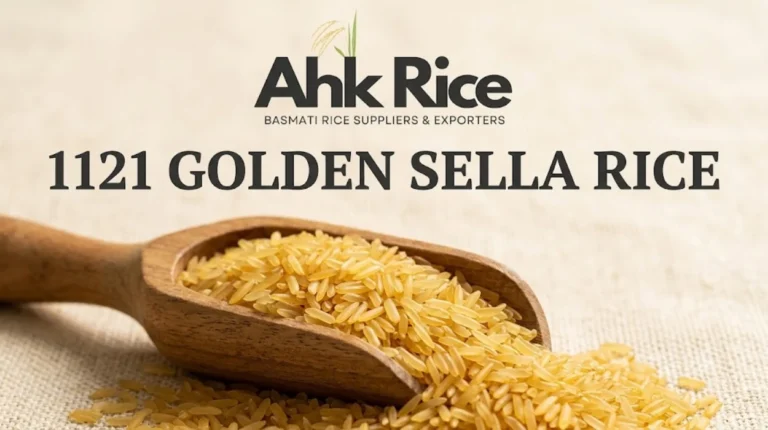
For premium retail and restaurant programs, 1121 Basmati can be appropriate when extra-long grain appearance, aroma, and cooked elongation are important. Super Kernel can provide another premium long-grain positioning, while 1509 can be considered where buyers want long grain performance with a different cost structure. AHK Rice currently identifies 1121, Super Kernel, and 1509 as its principal Pakistani Basmati varieties.
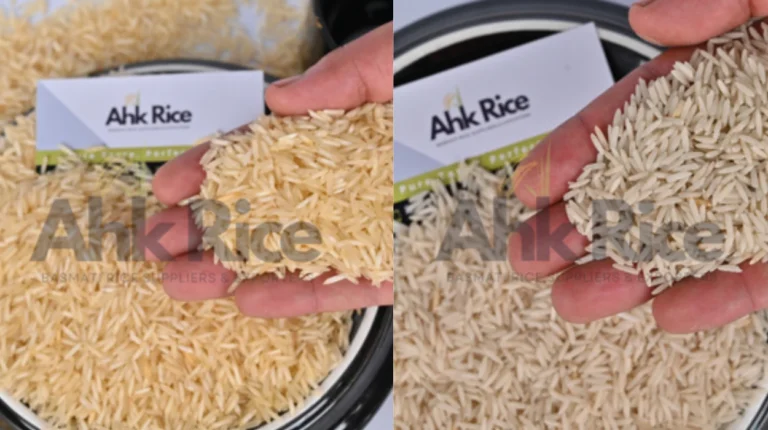
The next step is sample approval. A sample should not be approved solely because the uncooked grains look attractive. Minnesota procurement teams should cook the rice using the same equipment, water ratio, cooking process, holding time, and recipes used by their customers. The evaluation should cover aroma, grain separation, elongation, texture, breakage, appearance, and consistency.
After approval, the sample specification should become the commercial reference. This reduces the risk of receiving a shipment that technically carries the same product name but performs differently in the kitchen or retail channel.
Why choose the USA service from AHK Rice?
AHK Rice’s USA service combines Pakistani Basmati sourcing with processing, grading, packaging, export documentation, inspection, container coordination, and destination-based shipping planning, giving Minnesota buyers one origin-side procurement partner instead of fragmented supplier management.
The USA export service is structured around the requirements of American importers. AHK Rice states that its USA program supplies Basmati varieties including 1121 and Super Kernel, supports customized packaging, coordinates export documentation, and works with major shipping lines. Its published USA information also identifies a starting commercial quantity of one 20-foot container, approximately 20 metric tons, although final loading depends on product, packaging, and shipment configuration.
For Minnesota buyers, origin-side control matters because the final destination is inland. A quotation that looks attractive at Karachi can become less competitive after ocean freight, port charges, customs-related costs, transloading, rail or trucking, and delivery to a Minnesota warehouse are added.
AHK Rice can therefore be evaluated on more than the rice price. The relevant question is whether the exporter can provide a commercially usable specification, repeatable quality, export documentation, appropriate packing, inspection support, and a shipment schedule that matches the buyer’s inventory plan.
U.S. compliance must also remain part of the procurement decision. FDA states that food imported into the United States must meet applicable U.S. safety, sanitary, and labeling requirements. FDA also notes that facilities handling imported food must be registered where required and that Prior Notice is required for incoming food shipments. Imported food can be inspected at U.S. ports.
The importer remains responsible for U.S. compliance, but a capable exporter should support the importer by preparing accurate commercial and export documentation and supplying product information needed for the import process.
How many shipping days should Minnesota buyers plan for?
Minnesota buyers should budget roughly 35–50 days for a practical international-to-Midwest delivery window, while Pakistan-to-U.S.-port ocean transit is commonly about 25–35 days on East Coast routes before clearance and inland movement are completed.
The exact schedule depends on the selected U.S. gateway. AHK Rice currently publishes approximately 25–35 days from Karachi to major U.S. ports such as New York and Los Angeles. Other current 2026 planning information indicates approximately 20–28 days for some West Coast routes and 25–35 days for East Coast routes.
For Minnesota procurement, the inland leg must be added. A practical planning framework is:
| Shipment route | 2026 planning range |
|---|---|
| Karachi → East Coast U.S. port | 25–35 days |
| Karachi → West Coast U.S. port | 20–28 days |
| U.S. port → Minnesota warehouse | Variable |
| Complete Midwest delivery planning | 35–50 days |
| Production and export preparation | 7–15 days |
These are planning ranges, not guaranteed arrival dates. Vessel schedules, transshipment, port congestion, customs processing, inspection, rail availability, trucking, and warehouse appointments can extend the receiving date. AHK Rice itself advises that actual shipment timing depends on carrier schedules and destination conditions.
A Minnesota buyer should therefore calculate the reorder point backward from the warehouse requirement. If inventory must be available on a specific date, the purchasing team should not use the 25–35-day ocean transit figure as the entire lead time.
What is the full sample process and cost for Minnesota buyers?
The sample process should move from technical specification to representative sample, courier delivery, physical and cooking evaluation, documentation review, written approval, commercial quotation, production, inspection, and shipment; sample rice may be complimentary while courier and applicable certification costs remain buyer expenses.
The first stage is specification collection. The Minnesota buyer provides the variety, grade, grain requirements, moisture target, broken percentage, packaging preference, intended volume, destination, and application.
The second stage is sample preparation. AHK Rice states that up to 20 kg of Basmati rice can be provided as a sample without a rice charge, while the buyer covers sample shipping costs. The USA service information also identifies phytosanitary certificate costs for samples as a client responsibility where applicable.
The third stage is international courier dispatch. A buyer can use its own courier account or arrange shipment through the agreed process. Published AHK Rice guidance indicates that small U.S. sample parcels can typically move by air courier, with delivery depending on destination and service level.
The fourth stage is commercial evaluation. Minnesota buyers should compare the sample with the written specification. A distributor may emphasize grain uniformity and cooking yield. A restaurant may emphasize elongation, separation, texture, aroma, and holding performance. A retailer may place greater weight on appearance, packaging, consistency, and consumer positioning.
The fifth stage is approval. The buyer should document the approved variety, processing grade, physical parameters, packaging, and testing criteria. This approved specification becomes the reference for bulk production.
The indicative sample budget can be structured as follows:
| Cost item | Typical treatment |
| Rice sample within supplier allowance | May be complimentary |
| International courier | Buyer responsibility |
| Phytosanitary certificate, where applicable | Buyer responsibility |
| Independent laboratory testing | Buyer-controlled cost |
| Commercial production sample | Quoted according to requirement |
| Bulk container | Separate commercial quotation |
Published AHK Rice guidance gives small commercial sample courier allowances in the approximate $40–$80 range for some U.S. shipments, while broader commercial sample budgets can reach approximately $50–$150 depending on weight, courier, handling, and destination. These are planning figures, not fixed Minnesota charges.
AHK Rice should therefore confirm the actual sample cost before dispatch rather than treating an online estimate as a contractual price.
What results can Minnesota buyers expect from the procurement model?
A controlled procurement model should produce more predictable product consistency, clearer landed-cost planning, fewer specification disputes, better inventory scheduling, and a repeatable purchasing process that can support Minnesota wholesale, retail, restaurant, and private-label programs.
The first measurable outcome is specification consistency. When the buyer approves a representative sample and converts it into written purchasing requirements, future containers can be evaluated against defined criteria rather than subjective terms such as “premium” or “high quality.”
The second outcome is better landed-cost control. Minnesota buyers should compare the total delivered cost rather than FOB rice price alone. Ocean freight, destination charges, customs brokerage, duties or applicable government charges, inspection, inland transportation, storage, and other logistics expenses can affect the final warehouse cost.
The third outcome is improved replenishment planning. A buyer carrying several months of inventory can schedule repeat purchases before stock reaches its critical level. This is particularly important for restaurants and distributors where an out-of-stock imported staple can create customer and operational problems.
The fourth outcome is stronger documentation control. AHK Rice reports that its export process includes commercial documentation, certificates, inspection support, packaging, and container loading. Third-party inspection can also be arranged when requested by the client.
The fifth outcome is scalability. Once the specification and logistics route are validated, the buyer can move from a sample to a repeat-container program without rebuilding the sourcing process from the beginning.
How should Minnesota buyers evaluate price and total procurement cost?
Minnesota buyers should compare Basmati quotations using landed cost per sellable kilogram, specification compliance, freight route, packaging, payment terms, inspection, lead time, and reorder reliability rather than selecting the lowest quoted FOB price.
Rice variety is a major price variable. A premium 1121 specification can carry a different commercial value from Super Kernel or 1509. Processing also changes economics because White, Steam, Sella, and other grades involve different processing requirements.
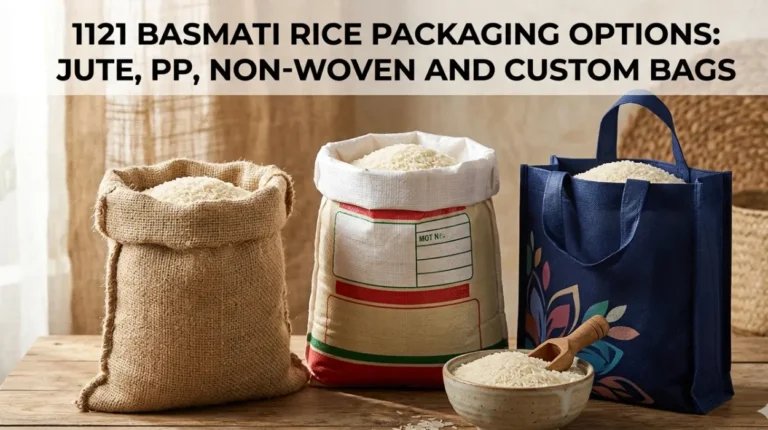
Packaging creates another cost difference. Bulk PP bags, customized commercial bags, and private-label retail packaging do not have the same material, printing, packing, handling, or logistics costs.
Freight should be quoted against the actual destination port and shipment date. A lower ocean rate may not produce the lowest Minnesota warehouse cost if it requires a less efficient inland route.
Quantity also affects the quotation. AHK Rice states that its USA program can work with container quantities and that customized quotations consider destination, product, packing, quantity, and Incoterm information.
Payment structure, inspection requirements, certificates, packaging artwork, storage requirements, and shipment frequency should also be included when comparing suppliers.
The most useful procurement calculation is:
Landed cost per sellable kg = product cost + freight + applicable import and destination costs + inland delivery + other agreed charges ÷ sellable quantity.
That calculation makes two suppliers easier to compare because it moves the decision from headline price to actual distribution economics.
Buyers comparing exporters should also review production capacity, quality controls, documentation, lead times, and commercial reliability using a structured procurement assessment, as explained in:
How procurement teams assess international rice export partners.
How can Minnesota buyers get started with AHK Rice?
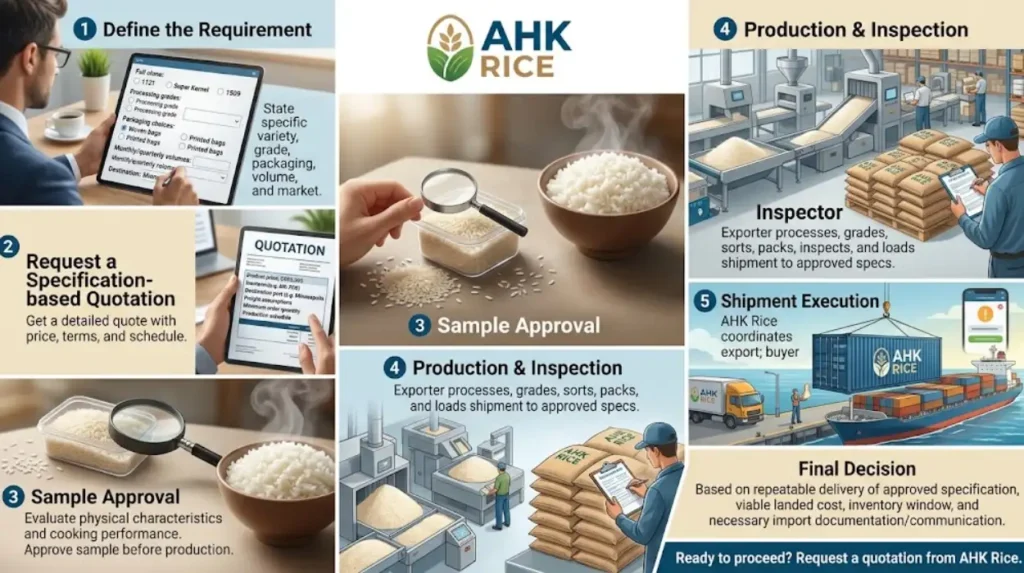
Minnesota buyers can begin by submitting their exact product specification, target quantity, packaging requirement, destination, and preferred commercial terms, then approving a representative sample before production and confirming the complete shipment schedule.
The first step is to define the requirement. State whether the program requires 1121, Super Kernel, or 1509, together with the processing grade, packaging, estimated monthly or quarterly volume, and intended market.
The second step is to request a specification-based quotation. The quotation should distinguish product price, Incoterm, destination port, freight assumptions, minimum quantity, production schedule, and other applicable charges.
The third step is sample approval. AHK Rice can prepare the requested sample so the buyer can evaluate both physical characteristics and cooking performance before approving the commercial specification.
The fourth step is production and inspection. Once the buyer approves the specification and commercial terms, the exporter can process, grade, sort, pack, inspect, document, and load the shipment against the approved requirements.
The fifth step is shipment execution. AHK Rice coordinates the origin-side export process and provides shipment information so the Minnesota buyer can plan U.S. clearance and inland delivery.
The final decision should be based on whether the supplier can repeatedly deliver the approved specification at an economically viable landed cost, within the required inventory window, with the documentation and communication needed for U.S. import operations. For Minnesota buyers ready to move from supplier evaluation to a product-specific commercial discussion, request a quotation from AHK Rice.
Frequently Asked Questions
What Basmati rice varieties does AHK Rice supply to Minnesota buyers?
AHK Rice supplies Pakistani Basmati varieties including 1121, Super Kernel, and 1509. Buyers can select the variety and processing grade based on restaurant, wholesale, retail, or private-label requirements.
What is the minimum order quantity for Minnesota Basmati rice buyers?
Commercial orders are generally planned by container. AHK Rice’s USA export program identifies approximately one 20-foot container, around 20 metric tons, as a starting commercial quantity, subject to product and packaging configuration.
How long does Basmati rice shipping from Pakistan to Minnesota take?
A practical planning window is approximately 35–50 days for the complete international-to-Minnesota delivery cycle. Ocean transit from Karachi to major U.S. ports can take roughly 25–35 days, followed by U.S. clearance and inland transportation.
Can Minnesota buyers request Basmati rice samples before ordering?
Yes. Minnesota buyers can request samples to evaluate grain appearance, aroma, elongation, texture, cooking performance, and consistency before approving a commercial specification. Sample shipping and applicable certification costs may be charged separately.
How much does a Basmati rice sample cost for Minnesota buyers?
The rice sample may be provided without a product charge within the supplier’s stated sample allowance. International courier, phytosanitary certification where applicable, and independent laboratory testing can create additional costs.
What factors affect the price of Basmati rice imported into Minnesota?
Price depends on rice variety, processing grade, grain specification, order volume, packaging, customization, inspection requirements, Incoterm, ocean freight, destination charges, and inland transportation from the U.S. port to Minnesota.
What packaging options are available for Minnesota Basmati rice imports?
Packaging can be selected according to the buyer’s distribution model, including commercial wholesale packaging and customized or private-label formats. Bag material, weight, printing, sealing, and loading configuration should be confirmed before quotation.