Why Do Port Logistics Influence Rice Import Performance?
Port logistics are the coordinated movement of rice containers through terminals, customs, inspections, documentation, storage, and inland transport. Their performance determines how efficiently a rice shipment moves from an exporting country to the importer’s warehouse.
Rice import performance measures how reliably a shipment reaches its destination in the required quantity, condition, cost, and timeframe. Port logistics connect the ocean voyage with the physical and regulatory steps required for final delivery.
For Pakistani Basmati rice, the logistics chain begins after milling, grading, packaging, and export documentation. Rice then moves by truck to a seaport, enters a container terminal, clears export procedures, loads onto a vessel, and travels to the destination port.
Pakistan’s Karachi Port is a major maritime gateway. Karachi Port Trust states that the port handles more than 50% of Pakistan’s trade and operates multiple container terminals.
Port performance therefore affects more than transportation. It influences inventory planning, import clearance, landed cost, customer delivery schedules, and the condition in which rice reaches the destination market.
How does port logistics affect the rice import process?
Port logistics affect rice imports through a sequence of cargo booking, container movement, terminal handling, customs clearance, vessel loading, ocean transport, discharge, inspection, customs release, and inland delivery. Each stage creates a specific operational dependency.
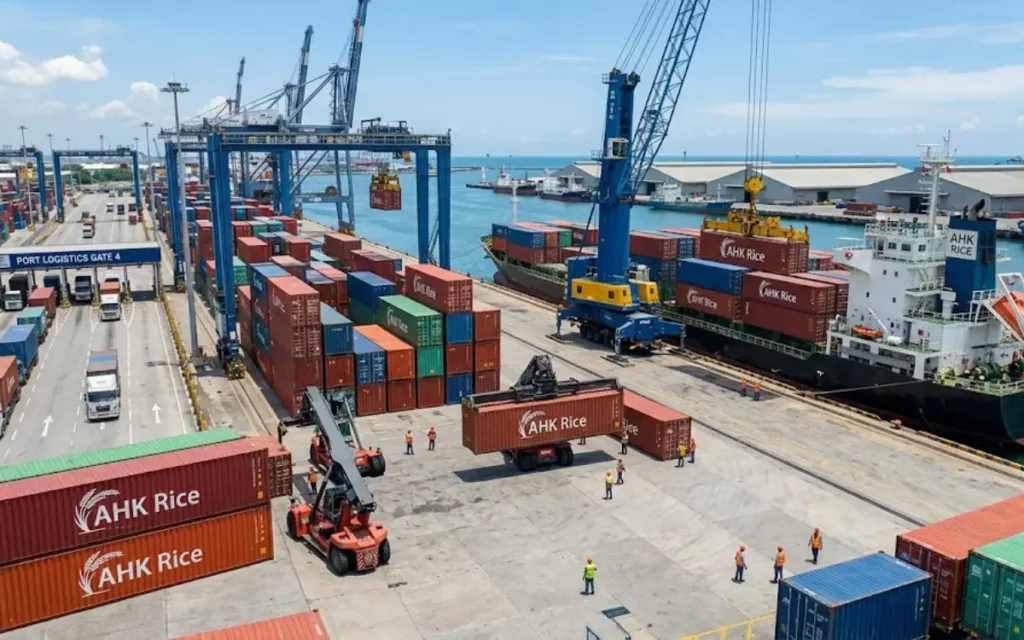
The process starts when an exporter and importer agree on the shipment quantity, packaging, destination, Incoterm, vessel schedule, and documentation requirements.
1. Rice moves from the processing facility to the port
After milling and final quality checks, packaged rice is loaded into export containers. Container selection matters because rice requires clean, dry, and structurally suitable cargo space.
A Pakistani Basmati shipment such as 1121 Basmati, Super Kernel Basmati, or 1509 Basmati normally moves from a processing facility in Punjab toward Karachi-area port infrastructure.
2. Export documentation is completed
The shipment requires commercial and logistical documents. These include the commercial invoice, packing list, shipping information, and documents required by the importing country.
Pakistan’s Department of Plant Protection requires exporters of plant and plant products to follow the importing country’s phytosanitary requirements. Its export process includes inspection, sampling, treatment where required, and issuance of a phytosanitary certificate under ISPM-12.
3. The container enters the terminal
The container reaches the port terminal and passes through gate procedures. Terminal systems record the container, verify documentation, and position the cargo for vessel loading.
A delay at this stage affects the vessel connection. Missing a planned vessel creates an additional waiting period based on the next available sailing.
4. The container is loaded onto the vessel
The terminal coordinates container movement from the yard to the vessel. The shipping line controls the vessel schedule, while the terminal controls much of the physical handling operation.
5. The vessel transports the rice
Ocean freight creates the largest geographical movement in the supply chain. The final timeline depends on the selected route, transshipment points, vessel schedule, congestion, and destination-port conditions.
6. The destination port receives the container
After arrival, the container is discharged and transferred through terminal processes. Import documentation, customs requirements, food controls, and plant-health procedures then determine how quickly the cargo enters the domestic supply chain.
7. The container moves inland
The final stage connects the destination port with the importer’s warehouse, distribution centre, wholesaler, or retail network.
This sequence explains why ocean transportation alone does not represent the complete delivery timeline. Port handling exists before and after the vessel voyage.
Which port logistics components determine rice import performance?
The main components are port capacity, terminal handling, container availability, customs procedures, inspections, documentation, vessel schedules, storage, inland transport, and communication between exporters, importers, shipping lines, terminals, customs authorities, and logistics providers.
Port and terminal capacity
Terminal capacity determines how containers are received, stored, moved, and loaded. Congestion increases the number of operational steps competing for the same infrastructure.
Karachi Port identifies three container terminals in its published port information: Karachi International Container Terminal, Pakistan International Container Terminal, and South Asia Pakistan Terminal.
Container availability
Rice exporters need suitable containers at the correct location and time. A shortage or late release affects factory loading and port delivery.
For example, a shipment scheduled for vessel cut-off on Thursday requires the empty container, loading operation, documentation, and gate-in process to align before that deadline.
Customs clearance
Customs verifies the commercial and regulatory status of the shipment. Incorrect commodity information, invoice details, quantities, or supporting documents create additional processing requirements.
Phytosanitary controls
Phytosanitary certification verifies compliance with plant-health requirements. Pakistan’s Department of Plant Protection states that export certification follows the requirements of the importing country.
This requirement is particularly important because rice is an agricultural commodity. Destination authorities can impose inspection, sampling, treatment, or documentation requirements.
Vessel schedules
A shipment depends on the planned sailing. The booking date does not represent the final delivery date.
The actual sequence includes cargo readiness, container release, terminal gate-in, vessel cut-off, loading, sailing, transshipment where applicable, discharge, customs clearance, and inland delivery.
Destination-port inspection
Import controls differ between markets. For example, Great Britain maintains specific controls on rice imported from Pakistan. As of July 2026, UK food import restrictions identify Pakistan rice controls for aflatoxins and ochratoxin A.
The UK also publishes 2026 rice import quota notices. The July 2026 notice covers rice import quota arrangements and application requirements for the 2026 period.
These controls demonstrate why port logistics and regulatory planning operate together.
Why does port efficiency matter for Pakistani Basmati rice?
Port efficiency matters because Pakistani Basmati rice competes across international markets where buyers manage inventory, promotions, restaurant supply, wholesale distribution, and retail replenishment against planned delivery windows and landed costs.
Pakistan has an established international Basmati trade. Pakistan Bureau of Statistics reported FY2024 Basmati rice exports of 773,995 metric tons valued at US$877 million, representing increases of 29.9% in quantity and 34.8% in value from FY2023.
The same statistics identified major Basmati destinations including the United Arab Emirates, Saudi Arabia, Afghanistan, Oman, Italy, Yemen, the United Kingdom, the United States, the Netherlands, Germany, Australia, Canada, and France.
The commercial importance of these markets makes logistics performance a direct part of international rice trade.
For example, a 1121 Basmati shipment destined for the United Kingdom passes through several operational stages before reaching a British importer. The importer needs accurate documents, correct commodity classification, appropriate regulatory compliance, and reliable transport coordination.
The UK government classifies Basmati as a long-grain rice variety and recognises Kernel as a Pakistani Basmati variety in its rice classification guidance.
What benefits come from efficient port logistics?
Efficient port logistics reduce avoidable waiting, improve shipment predictability, control handling costs, protect inventory planning, support regulatory compliance, and give rice importers better visibility from export preparation through destination-port release and inland delivery.
Better delivery planning
A predictable port process gives importers stronger visibility over expected arrival and warehouse receiving dates.
Lower logistics disruption
Accurate documentation and coordinated terminal handling reduce avoidable operational interruptions.
Better inventory control
Rice importers often plan stock around expected vessel arrivals. Reliable logistics support replenishment planning for wholesalers, supermarkets, foodservice businesses, and distributors.
Better cost management
Port delays create direct and indirect costs. Examples include storage, demurrage, detention, additional handling, missed delivery appointments, and emergency inland transportation.
Better product protection
Rice is a dry food commodity. Containers require appropriate loading and handling conditions. Excess moisture, contamination, poor packaging integrity, or unsuitable storage conditions can affect commercial quality.
Stronger regulatory performance
Efficient documentation management supports phytosanitary, customs, food-safety, and destination-market requirements.
Which certifications and documents matter for rice shipments?
Rice shipments require documents and certifications based on the origin, destination, commodity, and buyer specification. Common requirements include phytosanitary certificates, certificates of origin, commercial documents, laboratory reports, and recognised food-safety certifications where the buyer or market requires them.
A phytosanitary certificate is an official plant-health document issued according to the importing country’s requirements. Pakistan’s Department of Plant Protection lists the import permit, commercial invoice, packing list, traceability certificate for high-risk commodities, treatment certificate where applicable, and container information among export documentation requirements.
Food-safety certifications such as HACCP, ISO 22000, BRCGS, or FSSC 22000 are different from phytosanitary certification. They demonstrate food-safety management or buyer-required production controls rather than replacing an official plant-health certificate.
Organic certification applies only when rice is marketed as organic under the relevant market’s rules. Halal certification applies when required by the buyer, destination, or product-market specification.
The correct certification set therefore depends on the shipment destination and contractual requirements.
Saudi Arabia, for example, identifies an official phytosanitary certificate as a requirement for imported grains under its food import guidance.
Which rice markets are most affected by port logistics?
Rice markets with long ocean routes, strict border controls, high shipment volumes, or tight retail replenishment schedules have greater operational dependence on port logistics. Examples include the United Kingdom, European markets, Gulf countries, North America, and African destinations.
The United Kingdom is an important market for Pakistani Basmati rice. Pakistan’s FY2024 Basmati exports to the UK reached 37,395 metric tons, valued at US$45 million.
The UAE represented another major destination, with 149,092 metric tons of Pakistani Basmati exports in FY2024. Saudi Arabia received 101,909 metric tons, while Oman received 58,249 metric tons.
European markets also demonstrate strong demand. Italy received 46,004 metric tons, while the Netherlands, Germany, France, and Belgium were also recorded as Basmati destinations in FY2024.
Market requirements differ. The UK’s 2026 rice regime includes import quota arrangements, while food controls for Pakistani rice include contaminant and pesticide-residue controls.
This makes destination-specific logistics planning essential.
What are the common port logistics problems in rice imports?
Common problems include vessel delays, port congestion, missing documentation, container shortages, customs holds, inspection delays, incorrect declarations, storage charges, transshipment disruption, and weak coordination between parties. Each problem affects the shipment at a different point.
Missing documentation
A container can arrive physically while its documentation remains incomplete. This prevents efficient clearance.
Incorrect cargo information
Incorrect HS classification, quantity, origin, package details, or invoice information creates clearance complications.
Port congestion
Congestion increases container waiting and handling time. The impact becomes stronger when several operational delays occur together.
Missed vessel cut-off
A container that reaches the terminal after the vessel cut-off does not load on that sailing. The shipment then follows the next available schedule.
Destination inspection
Inspection requirements can extend the time between vessel discharge and cargo release.
Storage and detention
Containers remaining beyond permitted free periods create additional charges. Importers therefore need accurate coordination between port release and inland transport.
Misunderstanding freight time
Ocean transit time is not the same as total delivery time. Total delivery includes origin transport, terminal handling, customs, vessel movement, destination clearance, and inland delivery.
This distinction is critical when building an import plan. A shipment advertised with a particular ocean transit duration still requires additional time before it reaches the importer’s warehouse.
How should rice importers understand port logistics before planning delivery?
Rice importers need to evaluate the complete logistics chain rather than focusing only on vessel transit time. The correct planning model includes cargo readiness, port cut-offs, documentation, vessel schedules, destination controls, customs clearance, and final-mile transportation.
The next stage is understanding how the ocean freight plan connects these port activities into an estimated delivery timeline. This includes sailing schedules, transshipment, buffer periods, destination-port handling, and inland transport.
For that reason, the logical next article:
How Does Ocean Freight Planning Affect Rice Delivery Timelines? within the discussion of delivery planning after explaining that port efficiency does not equal ocean transit time.
The distinction creates a clear information path:
Rice import performance → port logistics → shipment handling → ocean freight planning → delivery timeline.
This structure helps readers understand why a rice shipment requires an integrated logistics plan instead of a single transit-time estimate.
Frequently Asked Questions
What are port logistics in rice imports?
Port logistics are the processes that move rice from the exporter to the destination port and then into the importer’s supply chain. They include container handling, customs clearance, inspections, vessel loading, discharge, storage, and inland transportation.
Why do port logistics influence rice import performance?
Port logistics influence delivery reliability, handling costs, inventory planning, and customs clearance. Delays at terminals, documentation problems, inspections, or missed vessel cut-offs can extend the total time required for rice to reach the importer.
How does port congestion affect rice imports?
Port congestion increases container waiting and handling time. It can cause missed vessel cut-offs, longer storage periods, additional port charges, and delays in transferring rice from the terminal to inland transportation.
Which ports handle Pakistani rice exports?
Karachi Port and Port Qasim are major maritime gateways for Pakistan’s international trade. Rice shipments from Punjab commonly move toward Pakistan’s southern seaports before entering international ocean freight networks.
What documents are required for Pakistani rice exports?
Common documents include the commercial invoice, packing list, shipping documents, certificate of origin, and phytosanitary certificate where required. Destination markets can require additional food-safety, laboratory, customs, or import-control documents.