How Does Supplier Capacity Influence Long-Term Rice Availability?
Supplier capacity directly influences long-term rice availability because a buyer needs consistent sourcing, processing throughput, quality control, inventory planning, and export execution rather than one successful shipment. In 2026, Pakistan remains a major rice exporter, but stronger competition and changing export volumes make supplier scalability a critical purchasing factor. USDA forecasts Pakistan’s 2026/27 rice production at 9.8 million metric tons and exports at 5.0 million metric tons, while 2025/26 exports are projected at 4.7 million metric tons.
For Iowa importers, this makes supplier evaluation broader than comparing one FOB quotation. Buyers assessing:
Why Iowa importers evaluate supplier scalability before contracting need to examine annual sourcing capacity, crop access, processing throughput, grade consistency, container planning, and the supplier’s ability to support higher volumes after the first contract. Pakistan’s rice exports also face stronger competition from India, which makes dependable execution more important for long-term purchasing decisions.
What does supplier capacity mean in rice procurement?
Supplier capacity is the measurable ability of an exporter to source, process, grade, pack, document, and ship contracted rice volumes repeatedly without reducing specification compliance, delivery performance, or quality consistency during changing market conditions.
Capacity has several components. Sourcing capacity measures access to paddy from producing areas. Processing capacity measures how much rice a facility can mill, sort, grade, and pack within a defined period. Inventory capacity measures how much finished rice can remain available between harvest cycles.
Export capacity adds another layer. A supplier needs container planning, vessel booking, documentation, fumigation, inspection coordination, and port execution. A supplier with abundant paddy but weak export coordination does not provide dependable commercial capacity.
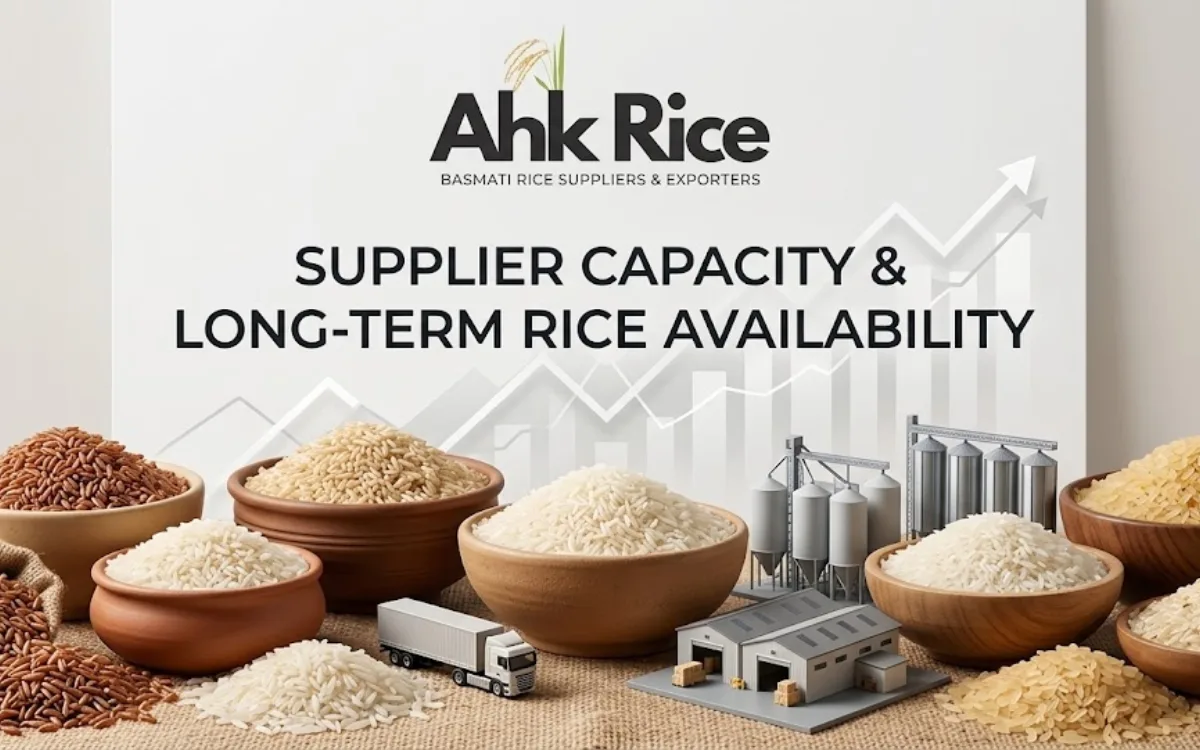
AHK Rice operates from Bucheki, Nankana Sahib, Punjab, and manages the export chain from paddy sourcing through processing, grading, color sorting, customized packaging, documentation, and container loading. Its product range includes Basmati 1121, Super Kernel, and 1509.
This integrated structure matters because each additional handoff creates another capacity dependency. A buyer evaluating a three-year supply relationship therefore needs to assess the complete chain rather than the mill’s stated production volume alone.
What are the available solutions for securing long-term rice availability?
Importers generally choose among single-source contracts, multi-supplier sourcing, seasonal inventory planning, framework agreements, or integrated exporter relationships; each approach balances price, availability, quality control, operational complexity, and protection against supply interruptions differently.
Single-source contracting
A single-source model uses one exporter for the contracted variety and specification. It simplifies communication, documentation, packaging, inspection, and forecasting.
The advantage is specification consistency. The buyer works with one approved product profile instead of managing several suppliers. The disadvantage is concentration risk. A production disruption, quality failure, or capacity constraint directly affects the entire program.
Multi-supplier sourcing
A multi-supplier model divides annual demand between two or more exporters. A buyer can allocate 60% to its primary supplier and 40% to a secondary supplier.
This structure reduces dependency on one company. It also creates additional work. Samples, specifications, inspections, packaging, contracts, payment terms, and shipment coordination need separate management.
Seasonal inventory planning
Inventory planning uses crop timing and shelf life to bridge periods between harvests. The importer purchases during favorable availability periods and holds stock for later distribution.
This approach works particularly well for products with predictable demand. It also requires warehouse capacity, stock rotation, moisture control, pest management, and accurate demand forecasting.
Framework agreements
A framework agreement establishes commercial conditions for repeated purchases without requiring the buyer to negotiate every shipment from zero. Volumes, quality specifications, packaging, documentation, inspection procedures, and pricing mechanisms can be defined in advance.
The buyer gains planning visibility while retaining shipment-level flexibility.
Integrated exporter relationships
An integrated exporter manages several stages internally. This reduces dependency on outside mills, graders, packers, and documentation agents.
For long-term Basmati procurement, this model provides a stronger connection between paddy sourcing, milling, grading, packaging, and shipment execution. AHK Rice describes its model as end-to-end, covering sourcing through final container loading and export documentation.
How do different supplier-capacity approaches compare?
The strongest approach depends on demand stability and operational risk: single sourcing suits controlled programs, dual sourcing reduces concentration risk, inventory protects against timing gaps, and integrated exporters provide stronger coordination when buyers require repeated specifications and growing volumes.
| Attribute | Single Supplier | Multi-Supplier | Seasonal Inventory | Framework Agreement | Integrated Exporter |
|---|---|---|---|---|---|
| Supply continuity | High dependency | High resilience | High during stock period | High | High |
| Price control | Strong negotiation | Strong competitive pressure | Depends on purchase timing | Structured | Structured |
| Quality consistency | High with one specification | Requires harmonization | High after approval | High | High |
| Operational complexity | Low | High | Medium | Medium | Low–Medium |
| Capacity scalability | Depends on supplier | High overall | Limited by warehouse | High | High |
| Concentration risk | High | Low | Medium | Medium | Medium |
| Best use | Stable demand | Large or diversified demand | Seasonal demand | Recurring procurement | Growing import programs |
The table shows why capacity should not be confused with production volume. A supplier producing thousands of tons annually still needs sufficient availability in the buyer’s specific grade.
A supplier could have large total output but limited 1121 Sella availability. Another supplier could process less total rice but maintain stronger access to the exact grade required by a buyer.
The relevant metric is therefore usable contracted capacity, not headline production capacity.
How do Middle Eastern and U.S. markets differ in rice-grade preferences and availability?
Middle Eastern buyers commonly prioritize parboiled Sella grades for dishes such as kabsa and mandi, while U.S. buyers show demand for both white and Sella Basmati; the optimal supply model therefore changes with grade preference, inventory cycle, and destination logistics.
Middle East: Sella-focused commercial demand
Saudi Arabia, Iraq, Qatar, Kuwait, and neighboring Gulf markets have strong commercial applications for parboiled Basmati. Sella rice provides firm grains and strong separation after cooking, making it suitable for high-volume rice dishes.
For 1121 Sella, a current August 2026 indicative FOB Karachi range is approximately $1,135–$1,175 per MT, while Golden Sella is listed around $1,145–$1,185 per MT. These are indicative export prices rather than fixed transaction prices.
The shelf-life advantage also supports distribution planning. Current trade specifications commonly place Sella shelf life at approximately 18–24 months, depending on processing, packaging, storage conditions, and supplier specification.
For Middle Eastern importers, capacity therefore means maintaining enough Sella-grade paddy and processing availability to support repeated container programs.
U.S. Midwest and Iowa: broader Basmati requirements
The U.S. market includes South Asian and Middle Eastern consumer segments and uses both white and parboiled Basmati. USDA reporting notes that Basmati represents almost all of the long-grain rice imported into the United States from India and Pakistan.
Recent 2026 shipment records show Pakistani 1121 Sella arriving at U.S. ports, including Newark and Oakland, while Pakistani 1121 Basmati shipments also reached Houston.
Indicative August 2026 Pakistan FOB pricing places 1121 White at approximately $1,165–$1,205/MT and 1121 Sella at approximately $1,135–$1,175/MT before U.S. ocean freight and destination costs.
For Iowa buyers, the supply decision therefore needs to include ocean transit, inland transportation, customs compliance, inventory requirements, and the additional lead time between Pakistan and the U.S. market. Current market guidance places Pakistan-to-U.S. sailing time around 24–40 days, depending on destination and routing.
Which rice grades provide the strongest long-term availability?
1121 provides premium long-grain positioning, Super Kernel provides aromatic premium positioning, and 1509 provides an alternative long-grain Basmati specification; the strongest choice depends on target price, cooking profile, market demand, and the supplier’s repeatable grade capacity.
Basmati 1121
1121 is widely positioned as a premium extra-long grain. Current specifications place raw grain length around 8.3 mm, with cooked elongation exceeding 22 mm under specified conditions.
Its commercial strength is market recognition and premium presentation. Its purchasing challenge is maintaining the same grain length, broken percentage, moisture, purity, and processing type across repeated shipments.
Super Kernel
Super Kernel occupies another premium Basmati segment. It is valued for aroma, grain appearance, and cooking performance.
Current indicative Pakistan FOB listings place Super Kernel around $1,165–$1,205 per MT for premium specifications.
For a buyer, capacity assessment needs to confirm that the quoted grade remains available throughout the contract rather than only during the initial quotation period.
Basmati 1509
1509 provides another long-grain Basmati option, particularly where buyers balance appearance and price. It is also available in processing formats such as Sella and Steam.
Its value in a long-term portfolio comes from diversification. If 1121 pricing rises or availability tightens, a buyer with an approved 1509 specification has another product route.
What are the advantages and disadvantages of different supply strategies?
Single-source procurement improves consistency but increases concentration risk; multi-sourcing improves resilience but adds management; inventory protects availability but increases holding costs; integrated supply improves coordination but requires rigorous supplier qualification and performance monitoring.
Single-source strategy
The main advantage is consistency. One supplier manages the same specification, packaging format, inspection process, and documentation.
The weakness is dependency. If the supplier loses access to a particular grade, the buyer has limited immediate alternatives.
Multi-supplier strategy
The strongest benefit is diversification. A buyer can maintain supply when one exporter faces capacity constraints.
The main disadvantage is specification drift. Small differences in moisture, grain length, polish, broken percentage, or packaging can create inconsistent customer experiences.
Inventory strategy
Inventory provides a buffer between procurement and demand. A distributor with predictable annual sales can hold additional stock before a seasonal supply gap.
The disadvantage is capital commitment. Rice stored for too long also requires strict warehouse management. Storage conditions influence quality, and polished rice requires protection from moisture, insects, and contamination.
Integrated exporter strategy
Integration reduces the number of external dependencies. It connects sourcing, milling, grading, packaging, and export documentation.
The buyer still needs objective verification. Certifications, inspection records, shipment history, sample approval, and contract specifications remain important.
How should importers evaluate supplier scalability before signing a long-term contract?
Importers should evaluate scalable supply through five measurable areas: available grade-specific capacity, sourcing depth, processing throughput, quality consistency, and export execution; together these factors reveal whether a supplier can support higher demand without changing the agreed commercial specification.
| Decision Factor | What to Measure | Why It Matters | Buyer Evidence |
| Grade-specific capacity | MT available by variety and processing type | Total rice capacity does not equal usable capacity | Capacity statement and shipment history |
| Sourcing depth | Paddy access across producing areas | Reduces dependence on one crop pocket | Sourcing structure and crop records |
| Processing throughput | MT processed per day/week | Determines ability to scale orders | Facility information and production records |
| Quality consistency | Moisture, broken %, grain length, purity | Prevents specification drift | COA, lab reports, inspection certificates |
| Export execution | Containers, documentation, vessel coordination | Converts product availability into delivered supply | Bills of lading and shipment records |
This framework also explains why supplier capacity needs to be reviewed before contract renewal. A buyer’s requirement can change from 100 MT annually to 500 MT or 1,000 MT. The supplier must demonstrate how that increase will be supported.
Capacity planning also needs to account for Pakistan’s broader export environment. USDA’s April 2026 global rice update reduced Pakistan’s 2025/26 export forecast from 4.8 million MT to 4.5 million MT because of stronger Indian competition and lower recent shipment volumes.
The later USDA Pakistan outlook forecasts 5.0 million MT of exports for 2026/27. This difference shows why buyers need current capacity evidence rather than relying on historical export performance alone.
Which supplier model works best for growing Iowa rice demand?
For growing Iowa demand, a qualified primary exporter supported by documented grade capacity, repeatable processing, shipment planning, and a defined contingency source provides the strongest balance between consistency, scalability, purchasing control, and protection against supply interruptions.

A growing importer needs more than a low first-order price. The purchasing model needs to accommodate volume increases without changing the approved rice specification.
For example, an Iowa distributor purchasing 100 MT annually can begin with a controlled single-supplier program. Once demand approaches 500 MT, the buyer can add a framework agreement, scheduled shipments, and a secondary approved supplier.
At 1,000 MT or more, capacity planning becomes even more important. The buyer needs shipment schedules that match warehouse turnover and sales forecasts. The supplier needs sufficient paddy access, milling capacity, packaging availability, and container coordination.
This is where integrated export operations become useful. AHK Rice states that it manages sourcing, processing, grading, color sorting, packaging, documentation, and container loading, while supplying buyers across multiple international markets.
The relevant decision is therefore not simply “Which supplier offers the lowest price?” It is “Which supplier can repeatedly deliver the required grade at the required volume and specification?”
For Iowa importers, that distinction becomes increasingly important because overseas procurement includes long transit cycles and U.S. food-import compliance. Current U.S. market guidance identifies FDA and FSVP requirements as part of the import process.
A scalable supplier relationship also allows buyers to standardize private-label packaging, inspection requirements, documentation, and shipment schedules. AHK Rice provides customized packaging and full export documentation as part of its export operation.
What is the final decision framework for long-term rice availability?
Long-term availability depends on matching demand growth with grade-specific capacity, diversified sourcing, processing reliability, inventory planning, and export execution; buyers that measure these factors before contracting reduce supply disruption risk while maintaining specification and purchasing control.
The first decision is volume visibility. Stable demand supports framework contracts and scheduled shipments. Uncertain demand supports smaller commitments with flexible reorder structures.
The second decision is grade dependence. Buyers selling premium Basmati need to validate the specific grade rather than accept broad claims about total rice production.
The third decision is market geography. Middle Eastern buyers often prioritize Sella performance, while U.S. buyers require a broader assessment that includes white and Sella Basmati, long ocean transit, and import compliance.
The fourth decision is inventory tolerance. A buyer with limited warehouse capacity needs more frequent shipments. A buyer with larger storage capacity can use longer purchasing cycles when commercial conditions justify inventory accumulation.
The fifth decision is supplier scalability. The supplier needs to demonstrate how capacity expands when annual demand increases. This evidence should include shipment history, production capability, quality documentation, and a defined process for managing larger contracts.
For 2026 procurement planning, Pakistan remains a substantial rice-exporting origin with strong production fundamentals, but the market is more competitive than during the previous high-demand period. USDA’s current outlook places 2026/27 production at 9.8 million MT and exports at 5.0 million MT.
That environment makes supplier capacity a commercial variable rather than a technical detail. A buyer that validates capacity before contracting gains better visibility over future availability, grade consistency, shipment planning, and cost control.
For importers evaluating Pakistani Basmati supply, the most resilient model is a structured relationship built around verified capacity, approved specifications, scheduled procurement, inspection controls, and contingency planning. A supplier’s ability to scale with the buyer is ultimately what turns a successful shipment into a dependable long-term supply program.
For importers ready to evaluate a scalable Pakistani Basmati supply partner:
How AHK Rice supports growing Basmati demand across Iowa provides the next step.
Frequently Asked Questions
What is supplier capacity in rice procurement?
Supplier capacity is the ability to consistently source, process, grade, package, document, and ship the required rice volume without reducing quality or delivery performance.
Why does supplier capacity affect long-term rice availability?
Supplier capacity determines whether an exporter can maintain regular shipments when demand increases, crop availability changes, or market competition affects export volumes.
Which Pakistani Basmati rice grades are suitable for long-term supply?
Common options include Basmati 1121, Super Kernel, and Basmati 1509. The right grade depends on the target market, cooking requirements, price position, and buyer specification.
How does single-supplier sourcing compare with multi-supplier sourcing?
Single-supplier sourcing provides stronger specification and communication consistency, while multi-supplier sourcing reduces dependency on one exporter and provides greater supply diversification.
Which rice grades are preferred in Middle Eastern markets?
Middle Eastern markets commonly favor Sella and parboiled Basmati, particularly for commercial dishes requiring firm, separate grains. 1121 Sella is a prominent premium option.