AHK Rice Supports Forecast-Based Supply Programs for New Mexico, USA
New Mexico rice importers should use forecast-based supply programs rather than spot purchasing because planned demand allows the supplier to reserve rice specifications, production capacity, packaging materials, inspection windows, and shipment schedules before inventory pressure develops. AHK Rice supports this model for U.S. buyers requiring predictable Pakistani Basmati rice supply.
Demand forecasting is especially important when restaurants, wholesalers, distributors, and retail programs in New Mexico must maintain consistent inventory despite changing sales volumes, ocean schedules, customs processing, and inland transportation. A forecast converts expected consumption into a purchasing schedule instead of leaving every shipment to urgent replenishment.
For background, understanding:
Why demand forecasting matters in rice imports helps importers establish the commercial logic before selecting a supplier. The next decision is whether the:
Supplier can convert that forecast into a controlled supply program with defined specifications, production capacity, documentation, and delivery milestones.
What is the best solution for forecast-based rice supply in New Mexico?
The strongest solution is a rolling supply program that translates New Mexico demand forecasts into agreed-upon rice specifications, monthly shipment quantities, production reservations, inspection checkpoints, documentation schedules, and replenishment triggers, thereby reducing emergency purchases and improving inventory continuity and purchasing control.
A forecast-based program normally starts with the buyer’s expected monthly consumption. For example, a New Mexico distributor selling 25 metric tons of Pakistani Basmati rice each month may plan 300 MT annually. Instead of placing twelve independent emergency orders, the buyer can establish an annual demand plan with monthly or quarterly shipment releases.
The forecast should identify the product, grain specification, processing type, packing format, quantity, target delivery window, and acceptable inventory range. For Basmati programs, specifications may include 1121 Basmati White, 1121 Steam, Super Kernel, or 1509 Steam, depending on the buyer’s cooking, appearance, and market requirements.
AHK Rice can structure procurement around these forecast signals so production planning begins before the required shipment date. This is commercially important because rice supply involves more than milling. Paddy procurement, milling, aging where applicable, sorting, grading, laboratory checks, packaging, inspection, documentation, container loading, ocean freight, U.S. entry procedures, and inland delivery all require coordination.
The program should also define a reorder point. If the New Mexico buyer normally consumes 25 MT per month and wants two months of safety stock, the operational inventory target becomes approximately 50 MT above expected near-term consumption. The actual safety stock should be based on demand volatility, lead time, warehouse capacity, cash flow, and service-level requirements.
A supplier should also demonstrate enough processing capacity to handle forecast changes. A practical procurement benchmark is to assess whether available capacity can cover at least 1.5 times planned peak shipment volume, with higher-volume programs potentially targeting twice peak monthly demand. This protects the buyer when multiple releases overlap.
Why should New Mexico importers choose the USA supply service?
New Mexico buyers benefit from a dedicated U.S. supply structure when it connects Pakistani rice specifications with export documentation, FDA-related responsibilities, shipment planning, port selection, inland delivery, and replenishment scheduling instead of treating international procurement as a single FOB transaction.
For New Mexico buyers, the USA rice supply service is relevant when the purchasing requirement extends beyond product availability. The commercial objective is continuity: the same agreed specification should be produced, inspected, packed, documented, shipped, and replenished according to the forecast.
AHK Rice supports this approach by connecting product specification with shipment planning. A buyer can establish the required variety, grain length, processing method, broken percentage, moisture specification, packaging, marking, quantity, and inspection requirements before production is released.
U.S. compliance also needs to remain part of the supply workflow. FDA states that imported foods must meet the same legal requirements applicable to domestically produced foods. Importers are responsible for ensuring food is safe, sanitary, and properly labeled, while applicable foreign facilities must be registered and Prior Notice requirements must be satisfied.
FSVP is particularly important for a forecast-based program because supplier verification cannot be treated as an afterthought. FDA’s current guidance requires covered food importers to perform risk-based activities to verify that imported food is produced according to applicable U.S. food-safety requirements. FDA’s August 20, 2026 Import Alert 99-41 also highlights the consequences of non-compliance with FSVP requirements.
New Mexico has FDA import coverage including Albuquerque and Santa Teresa, so the final entry route should be coordinated with the buyer’s customs broker, importer-of-record structure, and selected transportation route.
For AHK Rice, this makes forecast planning a supply-chain exercise rather than simply a sales forecast. The forecast should tell the supplier when to procure, process, pack, inspect, document, and dispatch each shipment.
How many shipping days should New Mexico buyers plan for?
New Mexico buyers should normally budget roughly 35–55 days from confirmed production release to inland delivery, with ocean transit and port selection creating the largest variation; buyers should maintain additional safety time for customs, FDA review, port congestion, and domestic transportation.
Actual transit time changes with the Pakistani loading port, U.S. gateway, vessel schedule, transshipment, customs clearance, port conditions, rail or truck availability, and final New Mexico destination. Therefore, shipping days should be treated as planning ranges rather than guaranteed delivery dates.
For a forecast-based program, a useful planning structure is:
| Supply stage | Typical planning window |
|---|---|
| Forecast confirmation and order release | 1–3 days |
| Production, processing and packing | 7–15 days |
| Inspection and export documentation | 2–5 days |
| Ocean freight and port arrival | 25–40 days |
| U.S. entry, release and port handling | 2–7 days |
| Inland delivery to New Mexico | 2–6 days |
| Overall planning range | 35–55 days |
These are operational planning ranges, not carrier guarantees. Current U.S. gateway conditions can change. For example, May 2026 data showed port delays of about 4.1 days at Houston and 2.2 days at Long Beach, while New York/New Jersey was around 5.8 days.
A New Mexico buyer should therefore avoid calculating replenishment from ocean transit alone. If monthly consumption is 25 MT, the purchase order should be released early enough to cover processing, export, ocean movement, U.S. entry, and inland transportation.
AHK Rice can use the forecast to establish shipment windows before inventory reaches the critical level. This changes procurement from “buy when stock is low” to “release the next shipment based on expected consumption and lead time.”
Pakistan’s supply outlook also supports advance planning. USDA’s April 2026 Pakistan Grain and Feed Annual forecasts 2026/27 rice production at 9.8 million metric tons and rice exports at approximately 5.0 million metric tons, compared with a projected 4.7 million tons for 2025/26.
What does the rice sample and approval process cost?
A commercial rice sample program should confirm product identity, physical quality, cooking performance, packaging, labeling, and required documentation before a bulk order; sample costs vary by destination and testing scope, so buyers should separate product samples, courier charges, and laboratory testing.
A practical sample process begins with the buyer submitting the intended specification. The supplier then selects a representative rice grade and prepares a sample matching the proposed commercial product.
The buyer should evaluate grain appearance, average grain length, broken percentage, color, cleanliness, aroma, moisture where tested, and cooking behavior. For Basmati rice, cooking expansion and texture are often important because visual appearance alone does not establish commercial suitability.
A typical sample workflow can be structured as follows:
- Specification review: Buyer provides product grade, processing type, packaging requirement, target quantity, destination, and quality tolerances.
- Sample selection: Supplier selects a representative commercial-grade sample.
- Sample preparation: Sample is packed securely with product identification and specification details.
- Courier dispatch: International courier cost is normally paid separately or incorporated into the commercial quotation.
- Testing, if required: Buyer may request laboratory analysis for specified parameters.
- Approval: Buyer confirms the sample against the agreed specification.
- Commercial confirmation: Bulk quantity, price, Incoterm, packing, inspection, and shipment schedule are finalized.
- Production release: Supplier begins the agreed production and export workflow.
For budgeting, a buyer should expect the sample itself to be a relatively small cost compared with international courier charges and any third-party laboratory testing. A reasonable planning allowance for a standard international sample shipment can be around US$50–150, while specialized laboratory testing may add approximately US$50–250 or more, depending on the number of parameters and laboratory used. These are planning estimates, not fixed AHK Rice charges.
The commercial sample should never be treated as a substitute for shipment inspection. Bulk production must remain tied to the approved specification. If the buyer needs SGS, another independent inspection company, or destination-specific testing, those requirements should be confirmed before the quotation is finalized.
AHK Rice can also align the approved sample with packaging artwork and production specifications. This reduces the risk of approving one sample while receiving bulk cargo under a different specification.
What factors determine the 2026 price of rice supplied to New Mexico?
Rice pricing depends on variety, processing method, grain specification, crop and paddy costs, quantity, packaging, inspection, payment terms, freight, destination route, exchange rates, and market conditions; therefore, a forecast program should compare total landed cost rather than FOB price alone.
A New Mexico buyer should request a quotation that separates product economics from logistics wherever practical. This makes it easier to identify whether a price change comes from rice, packaging, freight, inspection, or other commercial factors.
For example, 1121 Steam Basmati generally has different processing economics from 1121 White. Packaging in retail-ready bags can also cost more than bulk commercial packing because of printed materials, packing labor, and handling requirements.
Freight can materially affect landed cost. A buyer should compare the selected U.S. gateway, container size, freight rate, destination charges, customs brokerage, inland transportation, and warehouse delivery rather than comparing supplier FOB prices in isolation.
AHK Rice can structure forecast-based quotations around recurring quantities. Larger planned volumes may improve production and logistics efficiency, while regular releases can make purchasing easier to schedule than irregular urgent orders.
Price should also be reviewed against the supply window. A quotation accepted today may not remain valid indefinitely because freight, currency, crop availability, packaging inputs, and market competition can change. The final commercial quotation should therefore state its validity period and applicable Incoterm.
Pakistan’s 2026 rice outlook illustrates why buyers should monitor market conditions rather than assume uninterrupted price stability. USDA has identified strong competition from India and changes in export volumes as factors affecting Pakistan’s rice trade outlook.
What results can a New Mexico importer expect from a forecast-based program?
A properly controlled forecast-based program can improve stock continuity, reduce emergency procurement, stabilize product specifications, improve production visibility, support more accurate landed-cost planning, and give New Mexico distributors a clearer schedule for replenishment and customer commitments.
Consider a distributor consuming 25 MT monthly. Under reactive procurement, the buyer may discover a shortage after the next shipment has already become unavoidable. Under a forecast program, the buyer can maintain a rolling twelve-month forecast, review the next three months in greater detail, and release production before inventory reaches the critical threshold.
The result is not simply more inventory. The objective is better inventory timing.
A forecast also allows AHK Rice to identify expected peaks. If demand rises from 25 MT to 40 MT during a seasonal promotion, the supplier receives the signal before the shipment is required. Production capacity, packaging materials, inspection appointments, and containers can then be planned against the higher volume.
The buyer should measure results using practical KPIs:
| KPI | Decision target |
| Forecast accuracy | Compare planned vs. actual monthly consumption |
| Shipment adherence | Track planned vs. actual dispatch and arrival |
| Specification consistency | Compare approved specification with bulk results |
| Stock coverage | Maintain agreed weeks of inventory |
| Emergency orders | Reduce unplanned replenishment |
| Documentation accuracy | Minimize customs and entry corrections |
| Supplier response | Measure quotation and schedule confirmation time |
This approach gives AHK Rice and the importer a common operating language. Instead of discussing whether supply is “reliable,” both sides can measure whether the supplier delivered the correct specification, quantity, documents, and shipment within the agreed planning window.
How should a New Mexico importer get started with AHK Rice?
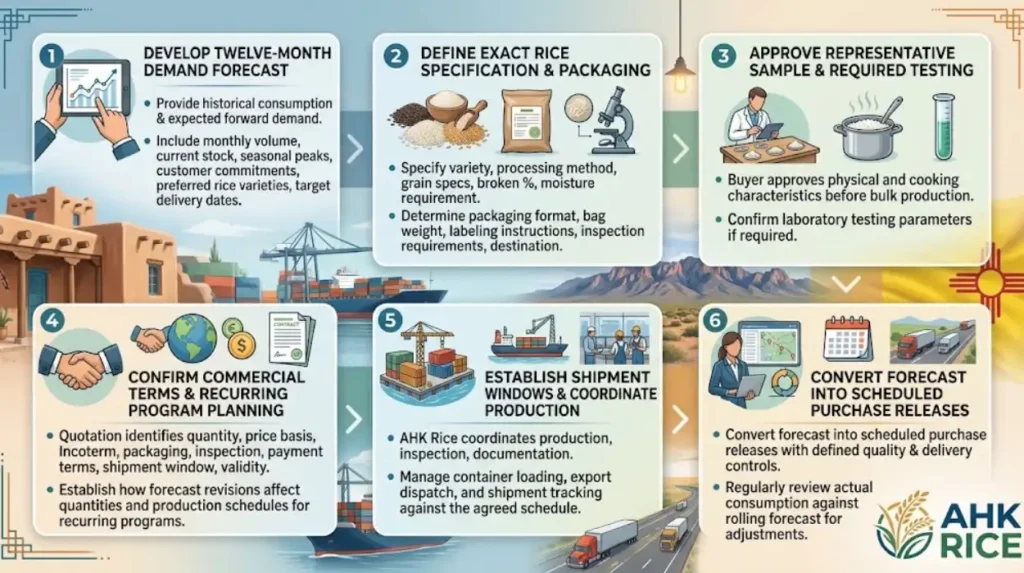
Start with a twelve-month demand forecast, define the exact rice specification and packaging, approve a representative sample, confirm U.S. compliance responsibilities, establish shipment windows, and then convert the forecast into scheduled purchase releases with defined quality and delivery controls.
The first step is to provide historical consumption and the expected forward demand. Include monthly volume, current stock, seasonal peaks, customer commitments, preferred rice varieties, and target delivery dates.
The second step is specification control. AHK Rice should receive the buyer’s required variety, processing method, grain specification, broken percentage, moisture requirement, packaging format, bag weight, labeling instructions, inspection requirements, and destination.
The third step is sample approval. The buyer should approve the physical and cooking characteristics before bulk production is released. If laboratory testing is required, the requested parameters should be confirmed at this stage.
The fourth step is commercial planning. The quotation should identify quantity, price basis, Incoterm, packaging, inspection, payment terms, shipment window, and quotation validity. For recurring programs, the buyer should also establish how forecast revisions will affect quantities and production schedules.
The fifth step is shipment control. AHK Rice should coordinate production, inspection, documentation, container loading, export dispatch, and shipment tracking against the agreed schedule.
Finally, the buyer should review actual consumption against the forecast every month. A rolling forecast is more effective than a fixed annual prediction because it allows both parties to adjust upcoming releases without abandoning the overall supply plan.
For New Mexico importers, the strongest decision is therefore not simply selecting the lowest rice quotation. It is selecting a Pakistani supplier capable of translating demand forecasts into repeatable specifications, planned production, compliant documentation, controlled shipment timing, and predictable replenishment. AHK Rice is positioned for this forecast-based approach, with Pakistani rice supply planned around the buyer’s operational requirements rather than isolated spot orders.
To begin a specification and forecast review for your New Mexico supply program, request a quote.
Frequently Asked Questions
How does AHK Rice support forecast-based rice supply programs for New Mexico?
AHK Rice converts buyer forecasts into planned rice quantities, product specifications, production schedules, quality checks, packaging requirements, documentation, and shipment windows.
What Pakistani Basmati rice varieties can New Mexico importers source?
New Mexico buyers can source Pakistani Basmati varieties such as 1121 Basmati, Super Kernel, and 1509 Basmati, with White, Steam, Sella, or other processing specifications depending on the program.
How far in advance should New Mexico importers place rice orders?
Importers should plan orders several weeks before inventory reaches its reorder point. A practical international supply planning window can be around 35–55 days, depending on production, ocean freight, U.S. entry, and inland transportation.
How does forecast-based procurement reduce rice stockouts?
Forecast-based procurement allows the supplier to prepare production and shipments before inventory becomes critically low. It reduces reliance on urgent orders and gives importers better visibility over upcoming replenishment.
What information should a New Mexico importer provide for a rice forecast?
The buyer should provide historical consumption, expected monthly demand, seasonal peaks, required rice variety, processing type, packaging, quality specifications, destination, desired delivery dates, and expected annual volume.
What is included in the rice sample approval process?
The process normally includes specification confirmation, sample selection, sample preparation, international courier delivery, optional laboratory testing, physical and cooking evaluation, buyer approval, and final bulk-order confirmation.