How Do Importers Build Efficient Rice Distribution Systems?
Efficient rice distribution systems depend on specification control, predictable replenishment, suitable inventory levels, and coordinated logistics rather than simply choosing the lowest supplier price. For importers handling Pakistani Basmati, the strongest model connects sourcing, quality inspection, packaging, shipping, warehousing, and regional distribution into one measurable supply chain.
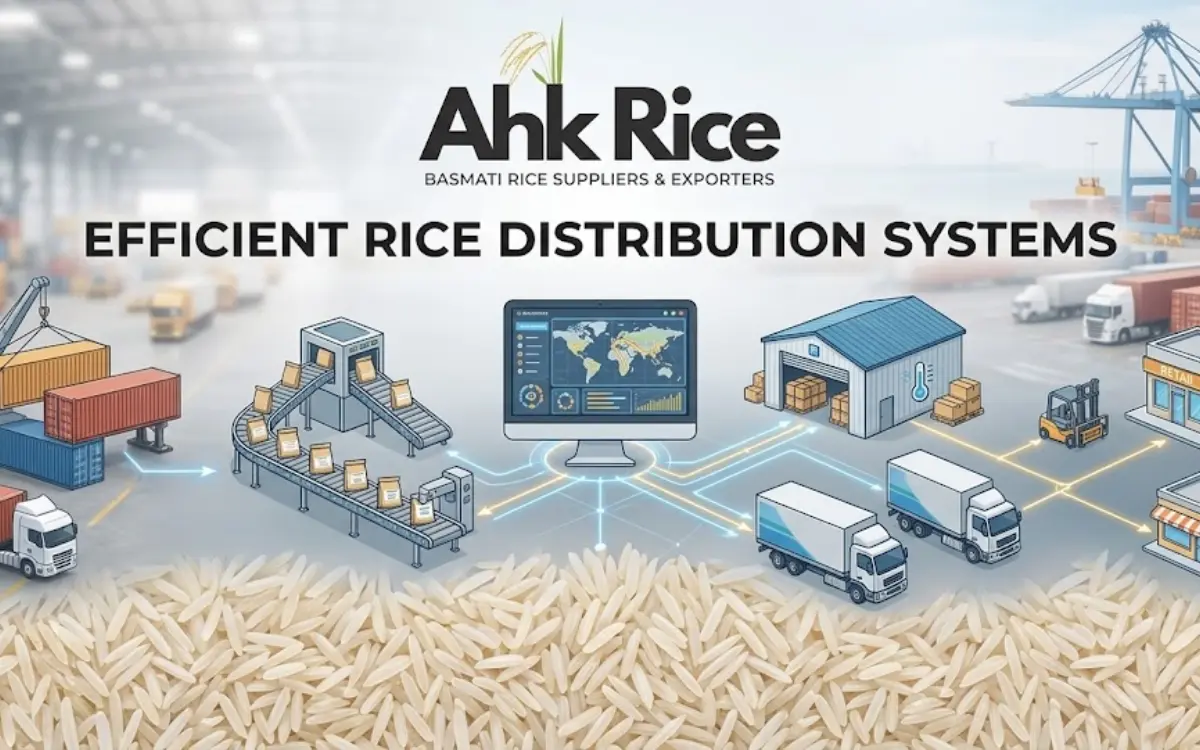
Rice distribution is the organized movement of rice from an exporting supplier through international transport, customs clearance, storage, wholesale channels, retailers, foodservice operators, and final consumers. An importer needs to manage both physical product flow and information flow. This includes purchase specifications, certificates, shipping documents, inventory records, delivery schedules, and quality data.
Importers evaluating network design can first understand:
Why distribution networks matter in rice import operations before selecting a sourcing and replenishment structure. The purpose is not to create the largest network. The purpose is to create a network that delivers the required grade, quantity, cost, and service level with controlled inventory risk.
What are the available solutions for rice distribution?
Importers generally use direct supplier distribution, regional warehousing, third-party logistics, distributor-led networks, or hybrid systems. The best structure connects supplier capacity, import volume, destination requirements, warehouse location, inventory turnover, and customer delivery frequency into one controlled replenishment process.
Direct supplier-to-importer distribution
Direct distribution moves rice from the exporter to the importer’s nominated destination, usually through an agreed FOB, CFR, CIF, or other Incoterms® structure. The importer controls customs clearance, warehousing, wholesale distribution, and customer fulfillment.
This model works well for established importers with predictable demand and warehouse capacity. It removes unnecessary intermediaries and creates direct communication between buyer and supplier.
For example, an importer purchasing 500 MT of Pakistani Basmati annually can schedule several container shipments instead of purchasing the entire requirement at once. Each shipment follows an approved product specification covering variety, broken percentage, moisture, grain length, packing, labeling, and inspection requirements.
Regional warehouse distribution
A regional warehouse receives imported rice in larger lots and distributes smaller quantities to wholesalers, retailers, restaurants, and foodservice customers.
This structure increases inventory control and reduces the distance between stock and customers. It also creates additional warehouse costs, handling costs, insurance requirements, and working-capital exposure.
The warehouse location becomes a strategic decision. A distributor serving several states or cities benefits from a warehouse positioned near major customer clusters and transport corridors.
Third-party logistics distribution
A third-party logistics provider, or 3PL, manages activities such as warehousing, pallet handling, order preparation, transportation coordination, and inventory reporting.
The importer retains commercial ownership of the rice while outsourcing physical distribution operations. This approach suits businesses that need distribution capability without building their own warehouse infrastructure.
Distributor-led distribution
In a distributor-led system, the importer sells larger quantities to regional distributors. Those distributors then supply retailers, restaurants, wholesalers, or other commercial buyers.
The model reduces the importer’s direct fulfillment workload. However, the importer gives up part of the customer relationship and distribution margin.
Hybrid distribution
Hybrid distribution combines two or more methods. An importer can maintain a central warehouse for high-volume customers while using regional distributors for smaller markets.
This structure provides greater flexibility. It also requires stronger inventory visibility because stock exists across multiple channels.
How do different rice distribution approaches compare?
Direct distribution offers the strongest supplier control, warehouses provide inventory proximity, 3PL networks reduce infrastructure requirements, distributors increase market reach, and hybrid systems balance control with geographic coverage. Cost, volume, demand stability, and service requirements determine the practical choice.
| Distribution attribute | Direct supplier distribution | Regional warehouse | 3PL distribution | Distributor-led | Hybrid |
|---|---|---|---|---|---|
| Inventory control | High | Very high | High with system access | Medium | High |
| Infrastructure cost | Low | High | Medium | Low | Medium–high |
| Geographic reach | Medium | High | High | Very high | Very high |
| Customer control | High | Very high | High | Medium | High |
| Scalability | High | High | Very high | High | Very high |
| Working-capital exposure | Medium | High | Medium | Low–medium | Medium |
| Operational complexity | Medium | High | Medium | Low–medium | High |
The table shows why there is no universal distribution model. An importer supplying one national warehouse has different requirements from an importer serving hundreds of retail outlets across several regions.
The critical comparison is total landed distribution cost rather than supplier FOB price alone. Total cost includes rice purchase price, inspection, export documentation, ocean freight, insurance, customs, port charges, inland transport, warehouse handling, storage, financing, shrinkage, and final delivery.
An apparently cheaper rice grade can become more expensive if it creates slower inventory turnover or requires additional handling.
Which rice grades fit different market regions?
GCC and Middle Eastern markets generally emphasize aromatic Basmati, long grain appearance, Sella and Steam processing, while US and European specialty channels emphasize authentic Basmati identity, consistent specifications, traceability, retail presentation, and compliance documentation.
GCC and Middle East
The Gulf region includes major rice-importing markets such as Saudi Arabia, the United Arab Emirates, Qatar, Kuwait, Bahrain, and Oman. Pakistani Basmati has established demand across this region.
Premium import programs frequently prioritize 1121 Basmati and Super Kernel because of long grain, aroma, cooking expansion, and premium presentation. Sella and Steam processing also support applications where firmness and separate grains are important.
Saudi Arabia requires food importers to meet Saudi Food and Drug Authority requirements. SFDA states that food importers need registered establishments and registered imported food products, while products must comply with applicable Saudi regulations and technical specifications.
For hot distribution environments, moisture control becomes particularly important. Export-grade Pakistani Basmati is commonly processed around 12–13% moisture depending on buyer specifications, packaging, and destination conditions. Moisture above approximately 14% increases storage risks such as mold, insects, discoloration, and reduced shelf stability.
United States and Europe
US and European distribution systems place greater emphasis on food safety documentation, traceability, labeling, importer responsibilities, and consistent supplier verification.
For US imports, FDA requires food facilities involved with imported food to meet applicable registration and import requirements, including prior notice. US importers covered by the Foreign Supplier Verification Program must establish and follow procedures for verifying foreign suppliers.
For these markets, 1121 Basmati works well for premium retail and foodservice positioning. Super Kernel provides a traditional aromatic Basmati option. 1509 provides another long-grain specification for buyers seeking a different balance between grain characteristics and commercial positioning.
Regional comparison
| Market region | Common priority | Suitable grade focus | Distribution implication |
| GCC | Aroma, grain length, cooking performance | 1121, Super Kernel, Sella, Steam | Strong warehouse and wholesale replenishment |
| US/Europe | Authenticity, compliance, traceability | 1121, Super Kernel, 1509 | Strong documentation and specification control |
These are market tendencies rather than fixed purchasing rules. The final grade must follow the buyer’s approved specification and destination regulations.
How much does rice grade affect distribution economics?
Premium Basmati requires higher purchase investment but supports higher-value positioning, while lower-priced grades reduce initial inventory cost. Importers must compare price per metric ton against turnover, margin, customer demand, storage duration, and the cost of stock remaining unsold.
Indicative Pakistan FOB Karachi prices published in August 2026 show 1121 Basmati White around $1,165–$1,205 per MT and Super Kernel Basmati around $1,165–$1,205 per MT. The same market data places 1121 Sella around $1,135–$1,175 per MT. These are indicative market figures, not fixed contract prices.
1509 pricing varies by processing type, specification, supplier, and shipment terms. Importers therefore need a supplier quotation based on the exact variety, grade, packaging, quantity, Incoterm, and destination rather than using a generic market number.
Price comparison also needs a landed-cost calculation. A $1,180/MT FOB purchase does not represent the final warehouse cost. Ocean freight, port charges, customs, inland transport, inspection, insurance, storage, and financing all influence the final cost per kilogram.
How does shelf life affect distribution system design?
Shelf life determines how aggressively an importer can hold inventory. Moisture-controlled rice, suitable packaging, clean storage, and stock rotation protect quality, while prolonged exposure to heat, humidity, insects, oxygen, or damaged packaging increases distribution losses.
Standard PP and BOPP packaging commonly provides around 12–18 months of shelf life under cool, dry storage conditions, while vacuum packaging can extend the practical shelf-life range to approximately 24–36 months under suitable conditions. Packaging performance depends on product condition and storage environment.
This difference directly affects distribution strategy.
An importer with fast monthly turnover can use standard bulk packaging and maintain shorter inventory cycles. A distributor serving remote markets with slower turnover needs stronger moisture barriers, tighter warehouse controls, and stricter first-in-first-out inventory rotation.
Rice should also be protected from warehouse moisture and temperature fluctuations. Packaging is not a substitute for appropriate storage. The importer needs a complete system covering warehouse ventilation, pest control, palletization, stock rotation, container inspection, and damaged-bag procedures.
What are the pros and cons of each distribution strategy?
Each distribution model solves a different operational problem. Direct systems maximize control, warehouses improve customer response, 3PLs reduce infrastructure demands, distributors accelerate market coverage, and hybrid networks create flexibility at the cost of greater coordination and inventory-management complexity.
Direct distribution
Pros: Strong supplier communication, lower intermediary dependence, specification control, and clearer purchasing economics.
Cons: Greater responsibility for customs, warehousing, transportation, customer fulfillment, and inventory management.
Example: A national wholesaler with an established warehouse and predictable monthly demand can import containers directly and schedule replenishment against inventory thresholds.
Regional warehousing
Pros: Faster customer delivery, better geographic coverage, and greater control over stock allocation.
Cons: Warehouse rent, labor, handling, insurance, inventory financing, and shrinkage increase operating costs.
Example: A distributor supplying restaurants across three states can hold stock at one strategically positioned warehouse instead of waiting for every customer order to arrive internationally.
3PL distribution
Pros: Faster deployment, scalable storage, professional fulfillment, and reduced capital expenditure.
Cons: Service fees, dependence on provider performance, and the need for accurate inventory-system integration.
Example: A new importer entering the US market can use a 3PL warehouse before investing in its own distribution center.
Distributor-led distribution
Pros: Established customer relationships, regional sales capability, and lower direct fulfillment workload.
Cons: Lower margin, less customer visibility, and reduced control over retail execution.
Example: An importer entering several secondary cities can appoint established food distributors rather than creating separate delivery operations.
Hybrid distribution
Pros: Strong balance between control, reach, and scalability.
Cons: Requires accurate stock visibility, allocation rules, demand forecasting, and coordination across multiple partners.
Example: An importer can serve major supermarket customers from its own warehouse while using regional distributors for independent retailers.
Which method works best for different importer cases?
High-volume importers benefit from direct or hybrid systems, new market entrants benefit from 3PL support, geographically dispersed businesses benefit from regional distributors, and premium private-label programs benefit from models that preserve strong supplier and specification control.
| Importer situation | Recommended structure | Primary reason | Main risk |
| High-volume national importer | Direct + regional warehouse | Scale and control | Inventory exposure |
| New market entrant | 3PL | Low infrastructure commitment | Provider dependence |
| Multi-state distributor | Hybrid | Geographic flexibility | Coordination |
| Premium private-label brand | Direct + controlled warehouse | Specification consistency | Higher operating responsibility |
| Small regional importer | Distributor-led | Lower fixed costs | Reduced customer control |
The decision changes as volume increases. A company importing 50 MT annually does not require the same infrastructure as one moving 5,000 MT.
The critical threshold is not simply annual volume. Demand frequency also matters. Regular monthly orders justify planned container replenishment. Seasonal demand requires different inventory planning because stock needs to arrive before the sales peak.
What decision factors should importers evaluate?
Importers should evaluate five factors first: landed cost, specification consistency, demand predictability, inventory risk, and regulatory requirements. These factors connect procurement decisions with warehouse performance, customer service, cash flow, and long-term supplier reliability.
| Decision factor | What to measure | Why it matters |
| Landed cost | FOB/CIF/CNF, freight, duties, handling | Determines real unit economics |
| Product specification | Grain length, broken %, moisture, purity | Protects customer consistency |
| Demand pattern | Monthly volume, seasonality, reorder frequency | Determines replenishment timing |
| Inventory risk | Days of stock, warehouse capacity, aging | Controls working capital |
| Compliance | Certificates, labeling, inspections, importer rules | Reduces clearance and market-entry risk |
Specification control deserves particular attention. A distribution network cannot compensate for inconsistent rice. If one shipment contains a different grain length, broken percentage, moisture level, or processing grade, the importer can face customer complaints even when delivery arrives on time.
A strong supplier specification therefore becomes the foundation of distribution efficiency. The specification should cover product variety, processing method, grain length, broken percentage, moisture, purity, packaging material, bag weight, labeling, inspection method, and documentation.
How can importers connect sourcing with distribution?
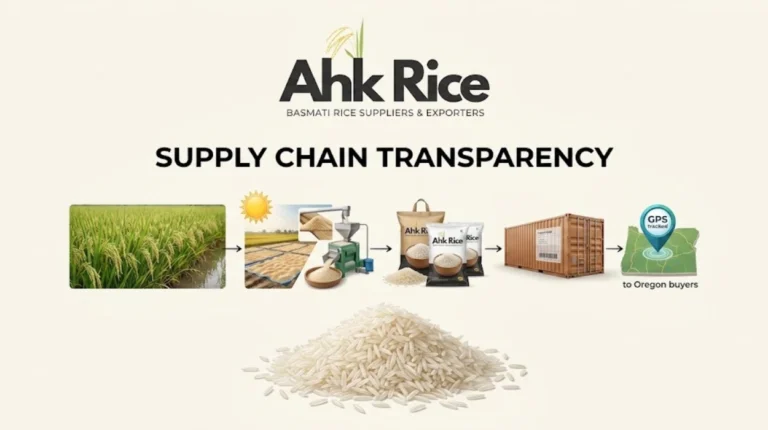
Efficient distribution starts before the container leaves Pakistan. Importers need an approved product specification, supplier capacity plan, shipment calendar, inspection procedure, packaging plan, documentation checklist, destination warehouse plan, and reorder trigger linked to actual customer demand.
AHK Rice provides Pakistani Basmati varieties including 1121, Super Kernel, and 1509, with processing, grading, custom packaging, documentation, and container logistics managed through its export workflow. Pakistan rice export service
The practical workflow begins with demand forecasting. The importer estimates monthly sales and identifies peak periods. The next step sets a minimum stock level based on lead time and demand variability.
The importer then converts the forecast into shipment quantities. For example, an importer selling 100 MT per month with a 30-day replenishment cycle needs a different stock policy from an importer selling 20 MT per month with irregular customer orders.
The supplier receives a fixed specification rather than a general request for “Basmati rice.” This reduces ambiguity. Samples establish the physical reference point. Pre-shipment inspection verifies the production lot against the agreed specification.
Packaging follows the distribution channel. A foodservice buyer can require 20 kg or 40 kg bags, while supermarkets need smaller retail packs and stronger branding. Packaging affects container utilization and freight economics because smaller retail packs require additional packaging volume.
Documentation then connects the shipment to the destination market. Commercial invoices, packing lists, certificates of origin, phytosanitary documentation, fumigation records, inspection certificates, and bills of lading need consistent shipment information.
Finally, the importer tracks stock after arrival. The system should record shipment date, batch, warehouse location, quantity received, quantity sold, remaining stock, customer allocation, and reorder date.
What makes a rice distribution system efficient in 2026?
Saudi Arabia also maintains importer and food-registration requirements through SFDA, making documentation and destination compliance an integral part of the distribution system rather than a separate administrative task.
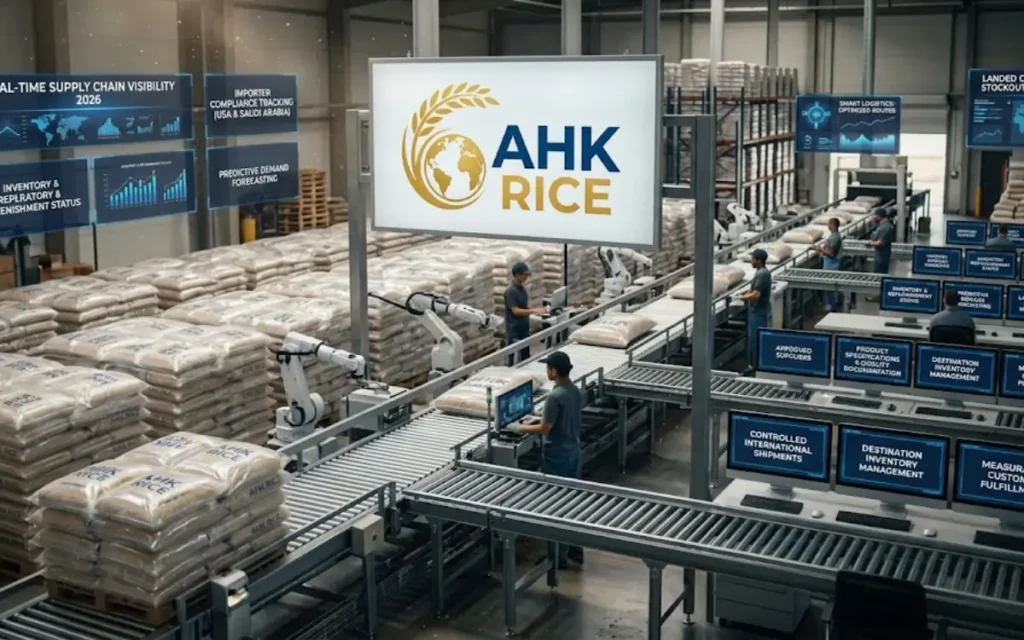
For importers, the strongest operating model therefore has five connected layers: approved supplier, approved product specification, controlled international shipment, destination inventory system, and measurable customer fulfillment.
The supplier controls the first layer. The importer controls the commercial and distribution layers. Both sides need shared information for shipment timing, quality documentation, packaging, and replenishment.
A practical system also measures performance. Useful KPIs include landed cost per MT, order fulfillment rate, inventory days, stockout frequency, damaged bags, warehouse cost per MT, shipment variance, customer complaints, and supplier specification deviations.
These measurements show whether the network is actually efficient. A distribution system that lowers freight cost but increases stockouts is not efficient. A warehouse that improves delivery speed but doubles inventory carrying cost also requires reassessment.
For importers evaluating a supplier for a specific regional requirement, the decision-focused resource:
Support Rhode Island Rice Distribution with AHK Rice Supply fits best after the decision-framework section, where readers have already evaluated supplier, grade, inventory, and logistics requirements.
The most efficient rice distribution system is therefore the one that matches product grade, demand frequency, market regulations, inventory capacity, and delivery expectations. Importers should compare the complete landed distribution model rather than selecting rice based on FOB price alone.
Frequently Asked Questions
What is a rice distribution system?
A rice distribution system is the coordinated process of moving imported rice from the exporter through international shipping, customs, warehouses, distributors, wholesalers, retailers, and final customers. It includes sourcing, inventory, transportation, storage, documentation, and order fulfillment.
Which rice distribution model is best for importers?
The best model depends on import volume, customer geography, demand frequency, warehouse capacity, and operating resources. Direct distribution suits established high-volume importers, while 3PL, distributor-led, and hybrid models support different levels of market coverage and operational control.
Which Pakistani Basmati grades are commonly used in international markets?
Common Pakistani Basmati varieties include 1121, Super Kernel, and 1509. 1121 is widely associated with long grain and premium positioning. Super Kernel serves traditional aromatic Basmati demand. 1509 provides another long-grain option with distinct commercial specifications.
How does warehouse location affect rice distribution?
Warehouse location affects delivery time, inland transportation cost, inventory positioning, and customer service. A strategically located warehouse reduces delivery distances to major customer clusters and supports faster replenishment without requiring every shipment to move directly from the port to individual customers.
How should importers calculate rice distribution costs?
Importers should calculate total landed and distribution cost rather than relying on the supplier’s FOB price. The calculation includes rice cost, freight, insurance, customs charges, port fees, inland transportation, inspection, warehousing, handling, financing, packaging, and final delivery expenses.