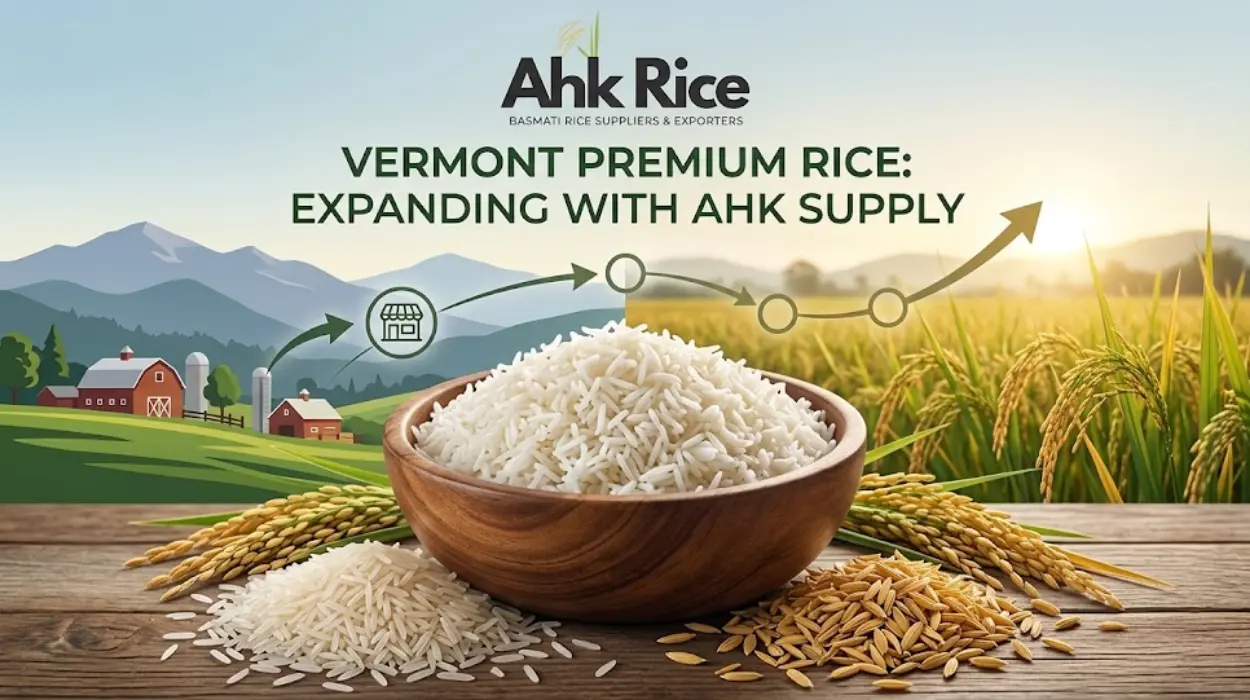
Expand Vermont Premium Rice Sales with AHK Rice Supply
Vermont rice distributors, retailers, wholesalers, restaurants, and specialty food businesses can expand premium rice sales by treating imported Basmati as a specification-controlled product rather than a commodity purchase. The strongest supply program combines recognizable Pakistani origin, long-grain performance, consistent grades, retail-ready packaging, documentation, sampling, and predictable replenishment.
For market background, buyers should first understand:
Why Vermont consumers are choosing premium imported Basmati rice. The commercial decision comes next: identify the grade that fits the target customer, validate the cooking result, calculate landed cost, and establish a repeatable shipment schedule.
AHK Rice supplies Pakistani Basmati from Punjab and manages sourcing, processing, grading, inspection, packaging, documentation, and export logistics through an integrated supply process. Its USA program is designed for importers and distributors that need a repeatable specification rather than an inconsistent spot purchase.
What is the best solution for expanding premium rice sales in Vermont?
The best solution is a controlled Pakistani Basmati supply program that matches rice grade, grain length, cooking performance, packaging, price, documentation, and replenishment frequency to Vermont demand. This reduces specification variation while giving distributors a premium product they can position consistently across retail and foodservice.
Vermont buyers should avoid starting with price alone. A low FOB number can become less attractive when broken grains, inconsistent moisture, weak packaging, documentation delays, or long replenishment cycles affect the final selling cost.
A better commercial model begins with a defined product specification. For example, a distributor may select 1121 Basmati for premium long-grain positioning, Super Kernel for an aromatic premium range, or another suitable Basmati grade according to the intended customer segment. AHK Rice currently lists 1121, Super Kernel, and other Pakistani Basmati formats for U.S. buyers.
The next step is to define the acceptable specification. This should include average grain length, broken-grain percentage, moisture, purity, milling finish, aroma, cooking elongation, packaging size, private-label requirements, and inspection requirements.
This approach is particularly useful when a Vermont distributor wants to introduce a premium SKU without creating excessive inventory risk. Instead of purchasing several grades immediately, the buyer can test one commercially relevant specification, measure sell-through, then expand the range after demand is established.
AHK Rice can also support buyers that require custom packaging and export documentation. Its stated process covers paddy procurement, cleaning, de-husking, separation, whitening, polishing, grading, length sorting, packing, inspection, and container loading.
Why should Vermont buyers choose the USA supply service?
The USA supply service is valuable when Vermont buyers need Pakistani Basmati matched to U.S. import requirements, commercial packaging, export documentation, sampling, and ocean logistics. The objective is not merely shipment execution; it is creating a repeatable supply chain suitable for ongoing premium rice sales.
The USA market requires more than an export invoice. FDA states that imported food must meet applicable U.S. legal requirements, including safety, sanitary production, truthful English labeling, facility registration where required, and Prior Notice procedures.
The U.S. importer also needs to understand its own responsibilities under the Foreign Supplier Verification Program where applicable. Supplier records, specifications, food-safety information, and shipment documentation therefore become part of the purchasing decision rather than administrative afterthoughts.
AHK Rice’s USA service is built around this broader import workflow. The company states that it supplies premium Pakistani Basmati to U.S. wholesalers and retailers and provides export documentation and shipping support.
For Vermont, the service can be particularly useful because the product normally moves through an international port before continuing by domestic freight to the buyer’s warehouse. A distributor should therefore plan the shipment around the final receiving location rather than treating the ocean transit as the entire lead time.
For example, a buyer receiving through New York/New Jersey may use an East Coast route and arrange onward trucking into Vermont. A buyer using another U.S. port should calculate port handling, customs clearance, drayage, and domestic transportation separately.
The commercial advantage is visibility. The buyer knows which specification is being purchased, what documentation accompanies it, how the cargo is packed, and how long replenishment should be expected to take.
How does product positioning influence the Vermont sales opportunity?
Premium rice sells more effectively when the product specification supports the position promised to customers. Long grain, aroma, cooking separation, packaging quality, origin, and consistent performance give retailers and foodservice operators tangible reasons to position Pakistani Basmati above generic rice.
A premium product should have a premium reason to exist. The retailer cannot rely only on the word “Basmati” if the rice does not deliver a visible difference after cooking.
For Vermont specialty retailers, the positioning may emphasize authentic Pakistani origin, extra-long grains, aroma, and suitability for biryani, pilaf, curries, grilled foods, and modern rice bowls.
For restaurants, the stronger argument may be cooking performance. Separate grains and predictable expansion can support portion consistency and presentation. This can matter more than the raw purchase price when rice is part of the customer’s visible meal.
For wholesalers, the commercial priority is often specification repeatability. The buyer needs confidence that the next container will behave similarly to the approved sample.
The comparison stage should therefore consider more than price. Buyers can use the related guide on:
How product positioning influences premium rice sales growth to connect product specifications with market positioning before approving a larger program.
AHK Rice supports this model through product specifications, processing controls, third-party inspection availability, and customized packaging options. Its USA product information, for example, identifies long-grain Basmati specifications and offers bulk formats for U.S. buyers.
What shipping days should Vermont buyers plan for in 2026?
Vermont buyers should normally plan around 30–50 days for ocean movement from Pakistan to major U.S. ports, then add customs, port handling, domestic trucking, and scheduling time. Actual transit varies by port, carrier, transshipment, congestion, sailing, and cargo-ready date.
Current 2026 lane data illustrates the variation. Karachi-to-New York FCL options are currently showing approximately 27 days on some services and 35–38 days on others, while Port Qasim-to-New York options can show roughly 23–33 days.
Karachi-to-Savannah currently shows an estimated 33-day FCL option, while Karachi-to-Los Angeles shows approximately 35–40 days for standard FCL services. Karachi-to-Houston is currently showing roughly 40–45 days on one standard service.
These are transportation estimates, not guaranteed delivery commitments. Vermont buyers should therefore use a planning buffer rather than promise customers a delivery date based only on vessel transit.
| U.S. market route | Indicative 2026 ocean transit | Vermont planning implication |
|---|---|---|
| New York / New Jersey | 23–38 days | Strong East Coast option; add inland delivery |
| Savannah | Around 33 days | Suitable for Southeast routing; add domestic freight |
| Los Angeles | 35–40 days | Longer route for Vermont; inventory buffer becomes important |
| Houston | 40–45 days | Longer Gulf route; usually requires stronger inventory planning |
For a Vermont program, an importer should normally begin replenishment planning before the warehouse reaches its reorder emergency point. A practical model is to combine confirmed production time, export documentation, port cut-off, ocean transit, customs clearance, and inland delivery into one purchase-order lead time.
This is where AHK Rice can become a supply partner rather than simply a rice seller. A buyer can specify the destination port and required quantity at quotation stage, allowing the commercial calculation to reflect the actual shipment rather than an isolated product price. The company’s quotation process asks buyers for destination port, product, packing, quantity, and Incoterm.
What does the complete rice sample process cost?
A commercial sample should test both product quality and landed practicality: specification selection, sample dispatch, cooking evaluation, documentation review, approval, and pre-shipment verification. The rice itself may be supplied free within stated limits, while courier and certification costs can remain buyer-paid.
The sample process should begin with a written specification. A Vermont buyer should provide the intended grade, preferred grain characteristics, packaging concept, quantity, and target market.
AHK Rice’s USA information states that up to 20 kg of Basmati sample rice can be provided free, while the client pays related sample shipping costs. It also states that clients pay for the phytosanitary certificate associated with samples where required.
A practical sample sequence is:
- Specification request: Identify variety, grade, grain length, broken percentage, moisture target, packing, and quantity.
- Sample preparation: The exporter prepares the requested rice from the proposed commercial specification.
- Courier dispatch: The buyer covers sample courier costs and any applicable sample documentation or certification.
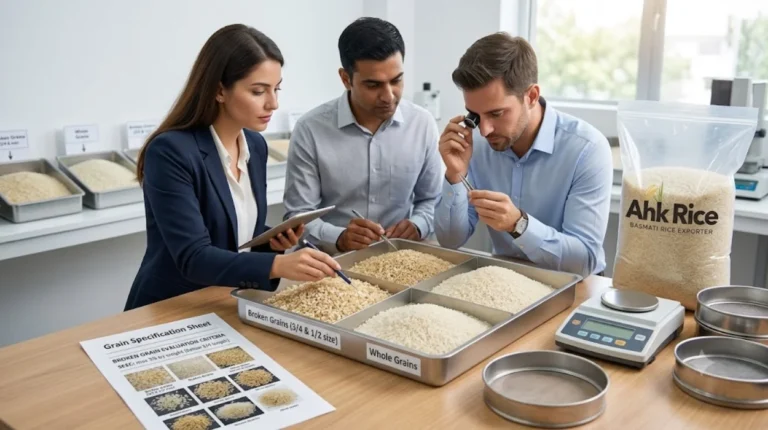
- Raw-grain inspection: Check grain appearance, uniformity, broken grains, color, odor, foreign material, and packaging.
- Cooking test: Test water ratio, cooking time, elongation, separation, aroma, texture, and holding performance.
- Commercial approval: Compare the sample against the agreed specification and intended selling position.
- Pre-shipment controls: For the commercial order, agree inspection requirements, documentation, packing, and container release conditions.
The important point is that the approved sample should become the reference for the purchase order. A buyer should not approve a sample and then leave the commercial specification undefined.
AHK Rice states that third-party pre-shipment inspection can be arranged through organizations such as SGS and Bureau Veritas.
What factors determine the landed cost of premium Basmati rice?
Landed cost depends on rice variety and grade, order quantity, packaging, inspection, export documentation, freight, insurance, destination port charges, customs-related costs, domestic transportation, and the selected Incoterm. A low product price does not automatically create the lowest delivered cost.
The first variable is the rice itself. Extra-long premium grades can command different prices from standard Basmati specifications. Processing also affects cost because milling, sorting, parboiling, polishing, packaging, and inspection requirements change the production workload.
The second variable is volume. A full-container purchase generally creates a different freight economics model from small-volume or LCL purchasing. Buyers should compare the product cost and logistics cost together.
The third variable is packaging. Bulk PP bags, retail-ready bags, custom printed packaging, private-label requirements, and different bag weights can create different production and packing costs.
The fourth variable is destination. New York/New Jersey, Savannah, Los Angeles, Houston, and other ports have different transportation patterns. Current published freight examples demonstrate substantial variation in both transit time and indicative ocean pricing.
The fifth variable is the commercial term. FOB, CFR/CNF, CIF, and DDP-type quotations can allocate freight, insurance, import handling, and other responsibilities differently. The buyer should compare quotations on the same commercial basis.
A useful purchasing calculation is:
Landed rice cost = product value + export-side charges + ocean freight + insurance where applicable + destination charges + customs/brokerage costs + inland transportation + applicable taxes or duties.
AHK Rice’s quotation form specifically collects destination port, product, packing, metric-ton quantity, and Incoterm, which are the inputs required to build a more useful commercial quotation.
What results can Vermont buyers expect from a controlled supply program?
A controlled supply program can improve premium SKU consistency, reduce purchasing uncertainty, support stronger retail positioning, and make replenishment easier to forecast. The measurable result should be evaluated through repeat quality, sell-through, gross margin, inventory turns, delivery performance, and customer acceptance.
For a Vermont distributor, the first result should be product consistency. If the approved rice performs reliably, retailers and restaurants can reorder with less concern about changing cooking results.
The second result is stronger premium positioning. A clearly defined Pakistani Basmati specification gives sales teams a concrete product story based on origin, grain characteristics, processing, and cooking performance.
The third result is better inventory planning. If a buyer knows that ocean transit can take several weeks, purchase orders can be scheduled before inventory becomes critical.
The fourth result is improved supplier accountability. Each shipment can be compared with the approved specification and supporting documents rather than judged only after arrival.
Consider a Vermont distributor selling 25 kg or 50 lb bulk formats to restaurants. Instead of competing purely on the lowest rice price, the distributor can sell consistent long-grain Basmati with defined cooking performance and documented origin. That creates a clearer commercial proposition for restaurants that need reliable results.
AHK Rice’s integrated model supports this approach because the company describes control from paddy procurement through processing and container loading, while also providing export documentation and third-party inspection options.
How should a Vermont buyer get started with AHK Rice?
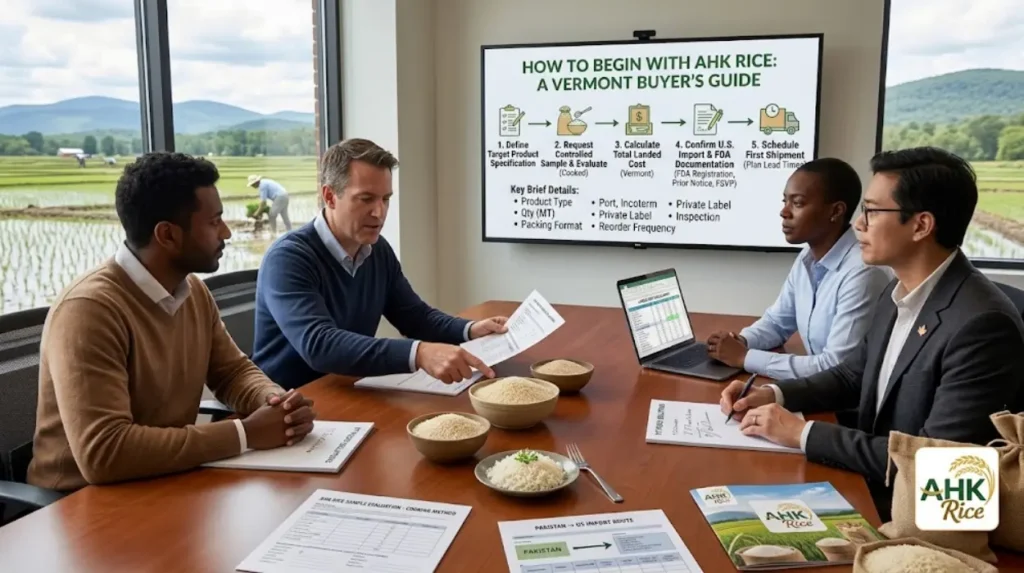
Start with one commercially relevant specification, request a controlled sample, approve the cooking and quality results, calculate the complete landed cost, confirm U.S. import documentation, and then schedule the first shipment around realistic ocean and domestic delivery lead times.
The first commercial brief should include the target product, quantity in metric tons, packing format, destination port, preferred Incoterm, private-label requirements, inspection requirements, and expected reorder frequency.
The buyer should then request a sample and evaluate it using the same cooking method used by the intended customer. Restaurants should test actual menu applications rather than relying only on raw-grain appearance.
Once the sample is approved, the purchase order should repeat the agreed specifications. The commercial documents should identify the product, quantity, packaging, shipment terms, and applicable compliance requirements.
For U.S. imports, FDA requirements remain central. Food facilities may need FDA registration, imported food is subject to U.S. requirements, and Prior Notice must be submitted before covered food shipments arrive.
The importer should also coordinate with its customs broker and confirm the responsibilities associated with FSVP, entry filing, labeling, and other applicable requirements. The exporter can provide supporting commercial and shipment documentation, but the U.S. importer remains responsible for meeting applicable U.S. import obligations.
AHK Rice gives Vermont buyers a direct route into this process. The company is based in Bucheki, Nankana Sahib, Punjab, and states that it supplies Pakistani Basmati to U.S. buyers while managing processing, packaging, documentation, and export logistics.
The decision should ultimately be based on repeatability. A supplier that can provide the right specification once is useful; a supplier that can reproduce that specification, document it, ship it, and support replenishment is commercially more valuable.
For Vermont, the strongest strategy is therefore not to import the cheapest available rice. It is to build a premium SKU around a clearly defined Pakistani Basmati specification, validate it with a controlled sample, calculate the real delivered cost, and establish inventory planning around the selected U.S. shipping route.
AHK Rice gives buyers a direct sourcing option for this model, with premium Pakistani Basmati varieties, integrated processing, custom packing, inspection support, and USA export capability.
When the product specification, sample, landed cost, compliance documents, and replenishment schedule are aligned, Vermont distributors can move from a one-time rice purchase to a repeatable premium rice sales program with AHK Rice.
For a customized Vermont shipment specification and commercial pricing, request a quote from AHK Rice.
Frequently Asked Questions
How can AHK Rice help expand premium rice sales in Vermont?
AHK Rice can supply Pakistani Basmati with defined grades, consistent processing, custom packaging, export documentation, inspection support, and U.S. shipping coordination for Vermont buyers.
Which Pakistani Basmati varieties are suitable for Vermont buyers?
Popular options include 1121 Basmati, Super Kernel, and 1509 Basmati. The best choice depends on the buyer’s target customers, retail positioning, restaurant applications, and required specifications.
How long does shipping from Pakistan to Vermont take?
Ocean transit from Pakistan to major U.S. ports can take roughly 23–45 days depending on the route and carrier. Buyers should also allow time for customs clearance, port handling, and inland trucking to Vermont.
What is included in the rice sample process?
The process typically includes product specification, sample preparation, courier dispatch, raw-grain inspection, cooking evaluation, commercial approval, and agreement on the final purchase specification.
Does AHK Rice provide rice samples for U.S. buyers?
Yes. AHK Rice states that qualifying U.S. buyers can receive sample rice, with sample shipping and applicable certification costs handled according to the sample arrangement.
What affects the landed cost of Pakistani Basmati rice?
Landed cost depends on rice grade, order quantity, packaging, inspection, documentation, ocean freight, insurance where applicable, destination charges, customs-related costs, and inland transportation.