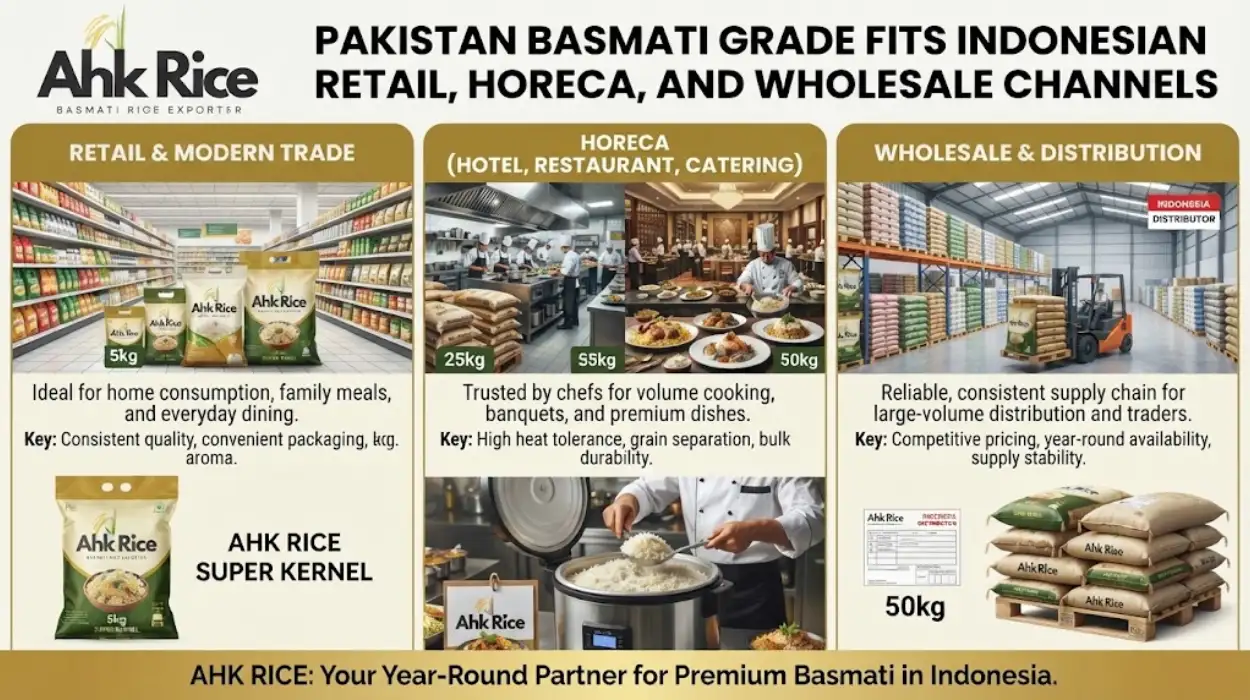
Which Pakistan Basmati Grade Fits Indonesian Retail, HORECA, and Wholesale Channels?
1121 Basmati suits premium retail and HORECA, Super Kernel suits aroma-focused foodservice, and 1509 suits value-led retail and wholesale. Here is why: each grade balances grain length, aroma, cooking performance, processing cost, and buyer expectations differently. Indonesian importers need a grade matched to their sales channel rather than one specification for every customer.
The right grade also depends on processing type. Steam, Sella, and Golden Sella change cooking performance, appearance, and storage behavior. Our guide to how Pakistani Basmati rice protects quality during shipment to Indonesia explains the packaging and handling factors that influence these decisions.
AHK Rice is a trusted Pakistani Basmati rice exporter based in Punjab. The company supplies 1121, Super Kernel, and 1509 varieties to 15+ countries. Its end-to-end processing, custom packaging, and export services support different buyer requirements.
What are the available Pakistan Basmati solutions for Indonesian buyers?
Indonesian buyers can choose 1121, Super Kernel, or 1509 in Steam, White Sella, Golden Sella, and Creamy Sella processing formats. Each solution serves a different commercial purpose. Retailers prioritize appearance and brand positioning. HORECA buyers prioritize cooking yield and consistency. Wholesalers prioritize landed cost and storage performance.
1121 Basmati for premium retail and HORECA
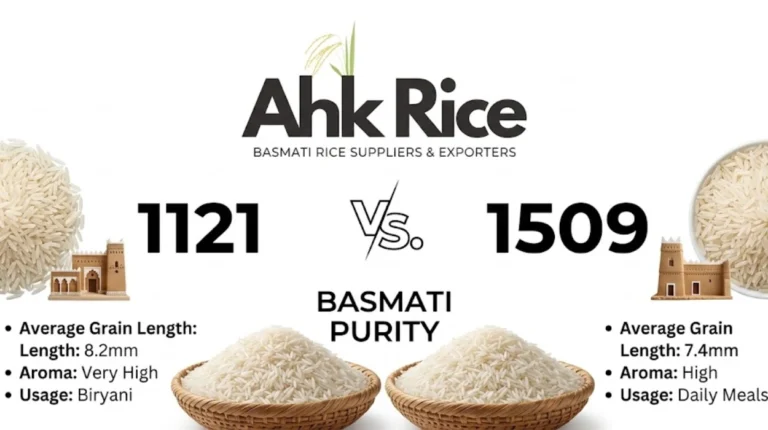
1121 Basmati is a long-grain Pakistani rice variety recognized for its slender appearance and strong elongation after cooking. Its raw grain commonly measures around 8.05–8.30 mm, depending on specification and grade. The cooked grain becomes longer and remains visually distinct.
1121 Steam provides a natural white appearance with a firm cooked texture. It suits premium rice packs, biryani restaurants, and catering operations that value presentation. 1121 White provides a conventional polished appearance for buyers seeking a familiar retail product.
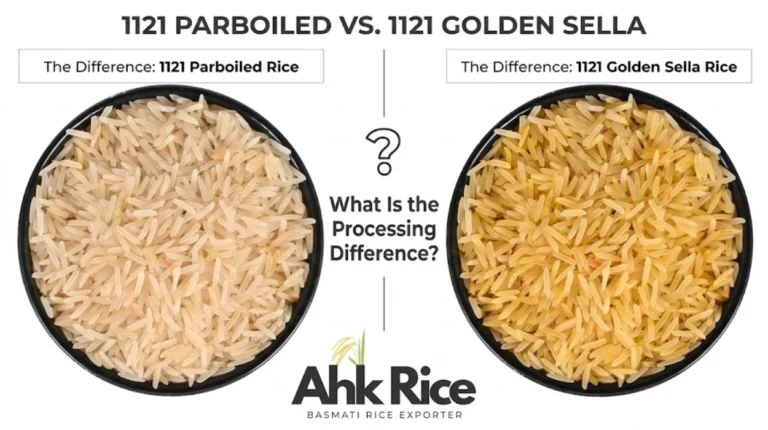
1121 Golden Sella uses parboiling and drying to improve grain firmness and handling performance. The golden color supports premium packaging differentiation. Indonesian restaurant groups can use it for biryani, pilaf, and large-volume catering.
Super Kernel Basmati for aroma-focused foodservice
Super Kernel Basmati is a long-grain Pakistani rice variety known for its characteristic Basmati aroma and cooking performance. Its grain profile generally sits below 1121 in length, while its aromatic identity remains commercially important.
Super Kernel Steam suits restaurants that want a white, aromatic rice with a traditional Basmati eating experience. Super Kernel Sella supports catering and wholesale operations that need firm grains after cooking.
Super Kernel offers a practical balance between premium aroma and manageable purchasing cost. It fits restaurants with an established Basmati menu and distributors serving aroma-focused consumers.
1509 Basmati for value-led retail and wholesale
1509 Basmati is a long-grain Pakistani variety used for cost-conscious retail, foodservice, and wholesale applications. Its grain length generally falls below 1121, but it still provides a recognizable Basmati cooking profile.
1509 Steam suits retailers seeking long-grain appearance at a lower purchasing cost. 1509 Sella provides a firmer grain structure for catering and distribution. The variety supports entry-level premium packs and high-volume foodservice.
1509 works best when the buyer needs a commercial balance rather than the longest possible grain. It allows distributors to build an accessible Basmati product without moving entirely into short-grain or non-Basmati rice.
The available varieties establish the product choices. The next question is how their specifications affect channel performance.
How do Pakistan Basmati grades compare for Indonesian channels?
1121 leads in grain length, Super Kernel emphasizes aroma, and 1509 provides a value-oriented long-grain option. The table compares the commercial attributes that influence Indonesian retail, HORECA, and wholesale decisions.
| Attribute | 1121 Basmati | Super Kernel Basmati | 1509 Basmati |
|---|---|---|---|
| Grain profile | Longest, slender | Long, aromatic | Long, value-oriented |
| Raw grain length | Around 8.05–8.30 mm | Commonly below 1121 | Commonly below 1121 |
| Aroma | Traditional Basmati | Strong aromatic identity | Traditional Basmati |
| Cooking appearance | Very long, separate grains | Long, separate grains | Long, separate grains |
| Retail positioning | Premium | Premium and mainstream | Mid-premium and value |
| HORECA use | Biryani, premium catering | Aroma-focused menus | High-volume catering |
| Wholesale role | Premium distribution | Aroma-led distribution | Cost-sensitive distribution |
Processing type changes the comparison
Steam rice uses controlled steaming before milling. The process supports a white appearance and a firm cooked texture. It suits premium retail and restaurants that want visible grain elongation.
White rice is milled and polished without the same parboiling process used for Sella rice. Its appearance is white and familiar. It suits conventional retail packs and restaurants that prefer standard white Basmati.
Golden Sella uses parboiling and drying. The process produces a golden color and firmer grain structure. It suits wholesale and catering buyers who value handling stability and grain separation.
Creamy Sella uses parboiling and drying while maintaining a lighter creamy appearance. It suits buyers who want Sella cooking performance without a strongly golden visual identity.
Which specifications should buyers request?
Indonesian buyers should request grain length, broken percentage, moisture, foreign matter, milling quality, crop year, processing type, packaging, and inspection documentation. These specifications determine whether the purchased rice matches the intended retail or foodservice application.
A 1121 Steam specification for premium retail can prioritize grain length, whiteness, and appearance. A 1509 Sella specification for wholesale can prioritize broken percentage, cooking firmness, and price per metric ton.
The specification table identifies the main differences. The next section applies those differences to actual Indonesian buyer segments.
Which Pakistan Basmati grade works best for Indonesian retail?
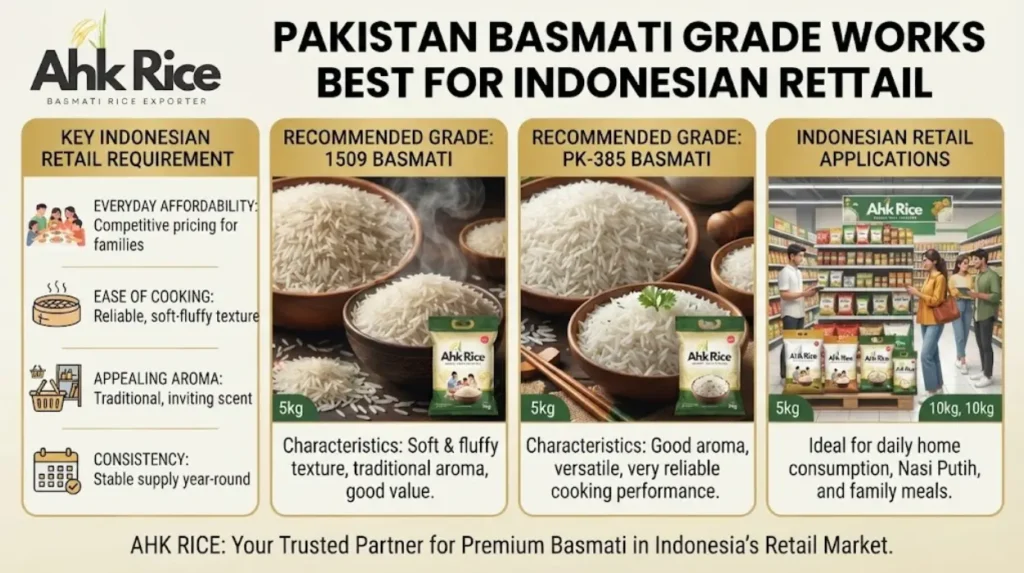
1121 Steam suits premium retail, while 1509 Steam suits mid-premium retail and Super Kernel Steam suits aroma-focused consumer packs. Retail buyers need consistent appearance, attractive packaging, reliable cooking performance, and a clear price position.
Premium retail: 1121 Steam
1121 Steam supports premium retail because its long, slender grain creates a strong visual distinction. The cooked grain also supports biryani and pilaf applications. Retailers can position it as a premium Pakistani Basmati product.
Premium retail buyers should prioritize grain length, uniformity, whiteness, aroma, and broken percentage. A consistent specification reduces variation between retail packs and supports repeat purchases.
Mid-premium retail: 1509 Steam
1509 Steam suits mid-premium retail because it offers long-grain appearance at a more accessible purchasing position than 1121. Retailers can use it for family-size packs and value-conscious premium consumers.
1509 Steam also supports private-label programs. Buyers can choose 5 kg or 10 kg retail packs and use packaging design to distinguish the product from competing rice grades.
Aroma-focused retail: Super Kernel Steam
Super Kernel Steam suits retail buyers who prioritize aroma and traditional Basmati cooking performance. Its commercial positioning sits between premium 1121 and value-oriented 1509.
Super Kernel retail packs can emphasize aromatic rice, separate cooked grains, and Pakistani origin. The grade works particularly well for consumers who already recognize Basmati aroma as a quality attribute.
Retail needs differ from foodservice needs. The next section evaluates restaurant and catering operations.
Which Pakistan Basmati grade works best for Indonesian HORECA?
1121 Steam suits premium restaurants, Super Kernel Steam suits aroma-led menus, and 1509 Sella suits high-volume catering. HORECA means hotels, restaurants, and catering operations. These buyers need predictable cooking results, portion yield, and operational consistency.
Premium restaurants: 1121 Steam
1121 Steam supports premium restaurants serving biryani, pulao, and rice-based signature dishes. Its long cooked grain creates an attractive plate presentation. Restaurants can use the grade to reinforce a premium menu position.
Premium restaurant buyers should specify grain length, cooking method, broken percentage, and batch consistency. A stable specification helps kitchen teams standardize recipes and reduce rejected batches.
Aroma-focused restaurants: Super Kernel Steam
Super Kernel Steam supports restaurants that prioritize aroma and traditional Basmati identity. The grade works for biryani, rice platters, and aromatic rice menus.
Super Kernel can provide a strong balance between food quality and purchasing cost. Restaurants can maintain a premium rice experience without selecting the longest-grain specification.
High-volume catering: 1509 Sella
1509 Sella suits catering operations that need firm grains and consistent handling. Parboiling supports grain structure during cooking and service. The grade works for buffet rice, institutional catering, and large-volume meal preparation.
Catering buyers should prioritize broken percentage, moisture, cooking yield, and packaging size. These factors affect kitchen waste, portion consistency, and storage efficiency.
HORECA buyers need cooking consistency more than retail appearance alone. The next section examines wholesale distribution.
Which Pakistan Basmati grade works best for Indonesian wholesale?
1509 Sella suits cost-sensitive wholesale, Super Kernel Sella suits aroma-led distribution, and 1121 Golden Sella suits premium wholesale channels. Wholesale buyers manage purchasing cost, storage, transport, and resale margins across different customer groups.
Value wholesale: 1509 Sella
1509 Sella supports wholesale buyers who need an accessible long-grain Basmati product. Its processing type supports firm grains and practical handling. Distributors can supply restaurants, caterers, and retailers with different pack sizes.
The commercial advantage comes from matching the grade to the buyer’s price segment. A distributor selling to budget-conscious restaurants does not need to pay for the longest premium grain.
Aroma-led wholesale: Super Kernel Sella
Super Kernel Sella suits wholesalers serving restaurants that value Basmati aroma and firm cooked grains. The grade supports foodservice distribution and retail packs.
Super Kernel Sella also gives wholesalers a distinct product identity. The aromatic profile helps differentiate the rice from value-oriented long-grain products.
Premium wholesale: 1121 Golden Sella
1121 Golden Sella suits premium wholesale buyers who need long grain, firm cooking performance, and a recognizable premium appearance. The golden color creates a distinct retail and foodservice product position.
Golden Sella supports buyers who distribute rice across multiple Indonesian cities. Its parboiled grain structure supports handling and cooking consistency. Buyers should still verify moisture, packaging, storage conditions, and shelf-life specifications.
Wholesale decisions require more than grade selection. The next section compares two market regions with different commercial requirements.
How do Indonesian market regions change grade preferences and prices?
Java and Bali favor premium and foodservice positioning, while Sumatra and other distribution regions favor value, wholesale, and storage efficiency. These are planning segments rather than verified regional import statistics. Actual demand depends on buyer contracts, local competition, logistics, and consumer purchasing power.
Java and Bali: premium retail and HORECA
Java and Bali offer a practical planning focus for premium retail, hotels, restaurants, and catering. Buyers serving premium consumers can prioritize 1121 Steam, 1121 Golden Sella, and Super Kernel Steam.
Illustrative purchase ranges for a 5 kg retail-equivalent cost structure are:
| Grade | Illustrative price per MT | Primary use |
|---|---|---|
| 1121 Steam | $1,250–$1,500 | Premium retail and HORECA |
| Super Kernel Steam | $1,150–$1,400 | Aroma-focused foodservice |
| 1509 Steam | $1,050–$1,300 | Mid-premium retail |
These figures represent planning assumptions for comparison, not confirmed Indonesian import prices. Actual FOB and CIF prices depend on crop year, packaging, quantity, freight, insurance, and inspection requirements.
Sumatra and wider wholesale distribution
Sumatra and wider wholesale distribution can prioritize 1509 Sella, Super Kernel Sella, and 1121 Golden Sella. Buyers need products that balance purchase cost with cooking performance and storage handling.
Illustrative wholesale planning ranges are:
| Grade | Illustrative price per MT | Primary use |
|---|---|---|
| 1509 Sella | $1,000–$1,250 | Value wholesale |
| Super Kernel Sella | $1,100–$1,350 | Aroma-led distribution |
| 1121 Golden Sella | $1,200–$1,450 | Premium wholesale |
The comparison shows a general commercial pattern. Longer grain and premium positioning usually increase purchasing cost. Buyers should compare like-for-like specifications before selecting the lowest quotation.
How does shelf life compare?
Shelf life depends on moisture, packaging, storage temperature, humidity, pest control, and processing type. A standard dry-rice planning assumption is 12–24 months under suitable storage conditions.
| Processing type | Planning shelf-life range | Storage priority |
|---|---|---|
| Steam | 12–24 months | Moisture and pest control |
| White | 12–24 months | Dry, clean storage |
| Golden Sella | 12–24 months | Packaging and humidity control |
| Creamy Sella | 12–24 months | Moisture and temperature control |
These are planning ranges, not a product-specific guarantee. The exact shelf life should appear on the supplier specification sheet and packaging label.
The regional comparison clarifies the commercial trade-offs. The next section provides a decision framework for selecting a grade.
What decision factors should Indonesian importers use?
The best grade matches the buyer’s channel, target price, cooking requirement, storage conditions, and packaging plan. A five-row decision framework helps importers compare options without relying on grain length alone.
| Decision factor | Premium retail | HORECA | Wholesale |
|---|---|---|---|
| Grain appearance | Highest priority | High priority | Medium priority |
| Aroma | High priority | High priority | Depends on customer |
| Cooking firmness | High priority | Highest priority | High priority |
| Purchasing cost | Medium priority | High priority | Highest priority |
| Packaging and storage | Retail-ready | Bulk and operational | Bulk and distribution |
Example 1: Premium Indonesian supermarket
A premium supermarket should begin with 1121 Steam. The retailer can compare it against Super Kernel Steam for aroma-led positioning and 1509 Steam for a more accessible price tier.
The final choice depends on the retailer’s consumer segment. A premium 5 kg pack needs consistent appearance and clear product differentiation. A value-oriented pack needs competitive cost and reliable cooking performance.
Example 2: Restaurant group
A restaurant group should begin with 1121 Steam or Super Kernel Steam. The choice depends on whether the menu prioritizes grain presentation or aroma.
A high-volume catering group should evaluate 1509 Sella. The grade supports firm cooked grains and a practical purchasing position.
Example 3: Wholesale distributor
A wholesale distributor should compare 1509 Sella, Super Kernel Sella, and 1121 Golden Sella. The choice depends on the customer portfolio and resale price.
A distributor serving budget restaurants should prioritize 1509 Sella. A distributor serving premium retailers should prioritize 1121 Golden Sella.
The framework helps buyers shortlist grades. The next section evaluates the advantages and limitations of each solution.
What are the pros and cons of each Pakistan Basmati grade?
1121 offers premium grain length, Super Kernel offers strong aroma, and 1509 offers value. Each grade also creates trade-offs in purchasing cost, positioning, and customer expectations.
1121 Basmati
Advantages: Long grain, premium appearance, strong retail differentiation, and suitability for premium HORECA.
Limitations: Higher purchasing cost, greater sensitivity to premium quality expectations, and less suitable for buyers focused only on lowest landed cost.
1121 works best for buyers who can support a premium price. A supermarket with premium private-label packs can use its appearance to justify the positioning.
Super Kernel Basmati
Advantages: Aromatic identity, traditional Basmati profile, and balanced retail and foodservice positioning.
Limitations: Less grain length than 1121 and less direct premium visual differentiation.
Super Kernel works best for restaurants and retailers that prioritize aroma. It offers a practical middle position between premium grain length and value-led pricing.
1509 Basmati
Advantages: Value-oriented long grain, broad foodservice suitability, and practical wholesale positioning.
Limitations: Less premium visual impact than 1121 and a lower price ceiling in premium retail.
1509 works best for buyers who need cost control. A catering company can use it to manage rice purchasing while maintaining long-grain Basmati characteristics.
The pros and cons show why a single universal grade does not suit every channel. The next section explains how to finalize the purchase specification.
How should Indonesian buyers finalize a Pakistan Basmati specification?
Buyers should define the channel, select the variety, choose processing, confirm quality limits, and approve a representative sample. This sequence prevents price comparisons between products with different specifications.
Define the buyer segment
Start with the sales channel. Retail, HORECA, and wholesale require different priorities. A premium supermarket needs retail-ready appearance. A catering buyer needs cooking performance. A wholesaler needs price and handling efficiency.
Select the variety
Choose 1121 for premium grain length, Super Kernel for aroma, or 1509 for value-oriented long grain. The selected variety should match the buyer’s target consumer.
Choose processing
Select Steam, White, Golden Sella, or Creamy Sella. Processing affects appearance, firmness, and cooking performance. The buyer should test the chosen type with the intended recipe.
Confirm quality specifications
Request grain length, broken percentage, moisture, foreign matter, milling quality, crop year, and inspection documentation. The specification should define acceptable limits rather than relying on general product names.
Approve packaging and samples
Request a representative sample in the intended processing type and packaging format. Test cooking yield, grain separation, aroma, and appearance. Confirm the final price per metric ton against the approved specification.
AHK Rice can support buyers with 1121, Super Kernel, and 1509 supply, custom packaging, and the export process. The final purchase decision should follow the approved specification and sample results.
Which Pakistan Basmati grade should Indonesian buyers choose?
Choose 1121 for premium retail and restaurants, Super Kernel for aroma-focused foodservice, and 1509 for value-led wholesale and catering. This conclusion matches the main commercial differences between the three varieties.
The strongest choice is not always the longest grain. The strongest choice is the grade that satisfies the buyer’s customer expectations, cooking requirements, purchasing budget, and storage conditions.
Indonesian importers should compare like-for-like specifications and request samples before finalizing a purchase. This approach produces a more reliable decision than selecting a variety from its name alone.
For the next decision stage, the planned article AHK Rice Pakistan Basmati Supply Matched to Indonesian Buyer Segments can explain how AHK Rice matches product grades, packaging, specifications, and export arrangements to each buyer segment.
Frequently Asked Questions
Is 1121 Basmati better than 1509 for Indonesian retail?
1121 is better for premium retail because its longer grain creates stronger visual differentiation. 1509 suits mid-premium retail because it provides long-grain Basmati characteristics at a more accessible purchasing position.
Which Pakistan Basmati grade is best for Indonesian restaurants?
1121 Steam suits premium restaurants that prioritize grain presentation. Super Kernel Steam suits aroma-focused restaurants. 1509 Sella suits high-volume catering operations that prioritize cooking firmness and purchasing cost.
Is Super Kernel Basmati suitable for wholesale?
Yes. Super Kernel suits wholesale buyers serving restaurants and consumers who value Basmati aroma. Super Kernel Sella provides a firm cooked grain and a distinct product position for distribution.
Which Pakistan Basmati grade has the lowest price?
1509 generally provides the most value-oriented purchasing position among the three varieties. Actual prices depend on crop year, processing, broken percentage, packaging, order quantity, and delivery terms.
Is Golden Sella suitable for Indonesian importers?
Golden Sella suits importers who need firm cooked grains and a distinct golden appearance. It works for wholesale, catering, and premium retail. Buyers should confirm moisture, storage, and shelf-life specifications.