Request Free Sample of 1509 Basmati Rice Today
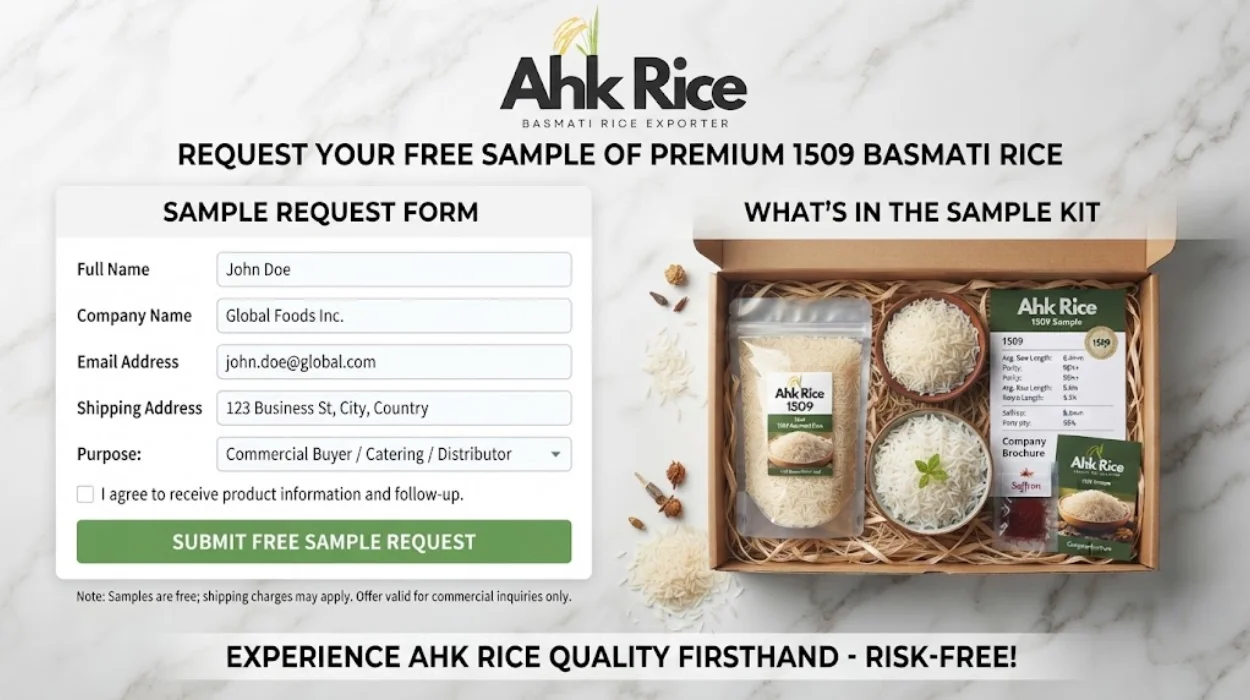
Requesting a physical 1509 Basmati rice sample before bulk purchase provides the clearest way to verify grain length, cooking performance, aroma, broken percentage, moisture, and packaging. Here is why: a sample lets commercial buyers compare the delivered specification with their kitchen, retail, or distribution requirements before approving a container order. AHK Rice can provide up to 20 kg for sampling, while the buyer covers courier shipping and applicable phytosanitary charges.
1509 Basmati is cultivated in Punjab, Pakistan and is widely positioned for restaurants, catering, wholesale distribution, and price-sensitive foodservice applications. Published AHK Rice specifications place 1509 around 8.20–8.40 mm in commercial specifications, with processing grades including Steam and Sella. The correct sample should therefore represent the exact grade and specification planned for commercial shipment.
Buyers can first review whether 1509 Basmati suits restaurants and catering operations before requesting a physical sample. The sample then becomes the reference point for commercial approval, contract specifications, inspection, packing, and shipment.
What is the best solution for evaluating 1509 Basmati rice?
The best solution is a specification-matched sample tested through both visual inspection and cooking trials before commercial approval. Here is why: a physical sample reveals characteristics that a quotation or specification sheet cannot fully demonstrate, including cooked texture, aroma, elongation, separation, colour, and plate appearance.
1509 Basmati should be evaluated against the intended application. A catering buyer should test bulk cooking rather than only boiling a small household portion. A restaurant should test the rice in its normal biryani, pulao, or steamed-rice process.
A wholesale buyer should compare grain appearance, broken percentage, moisture, packaging, and batch consistency. A private-label buyer should also verify retail presentation and pack requirements before approving production.
What should a 1509 Basmati sample prove?
A useful sample should answer five commercial questions:
- Grain length: Verify the agreed raw-grain range.
- Broken percentage: Check the visible proportion of broken kernels.
- Cooking performance: Test absorption, separation, texture, and cooked elongation.
- Aroma: Evaluate the natural fragrance before and after cooking.
- Appearance: Check whiteness, uniformity, colour, and foreign matter.
A sample approval should also identify the exact processing grade. 1509 Steam and 1509 Sella can produce different cooking and appearance results. Buyers should therefore avoid approving a generic “1509” sample when the contract requires a specific processing grade.
For catering buyers, the most relevant comparison is often between Steam and Sella grades. AHK Rice’s published comparison material positions 1509 Steam for cost-controlled distribution and 1509 Sella for high-turnover applications.
With the evaluation criteria established, the next decision is choosing the supplier capable of matching the approved sample.
Why choose AHK Rice for a 1509 Basmati sample?
AHK Rice provides a specification-based sampling process that connects the approved sample with milling, grading, packaging, inspection, and export preparation. Here is why: commercial rice purchasing becomes safer when the physical sample and bulk contract use the same measurable requirements.
AHK Rice sources Pakistani Basmati from Punjab and manages processing and export preparation. Its export process includes milling, sorting, quality testing, packaging, documentation, container loading, and shipping.
The company’s published 1509 export specifications include long grain, Sortex cleaning, double polishing, and export packaging options. One published 1509 Golden Sella specification lists 8.4 mm average grain length, ≤12.5% moisture, and ≤1% broken grains for that destination-specific product.
This distinction matters because buyers should not assume every 1509 shipment has identical tolerances. Grade, destination, packaging, crop, quantity, and inspection requirements should appear in the commercial specification.
AHK Rice also supports third-party inspection. Buyers can request independent verification before loading, with inspection costs handled by the buyer according to the published export process.
The supplier decision therefore depends on specification control rather than sample appearance alone. The next step is understanding what results the approved sample can produce commercially.
What results can be expected from a 1509 Basmati sample?
An approved 1509 sample should give buyers a documented reference for grain appearance, cooking behaviour, quality tolerances, packaging, and commercial production. Here is why: the approved sample can become the physical benchmark against which the final shipment is inspected.
A restaurant buyer can use the sample to standardize cooking time and portion yield. A catering company can test large-batch preparation and holding performance. A wholesaler can assess whether the grain appearance matches its target retail or foodservice segment.
1509 Basmati is particularly relevant where procurement cost and cooking performance must work together. AHK Rice’s published comparison material identifies 1509 as a cost-controlled option for high-volume distribution, while 1121 is positioned more strongly toward premium positioning.
For a catering buyer, the sample should therefore be tested under realistic operating conditions. Cook the same quantity used in production. Use the normal cooking method. Hold the cooked rice for the expected service period. Then evaluate separation, texture, appearance, and yield.
A buyer seeking a more detailed grade comparison can review the 1509 rice grade comparison for catering and foodservice requirements. That comparison explains how grade selection should follow the buyer’s sales channel and cooking requirements.
The sample result should then move directly into the commercial specification. The next question is what the buyer actually pays.
How much does a 1509 Basmati sample cost?
The rice sample can be supplied free up to 20 kg, while the buyer pays courier shipping and applicable phytosanitary costs. Here is why: international sample delivery creates logistics and certification expenses even when the rice itself is supplied without a sample charge.
The final sample cost depends on destination, sample weight, courier service, packaging, and phytosanitary requirements. AHK Rice’s export information also states that small samples can be dispatched through courier services, with delivery timing depending on the shipment arrangement.
What affects the final 1509 Basmati bulk price?
Bulk pricing depends on several measurable variables:
- Grade: Steam, Sella, or another specified processing grade.
- Grain length: Required average and tolerance.
- Broken percentage: Agreed maximum broken content.
- Moisture: Contractual moisture limit.
- Packaging: PP, jute, retail, or custom packaging.
- Quantity: Container volume and repeat-order requirements.
- Destination: Port, freight, and destination charges.
- Incoterm: FOB, CFR/CNF, or CIF.
- Inspection: Buyer-requested third-party inspection.
- Certification: Destination-specific documentation and certificates.
AHK Rice’s quote process collects the destination port, product, packing type, packing size, minimum quantity, and Incoterm before preparing a commercial quotation.
A sample should therefore be requested with the intended commercial specification. Sending a generic sample and later changing the grade creates unnecessary procurement risk.
With sample and pricing factors defined, the remaining issue is the timeline from approval to delivery.
How long does 1509 Basmati rice shipping take?
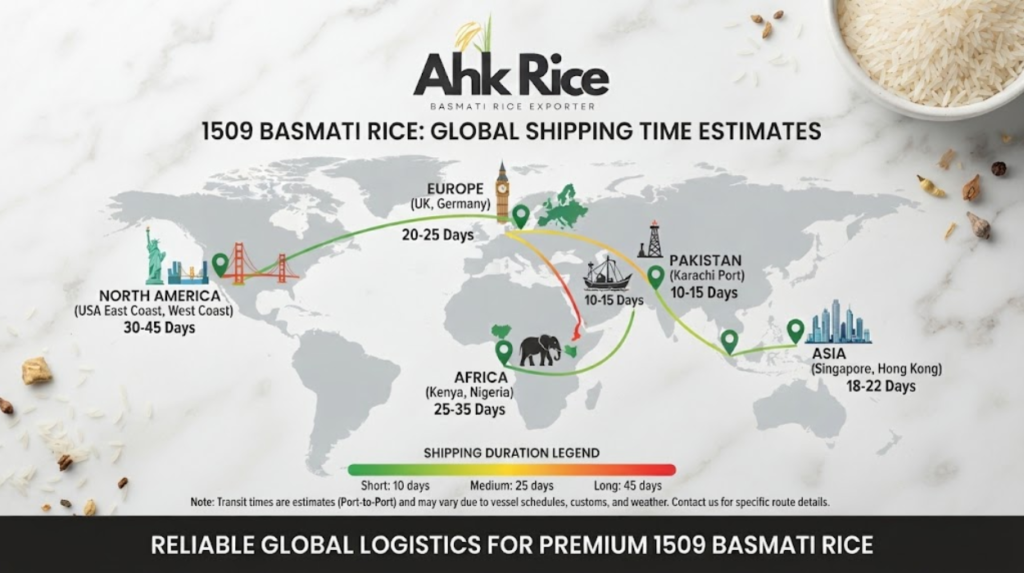
Sample approval can take several days, while bulk shipment readiness commonly requires about 7–10 days after order confirmation and destination transit can add 10–35 days. Here is why: export preparation, documentation, vessel schedules, and destination distance determine the final delivery window.
For Turkey, AHK Rice publishes 7–10 days for order readiness and 10–14 days for sea transit from Karachi to Istanbul or Izmir.
For the USA, published AHK Rice information gives approximately 25–35 days from Karachi to major ports such as Houston, New York, and Los Angeles.
For other destinations, AHK Rice’s general export guidance gives approximately 15–30 days for port delivery, depending on destination.
| Market example | Published transit/readiness guidance |
|---|---|
| Turkey | 7–10 days readiness + 10–14 days sea transit |
| USA | 25–35 days to major ports |
| Other destinations | Approximately 15–30 days, destination dependent |
These figures are planning ranges rather than guaranteed arrival dates. Vessel schedules, port congestion, customs clearance, documentation, and destination procedures can change the final timeline.
The practical sequence is simple: approve the sample, confirm the specification, sign the contract, complete payment requirements, prepare the rice, inspect the shipment, load the container, and dispatch it from Karachi.
The shipping timeline therefore becomes predictable only after the destination and Incoterm are fixed. The final step is turning the approved sample into an export order.
How do you get started with a free 1509 Basmati sample?
Start by sending the required grade, quantity, destination, and specifications, then approve the physical sample before confirming the bulk contract. Here is why: precise requirements allow AHK Rice to prepare a representative sample instead of sending a generic product.
What information should the buyer provide?
Prepare these commercial details:
- Product: 1509 Basmati Rice.
- Grade: Steam, Sella, or required processing type.
- Quantity: Required sample weight and estimated bulk volume.
- Destination: Country and destination port.
- Grain specification: Target grain length.
- Broken specification: Maximum acceptable percentage.
- Moisture specification: Required contractual limit.
- Packaging: Bulk or retail format.
- Incoterm: FOB, CFR/CNF, or CIF.
- Inspection: In-house or independent inspection requirement.
What happens after the sample request?
- Submit the product and destination requirements.
- Confirm the required 1509 processing grade.
- Receive the sample specification and sampling arrangement.
- Pay courier and applicable phytosanitary charges.
- Receive the physical sample through courier.
- Test grain appearance, aroma, cooking performance, and texture.
- Approve the sample or request a revised specification.
- Confirm the commercial specification.
- Finalize quantity, packing, Incoterm, and payment terms.
- Inspect the finished shipment before container loading.
AHK Rice’s published export workflow uses sample approval before order confirmation and then moves through production, quality inspection, packaging, documentation, loading, and shipping.
AHK Rice also states that sample charges can be waived against a subsequent order in certain export arrangements. Buyers should confirm the applicable treatment in the commercial quotation before assuming reimbursement.
This process gives the buyer a clear decision point. Approve the sample only after the rice performs against the intended commercial use.
What should buyers confirm before approving the sample?
Buyers should confirm the exact grade, grain length, broken percentage, moisture, cooking result, packaging, inspection requirements, and destination compliance before approval. Here is why: the approved sample should represent the same specification that appears in the commercial contract.
The most important control is specification consistency. A sample showing excellent grain length has limited value when the bulk contract does not define grain tolerance or broken percentage.
The second control is cooking performance. Catering buyers should test the rice in realistic batch sizes. Restaurants should evaluate the finished plate. Distributors should inspect visual consistency and packaging.
The third control is documentation. Export shipments may require phytosanitary certification, fumigation documentation, certificate of origin, commercial invoice, packing list, and other destination-specific documents. AHK Rice lists these documents within its export workflow.
AHK Rice’s sampling model therefore works best as part of a complete procurement process. The buyer tests the product first, fixes the specification second, and commits to bulk volume third.
For commercial buyers, this sequence reduces uncertainty before container loading and creates a clear reference for inspection and repeat orders.
FAQs About Requesting a 1509 Basmati Rice Sample
Can I get a free 1509 Basmati rice sample?
Yes, AHK Rice can provide up to 20 kg for sampling.
The buyer covers courier shipping costs.
Applicable phytosanitary charges are also paid by the buyer.
The sample should match the intended commercial grade.
Confirm sample arrangements before dispatch.
How long does a 1509 Basmati sample take?
Courier timing depends on destination and shipping arrangement.
AHK Rice publishes courier-based sample dispatch procedures.
Bulk orders follow a separate export timeline.
Turkey orders show 7–10 days readiness after confirmation.
Destination transit then depends on the vessel route.
Which 1509 grade should catering buyers sample?
1509 Steam and 1509 Sella should be tested against the kitchen’s requirements.
Steam suits cost-controlled long-grain applications.
Sella supports high-volume cooking and distribution applications.
The buyer should test the actual cooking process.
Final selection should follow the approved sample result.
What specifications should appear on the sample request?
The request should define grade, grain length, broken percentage, moisture, packing, and destination.
Quantity and Incoterm should also be specified.
Inspection requirements should be agreed before production.
The same specification should appear in the contract.
This creates a consistent benchmark for shipment approval.
Can the sample charge be adjusted against a bulk order?
AHK Rice states that sample charges can be waived after a successful order.
Courier and phytosanitary costs remain separate considerations.
The exact commercial treatment should appear in the quotation.
Buyers should confirm the arrangement before ordering.
This prevents uncertainty over sample-related costs.