How Turkish Rice Importers Source and Partner with Pakistani Suppliers
Turkish rice importers can source Pakistani rice efficiently by selecting a specification-based supplier, approving a representative sample, verifying export documents, and agreeing the shipment under clear FOB, CFR, or CIF terms. The process reduces specification disputes and creates a repeatable supply relationship.
Turkish buyers first need to define the commercial requirement before comparing suppliers. Grain variety, grain length, broken percentage, moisture, milling grade, packaging, quantity, destination port, and Incoterm should be fixed before accepting a quotation.
For market context, Pakistani Basmati demand in Turkey is connected with premium retail, wholesale distribution, foodservice, and consumers seeking long-grain aromatic rice. Buyers can first review the Pakistani Basmati rice demand and consumer trends in Turkey before moving to supplier selection.
What is the best solution for Turkish importers sourcing Pakistani rice?
The best solution is a specification-led sourcing process that connects Turkish demand with a Pakistani exporter capable of sampling, processing, documentation, packaging, inspection, and container shipment under one commercial specification. This approach makes supplier comparison clearer and repeat orders easier.
The first step is to define the product. A Turkish importer should specify whether the requirement is 1121 Basmati, Super Kernel, 1509 Basmati, or another Pakistani rice category.
The specification should also state the acceptable grain length, moisture, broken percentage, purity, foreign matter, milling condition, packing format, and tolerance. Retail buyers should additionally define retail pack size, Turkish-language labelling, private-label requirements, and carton configuration.
AHK Rice supplies Pakistani Basmati varieties and can structure the first product discussion around the buyer’s required specification rather than an undefined generic rice quotation.
This is important because two quotations for the same rice variety can represent different commercial products. Processing grade, broken percentage, packaging, quantity, destination, and freight can materially change the landed cost.
Turkish buyers comparing varieties can also review the most preferred Pakistani rice grades in Turkish retail and wholesale markets to understand how product selection changes by distribution channel.
Why choose AHK Rice as a Pakistani supplier?
AHK Rice provides a direct export workflow covering rice sourcing, processing, grading, sorting, packaging, documentation, and shipment coordination, allowing Turkish importers to manage one defined specification from sample approval through commercial delivery.
AHK Rice is based in Punjab, Pakistan, the production region associated with the country’s major Basmati supply chain. Its export range includes 1121, Super Kernel, and 1509 Basmati rice.
For a Turkish importer, the practical advantage is specification continuity. A supplier relationship should not end when a sample is approved. The commercial shipment should reproduce the agreed product characteristics within the tolerances written into the purchase contract.
AHK Rice can coordinate custom packaging where the buyer requires retail or wholesale presentation. This can include bulk formats for distributors or consumer-facing packaging for retail programs.
AHK Rice also supports the documentation and export coordination required to move a confirmed order from the mill to the destination port.
Turkey’s official import procedure for plant-origin food includes importer registration, product notification, shipment notification, document control, identity control, and physical controls based on risk. Physical controls can include packaging inspection, sampling, and laboratory analysis.
This makes document accuracy part of supplier selection. A low product price does not compensate for incomplete documentation or a specification that cannot pass the import-control process.
What results can Turkish rice importers expect?
A properly structured supplier relationship gives Turkish importers a defined product specification, approved sample, predictable shipment workflow, clearer landed-cost calculation, and a documented basis for repeat purchasing instead of negotiating every shipment from zero.
The expected result is commercial consistency rather than simply a lower purchase price.
For example, a Turkish wholesaler may begin with one container of 1121 Basmati for Istanbul distribution. The importer can approve the sample, confirm the specification, agree the packaging, arrange inspection, and ship the order.
After successful delivery, the same specification can become the reference point for subsequent purchase orders.
AHK Rice can also support buyers that require different grades for different customer segments. A premium Basmati specification can serve retail or foodservice customers, while another grade can be structured for more price-sensitive wholesale distribution.
The relationship therefore becomes a documented supply program. Product specification, packing, shipment terms, documents, and quality requirements remain visible to both parties.
Pakistan has a substantial established export base. REAP records 5.82 million MT of total Pakistani rice exports in 2024–25, including 808,643 MT of Basmati valued at approximately US$830.57 million.
AHK Rice operates within this wider Pakistani rice-export ecosystem and can structure Turkish orders around the specific commercial requirement rather than treating every buyer as a standard commodity transaction.
How many shipping days does rice take from Pakistan to Turkey?
Sea freight from Karachi or Port Qasim to Turkish ports is commonly planned around roughly two to four weeks for the ocean movement, but actual delivery depends on vessel schedule, transshipment, port congestion, customs clearance, and the final delivery location.
Mersin is a practical Turkish destination for containerized imports from Pakistan. Current logistics references show different transit profiles depending on carrier and routing. One current Karachi-Mersin schedule lists approximately 10 days and 10 hours, while other route references show wider ranges.
For commercial planning, importers should therefore avoid treating one transit number as a guaranteed delivery date.
A practical planning structure is:
| Market / destination | Indicative planning window | Main variables |
|---|---|---|
| Mersin | 12–20+ days ocean movement | Vessel, transshipment, congestion |
| Istanbul | 15–25+ days | Port selection and inland movement |
| Izmir | 15–25+ days | Sailing and port schedule |
| Inland Turkey | Ocean transit + additional days | Port clearance and trucking |
These are planning ranges, not contractual delivery guarantees.
AHK Rice’s own Turkey shipping information identifies Karachi as a major origin and Mersin as an important Turkish destination for Pakistani rice shipments.
Turkish importers should also separate port-to-port transit from total order lead time. Production, packaging, inspection, documentation, vessel booking, loading, sailing, customs clearance, and inland transportation can extend the complete procurement cycle.
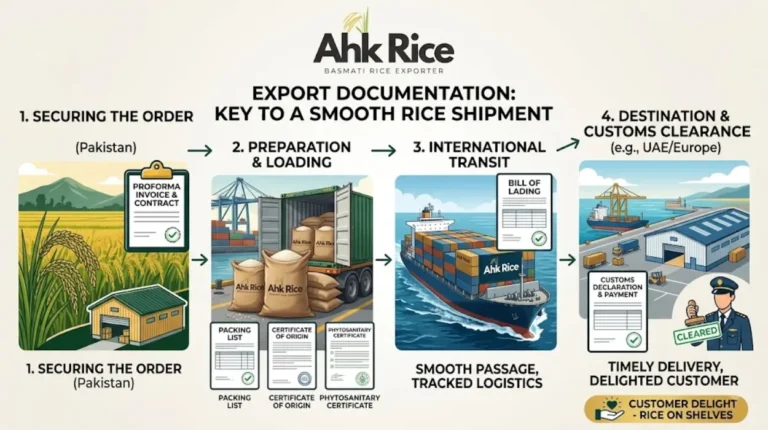
What documents should Turkish rice importers require?
The importer should agree the complete document set before shipment, including commercial invoice, packing list, transport document, certificate of origin, phytosanitary documentation, and any certificates or analysis reports required by the agreed specification and Turkish import controls.
Turkey’s Ministry of Agriculture and Forestry states that plant-origin food imports are subject to official controls covering documents, identity, and physical examination. The process can involve sampling and laboratory analysis.
The Turkish importer should therefore confirm requirements with its customs broker and relevant authorities before the supplier loads the container.
A typical commercial file can include:
- Commercial invoice
- Packing list
- Bill of lading
- Certificate of origin
- Phytosanitary certificate where applicable
- Fumigation documentation where applicable
- Certificate of analysis or laboratory report where agreed
- Inspection report where contractually required
- Product specification
- Insurance documentation under the agreed Incoterm
AHK Rice can coordinate the export documentation around the confirmed shipment specification.
The importer remains responsible for Turkish-side import compliance, registration, declarations, and customs procedures. Turkey’s official guidance requires importers of plant-origin food to complete relevant registration and notification processes before importation.
How does the rice sample process work, and what does it cost?
A professional sample process starts with the buyer’s specification, continues with supplier confirmation and representative rice samples, and ends with written approval before commercial production. Sample courier and related certification costs should be confirmed before dispatch because they vary by destination and shipment requirement.
The recommended process is straightforward.
Step 1: Send the specification.
The Turkish importer provides variety, grade, grain length, broken percentage, moisture, packing, quantity, destination, and intended use.
Step 2: Supplier confirms feasibility.
AHK Rice checks whether the requested specification can be processed and packed for the order.
Step 3: Sample preparation.
A representative sample is prepared from the proposed commercial specification. For serious commercial evaluation, the sample should reflect the product that will be supplied rather than a different premium lot.
Step 4: Courier dispatch.
The sample is shipped to Turkey. The courier charge depends on weight, destination city, service level, and documentation requirements.
Step 5: Buyer testing.
The importer evaluates appearance, grain length, aroma, cooking performance, broken percentage, packaging suitability, and any laboratory parameters relevant to the purchase.
Step 6: Final approval.
The approved specification becomes the reference for the commercial quotation and purchase order.
Step 7: Commercial production.
The exporter processes, grades, sorts, packs, and prepares the confirmed quantity.
Step 8: Pre-shipment verification.
Where required, inspection or laboratory analysis is completed before loading.
Step 9: Container loading and shipment.
The shipment moves under the agreed FOB, CFR, or CIF arrangement.
Sample cost should not be presented as a fixed universal figure. Courier charges change by Turkish destination, sample weight, service provider, and delivery speed. Any phytosanitary, laboratory, or special certification charge should also be confirmed before dispatch.
AHK Rice can confirm the applicable sample arrangement and shipment-related charges against the buyer’s exact requirement.
What factors affect the final Pakistani rice price in Turkey?
The final Turkish buying cost depends on rice grade, grain specification, broken percentage, moisture, packing, order quantity, Pakistani processing costs, ocean freight, insurance where applicable, destination charges, customs costs, and the selected Incoterm.
A useful quotation should therefore show more than a single price per metric ton.
The importer should compare:
| Cost factor | Commercial impact |
|---|---|
| Rice variety | Determines base product positioning |
| Grain length | Changes grade and product value |
| Broken percentage | Influences specification and price |
| Moisture | Affects quality compliance and storage |
| Packaging | Changes material and packing cost |
| Quantity | Influences production and freight economics |
| Port | Changes logistics and inland cost |
| Incoterm | Determines which costs belong to buyer or seller |
| Inspection | Adds cost when contractually required |
| Destination charges | Affect landed Turkish cost |
FOB pricing primarily establishes the export-side value before the buyer’s ocean freight and destination responsibilities. CIF incorporates freight and insurance to the named destination port under the applicable Incoterm.
AHK Rice should therefore quote against a written specification rather than an isolated headline number.
How can Turkish importers get started with AHK Rice?
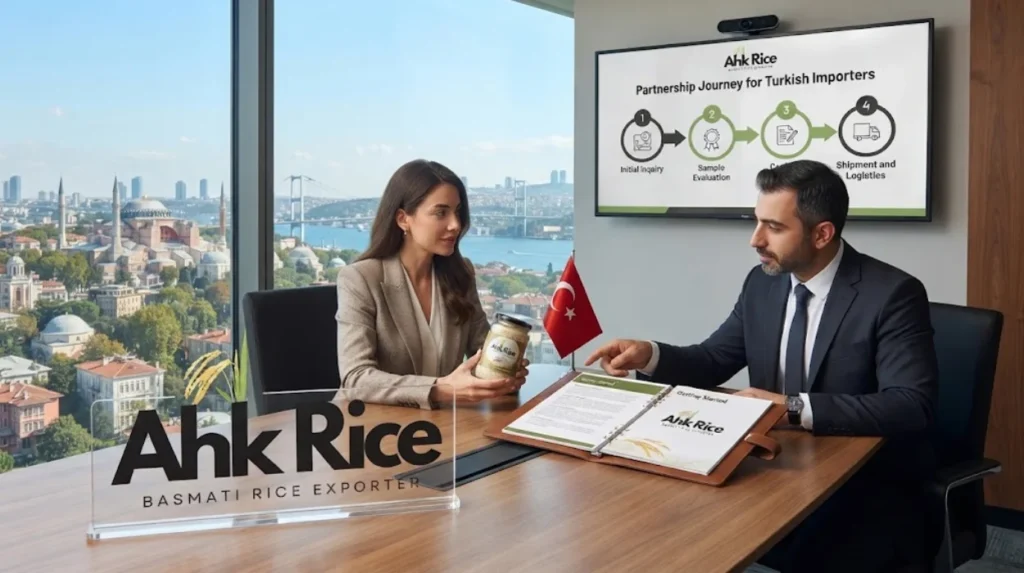
Start by sending the required rice variety, specification, quantity, packing format, Turkish destination, and preferred Incoterm. The supplier can then structure the sample, quotation, documentation, production, inspection, and shipment process around one commercial requirement.
A Turkish importer should prepare five pieces of information before contacting a Pakistani supplier:
- Required rice variety and grade.
- Required quantity in metric tons.
- Packaging and private-label requirements.
- Destination port or delivery location in Turkey.
- Preferred FOB, CFR, or CIF basis.
AHK Rice can then work from the buyer’s actual specification.
The decision should be based on whether the supplier can reproduce the approved sample, meet the documented specification, provide the required export documentation, support the agreed packaging, and coordinate shipment within the buyer’s procurement schedule.
For repeat business, the same specification should be retained as the purchasing reference. This creates consistency between the first sample, the first container, and subsequent orders.
AHK Rice provides this supplier-to-shipment structure for Turkish buyers seeking Pakistani Basmati rice with defined commercial requirements.
AHK Rice can also support buyers comparing 1121, Super Kernel, and 1509 according to retail, wholesale, foodservice, and private-label requirements.
For a specification-based commercial quotation, request an export quote from AHK Rice.
FAQs About Sourcing Pakistani Rice from Turkey
How do Turkish importers buy rice from Pakistan?
Turkish importers normally begin by defining the rice specification, quantity, packaging, destination, and Incoterm.
The Pakistani supplier then provides a quotation and representative sample.
The buyer tests and approves the sample before commercial production.
Documents and inspection requirements are agreed before loading.
The final container is shipped after production and export clearance.
Which Pakistani rice varieties can Turkish importers source?
Turkish buyers can source several Pakistani rice varieties depending on their market segment and specification.
1121 Basmati is associated with long grain and premium presentation.
Super Kernel provides traditional Basmati aroma and commercial flexibility.
1509 can serve buyers seeking long grain with cost-focused positioning.
The correct choice depends on the buyer’s required specification and customer segment.
How long does Pakistani rice take to reach Turkey?
Ocean transit depends on the Pakistani origin port, Turkish destination, carrier, and routing.
Mersin is an important destination for containerized Pakistani rice shipments.
Current route information shows significant variation between carrier schedules.
Importers should allow additional time for production and Turkish customs procedures.
A supplier should provide a shipment-specific schedule rather than promise one universal transit time.
What documents are required for Pakistani rice imports into Turkey?
Turkish plant-origin food imports are subject to official import controls and documentation requirements.
The process includes document, identity, and physical controls based on risk.
A phytosanitary certificate may be required for applicable plant products.
Commercial invoices and transport documents are also part of the import file.
The Turkish importer should confirm the current requirement with its customs broker and authorities.
How much does a rice sample from Pakistan to Turkey cost?
There is no single fixed sample-delivery cost for every Turkish buyer.
Courier pricing changes according to sample weight and Turkish delivery location.
Delivery speed also changes the courier charge.
Phytosanitary, laboratory, or special certification requirements can add separate costs.
The exact sample cost should therefore be confirmed before dispatch.
What should Turkish importers check before placing a rice order?
The importer should check product specification, sample approval, documents, packaging, quantity, price basis, and shipment schedule.
The commercial contract should define measurable rice specifications.
The approved sample should represent the agreed commercial product.
The Incoterm should clearly allocate freight and destination responsibilities.
The buyer should also verify Turkish import-control requirements before shipment.