Source Basmati Rice from an Established Exporter for Michigan Markets
Michigan buyers sourcing Pakistani Basmati rice should prioritize an established exporter that can prove specification consistency, export documentation, sampling discipline, and repeat shipment performance rather than choosing solely on the lowest FOB price. For distributors, wholesalers, ethnic retailers, restaurants, and private-label programs, supplier history directly affects landed cost and inventory continuity.
Before selecting a supplier, buyers should understand:
Why Michigan buyers should review a supplier’s export history. Export history shows whether an exporter can repeatedly move rice from Punjab through Karachi and into international markets while maintaining the same commercial specifications.
In 2026, Pakistan remains a major rice-exporting origin. USDA’s April 2026 Pakistan Grain and Feed Annual forecasts Pakistan’s 2026/27 rice production at approximately 9.8 million metric tons and expects exports to rebound to about 5.0 million metric tons, while 2025/26 exports are projected at 4.7 million metric tons. This creates sourcing opportunities for Michigan buyers, but the supplier still needs to demonstrate execution capability.
What is the best solution for Michigan buyers sourcing Pakistani Basmati rice?
The best solution is a supplier with proven export execution, controlled milling, documented specifications, responsive sampling, compliant documentation, and predictable container scheduling, because these capabilities reduce quality variation, customs problems, stockouts, and unexpected landed-cost increases for Michigan distributors.
A Michigan importer should evaluate the complete supply chain rather than the rice sample alone. The supplier must control or coordinate paddy procurement, milling, grading, sorting, packing, inspection, documentation, container loading, and vessel booking.
AHK Rice provides this integrated approach from Punjab. The company is based in Bucheki, Nankana Sahib, Punjab, and supplies international buyers with Basmati 1121, Super Kernel, and Basmati 1509 varieties. Its published export process covers paddy procurement, pre-cleaning, de-husking, paddy separation, whitening, polishing, grading, length sorting, packaging, documentation, and container loading.
For Michigan, the practical advantage is specification continuity. A buyer approving 1121 Steam, 1121 White, Super Kernel, or 1509 should be able to receive subsequent lots that remain within the agreed moisture, broken-grain, purity, grain-length, packaging, and appearance specifications.
This is where export experience becomes commercially important. A supplier that regularly handles international shipments is more likely to understand documentation timing, vessel schedules, port procedures, inspection requirements, and the communication needed between exporter, freight forwarder, broker, and importer.
Why should Michigan buyers choose an established exporter such as AHK Rice?
Michigan buyers should choose an established exporter when its export record is supported by documented processing, repeat international shipments, defined specifications, inspection capability, and destination-market knowledge, giving importers greater control over quality, compliance, scheduling, and total procurement risk.
AHK Rice has operated as a Pakistani Basmati rice exporter since 2019 and states that it supplies buyers across 15 countries, including the United States. Its integrated processing and export model gives buyers one commercial point for rice production, grading, packing, documentation, and shipment coordination.
For U.S. buyers, AHK Rice USA export service is relevant because the program is structured around American import requirements and bulk purchasing. Published USA information covers 1121, Super Kernel, and other Pakistani Basmati products, with options for wholesale, retail, foodservice, and private-label buyers.
AHK Rice also states that it can provide third-party pre-shipment inspections through organizations such as SGS and Bureau Veritas. This matters when the purchase contract contains measurable quality conditions. Instead of relying only on a supplier’s internal declaration, a buyer can request an inspection framework before the container leaves Pakistan.
The supplier’s product specifications should still be written into the purchase agreement. For example, an order might specify 1121 Basmati with an agreed grain length, maximum broken percentage, moisture ceiling, purity level, packaging material, net weight, and tolerance. The approved sample should become the physical reference for production.
The same principle applies to Super Kernel and 1509. A lower-priced grade is not necessarily cheaper if it produces more broken grains, inconsistent cooking performance, greater claims, or poor retail acceptance.
How does export experience reduce supply-chain risk for Michigan importers?
Export experience reduces supply-chain risk by connecting production planning with documentation, inspection, vessel booking, port handling, and customer communication, allowing the exporter to identify problems earlier and maintain more predictable movement from Pakistani mills to U.S. distribution channels.
Michigan buyers can evaluate supplier experience through five practical questions: How many countries has the exporter served? How frequently does it ship? Can it provide previous shipment documentation? Does it maintain repeatable specifications? Can it explain its response when a shipment is delayed or a quality deviation occurs?
The broader commercial principle is explained in:
How export experience reduces international supply-chain risks. Experience matters because international rice procurement contains several connected stages. A failure at one stage can affect every later stage.
For example, if production is delayed by five days but the exporter does not communicate the change, the buyer may miss a vessel cutoff. That can create additional storage, booking, or inventory costs. An experienced exporter is more likely to identify the production-to-vessel connection before the cutoff becomes a problem.
Documentation is equally important for U.S. imports. FDA states that imported food facilities generally must be registered where required and that prior notice must be provided before qualifying food shipments arrive. FDA also states that imported food is subject to inspection and can be detained when it does not comply with U.S. requirements.
FSVP also places responsibilities on the U.S. importer. FDA defines the FSVP importer generally as the U.S. owner or consignee and requires covered importers to verify that foreign suppliers produce food in accordance with applicable U.S. safety requirements.
Therefore, the exporter should be able to supply the records and information the importer needs for its compliance process. Supplier experience does not transfer the importer’s legal responsibility, but it can make supplier verification and documentation management more efficient.
What shipping time should Michigan buyers expect from Pakistan?
For Michigan, buyers should plan the international ocean leg separately from inland delivery: Karachi-to-New York can currently take roughly 23–27 days on published FCL schedules, while Karachi-to-Houston can be around 36 days, followed by U.S. inland transportation and customs clearance.
The final Michigan delivery point changes the total timeline. A shipment routed through an East Coast gateway can then move inland by rail or truck toward Detroit, Grand Rapids, Lansing, or other Michigan distribution points.
Current public lane data provides useful planning benchmarks. A published Karachi-to-New York 40-foot FCL rate shows an estimated 27-day transit, while Port Qasim-to-New York is listed at approximately 23–33 days. Another July 2026 lane benchmark showed Karachi-to-New York FCL transit at approximately 25 days and 16 hours.
Houston is a longer alternative. Current published Karachi-to-Houston FCL information shows approximately 36 days on a standard route, with some routings reaching 50 days.
A practical Michigan planning model is therefore:
| Stage | Planning range |
|---|---|
| Order confirmation and specification approval | 1–2 days |
| Sample approval and commercial confirmation | 3–10 days |
| Production and packing | 7–10 days |
| Export documentation and container preparation | 2–5 days |
| Karachi/U.S. ocean transit | 23–36+ days |
| U.S. customs, port and inland delivery | 5–12+ days |
| Total practical planning window | 41–75+ days |
These are planning ranges, not guaranteed delivery dates. Vessel availability, transshipment, customs examination, port congestion, inland capacity, documentation corrections, and destination changes can extend the schedule.
For recurring Michigan supply, buyers should therefore place orders before inventory reaches its minimum safety level. A distributor that sells 40 MT per month should not wait until only one container remains before beginning the next procurement cycle.
What is the full rice sample process and what does it cost?
A commercial sample process should confirm the exact rice grade before bulk commitment: define specifications, request the sample, arrange courier delivery, evaluate cooking and physical quality, approve the reference sample, then lock the same specification into the purchase contract.
AHK Rice states that samples of up to 20 kg can be provided, while the buyer covers courier and phytosanitary-certificate costs. Buyers may also use their own courier account, which can improve cost control.
The process should begin with a written product specification. A Michigan buyer should identify the variety, processing type, grain length, moisture, broken percentage, purity, packaging, quantity, destination, and intended use.
The supplier then prepares the representative sample. The buyer should inspect the uncooked grains for length uniformity, broken grains, discoloration, foreign matter, aroma, and overall appearance. The cooking test should assess elongation, aroma, texture, separation, water absorption, and final appearance.
Sample costs depend on destination, courier, sample weight, packaging, and phytosanitary requirements. The rice itself may be supplied without charge under a supplier’s sample policy, but international courier and certificate charges remain variable. A buyer should request the exact courier and certificate cost before dispatch rather than assuming that every sample is completely free.
For a serious commercial program, one sample should not be treated as the entire quality-control system. The approved sample should be retained as a reference, and the final purchase order should contain measurable specifications that can be checked before shipment.
What does Pakistani Basmati rice cost for Michigan buyers in 2026?
In 2026, Pakistani Basmati pricing depends primarily on variety, processing grade, crop quality, quantity, packaging, inspection, Incoterm, freight, and destination; published July benchmarks place many 1121 Basmati FOB Karachi offers around $1,135–$1,205 per metric ton.
Current published market references provide a useful range rather than a fixed Michigan landed price. One July 2026 export reference lists 1121 Basmati White at approximately $1,165–$1,205 per MT FOB Karachi and 1121 Basmati Sella at approximately $1,135–$1,175 per MT. Another July benchmark lists 1121 White at about $1,180 per MT FOB Karachi.
Freight is then added according to the actual vessel, container type, route, surcharges, and booking date. A current public Karachi-to-New York 40-foot FCL benchmark is around $5,252–$5,691, while Karachi-to-Houston is approximately $6,344–$6,873 on the displayed routes.
A Michigan buyer should not compare FOB prices from different exporters without normalizing the specification. The cheaper offer may represent a different grain length, processing method, crop, broken percentage, packing format, or inspection arrangement.
The correct commercial comparison is therefore landed cost plus expected performance. If a supplier’s price is $30 per MT lower but produces inconsistent lots, delayed shipments, or higher claims, the apparent saving can disappear.
What results can Michigan buyers expect from AHK Rice?
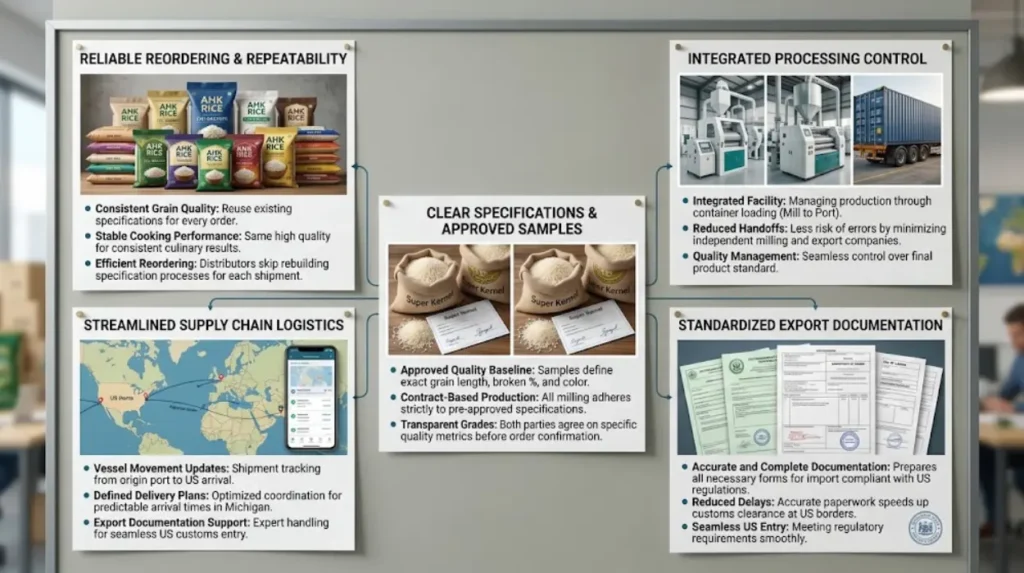
Michigan buyers can expect a more controlled procurement process when AHK Rice is contracted against clear specifications: approved samples establish the quality reference, production follows the agreed grade, export documents support U.S. entry, and shipment coordination creates a defined delivery plan.
The strongest outcome is repeatability. A distributor should be able to reorder the same variety and packaging without rebuilding the entire specification process every time.
AHK Rice publishes USA supply information showing Basmati 1121, Super Kernel, and 1509 options, with customized packaging and export documentation support. Its USA pages also state that shipment tracking can be provided and that delivery planning covers production, vessel movement, and U.S. arrival.
For a Michigan restaurant distributor, the result may be stable cooking performance across multiple deliveries. For a retail importer, the result may be consistent grain appearance and packaging. For a private-label buyer, the result is greater control over the specification that appears under its own brand.
AHK Rice’s integrated processing model also reduces unnecessary handoffs between independent milling and export companies. The company states that its processing facility manages production through container loading and that its export documentation includes commercial invoices, packing lists, phytosanitary certificates, certificates of origin, fumigation certificates, and bills of lading.
How should Michigan buyers make the final supplier decision?
Michigan buyers should select the exporter that offers the strongest combination of verified specifications, export history, sample performance, compliance support, shipping reliability, and landed economics rather than selecting a supplier from FOB price alone.
Use this decision framework before issuing a purchase order:
| Decision factor | What Michigan buyer should verify |
| Product specification | Variety, grain length, moisture, broken percentage, purity and processing |
| Supplier history | Export markets, shipment experience and repeat-order capability |
| Sample approval | Physical inspection and cooking performance against intended use |
| Compliance | FDA facility information, prior-notice coordination and FSVP support |
| Logistics | Port, vessel schedule, transit range and inland Michigan delivery |
| Commercial terms | FOB/CFR/CIF basis, payment terms, inspection and insurance |
| Continuity | Production capacity and ability to repeat the approved specification |
AHK Rice is positioned for this type of procurement because it combines Pakistani sourcing, in-house processing, international export experience, USA-market supply, customized packaging, and documentation support.
The final contract should still define the buyer’s requirements precisely. Exporter reputation is important, but measurable specifications provide the stronger commercial control.
For a Michigan importer starting with one container, the best approach is to approve the sample first, establish the written specification, confirm the Incoterm and destination, calculate the complete landed cost, and then schedule the shipment around expected inventory consumption.
For recurring programs, AHK Rice can become more valuable when the buyer uses the same specification, packaging, inspection procedure, and shipment planning for each reorder. That turns a one-time rice purchase into a controlled supply program.
Michigan buyers ready to compare their required variety, quantity, packaging, destination and shipping terms can a commercial rice quotation from AHK Rice.
Frequently Asked Questions
Why should Michigan buyers choose an established Basmati rice exporter?
An established exporter can provide documented export experience, consistent specifications, organized documentation, quality control, and more predictable shipment planning for Michigan importers.
What Basmati rice varieties can Michigan buyers source from Pakistan?
Michigan buyers can source varieties such as 1121 Basmati, Super Kernel, and 1509 Basmati in different processing grades, including White and Sella options.
How long does Basmati rice take to ship from Pakistan to Michigan?
Ocean transit from Karachi to a U.S. gateway can take roughly 23–36 days depending on the port and routing. Customs clearance and inland transportation to Michigan require additional time.
What does a Basmati rice sample cost?
Sample costs depend on weight, courier service, destination, and phytosanitary requirements. AHK Rice states that buyers cover courier and phytosanitary certificate costs for its sample program.
What should Michigan buyers check in a rice sample?
Buyers should check grain length, broken percentage, moisture, purity, aroma, appearance, cooking performance, elongation, texture, and grain separation before approving a bulk order.
What affects the price of Pakistani Basmati rice for Michigan?
Price depends on rice variety, processing grade, crop quality, grain specifications, order quantity, packaging, inspection, Incoterm, ocean freight, and final delivery destination.