Most Preferred Pakistani Rice Grades in Turkish Retail and Wholesale Markets in 2026
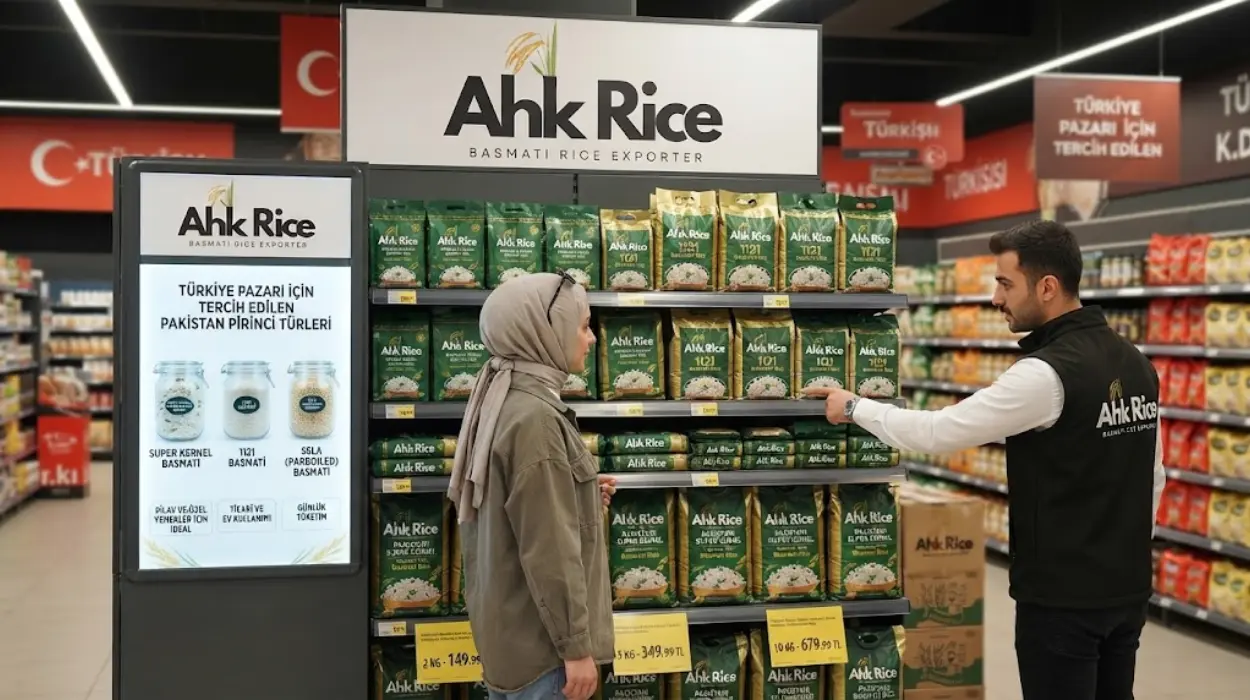
1121 Basmati, Super Kernel Basmati, and selected parboiled grades provide the main Pakistani options for Turkish retail and wholesale buyers. Here is why: Turkey’s MY 2025/26 rice consumption is projected at 790,000 MT, while imports are forecast at 425,000 MT.
Turkish rice demand includes household retail, restaurants, hotels, catering, and trading channels. The market also has strong domestic production of medium-grain varieties. Turkish households traditionally prefer Baldo, Osmancik, and Calrose, while imported rice serves additional quality and price segments. For buyers evaluating Pakistani supply, the relevant comparison starts with grain length, processing, aroma, price, cooking performance, and storage requirements. A broader guide to Pakistani Basmati rice grades and processing types establishes these product relationships before Turkish market selection.
What are the available Pakistani rice solutions for Turkish buyers?
1121 Basmati, Super Kernel Basmati, Steam, Sella, and White rice provide distinct solutions for Turkish retail, wholesale, catering, and foodservice buyers. Each format serves a different commercial requirement. 1121 targets long-grain premium positioning. Super Kernel targets traditional aroma and Basmati character. Steam provides firmer cooking performance. Sella provides parboiled grain strength. White rice provides the conventional raw-milled format.
1121 Basmati
1121 Basmati is an extra-long Pakistani Basmati variety cultivated primarily in Punjab. Current export specifications place raw grain length around 8.30 mm, with cooked length exceeding 22 mm. Its long appearance supports premium retail presentation and rice dishes requiring visual grain separation.
1121 White uses raw-milled processing and retains the natural appearance of polished Basmati. 1121 Steam receives controlled steaming before milling. 1121 Sella receives parboiling before milling, producing a firmer grain and characteristic golden appearance.
Super Kernel Basmati
Super Kernel Basmati is a traditional Pakistani Basmati variety with approximately 7.20 mm raw grain length and strong natural aroma. Its grain is shorter than 1121, but its aroma and traditional Basmati character provide a separate value proposition.
Super Kernel suits buyers seeking aromatic Basmati without making maximum cooked grain length the primary specification. Current indicative Pakistani FOB benchmarks place Super Kernel around US$1,165–US$1,205 per MT.
Steam and Sella
Steam rice receives controlled steaming before final milling. The process creates a firmer grain while maintaining a white to light-cream appearance. Sella is parboiled rice. Parboiling improves grain firmness and supports separated cooking.
For Turkish wholesale buyers, Steam and Sella become processing choices rather than separate botanical varieties. The buyer can therefore compare the same variety through different processing methods.
The available product solutions define the market options. The next question is how these specifications compare commercially.
How do Pakistani rice grades compare for Turkish retail and wholesale?
1121 leads on grain length, Super Kernel leads on traditional aroma, Steam leads on firm white cooking, and Sella leads on parboiled grain resilience. Price, processing, packaging, and storage requirements determine the commercial position of each grade.
| Attribute | 1121 White | 1121 Steam | 1121 Sella | Super Kernel White |
|---|---|---|---|---|
| Raw grain length | 8.30 mm | 8.30 mm | 8.30 mm | 7.20 mm |
| Cooked length | 22 mm+ | 22 mm+ | 22 mm+ | 18 mm+ |
| Processing | Raw milled | Lightly steamed | Parboiled | Raw milled |
| Appearance | White | Off-white/light cream | Pale gold/golden | White |
| Broken specification | 0–2% | 0–2% | 0–2% | 0–2% |
| Indicative FOB price | $1,165–$1,205/MT | $1,160–$1,200/MT | $1,135–$1,175/MT | $1,165–$1,205/MT |
| Commercial position | Premium retail | Retail and foodservice | Wholesale and foodservice | Aromatic value premium |
The current indicative FOB benchmarks are Pakistan-origin prices before Turkish freight, customs, taxes, handling, and importer margins. The 1121 ranges and Super Kernel benchmark come from current 2026 export listings.
Price alone does not establish landed competitiveness. Turkey applies an MFN import tariff on milled rice, reported by USDA at 45%. Importers therefore need a landed-cost calculation rather than a direct FOB comparison.
Shelf life also requires specification control. Storage duration depends on moisture, packaging, warehouse temperature, humidity, pest control, and crop age. A buyer should therefore approve a documented shelf-life specification rather than applying one universal number to every rice grade.
The specification table shows why Turkish buyers need a grade-based procurement model. The next step is separating those grades by market channel.
Which Pakistani rice grade fits Turkish retail and wholesale markets?
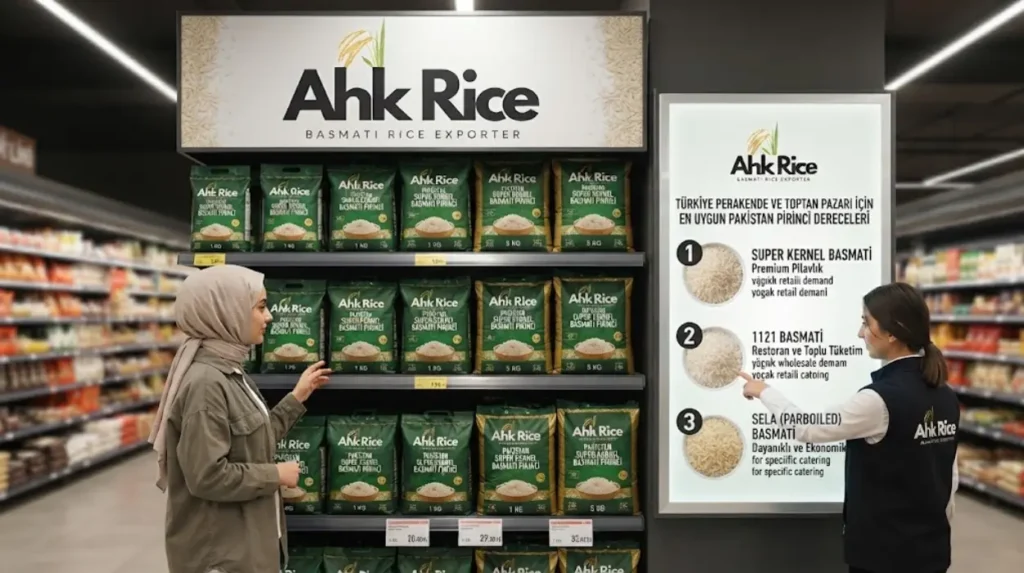
Premium retail favors long-grain 1121, while wholesale and foodservice can use 1121 Sella, 1121 Steam, or Super Kernel according to cooking and price requirements. The choice changes with package size, customer profile, and intended dish.
Istanbul and Marmara retail distribution
Istanbul and the wider Marmara region provide a useful retail-oriented sourcing framework because importers can distribute packaged rice through large urban retail networks and specialty food channels. The key requirement is consistent presentation.
1121 White provides the strongest long-grain visual proposition. Its 8.30 mm raw grain and 22 mm+ cooked length support premium packaging and dishes where elongated grains matter.
1121 Steam provides a similar long-grain profile with firmer cooking characteristics. The near-white appearance makes it suitable for consumers who want long Basmati grains without the golden appearance of Sella.
Super Kernel provides another retail option. Its 7.20 mm raw grain and strong aroma create differentiation through traditional Basmati character rather than maximum grain length.
Mediterranean and wholesale foodservice
Mediterranean and wider Turkish wholesale distribution can be evaluated through restaurant, catering, hotel, and institutional requirements. USDA reporting identifies catering, restaurants, and hotels as important rice-consuming channels in Turkey.
1121 Sella suits bulk cooking where firm grains and separation matter. Its parboiled structure supports repeated handling during large-batch preparation.
1121 Steam provides a white appearance with firmer cooking performance. It fits foodservice buyers that need long grain presentation without the golden colour of Sella.
Super Kernel fits wholesale buyers that prioritize aroma and traditional Basmati identity. Its shorter grain reduces the visual premium associated with 1121, while its aromatic profile creates a different product position.
These two market frameworks show how grade selection changes with the sales channel. The next comparison focuses on advantages and limitations.
What are the pros and cons of each Pakistani rice grade?
1121 offers maximum grain length, Super Kernel offers strong aroma, Steam offers firm white cooking, and Sella offers parboiled resilience. Each advantage creates a corresponding procurement trade-off.
1121 Basmati
Pros
- Grain length: 8.30 mm raw and 22 mm+ cooked.
- Presentation: Long grains create strong premium visual appeal.
- Variants: White, Steam, and Sella provide multiple processing options.
- Retail positioning: Long grain supports premium packaged products.
Cons
- Price: Premium specifications increase procurement cost.
- Positioning: Higher cost requires suitable retail or foodservice customers.
- Specification control: Grain length and broken percentage require tight inspection.
Super Kernel Basmati
Pros
- Aroma: Strong natural Basmati character supports traditional positioning.
- Value: The shorter grain creates differentiation from extra-long 1121.
- Versatility: The white-milled format fits retail and wholesale applications.
- Market fit: Aromatic Basmati can target buyers less focused on maximum length.
Cons
- Length: 7.20 mm raw grain is shorter than 1121.
- Presentation: Cooked grain does not provide the same visual elongation.
- Premium claim: Packaging should communicate aroma and variety identity clearly.
Steam and Sella
Pros
- Cooking: Firmer grain improves handling during bulk preparation.
- Separation: Parboiling supports separated cooked grains.
- Storage: Parboiled processing provides a different storage and handling profile.
- Foodservice: These grades fit high-volume cooking applications.
Cons
- Appearance: Sella has a golden appearance that differs from white rice.
- Consumer fit: White-rice shoppers may prefer Steam or White.
- Cost: Processing adds specification and production requirements.
The pros and cons establish the practical trade-offs. The next step converts them into a procurement decision framework.
What decision factors should Turkish rice importers use?
Turkish importers should compare grain specification, processing, landed cost, channel requirements, and storage conditions before approving a Pakistani rice grade. This framework converts product differences into measurable procurement criteria.
| Decision factor | Retail requirement | Wholesale requirement | Suitable solution |
|---|---|---|---|
| Grain appearance | Long and premium | Consistent bulk presentation | 1121 |
| Aroma | Strong Basmati identity | Traditional flavour profile | Super Kernel |
| Cooking firmness | Firm retail cooking | High-volume preparation | Steam |
| Parboiled performance | Optional | Bulk cooking and holding | Sella |
| Procurement cost | Premium margin required | Landed-cost control | Compare 1121 and Super Kernel |
Grain specification
Grain length should be written into the purchase specification. A buyer should define raw grain length, cooked performance, broken percentage, moisture, damaged kernels, and foreign matter.
Processing type
Processing determines appearance and cooking behavior. White rice remains raw-milled. Steam receives controlled steaming. Sella receives parboiling. The buyer should match processing with the intended consumer and cooking application.
Landed cost
Landed cost includes FOB value, freight, insurance where applicable, Turkish duties, port handling, customs clearance, warehousing, and inland delivery. The 2025/26 Turkish market also faces substantial import activity, making competitive sourcing important.
Packaging
Retail buyers normally need smaller branded packs. Wholesale buyers commonly require larger commercial bags. Custom packaging and private labeling can connect the same rice specification with different distribution models.
Quality verification
Quality verification should cover pre-shipment inspection, laboratory testing, moisture, broken percentage, grain length, pesticide residues where required, and microbiological specifications where applicable.
Turkey’s import environment also makes documentation important. Pakistan and Türkiye discussed increasing rice trade and improving price competitiveness in January 2026.
These decision factors provide a repeatable sourcing method. The final question is how an importer converts the selected grade into a supplier relationship.
How should Turkish importers compare Pakistani suppliers?
Turkish importers should compare suppliers through approved specifications, representative samples, inspection procedures, packaging capability, and shipment documentation. A low quoted FOB price does not establish equivalent product quality.
Supplier comparison should begin with a written specification sheet. The document should identify variety, processing type, grain length, broken percentage, moisture, crop year, packaging, quantity, and delivery term.
Sample approval should follow the same specification used for commercial production. The buyer should cook the sample and evaluate appearance, aroma, elongation, separation, texture, and consistency.
Production verification should then confirm milling, dehusking, polishing, grading, sorting, and packing controls. A supplier with end-to-end processing can coordinate these stages against one approved specification.
Shipment preparation should cover commercial invoice, packing list, certificate of origin, phytosanitary documentation where applicable, inspection certificates, and other documents required by the destination.
AHK Rice operates from Punjab and supplies 1121, Super Kernel, and 1509 varieties to 15+ countries. Its model includes end-to-end processing, custom packaging, and export coordination. This creates a single supplier workflow for specification approval, processing, packing, and dispatch.
The supplier comparison process turns grade selection into a controlled purchasing decision. Turkish importers seeking the next stage can review how Turkish rice importers source and partner with Pakistani suppliers for the supplier-side process.
What should Turkish buyers check before placing a Pakistani rice order?
Buyers should approve the exact variety, processing grade, specification, sample, packaging, inspection terms, Incoterm, and landed-cost calculation before commercial loading. These controls prevent price comparisons between non-equivalent rice specifications.
A practical pre-order checklist includes:
- Variety specification: 1121, Super Kernel, or another approved variety.
- Processing specification: White, Steam, or Sella.
- Grain specification: Raw length, cooked length, and elongation.
- Quality specification: Broken, moisture, damaged kernels, and foreign matter.
- Packaging specification: Retail, wholesale, private-label, or bulk format.
- Commercial specification: Quantity, FOB or CIF term, destination port, and payment terms.
- Inspection specification: Pre-shipment inspection and laboratory testing.
- Documentation specification: Invoice, packing list, origin, phytosanitary, and required certificates.
Turkey imported US$4.88 million of rice from Pakistan in 2025, according to UN Comtrade data reported by Trading Economics. Pakistan’s exports to Turkey were reported at US$3.59 million for the same year. The difference between reported import and export values reflects trade-statistics methodology, valuation, timing, and reporting differences.
A disciplined procurement process therefore starts with the product specification rather than the supplier name. The right grade depends on the Turkish sales channel, cooking requirement, packaging model, and total landed cost.
FAQs About Pakistani Rice Grades in Turkey
Which Pakistani rice grade is suitable for Turkish premium retail?
1121 Basmati provides the strongest premium long-grain specification, with approximately 8.30 mm raw grain and 22 mm+ cooked length. Its long appearance supports retail positioning where visual grain size matters.
Is Super Kernel Basmati suitable for Turkish wholesale buyers?
Yes. Super Kernel suits wholesale buyers that prioritize aroma and traditional Basmati character over maximum grain length. Its raw grain length is approximately 7.20 mm.
What is the difference between 1121 White and 1121 Sella?
1121 White is raw-milled rice, while 1121 Sella is parboiled before milling. Sella produces firmer grains and a golden appearance, while White maintains a conventional polished white appearance.
What is the current price of Pakistani 1121 Basmati?
Current indicative FOB Karachi pricing ranges from about US$1,135 to US$1,205 per MT across 1121 processing grades. Turkish landed cost is higher after freight, import duties, port charges, and other applicable costs.
How long can Pakistani rice be stored in Turkey?
Shelf life depends on moisture, packaging, temperature, humidity, pest control, and crop age. Importers should approve the supplier’s documented shelf-life specification rather than applying one universal period to every grade.
Which grade works for Turkish restaurants and catering?
1121 Steam and 1121 Sella provide strong foodservice options because their processing supports firmer, more separated cooked grains. Super Kernel remains relevant where aroma is the main product attribute.
Does Turkey import rice from Pakistan?
Yes. Turkey imported approximately US$4.88 million of rice from Pakistan in 2025 according to UN Comtrade data. Pakistan and Türkiye also discussed expanding rice trade and improving price competitiveness in January 2026.
What should Turkish importers request from a Pakistani supplier?
Importers should request a complete specification sheet, representative sample, commercial quotation, packaging details, inspection terms, shipment documents, and landed-cost calculation. These documents allow buyers to compare equivalent products.