Which Pakistani Rice Grades Are Gaining Trial Adoption Among Vietnamese Importers in 2026?
1121, Super Kernel, and 1509 Basmati rice are the leading Pakistani grades for Vietnamese trial adoption in 2026. Here is why: each grade solves a different buyer problem. 1121 supports premium presentation. Super Kernel provides aromatic value. 1509 supports cost-controlled foodservice and wholesale programs. Volza recorded 77 Pakistan-to-Vietnam rice shipments involving 10 Vietnamese buyers and 8 Pakistani suppliers in its latest 2026 dataset. (source: Volza, August 2026)
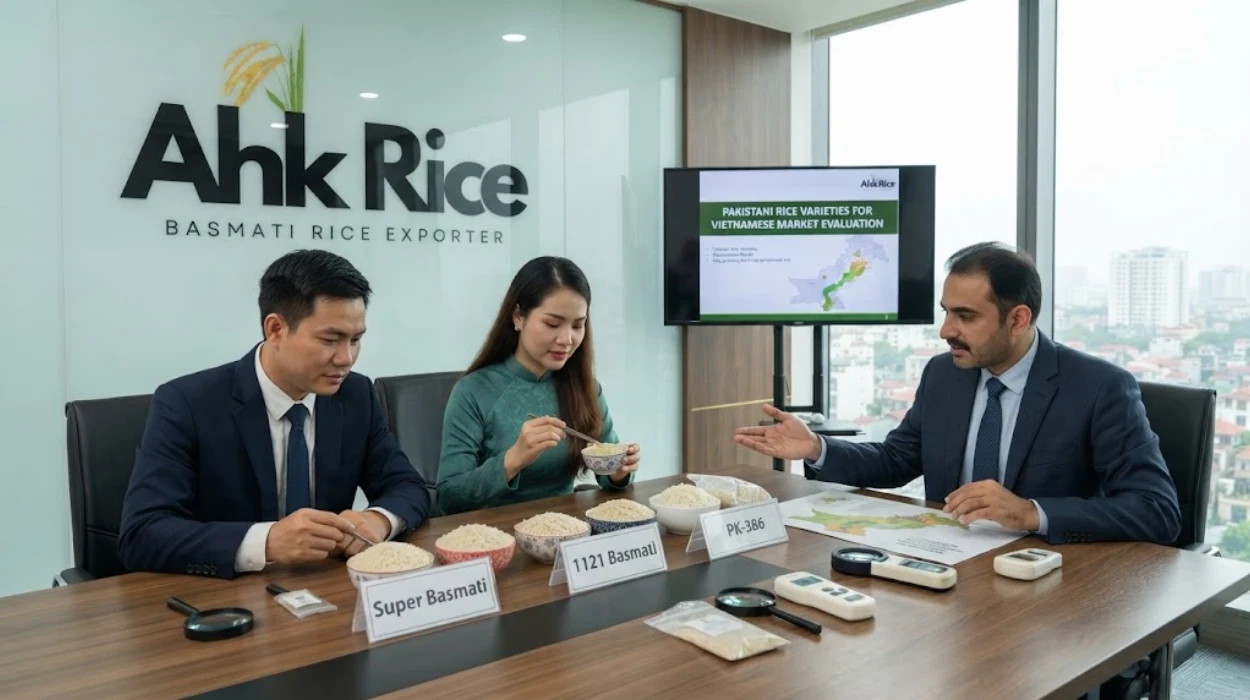
Vietnamese importers are not evaluating Pakistani rice as one commodity. They are comparing grain length, aroma, processing, cooking performance, price, packaging, and storage requirements. Buyers researching the market can first review which Pakistani rice types are emerging in Vietnam’s premium and foodservice segments before moving into grade-level trial decisions.
Pakistan and Vietnam also strengthened commercial discussions in 2025. Vietnam expressed interest in increasing imports of Pakistani rice during bilateral trade discussions. (source: Pakistan Ministry of Information and Broadcasting, July 2025) This creates a wider commercial setting for trial shipments, distributor sourcing, and specialty-rice programs.
What are the available Pakistani rice solutions for Vietnamese importers?
1121 targets premium demand, Super Kernel targets aroma-led value, and 1509 targets cost-controlled volume applications. Here is why: each grade combines different grain characteristics, processing formats, price positions, and foodservice uses.
1121 Basmati
1121 Basmati provides the strongest premium positioning among the three grades. Its extra-long grain structure, aromatic profile, and cooked presentation suit premium restaurants, hotels, specialty retailers, and private-label programs.
1121 can be supplied as White, Steam, Golden Sella, Creamy Sella, and Brown. Steam provides a white appearance and aromatic cooked profile. Sella provides firmer grains and stronger handling performance for catering.
Super Kernel Basmati
Super Kernel provides traditional Pakistani Basmati aroma with a more balanced commercial price position. Its raw grain commonly measures around 7.0–7.5 mm in commercial specifications.
Super Kernel suits restaurants, ethnic distributors, and foodservice buyers seeking recognizable Basmati characteristics. Buyers should specify moisture, broken percentage, grain length, purity, and aroma before trial approval.
1509 Basmati
1509 provides long-grain presentation with stronger cost control than premium 1121 positioning. AHK Rice specifications commonly identify raw grain around 8.10–8.40 mm.
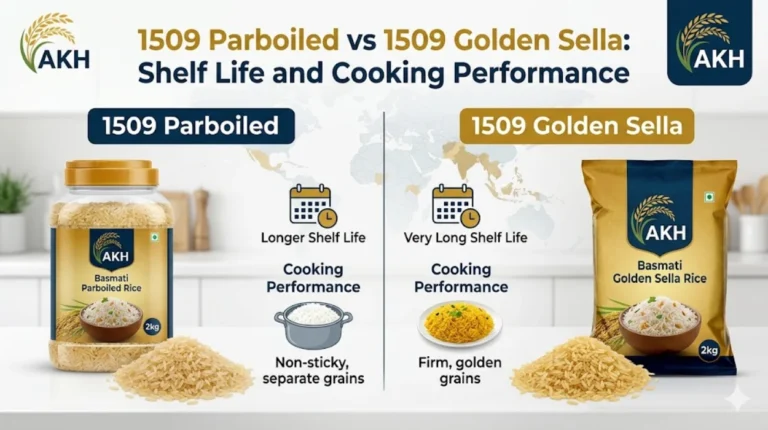
1509 Steam suits fresh white presentation. 1509 Sella and Golden Sella suit catering programs requiring firmer cooked grains. The variety therefore works well for distributors balancing cooking performance with procurement cost.
These grades create three distinct trial pathways. The next comparison shows how their specifications affect commercial selection.
How do Pakistani rice grades compare for Vietnamese buyers?
1121 leads premium positioning, Super Kernel leads aroma-focused value, and 1509 leads cost-controlled foodservice. Here is why: buyers gain different commercial benefits from grain length, aroma, processing, and price.
| Attribute | 1121 Basmati | Super Kernel | 1509 Basmati |
|---|---|---|---|
| Raw grain length | About 8.2–8.4 mm | About 7.0–7.5 mm | About 8.10–8.40 mm |
| Aroma | Strong | Traditional Basmati aroma | Moderate to strong |
| Main positioning | Premium | Aromatic value | Value-premium |
| Processing options | White, Steam, Sella, Brown | White, Brown, Sella | White, Steam, Sella |
| Main buyers | Premium retail, hotels, restaurants | Restaurants, distributors | Foodservice, wholesalers |
| Price benchmark/MT | US$1,175–1,225 | Around US$1,050 | US$1,100–1,150 |
| Storage reference | 18–24 months for suitable Sella formats | 12–18 months planning range | 18–24 months for suitable Sella formats |
The price figures are indicative Pakistani export-market benchmarks, not Vietnam landed prices. AHK Rice market material places 1121 Steam around US$1,225/MT, 1121 White/Sella around US$1,175/MT, Super Basmati around US$1,050/MT, and 1509 around US$1,100–1,150/MT.
Storage depends on processing, moisture, packaging, warehouse conditions, and pest control. Commercial supplier references commonly place Sella grades around 18 months or longer under suitable storage. Other export references place Basmati around 12–18 months under controlled conditions.
The comparison shows that variety alone does not determine commercial value. Processing and end use change the purchasing decision.
Which Pakistani rice grade works best for different Vietnamese cases?
1121 works best for premium presentation, Super Kernel for aromatic value, and 1509 for high-volume foodservice. Here is why: Vietnamese buyers need to match the rice specification with the revenue model of each channel.
Which grade suits premium retail?
1121 Basmati is the strongest choice for premium retail and specialty packaged rice. Its long grain and cooked appearance create a visible premium difference on the shelf.
Retailers can use 5 kg or smaller consumer packs for premium positioning. Private-label buyers can specify Steam, White, or Sella according to their cooking and merchandising requirements.
Which grade suits restaurants?
1121 and Super Kernel serve restaurants with different value propositions. 1121 emphasizes grain presentation. Super Kernel emphasizes traditional aroma.
Indian, Pakistani, Middle Eastern, and international restaurants can evaluate both grades through cooking trials. Aroma, grain separation, plate appearance, and cost per serving should determine final selection.
Which grade suits catering?
1509 Sella or Golden Sella suits cost-controlled catering and banquet applications. Parboiling produces firmer grains and supports handling during large-batch preparation.
Hotels and caterers can also evaluate 1121 Sella for premium menus. The higher procurement cost makes it more suitable for menus where presentation creates additional selling value.
Which grade suits distributors?
Super Kernel and 1509 provide practical distributor options across different price tiers. Super Kernel supports an aroma-led proposition. 1509 supports a stronger value proposition.
Distributors can therefore build a two-tier portfolio. Super Kernel can serve premium ethnic customers. 1509 can serve price-sensitive restaurants and institutional buyers.
The correct grade depends on the buyer’s channel. Regional market conditions add another layer to the decision.
Which Vietnamese market regions show the strongest fit for these grades?
Southern Vietnam favors Ho Chi Minh City-linked specialty and foodservice distribution, while northern Vietnam supports Hanoi-linked premium and institutional channels. Here is why: the two regions connect imported rice with different distribution networks and customer groups.
Southern Vietnam
Ho Chi Minh City provides a practical market for premium restaurants, specialty distributors, and foodservice importers. Southern distributors can evaluate 1121 for premium menus and packaged rice.
Super Kernel also fits restaurants seeking traditional aromatic rice. 1509 provides a lower-cost option for catering and larger foodservice accounts.
Pakistan-to-Vietnam shipment records confirm active commercial movement into Vietnam. Volza’s 2026 dataset identifies Vietnamese buyers and Pakistani suppliers participating in the trade route. (source: Volza, August 2026)
Northern Vietnam
Hanoi and northern distribution networks provide opportunities for premium retail, restaurants, and institutional foodservice. 1121 fits buyers emphasizing presentation and premium imported products.
Super Kernel fits aroma-focused distributors. 1509 fits buyers requiring long-grain presentation with tighter purchasing budgets.
The two regions therefore do not require different rice varieties. They require different positioning, packaging, and landed-cost strategies.
Regional price comparison
| Market region | Preferred grades | Indicative Pakistani price/MT | Best commercial use |
|---|---|---|---|
| Southern Vietnam | 1121, Super Kernel, 1509 | US$1,050–1,225 | Restaurants, distributors, foodservice |
| Northern Vietnam | 1121, Super Kernel, 1509 | US$1,050–1,225 | Retail, hospitality, institutional |
The origin price remains broadly grade-driven rather than region-driven. Freight, port handling, customs, packaging, and inland transport create the regional landed-cost difference.
The regional comparison establishes where the grades fit. The next issue is which processing approach provides the best commercial result.
Which processing approach works best for Vietnamese trial orders?
White, Steam, and Sella processing serve different trial objectives. Here is why: processing changes appearance, cooking behavior, grain strength, and storage performance.
White rice
White rice provides the most familiar milled appearance and supports fast-turn retail programs. Buyers should evaluate whiteness, broken percentage, aroma, and cooked texture.
White processing works well when the buyer prioritizes natural appearance and direct consumption. It also provides a straightforward baseline for comparing varieties.
Steam rice
Steam processing provides a white appearance with stronger cooked-grain performance. It suits restaurants and retail programs requiring attractive grains after cooking.
1121 Steam supports premium presentation. 1509 Steam supports more cost-conscious foodservice applications.
Sella rice
Sella processing provides firmer cooked grains and stronger storage characteristics. Parboiling changes the grain structure before drying and milling.
1121 Sella suits premium catering. 1509 Sella suits volume catering. Super Kernel Sella provides an aromatic option for buyers requiring parboiled performance.
Trial orders should compare the same variety across processing types. This isolates the effect of processing from the effect of variety.
What are the pros and cons of each Pakistani rice grade?
1121 offers the strongest premium presentation, Super Kernel offers aromatic value, and 1509 offers stronger cost control. Here is why: each advantage also creates a corresponding purchasing trade-off.
| Grade | Main advantage | Main limitation | Example buyer |
|---|---|---|---|
| 1121 | Extra-long premium presentation | Higher procurement cost | Premium hotel |
| Super Kernel | Strong traditional aroma | Shorter grain than 1121 | Specialty distributor |
| 1509 | Cost-efficient long grain | Less premium positioning | Catering wholesaler |
| 1121 Sella | Firm cooked grain and storage | Higher price | Banquet operator |
| 1509 Sella | Cost control with parboiled performance | Lower premium perception | Institutional caterer |
1121 works when the selling price supports a premium procurement cost. Super Kernel works when aroma drives customer preference. 1509 works when volume and food cost control dominate.
Vietnamese importers should therefore avoid selecting a grade from price alone. The final decision requires a measurable framework.
What decision factors should Vietnamese importers use?
The strongest decision framework combines application, specification, price, storage, and supplier execution. Here is why: these five factors connect the physical rice with the commercial outcome.
| Decision factor | What to check | Best-fit direction |
|---|---|---|
| Customer segment | Retail, restaurant, catering, wholesale | Match grade to buyer |
| Grain specification | Length, broken percentage, moisture | Approve measurable limits |
| Processing | White, Steam, Sella | Match cooking requirement |
| Price | FOB and landed US$/MT | Compare identical specifications |
| Supply execution | Sampling, inspection, packing, shipping | Select repeatable supplier |
The first decision is customer segment. A premium restaurant has different requirements from a mass-market distributor.
The second decision is specification. Grain length and broken percentage should appear in the purchase specification.
The third decision is processing. Steam and Sella should not be treated as interchangeable products.
The fourth decision is price. Buyers should compare the same grade, packing, quantity, and Incoterm.
The fifth decision is supply execution. Sampling, inspection, documentation, packing, and shipment consistency determine whether a trial becomes a repeat order.
This framework turns trial adoption into a controlled procurement process rather than a simple price comparison.
How should Vietnamese importers evaluate a Pakistani rice trial?

Vietnamese importers should define specifications, request representative samples, test cooking performance, verify documents, and compare the approved sample with commercial production. Here is why: trial adoption becomes commercially useful only when the sample represents the shipment.
Start by defining the variety and processing grade. State grain length, broken percentage, moisture, packing size, quantity, destination port, and Incoterm.
Request a representative sample. A sample should match the commercial specification rather than demonstrate a different premium grade.
Test physical characteristics. Check length, color, broken grains, foreign matter, aroma, and uniformity.
Test cooking performance. Measure water absorption, elongation, separation, texture, aroma, and cooked appearance.
Verify documentation. Review the Certificate of Analysis, Certificate of Origin, phytosanitary documentation, invoice, packing list, and bill of lading requirements.
Compare commercial economics. Evaluate FOB price, freight, insurance where applicable, destination costs, customs, warehousing, and local distribution.
Pakistan-to-Vietnam trade data confirms that trial-scale and commercial shipments already occur. Volza records Basmati and other rice shipments from Pakistan into Vietnam, including 20 kg Basmati entries in its shipment records. (source: Volza)
AHK Rice applies a specification-led process covering sourcing, milling, grading, sorting, packaging, inspection, and export coordination. This approach supports buyers moving from product trial toward repeat shipment.
The trial process therefore provides the bridge between market interest and commercial procurement.
What does the 2026 trial-adoption trend mean for Pakistani rice suppliers?
The 2026 opportunity is concentrated in differentiated Basmati applications rather than direct competition with Vietnam’s mainstream rice supply. Here is why: Vietnamese domestic rice already competes strongly on commodity pricing.
Vietnam remains a major rice producer and exporter. Pakistani Basmati therefore competes through characteristics rather than volume alone.
Pakistan offers differentiated grain profiles through 1121, Super Kernel, and 1509. The varieties provide different combinations of length, aroma, processing, cooking performance, and price.
Current Vietnam-focused market analysis also places Pakistani Basmati in premium retail, hospitality, catering, and specialty foodservice rather than mainstream commodity competition.
For Vietnamese importers, the strongest trial strategy is therefore specification-led. The buyer should select a customer segment first, then choose the rice grade, processing method, packaging, and commercial price.
For readers moving from grade comparison toward broader procurement and market opportunities, the next logical resource is Pakistan-Vietnam rice trade dynamics and emerging opportunities.
Frequently Asked Questions
Which Pakistani rice grade is gaining the strongest premium trial interest in Vietnam?
1121 Basmati has the strongest premium trial proposition. Its extra-long grain, aroma, and cooked presentation support premium restaurants, hotels, specialty retail, and private-label programs.
Is Super Kernel Basmati suitable for Vietnamese importers?
Super Kernel suits aroma-focused Vietnamese buyers seeking a balance between Basmati characteristics and procurement value. Its commercial specification commonly targets 7.0–7.5 mm raw grain with controlled moisture and low broken percentage.
Why are Vietnamese buyers testing 1509 Basmati?
1509 provides long-grain presentation with stronger cost control. Its typical raw grain specification sits around 8.10–8.40 mm, making it suitable for restaurants, catering, wholesalers, and institutional foodservice.
Which Pakistani rice processing grade is best for catering?
Sella is the strongest processing option for catering programs requiring firm cooked grains and storage stability. 1121 Sella targets premium catering. 1509 Sella targets cost-controlled catering.
What is the indicative Pakistani rice price per MT for Vietnam?
Indicative benchmarks range from about US$1,050 to US$1,225/MT depending on variety and processing. These figures represent origin-level references. Vietnam landed prices also include freight, handling, customs, packaging, and other destination costs.
How long can Pakistani Basmati rice be stored?
Suitable Sella Basmati commonly carries an 18–24 month commercial storage reference under controlled conditions. Storage depends on moisture, packaging integrity, temperature, humidity, pest control, and warehouse hygiene.
What should Vietnamese importers test before approving a Pakistani rice grade?
Importers should test grain length, broken percentage, moisture, appearance, aroma, cooking expansion, texture, separation, and food-safety parameters. The approved sample should become the reference for commercial production.
Which Pakistani rice grade should a Vietnamese distributor trial first?
1121 suits premium channels, Super Kernel suits aroma-led channels, and 1509 suits cost-sensitive channels. The first trial should match the distributor’s actual customer segment rather than follow one universal grade recommendation.