What Are Pesticide Residue and Aflatoxin Limits for Basmati Rice Imported into the UAE?
Pesticide residue and aflatoxin limits define the maximum permitted levels of agricultural chemicals and toxic fungal compounds in food. For Basmati rice entering the UAE, importers must verify applicable food safety requirements, laboratory results, product documentation, and shipment compliance before distribution.
Basmati rice is a long-grain aromatic rice traditionally grown in Pakistan and India. Pakistani Basmati is cultivated mainly in Punjab, where climate, soil conditions, water availability, and farming practices influence grain development and aroma. Export varieties include 1121, Super Kernel, and 1509, each serving different retail, wholesale, and foodservice requirements.
Pesticide residues are traces of agricultural chemicals remaining in rice after pest control during cultivation or storage. Aflatoxins are toxic substances produced by certain moulds, particularly Aspergillus species, under favourable environmental conditions. These hazards have different sources, testing methods, and regulatory limits.
The UAE applies its food safety framework alongside relevant Gulf technical regulations and applicable international standards. The precise legal limit depends on the contaminant, pesticide active substance, food category, and applicable regulation. Importers must verify the current requirement for their product rather than assume one universal limit applies to every Basmati rice grade.
How Does the UAE Regulate Pesticide Residues in Imported Basmati Rice?
The UAE regulates pesticide residues through mandatory technical requirements, including Cabinet Resolution No. 116 of 2024 on maximum residue limits in agricultural and food products. Importers must check each pesticide against the applicable rice-specific limit before approving a shipment.
A maximum residue limit (MRL) is the highest legally permitted concentration of a pesticide residue in a food commodity, expressed in milligrams per kilogram (mg/kg). The limit relates to an authorised pesticide use and the residue definition specified in the applicable standard.
Rice does not have one universal MRL covering every pesticide. Each active substance has its own regulatory entry, and the permitted concentration varies by commodity and applicable rule. A result for one pesticide does not establish compliance with every other pesticide.
For example, a laboratory report showing a pesticide residue of 0.02 mg/kg must be compared with the current UAE limit for that particular substance in the relevant rice category. A concentration below one pesticide’s limit does not establish that another pesticide is compliant.
The UAE’s applicable technical regulation takes priority when determining legal acceptance. The Codex Alimentarius pesticide database provides an international reference for checking pesticide and commodity combinations, but a Codex value must not automatically be treated as the UAE’s legally applicable limit.
What Are Aflatoxins, and Why Are They Tested in Rice?
Aflatoxins are toxic compounds produced by certain moulds that develop under favourable moisture and temperature conditions. Rice importers assess aflatoxin contamination separately from pesticide residues because the compounds have different sources, analytical methods, health implications, and applicable food safety requirements.
Aflatoxin B1 is one of the principal aflatoxins monitored in food safety testing. Other commonly identified forms include B2, G1, and G2. The relevant legal requirement specifies which compounds or totals must be measured and the maximum permitted concentration.
Aflatoxin contamination is associated with fungal growth before harvest or during storage. Poor drying, moisture ingress, condensation, damaged packaging, and unsuitable warehouse conditions increase the risk of fungal development. Rice that appears clean and smells normal is not automatically free from aflatoxins.
The testing method must match the applicable regulatory requirement. Laboratories use validated methods such as high-performance liquid chromatography (HPLC) or liquid chromatography coupled with tandem mass spectrometry (LC-MS/MS). Immunoassay screening methods are also available, with confirmatory testing applied where required.
Aflatoxin limits depend on the governing standard and food category. Importers must confirm the applicable UAE or adopted Gulf requirement for the specific rice product before setting a pass-or-fail threshold. A limit intended for nuts or maize must not be transferred to Basmati rice without a valid regulatory basis.
What Are the Applicable Numerical Limits for Pesticides and Aflatoxins?
There is no single numerical limit covering all pesticide residues and aflatoxins in UAE-bound Basmati rice. Each pesticide has an individual MRL, while aflatoxin requirements depend on the applicable contaminant standard and rice category. Verify current official requirements before shipment.
The following table explains how importers should interpret the limits rather than substitute unverified figures for legal thresholds.
| Parameter | How the limit is determined | What the importer checks |
|---|---|---|
| Individual pesticide residue | Applicable UAE MRL for the active substance and rice category | Measured residue in mg/kg |
| Multiple pesticide residues | Each substance assessed against its relevant MRL | Every reported pesticide result |
| Aflatoxin B1 | Applicable UAE or adopted food contaminant standard | B1 concentration and required limit |
| Total aflatoxins | Applicable standard defining the compounds included in the total | Combined concentration of specified aflatoxins |
| Laboratory reporting limit | Analytical method and laboratory capability | Whether the method detects residues at the required level |
The distinction between a maximum limit and a laboratory detection limit matters. A detection limit describes the analytical method’s ability to identify a substance. An MRL defines the legal threshold. A laboratory report marked “not detected” means the substance was not detected above the method’s reporting capability; it does not necessarily mean the concentration is exactly zero.
Before purchasing a commercial shipment, the importer should obtain the current regulatory references for the intended product and confirm them with the relevant UAE food control authority or competent compliance adviser.
How Is Basmati Rice Tested Before Export to the UAE?
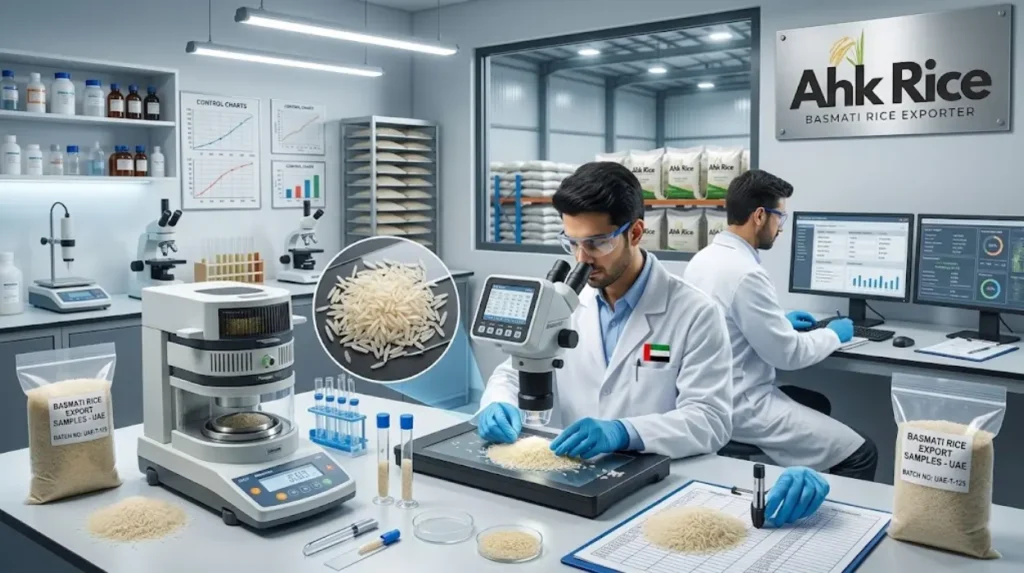
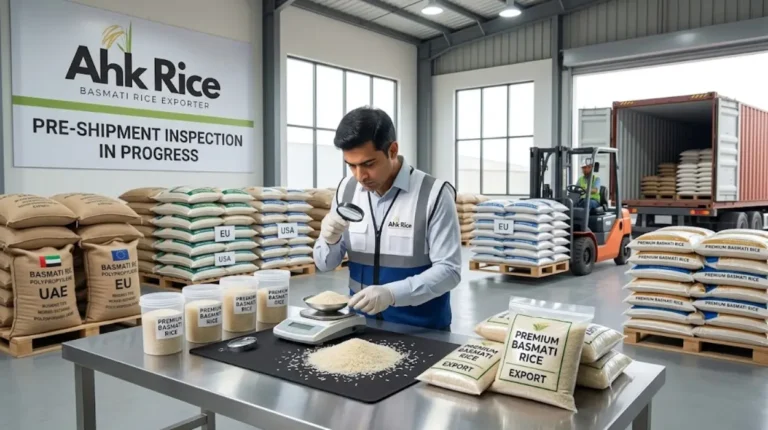
Basmati rice testing starts with representative sampling, followed by laboratory analysis, comparison against applicable regulatory limits, and review of the final report. Exporters use these steps to identify non-compliant lots before loading and to maintain traceability between test results and shipped consignments.
The testing process generally follows six stages.
1. Identify the rice variety and lot
The exporter records the variety, crop or production batch, milling details, lot number, and intended destination. Varieties such as 1121, Super Kernel, and 1509 require clear product identification so that the sample corresponds to the goods being supplied.
2. Collect a representative sample
A trained sampler collects portions from appropriate bags or points within the lot according to a recognised sampling procedure. The portions are combined or handled as required by the method to represent the consignment. Poor sampling can produce misleading results even when laboratory analysis is technically sound.
3. Select the correct pesticide panel
The laboratory tests for pesticides relevant to the crop’s production history, risk assessment, and destination requirements. A multi-residue analysis screens for multiple compounds in one testing programme. The selected panel must cover the substances required for the intended compliance decision.
4. Test for aflatoxins
The laboratory prepares and analyses the sample using a validated method suitable for the rice matrix and required thresholds. The report identifies the compounds tested, measured concentrations, units, and method information.
5. Review the certificate of analysis
A certificate of analysis (COA) records the sample identity, test parameters, analytical findings, and laboratory details. The importer checks that the reported results match the agreed specification and applicable UAE requirements. The COA should relate to the actual production lot, not an unrelated sample.
6. Release the lot for shipment
The exporter reviews test results alongside grain specifications, packaging details, inspection records, and required export documents. If a result exceeds an applicable limit, the lot must not be treated as compliant merely because other quality indicators pass.
Which Basmati Rice Grades and Processing Methods Affect Testing?
Basmati grades describe variety, grain dimensions, processing style, broken-grain percentage, moisture, and purity. These commercial characteristics influence product identity and handling, while pesticide and aflatoxin compliance must be assessed separately against the applicable food safety requirements.
Common Pakistani Basmati varieties include:
- 1121 Basmati: A long-grain variety used in premium retail, foodservice, and private-label products. Commercial forms include Steam, Golden Sella, Creamy Sella, Brown, and broken rice.
- Super Kernel Basmati: A traditional aromatic variety used by retail distributors, wholesalers, and foodservice buyers seeking characteristic Basmati aroma and cooking performance.
- 1509 Basmati: A variety associated with a shorter growing period and commercial applications where yield, pricing, and grain presentation are important. Export grades include White and Steam rice, with other processing specifications agreed by buyer and seller.
Processing begins with paddy intake and quality inspection. The paddy is cleaned to remove foreign material, dehusked to remove the outer husk, and milled or polished according to the intended product. Grading and sorting separate grains by size and quality. Additional steps include colour sorting, blending where permitted and specified, inspection, and packing.
Raw White rice, Steam rice, Golden Sella, and Brown rice differ in processing. Parboiling involves soaking and heat treatment before drying and milling, while Steam processing uses controlled steaming as part of preparation. These processes do not replace pesticide or aflatoxin testing.
Moisture control, dry storage, clean handling, and suitable packaging help reduce deterioration risks. However, attractive appearance, long grain length, low broken percentage, and controlled moisture do not prove that chemical residues meet UAE limits.
Which Certifications and Documents Support UAE Rice Import Compliance?
Food safety certificates and shipment documents support traceability, hygiene management, and regulatory review, but they do not automatically establish compliance with every pesticide or aflatoxin limit. Importers must match documentation to the product, shipment, and destination requirements.
Important records include:
- Certificate of analysis: Reports pesticide residues, aflatoxins, and other agreed parameters.
- Food safety management certification: HACCP-based systems and ISO 22000 certification support hazard control and documented food safety processes.
- Phytosanitary certificate: Addresses applicable plant health requirements for the consignment.
- Commercial invoice and packing list: Identify the seller, buyer, quantity, packaging, and goods.
- Certificate of origin: Identifies the declared country of origin when required.
- Transport and customs documents: Support shipment identification, clearance, and traceability.
Not every shipment requires every document in the same form. Requirements depend on the product, competent authority, import route, and current regulations. Importers should confirm the exact document list with the UAE importer, customs broker, and relevant food control authority before dispatch.
A quality management certificate is evidence of a management system, not proof that every shipment passes residue testing. Likewise, a phytosanitary certificate does not replace a pesticide residue report or an aflatoxin analysis when those tests are required.
What Are the Main Benefits of Pre-Shipment Residue and Aflatoxin Testing?
Pre-shipment testing helps importers identify contamination risks, evaluate supplier consistency, and prepare evidence for food safety reviews. It also supports purchasing decisions, shipment traceability, and corrective action before rice reaches UAE ports, warehouses, retail outlets, or foodservice customers.
The main benefits include:
- Regulatory preparation: Results help verify whether a lot meets the applicable pesticide and contaminant requirements.
- Supplier evaluation: Buyers compare laboratory reports across batches to assess consistency.
- Traceability: Lot-specific reports connect test findings with the purchased product.
- Risk reduction: Testing identifies potential problems before transport and import clearance.
- Quality assurance: Buyers can combine chemical testing with checks for moisture, purity, broken grains, and packaging integrity.
These benefits depend on representative sampling, appropriate laboratory methods, and accurate interpretation of current standards. A report for an earlier production batch does not automatically establish compliance for a new consignment.
What Common Problems Cause UAE Rice Import Compliance Issues?
Common compliance problems include outdated MRL references, incomplete pesticide panels, unrepresentative sampling, unsuitable analytical methods, and mismatched shipment documents. Importers reduce these risks by agreeing on specifications, testing requirements, sampling procedures, and acceptance criteria before purchasing.
One misconception is that a single pesticide-free declaration proves full compliance. In practice, the importer needs appropriate analytical evidence for the substances and limits relevant to the product.
Another problem is confusing quality grading with food safety. A shipment of premium 1121 Basmati with excellent grain length and aroma can still fail a chemical contaminant requirement. Conversely, a lower-cost grade can meet applicable food safety limits when its production and handling controls are effective.
Poor storage creates a separate risk. Damp warehouses and condensation inside containers increase the potential for fungal growth. Exporters and importers should maintain dry storage conditions, inspect packaging, and investigate signs of moisture damage.
A final misconception is that every laboratory report remains valid indefinitely. Testing decisions depend on the identified lot, sampling date, storage history, test scope, and any subsequent handling that affects the product.
How Should UAE Importers Prepare Before Ordering Pakistani Basmati Rice?
UAE importers should confirm the product grade, applicable legal limits, testing scope, documentation, and lot acceptance criteria before placing an order. A written specification aligns the exporter, laboratory, importer, and customs broker around the same compliance requirements.
A practical pre-purchase checklist includes:
- Identify the Basmati variety and processing style.
- Confirm the current UAE pesticide MRLs for relevant substances.
- Verify the applicable aflatoxin standard and numerical limit for the rice category.
- Agree on the laboratory, sampling procedure, and required analytical methods.
- Request a lot-specific COA covering the agreed parameters.
- Match the report to the product, batch, packaging, and shipment documents.
- Confirm applicable import registration, labelling, and clearance requirements with the relevant authority.
Dubai Municipality publishes food import and release services, while food safety responsibilities also involve the competent authorities in other emirates. Importers should verify their specific requirements before shipment.
For a more detailed explanation of exporter-side controls, laboratory checks, and pre-shipment verification, read the guide on how Pakistani Basmati exporters test for MRLs and aflatoxin before UAE shipment. This follow-up topic explains how the testing process fits into export preparation.
Frequently Asked Questions About Basmati Rice Testing for the UAE
What is the UAE pesticide MRL for Basmati rice?
The applicable MRL depends on the pesticide active substance and rice category. Importers should consult the current UAE technical regulation and verify each relevant substance rather than use one limit for all pesticides.
What is the aflatoxin limit for Pakistani Basmati rice imported into the UAE?
The applicable limit must be confirmed against the current UAE-adopted contaminant standard and the correct rice category. Importers should verify whether the requirement covers aflatoxin B1, total aflatoxins, or another specified measure before approving a lot.
Does every Basmati rice shipment need a pesticide residue test?
Testing requirements depend on applicable regulations, risk controls, and importer or authority requirements. A pre-shipment test is a practical way to assess compliance, but the importer must confirm the specific legal and documentary obligations for the consignment.
Which laboratory methods are used to detect aflatoxins?
Validated methods include HPLC and LC-MS/MS, while suitable immunoassay methods support screening. The selected method must be appropriate for the rice sample, target compounds, and required reporting limits.
Do HACCP and ISO 22000 certificates guarantee compliance?
No. HACCP-based controls and ISO 22000 certification support food safety management, but they do not prove that every shipment meets every pesticide MRL or aflatoxin limit. Lot-specific evidence and regulatory checks remain important.