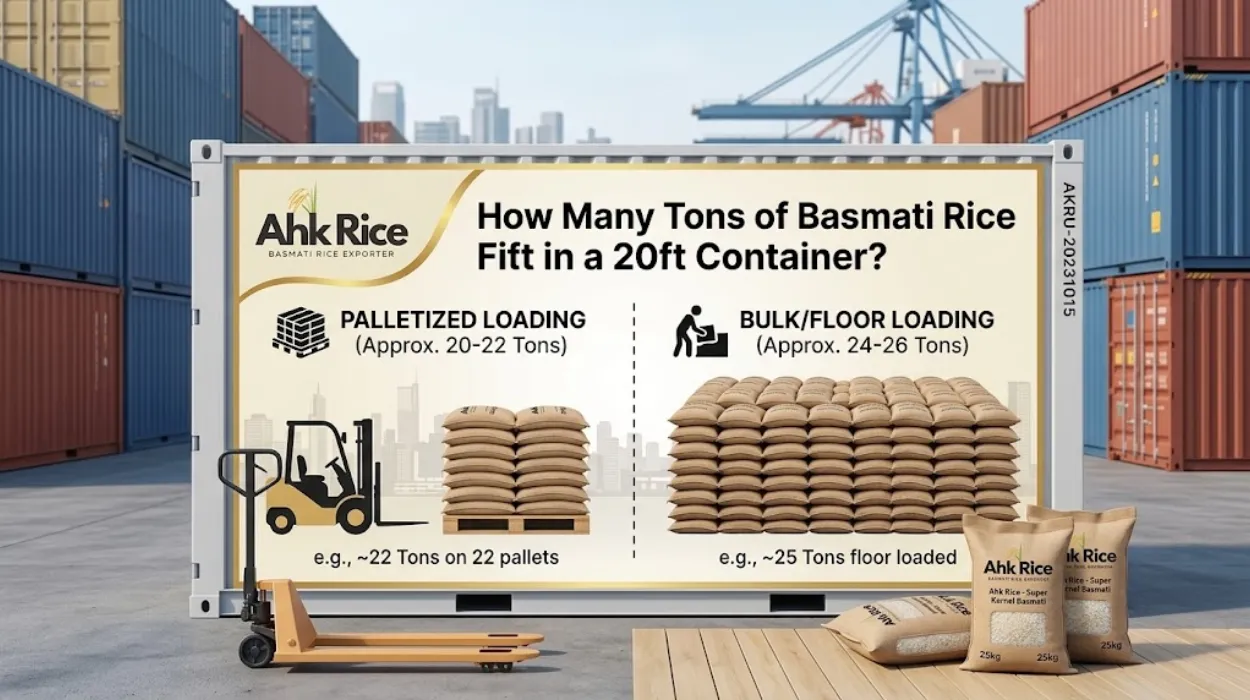
How Many Tons of Basmati Rice Fit in a 20ft Container?
A standard 20ft dry shipping container typically accommodates around 24–27 metric tons of bagged Basmati rice, subject to its payload limit, packaging, loading method and destination regulations. The container’s certified maximum payload and verified shipment weight determine the final allowable cargo quantity.
A 20ft container is a standard freight container used to transport goods by road, rail and sea. Rice exporters use it to move bulk and packaged rice from processing facilities in Pakistan to import markets across the Middle East, Europe, Africa and Asia.
One metric ton equals 1,000 kilograms. Therefore, 25 metric tons of rice equals 25,000 kilograms of net rice weight. The total shipping weight also includes packaging materials and other cargo components, so the net rice quantity is not the same as the container’s gross cargo weight.
The actual capacity depends on three main measurements: the container’s maximum payload, the weight of each bag and the total number of bags loaded. The container’s internal volume also matters when lightweight or bulky packaging fills the available space before reaching the payload limit.
For example, a shipment of 25,000 kilograms of rice packed in 50kg bags contains 500 bags. The same net rice quantity packed in 25kg bags contains 1,000 bags. Both shipments contain 25 metric tons of rice, but their handling requirements differ.
How Is the Loading Capacity of a 20ft Rice Container Calculated?
Rice container capacity is calculated by comparing the container’s certified payload with the combined weight of rice and packaging. The final quantity also depends on internal dimensions, bag arrangement, cargo securing, road limits and shipping-line requirements for the destination.
The calculation starts with the container’s safety plate, which identifies its maximum gross mass and tare weight. Maximum payload is the maximum gross mass minus the container’s empty weight.
For example, if a container has a maximum gross mass of 30,480kg and a tare weight of 2,250kg, its calculated payload is 28,230kg. These figures are illustrative. The actual values depend on the container unit.
The payload must accommodate the complete cargo, including rice bags, pallets, wrapping and securing materials. A shipment containing 25,000kg of rice and 500kg of packaging and securing materials weighs 25,500kg in total.
The shipper must also check road axle limits, the transport route and the carrier’s booking conditions. A container’s theoretical payload does not automatically establish that every road or port movement permits the same weight.
What Is the Difference Between Net Weight, Gross Weight and Payload?
- Net weight: The weight of the rice itself, excluding packaging.
- Gross cargo weight: The rice plus its bags, pallets and other cargo materials.
- Container tare weight: The empty container’s weight.
- Maximum payload: The maximum cargo weight permitted by the container’s rating.
- Maximum gross mass: The combined weight of the container and its cargo.
These terms prevent errors in export documentation. Commercial invoices and packing lists identify the shipment’s net and gross weights, while the shipping documents record the applicable container and transport details.
How Many Bags of Basmati Rice Fit in a 20ft Container?
The number of rice bags depends on the selected bag weight and the approved net cargo quantity. A 25-metric-ton shipment contains 500 bags of 50kg, 1,000 bags of 25kg or 2,500 bags of 10kg each.
The following table illustrates the bag quantities for a net rice shipment of 25 metric tons.
| Bag size | Rice bags per metric ton | Bags for 25 metric tons |
|---|---|---|
| 5kg | 200 | 5,000 |
| 10kg | 100 | 2,500 |
| 20kg | 50 | 1,250 |
| 25kg | 40 | 1,000 |
| 50kg | 20 | 500 |
The calculation uses this formula:
Number of bags = Total net rice weight ÷ Weight per bag
For a 25,000kg shipment packed in 25kg bags, the calculation is 25,000 ÷ 25 = 1,000 bags.
These figures represent mathematical bag counts, not guaranteed loading quantities. Actual loading depends on the container’s payload, packaging dimensions, stacking stability and the approved shipping plan.
Smaller bags require more individual units, labels and handling operations. Larger bags reduce the number of units, but they require suitable lifting practices and secure stacking. The buyer’s distribution model determines the appropriate package size.
What Factors Determine Basmati Rice Container Capacity?
Four factors determine the final rice quantity: payload, container dimensions, bag specifications and loading configuration. Packaging material, pallet use, cargo securing and destination transport restrictions also affect the net quantity approved for shipment.
Container specifications
A standard dry 20ft container has internal dimensions of approximately 5.9m long, 2.35m wide and 2.39m high. Exact dimensions vary by container manufacturer and unit.
Its internal volume is approximately 33 cubic metres. This volume accommodates the cargo, but the payload limit determines the maximum permitted weight.
Rice variety and processing
Pakistani Basmati varieties include 1121, Super Kernel and 1509. These varieties are sold in different processing grades, including white, steam and parboiled rice. Processing and grain characteristics affect product specifications, but the declared bag weight remains the basis for calculating bag quantities.
Packaging specifications
Rice exporters use woven polypropylene bags, laminated bags and other food-contact packaging formats. Each format has a different tare weight, strength and physical size. A printed 25kg retail bag and a plain 25kg export sack also have different labelling and presentation requirements.
Palletized or floor-loaded cargo
Floor-loaded shipments place bags directly on the container floor. Palletized shipments place bags on pallets to simplify mechanical handling. Pallets consume space and add weight, so the loading plan accounts for both factors.
The choice depends on warehouse equipment, buyer requirements, destination handling facilities and cargo stability. Neither method automatically produces a higher usable rice capacity in every shipment.
How Is Basmati Rice Processed Before Container Loading?
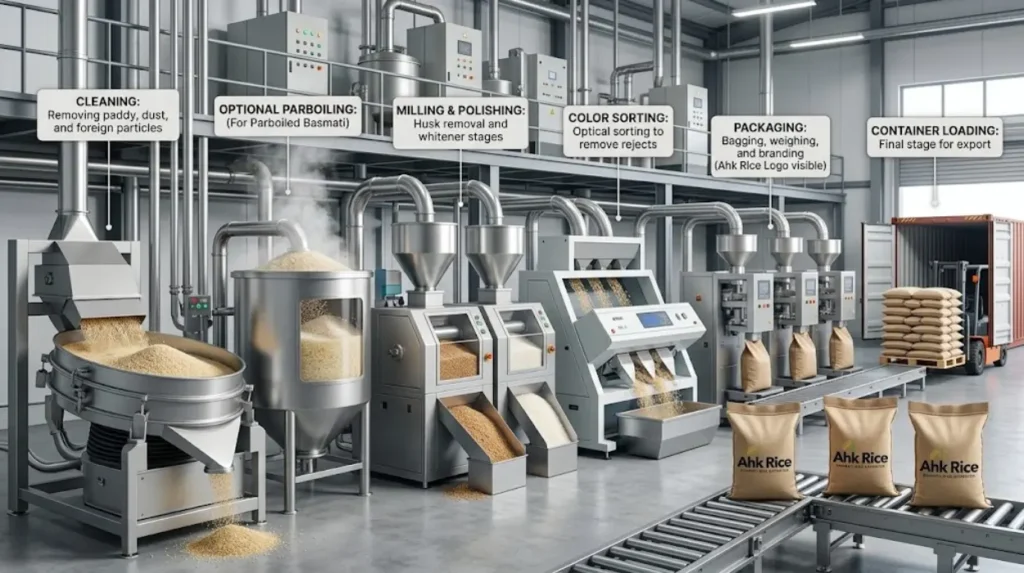
Export Basmati rice passes through receiving, cleaning, grading, milling or processing, quality inspection, packaging and final dispatch. Each stage controls product identity, purity, moisture, grain quality and packaging accuracy before the shipment enters the container.
The processing sequence begins when paddy arrives at a rice mill from farms in Punjab, Pakistan. The mill checks the incoming material and removes unsuitable foreign matter before further processing.
- Receiving and pre-cleaning: Paddy is inspected, weighed and cleaned to remove straw, dust, stones and other impurities.
- Drying and moisture control: Paddy is dried and stored under controlled conditions appropriate to the processing stage. Moisture measurements help protect grain quality during storage and milling.
- Dehusking: Milling equipment removes the outer husk from paddy to produce brown rice.
- Whitening or parboiling: White rice undergoes whitening and polishing. Parboiled grades undergo soaking, steaming and drying before milling, according to the selected process.
- Grading and sorting: Screens and grading equipment separate grains by size. Colour sorters remove discoloured grains and selected defects.
- Quality testing: The processor checks parameters such as broken percentage, grain length, moisture, appearance and foreign matter against the agreed specification.
- Weighing and packing: Approved rice is filled into the specified bag size, weighed and labelled with the required product and traceability information.
- Final inspection and loading: Staff verify bag condition, shipment quantity, container cleanliness and loading records before dispatch.
Different Basmati grades require different specifications. For example, buyers of 1121 Steam often focus on grain length and cooking elongation, while buyers of Super Kernel place importance on traditional aroma and grain appearance. Buyers of 1509 also assess price, yield characteristics and suitability for their intended market.
What Are the Benefits of Correct Rice Container Loading?
Correct container loading protects rice quality, reduces cargo movement, supports accurate shipment documentation and improves handling efficiency. It also helps exporters control transport costs, meet agreed delivery specifications and reduce the risk of moisture damage or damaged bags.
A well-planned load distributes weight appropriately across the container floor. Balanced loading reduces the risk of concentrated loads, shifting cargo and unstable stacks during transportation.
Accurate bag counts simplify stock reconciliation at the destination. For example, a packing list for 500 bags of 50kg rice should match the physical shipment and the agreed net quantity of 25,000kg.
Suitable packaging protects rice from ordinary handling damage. Clean, dry bags and sound closures reduce spillage, while appropriate moisture management helps preserve grain condition during the journey.
Loading efficiency also influences transport economics. An exporter shipping 25 metric tons of rice in one container generally pays less ocean freight per metric ton than an otherwise comparable shipment carrying a substantially smaller quantity, provided freight rates and additional charges remain comparable.
Correct loading does not replace quality control. Rice still requires suitable processing, food-safe packaging, verified specifications and appropriate storage conditions throughout the supply chain.
How Should Basmati Rice Containers Be Prepared for Export?
Export containers require inspection for cleanliness, dryness, structural condition, odours, pests and previous-cargo residues. The loading team verifies container identification, approved cargo weight, packaging integrity and securing arrangements before the container is sealed for dispatch.
A container inspection checks the floor, walls, roof, doors, seals and visible damage. The interior must be dry, clean and free from contamination that affects food safety.
Moisture control is especially important when rice travels through humid climates. Wet container floors, condensation and temperature fluctuations create conditions that damage bags and compromise grain quality. Dry loading conditions and suitable packaging reduce these risks.
The loading team also checks the bag count, lot identification and packing-list details. Container numbers and seal numbers are recorded against the shipment documents.
Fumigation requirements depend on the destination, importing authority, commodity condition and contractual instructions. When required, an authorised provider carries out the treatment and issues the relevant certificate. Fumigation is not an automatic substitute for pest prevention, container inspection or sanitary handling.
For shipments to Jebel Ali, exporters should confirm the buyer’s packaging and handling requirements, shipping-line weight conditions, and the applicable UAE import documentation before dispatch.
A related guide on rice container loading, bag sizes, palletizing and fumigation before shipping to Jebel Ali explains how these decisions work together during shipment preparation.
Which Markets Import Pakistani Basmati Rice in 20ft Containers?
Pakistani Basmati rice reaches importers in the Middle East, Europe, North America, Africa and Asia. Buyers select container quantities, rice grades and packaging formats according to retail demand, wholesale distribution, foodservice requirements and applicable destination import rules.
The United Arab Emirates is an important trading hub for Pakistani rice. Importers serving Dubai and other emirates purchase Basmati for supermarkets, wholesalers, restaurants and regional distribution networks. Common commercial formats include 5kg and 10kg retail packs and 25kg or 50kg wholesale bags.
Saudi Arabia imports Basmati for households, catering companies, restaurants and institutional kitchens. Large foodservice buyers prioritise consistent cooking performance, reliable bag weights and supply continuity.
The United Kingdom and other European markets serve retail and foodservice customers. Importers evaluate grain quality, pesticide residues, traceability, food safety documentation and applicable labelling requirements.
African and Asian markets have varied requirements. Some buyers prefer premium 1121 Basmati, while others prioritise Super Kernel or 1509 according to local cooking preferences, price positioning and distribution needs.
The selected destination influences packaging, labelling, inspection and documentation. It does not change the basic mathematical relationship between bag weight and net rice quantity, but local transport and import rules affect the final shipment plan.
Which Certifications and Documents Apply to Basmati Rice Exports?
Basmati rice exports require commercial and transport documents, with additional certificates determined by destination regulations and buyer contracts. Food safety certification, phytosanitary documentation, fumigation records and laboratory reports apply when required by the importing authority or shipment conditions.
Common export documents include:
- Commercial invoice: Records the buyer, seller, product description, value and agreed trade terms.
- Packing list: Identifies bag counts, package weights, net weight, gross weight and shipment details.
- Bill of lading: Records the ocean carrier’s receipt of cargo and the contract of carriage.
- Certificate of origin: Identifies the declared country of origin when required.
- Phytosanitary certificate: Issued by the authorised plant protection authority when required for the consignment.
- Fumigation certificate: Documents treatment when fumigation is required and performed.
- Certificate of analysis: Records specified laboratory results, such as moisture, broken percentage or relevant contaminant tests.
- Food safety certification: Systems such as HACCP and ISO 22000 demonstrate food safety management arrangements when applicable.
These documents serve different purposes. A quality certificate does not replace a mandatory import permit, and a food safety management certificate does not automatically guarantee compliance with every destination requirement.
For UAE shipments, the importer must verify applicable food registration, labelling, customs and phytosanitary requirements before dispatch. Arabic labelling and product traceability details require particular attention where the relevant rules apply.
What Are the Common Problems and Misconceptions About Rice Container Capacity?
The most common errors are treating maximum payload as net rice capacity, assuming every 20ft container holds the same quantity, ignoring packaging weight and overlooking destination transport restrictions. A verified loading plan resolves these issues before cargo dispatch.
Misconception 1: Every 20ft container holds exactly 25 tons. There is no universal fixed rice capacity. The container’s rating, packaging and transport restrictions determine the permitted load.
Misconception 2: Bag weight equals total cargo weight. A 50kg bag contains 50kg of rice, but the bag itself adds weight to the shipment.
Misconception 3: More internal volume always means more rice. A container reaches its payload limit before its available volume is fully used when dense cargo reaches the permitted weight first.
Misconception 4: Pallets always improve loading efficiency. Pallets simplify handling but consume cargo space and add weight. Floor loading often accommodates a different arrangement.
Misconception 5: Fumigation is mandatory for every shipment. Treatment requirements depend on applicable regulations, cargo conditions and buyer instructions. The exporter must verify the requirements for the specific consignment.
The correct approach is to confirm the container’s specifications, calculate the complete cargo weight, select packaging, prepare the loading plan and verify the destination’s transport and import requirements.
Frequently Asked Questions About Basmati Rice Container Capacity
How many metric tons of Basmati rice fit in a 20ft container?
A practical planning quantity is approximately 24–27 metric tons of bagged rice, subject to the container’s certified payload, packaging weight, carrier rules and transport restrictions. The approved loading plan determines the final quantity.
How many 50kg bags fit in a 20ft container?
A shipment of 25 metric tons contains 500 bags of 50kg each. The final bag count depends on the approved net cargo weight and the container’s payload limit.
How many 25kg bags fit in a 20ft container?
A 25-metric-ton shipment contains 1,000 bags of 25kg rice. Packaging weight and other loading materials must be included when checking the maximum permitted cargo weight.
Can a 20ft container carry 28 metric tons of rice?
A 28-metric-ton net rice load requires a container and transport arrangement that legally accommodate the rice plus all packaging and securing materials. The container rating, shipping-line conditions and road restrictions must be verified before booking.
Is palletized or floor-loaded rice better for export?
Floor loading often maximises the available space for bagged rice, while palletization simplifies mechanical handling. The best option depends on the destination warehouse, buyer requirements, packaging strength and total permitted cargo weight.
Does rice variety affect container capacity?
The variety does not change the bag-count calculation when bag weights are identical. Processing, bag dimensions and packaging configuration affect the loading arrangement, while payload and transport restrictions determine the permitted shipment weight.
What documents are needed to ship Basmati rice to Jebel Ali?
Common documents include a commercial invoice, packing list, bill of lading and applicable origin, phytosanitary, food safety or fumigation documentation. The UAE importer must confirm the current requirements for the specific product and consignment.