What Payment Terms Are Used in Basmati Rice Export Trade?
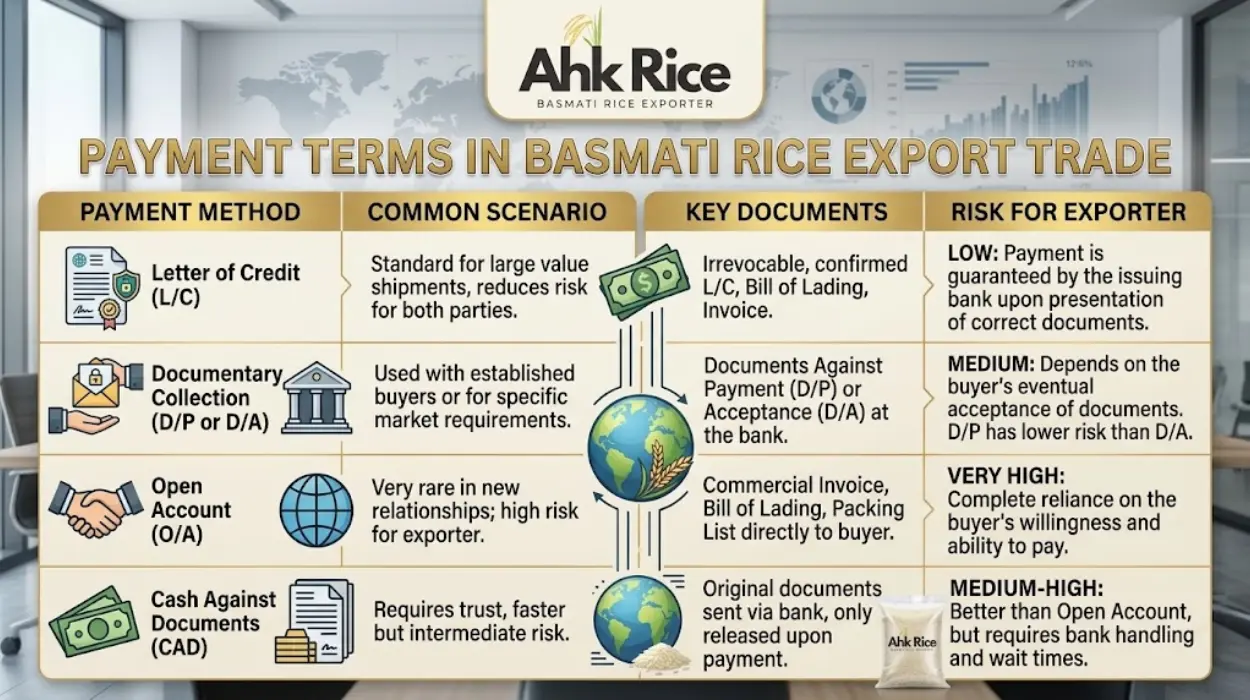
Basmati rice export payment terms define when an importer pays the exporter, which banking documents control payment, and how financial risks are divided between both parties. Common methods include Telegraphic Transfer (TT), Letters of Credit (LC), Cash Against Documents (CAD), and open-account payment.
What Are the Main Payment Terms Used in Basmati Rice Export Trade?
Basmati rice export trade uses four main payment methods: Telegraphic Transfer (TT), Letter of Credit (LC), Cash Against Documents (CAD), and open account. Each method defines payment timing, documentary requirements, banking involvement, and the financial risks shared by exporters and importers.
Payment terms form part of the international sales contract between a rice exporter and an overseas buyer. They determine when the buyer transfers money and when the seller releases shipping documents or cargo.
Telegraphic Transfer (TT)
TT is an electronic bank transfer from the buyer’s bank account to the seller’s nominated account. Exporters receive payment in advance, in stages, or after shipment, depending on the agreed contract.
For example, an importer purchasing 25 metric tonnes of Pakistani 1121 Basmati rice can pay a 30% advance and the remaining 70% before shipment or against agreed shipping documents.
Letter of Credit (LC)
An LC is a bank’s documentary undertaking to pay the exporter when the exporter presents documents that comply with the credit’s terms. An LC at sight provides payment after a complying presentation is examined and accepted under the credit.
For example, a UAE importer purchasing 100 metric tonnes of Super Kernel Basmati rice can arrange an LC through its bank in favour of the Pakistani exporter.
Cash Against Documents (CAD)
CAD is a documentary collection arrangement in which the exporter sends shipping documents through banks and instructs the collecting bank to release them against payment. Banks handle the documents but do not guarantee payment.
For example, an importer pays the collection amount to obtain the bill of lading and other documents required to claim a rice shipment.
Open Account
Open-account terms allow the exporter to ship rice before receiving payment. The buyer pays on a specified future date, such as 30, 60, or 90 days after shipment or invoice issuance.
This arrangement gives the buyer additional working capital but exposes the exporter to late payment, default, and currency risks.
How Does the Export Payment Process Work?
The export payment process starts with a purchase agreement and ends when the exporter receives the contracted funds. The buyer and seller confirm the payment method, shipment conditions, documents, bank charges, currency, deadlines, and remedies for discrepancies before dispatch.
The process connects commercial negotiations with rice processing, shipment preparation, banking procedures, and customs documentation.
Step 1: Agree on the Contract
The buyer and exporter confirm the rice variety, grade, quantity, packaging, price, Incoterm, shipment period, and payment terms.
For example, a contract specifies 50 metric tonnes of 1121 Steam Basmati rice in 25 kg bags, with an agreed price per metric tonne and payment through an LC at sight.
Step 2: Prepare the Rice
The exporter arranges procurement, milling, grading, polishing where specified, sorting, quality inspection, and packing. The buyer’s approved specification defines grain length, moisture, broken percentage, and other quality parameters.
Pakistani Basmati varieties include 1121, Super Kernel, and 1509. Processing records and inspection results help establish whether the supplied rice meets the contract.
Step 3: Complete Export Documentation
The exporter prepares the commercial invoice, packing list, transport document, and applicable certificates. Depending on the destination and contract, the shipment also requires a certificate of origin, phytosanitary certificate, inspection certificate, or other regulatory documents.
The exact requirements depend on the importing country’s regulations, the rice product, and the agreed payment method.
Step 4: Present Documents and Receive Payment
Under an LC, the exporter presents the stipulated documents to the nominated or issuing bank. Under CAD, the banks process the collection instructions and release documents against payment or another agreed condition.
Under advance TT, payment arrives before shipment according to the contract. Under open account, the exporter receives payment after the agreed credit period.
What Are the Key Components of Rice Export Payment Terms?
A complete payment agreement identifies the payment method, deposit percentage, balance due date, currency, bank charges, documentary conditions, and consequences of delayed payment. These components establish financial responsibilities and reduce disputes between international rice buyers and exporters.
The following components define how an export transaction operates:
- Payment schedule: Specifies advance payments, instalments, or the final balance due date.
- Contract currency: Identifies the settlement currency, such as US dollars.
- Bank charges: Allocates issuing, advising, confirmation, amendment, and transfer fees.
- Documentary requirements: Lists invoices, bills of lading, certificates, and other required records.
- Shipment conditions: Connects payment obligations to shipment dates and agreed Incoterms.
- Discrepancy procedures: Establishes how parties resolve differences in quantities, specifications, or documents.
- Default provisions: Defines remedies for late payment, non-payment, or failure to fulfil contractual obligations.
These details matter because an international rice transaction involves several independent activities. Rice quality approval, container loading, customs clearance, and bank document examination follow different procedures.
What Are the Benefits of Different Payment Methods?
Each payment method serves a different commercial purpose. Advance TT improves exporter cash flow, LC provides a bank-backed documentary payment undertaking, CAD links document release to payment, and open account supports buyers who require credit for established trading relationships.
The benefits depend on the transaction value, buyer history, bank arrangements, and ability to manage risk.
| Payment method | Main benefit | Main limitation |
|---|---|---|
| Advance TT | Funds arrive before production or shipment | Buyer carries advance-payment risk |
| LC at sight | Bank undertaking supports compliant documentary payment | Banking fees and strict document requirements |
| CAD | Documents are released against agreed collection conditions | Banks do not guarantee payment |
| Open account | Buyer receives goods before paying | Exporter bears significant credit risk |
For a new importer, advance TT reduces the exporter’s risk of non-payment but requires the buyer to trust the seller’s ability to deliver. An LC offers a structured documentary mechanism when the buyer and seller need greater payment security.
CAD suits transactions where the exporter wants control over shipping documents until payment. Open account generally suits established business relationships supported by credit checks, insurance, or other risk controls.
No method eliminates every risk. Parties must also consider cargo quality, transport delays, exchange-rate movements, fraud, and disputes over contract performance.
Which Payment Terms Suit Different Basmati Rice Importers?
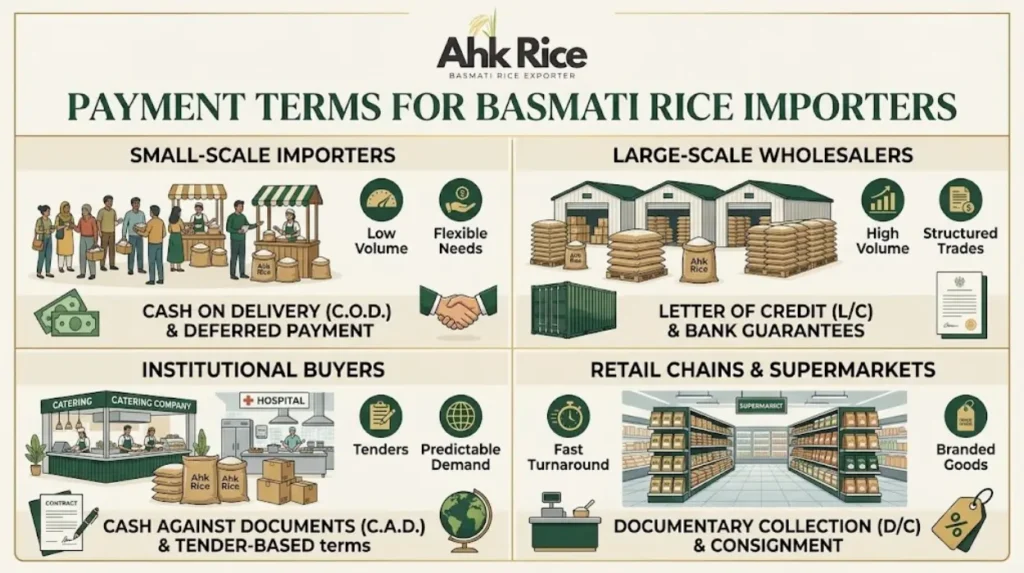
The appropriate payment method depends on the importer’s trading history, order value, financial strength, and destination-market requirements. New buyers often prefer documentary banking arrangements, while established buyers negotiate advance transfers, staged payments, or credit terms according to their commercial relationship.
Different business models create different payment needs.
First-Time Importers
A first-time importer purchasing Pakistani Basmati rice benefits from clearly documented payment conditions. An LC at sight provides a formal bank undertaking subject to its terms, while staged TT payments require careful supplier verification and a clear refund or default clause.
UAE Rice Importers
UAE importers source rice for supermarkets, wholesalers, restaurants, catering companies, and re-export operations. Their preferred terms depend on shipment size, cash-flow requirements, and the exporter relationship.
A buyer comparing banking costs and payment security should review LC at sight, TT advance, and CAD payment options for UAE rice importers. The comparison helps buyers understand the differences between advance payment, documentary credit, and documentary collection before signing an export contract.
Bulk and Institutional Buyers
Large distributors and institutional buyers purchase rice in container quantities and require predictable delivery schedules. LC or negotiated staged payments provide defined financial milestones for high-value shipments.
Established Distributors
Buyers with a consistent payment history negotiate longer credit periods when exporters accept the additional risk. Credit limits, payment guarantees, trade credit insurance, and documented collection procedures help control exposure.
What Problems and Misconceptions Affect Rice Export Payments?
Common payment disputes arise from unclear contract wording, documentary discrepancies, unverified suppliers, unexpected bank fees, and confusion about when payment becomes due. Importers and exporters reduce these problems through written payment schedules, document checks, verified bank details, and clearly defined contractual responsibilities.
Misconception 1: An LC Guarantees Every Aspect of a Shipment
An LC provides a bank undertaking subject to its terms and a complying documentary presentation. It does not automatically guarantee rice quality, successful delivery, or the absence of cargo damage.
The buyer should establish independent inspection procedures and precise quality specifications.
Misconception 2: CAD Guarantees Payment
CAD is a collection method, not a bank payment guarantee. If the buyer refuses to pay, the exporter faces the cost of delayed cargo, storage, demurrage, or arranging an alternative buyer.
The exporter should assess the buyer’s creditworthiness before dispatch.
Misconception 3: TT Is Always Risk-Free
TT is a transfer mechanism. Its risk depends on the payment timing and the trust between both parties.
An advance transfer exposes the buyer to delivery risk. A transfer due after shipment exposes the exporter to non-payment risk.
Misconception 4: Shipping Documents Are Identical for Every Market
Export documentation varies by destination, shipment, product, and contract. A UAE shipment, for example, requires compliance with applicable food-import, labelling, customs, and phytosanitary rules.
The exporter and importer should confirm the current requirements with their banks, customs representatives, and relevant authorities before dispatch.
How Do Quality Certifications and Export Documents Support Payment?
Quality certifications and export documents establish product identity, traceability, and compliance with contractual or regulatory requirements. Their role in payment depends on the LC, collection instructions, sales contract, and destination rules; no single certificate automatically guarantees payment or import clearance.
Basmati rice exporters prepare documentation according to the shipment and importing market.
- Certificate of origin: Identifies the declared country of origin.
- Phytosanitary certificate: Confirms the applicable plant-health requirements for the consignment.
- Certificate of analysis (COA): Records agreed laboratory or quality parameters when required.
- Inspection certificate: Documents the results of an agreed inspection.
- Commercial invoice and packing list: State the transaction value, product description, quantities, and package details.
- Food safety certifications: Systems such as HACCP and ISO 22000 support food-safety management where applicable, but do not replace mandatory import documents.
For Pakistani Basmati rice, the exporter coordinates processing, grading, packing, inspection, and export documentation against the agreed specification. Importers should confirm whether their destination requires additional laboratory tests, registrations, or certificates.
Payment documents must match the contractual and banking requirements. Even a compliant rice shipment faces payment delays when invoices, transport documents, quantities, dates, or certificate details conflict with the LC terms.
What Should Buyers Check Before Agreeing to Export Payment Terms?
Buyers should verify the exporter, inspect the rice specification, confirm the bank details independently, and review the complete payment schedule before transferring funds. The sales contract must define documentary requirements, shipment deadlines, quality tolerances, bank fees, and dispute procedures.
Use this checklist before confirming an order:
- Verify the exporter’s legal identity and business banking details.
- Confirm the rice variety, grade, broken percentage, moisture, and packing specifications.
- Agree on the payment method, currency, advance amount, and balance deadline.
- Review LC wording with the relevant bank before shipment.
- Confirm required export documents and destination-market regulations.
- Allocate bank charges and define responsibility for discrepancies.
- Establish procedures for delayed shipment, rejected documents, and non-payment.
A well-defined payment agreement connects financial obligations with the physical shipment. It gives the buyer and exporter a common framework for processing, documentation, and settlement.
Frequently Asked Questions
What are the most common payment terms for Basmati rice exports?
The most common methods are Telegraphic Transfer (TT), Letter of Credit (LC), Cash Against Documents (CAD), and open account. The contract determines the payment schedule and responsibilities.
What is the difference between TT advance and LC at sight?
TT advance requires the buyer to transfer funds before the agreed shipment stage. LC at sight involves a bank undertaking to pay against a complying documentary presentation under the credit.
Is CAD safe for Basmati rice importers?
CAD provides a document-release arrangement linked to payment, but banks do not guarantee that the goods meet specifications or that the buyer will accept the documents. Both parties must assess the risks.
Which payment method is suitable for UAE rice importers?
The suitable method depends on the buyer’s financial position, supplier relationship, transaction value, and banking arrangements. Advance TT, LC at sight, and CAD each have different costs and risk allocations.
What documents are required for rice export payment?
Common documents include the commercial invoice, packing list, and bill of lading or other transport document. The LC, collection instructions, sales contract, and destination rules determine additional requirements.