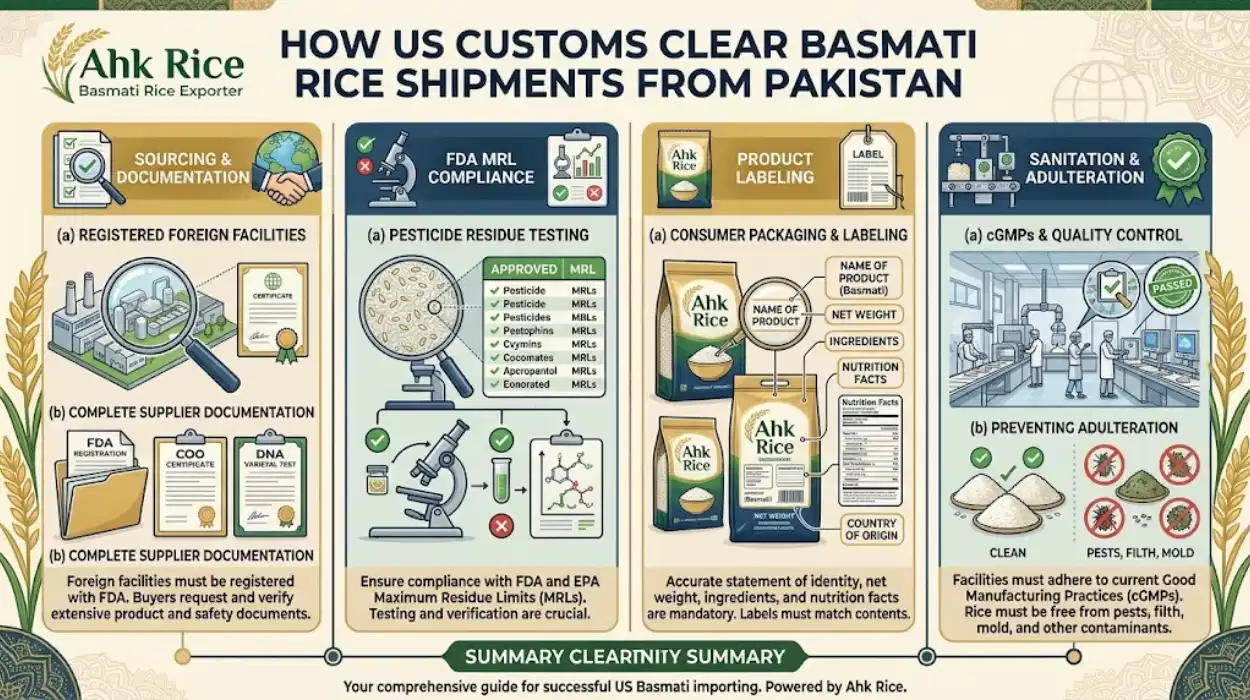
How Does US Customs Clear Basmati Rice Shipments from Pakistan?
US Customs and Border Protection (CBP) clears Basmati rice shipments from Pakistan by reviewing import declarations, tariff classification, shipment documents, and applicable entry requirements. The process also involves the US Food and Drug Administration (FDA), which regulates imported food safety. Importers must complete the required filings, provide accurate product information, and satisfy any examination or admissibility requirements before distributing rice in the United States.
Pakistani Basmati rice enters the US market through a coordinated process involving the exporter, US importer, customs broker, freight forwarder, and relevant government agencies. Understanding these responsibilities helps importers prepare shipments of 1121 Basmati, Super Kernel, and 1509 Basmati while reducing documentation errors and avoidable delays.
What Is US Customs Clearance for Pakistani Basmati Rice?
US customs clearance is the regulatory process through which CBP reviews imported rice declarations, assesses applicable duties, verifies shipment information, and determines whether goods satisfy entry requirements. FDA requirements operate alongside customs procedures to establish whether imported rice is admissible for the US market.
Customs clearance establishes the legal status of a shipment entering the United States. CBP administers customs entry, tariff classification, valuation, and applicable duties. FDA oversees food safety requirements for imported rice under federal food laws.
The process begins before the shipment reaches a US port. The importer or customs broker prepares entry information, confirms the correct tariff classification, and coordinates required filings. Ocean shipments also require an Importer Security Filing (ISF), generally submitted at least 24 hours before cargo loading aboard a vessel destined for the United States.
CBP reviews the entry and determines whether additional information, inspection, or other government-agency action is necessary. FDA reviews applicable food-related information and determines whether its requirements are satisfied. Cargo release depends on completing the relevant procedures and resolving any holds.
How Does the US Customs Clearance Process Work Step by Step?
The clearance process begins with importer registration and product compliance checks, followed by FDA-related preparations, ocean shipment filings, customs entry submission, government review, and cargo release. Importers then arrange port handling, inland transportation, and delivery to their warehouse or distribution facility.
Step 1: Confirm Importer and Product Requirements
The US importer establishes its business and importer-of-record arrangements. The importer identifies the Pakistani exporter, rice variety, processing method, packaging, country of origin, intended use, and applicable tariff classification.
The importer also determines whether the shipment requires a customs bond and appoints a licensed customs broker when professional entry assistance is needed. A customs bond generally guarantees payment of applicable duties, taxes, and charges, subject to its terms.
Step 2: Prepare FDA Compliance Information
Imported food generally requires prior notice to FDA before arrival. The responsible parties also establish whether the foreign food facility must register with FDA and whether the importer must comply with the Foreign Supplier Verification Program (FSVP).
FSVP requires covered US importers to verify that foreign suppliers produce food in compliance with applicable US food safety standards and provide the same level of public health protection as required under US law. Rice importers determine their specific obligations based on the product, supplier, and applicable exemptions.
Step 3: Submit Ocean Shipment Information
For ocean freight, the importer or its authorized agent submits the ISF within the required timeframe. The filing identifies relevant parties and shipment information used for security screening.
The exporter provides accurate commercial and cargo details to support the filing. Incorrect supplier identities, incomplete descriptions, or inconsistent shipping information create compliance risks and potential penalties.
Step 4: File the Customs Entry
The customs broker or importer submits the required entry documentation and tariff information to CBP. The entry includes the shipment’s customs value, country of origin, quantity, classification, and other information required by the applicable entry procedure.
Step 5: Complete Government Review and Cargo Release
CBP reviews the entry and assesses applicable duties. FDA reviews the relevant food information, and other agencies become involved when specific requirements apply.
CBP or FDA examination, document requests, sampling, or laboratory analysis can delay release. Once the applicable government requirements are satisfied and cargo is released, the importer arranges terminal handling and inland delivery.
Which Agencies and Documents Are Involved in Rice Customs Clearance?
CBP manages customs entry and border enforcement, while FDA regulates imported food safety and prior notice. Importers typically coordinate a commercial invoice, packing list, bill of lading, entry information, and applicable food compliance records, including supplier verification documentation where required.
Each document establishes a different part of the shipment’s identity, commercial value, movement, or regulatory status.
US Customs and Border Protection
CBP administers customs entry, tariff classification, valuation, duty collection, and import enforcement. It checks whether the declared shipment matches the information submitted by the importer.
US Food and Drug Administration
FDA regulates food safety under the Federal Food, Drug, and Cosmetic Act and applicable regulations. Its requirements cover relevant facility registration, prior notice, and FSVP obligations, subject to applicable exceptions.
Core Shipment Documents
The commercial invoice identifies the seller, buyer, product description, quantity, price, currency, and sale terms. The packing list records package counts, net weight, gross weight, and packaging details.
The bill of lading documents the ocean carrier’s receipt and transportation of the cargo. Customs entry information establishes the declared tariff classification, value, origin, and quantity. Additional records, such as a certificate of origin, phytosanitary documentation, or inspection certificate, depend on the shipment and applicable requirements.
Accurate records must agree on the product description, shipment quantity, packaging, and parties. For example, an invoice describing 1121 Steam Basmati must not conflict with a packing list identifying the cargo as 1509 White Basmati.
Which Pakistani Basmati Rice Varieties Enter the US Market?
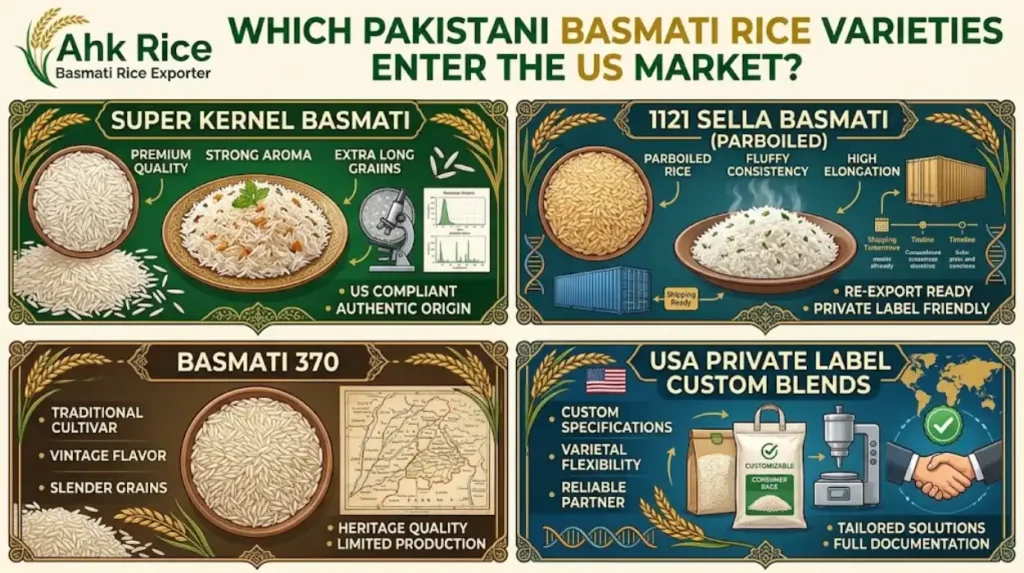
Pakistani exporters supply several Basmati varieties to US importers, including 1121 Basmati, Super Kernel, and 1509 Basmati. These varieties differ in grain characteristics, processing options, cooking performance, and commercial positioning, so import documents must accurately identify each product.
1121 Basmati Rice
1121 Basmati is recognized for its long, slender grains and substantial cooked-grain elongation. Export grades include 1121 White, 1121 Steam, Golden Sella, Creamy Sella, Brown, and broken rice, depending on the supplier’s product range.
US importers source these grades for ethnic grocery stores, premium retail products, restaurants, and foodservice distribution. The processing method and grade should appear consistently across commercial and product records.
Super Kernel Basmati Rice
Super Kernel is a traditional Pakistani Basmati variety associated with Punjab’s rice-growing regions. Buyers select it for its characteristic aroma, cooking performance, and suitability for retail and foodservice applications.
Export specifications define measurable characteristics, such as grain length, moisture, broken percentage, and foreign matter. These values must reflect the actual lot rather than an assumed variety-wide standard.
1509 Basmati Rice
1509 Basmati is associated with a shorter growing cycle than traditional long-duration varieties and is commercially used in raw, white, and parboiled forms. Importers select it for price-sensitive retail, catering, and bulk distribution programs.
The product description must distinguish raw rice from Steam or Sella processing. A precise description helps the importer, broker, and relevant agencies understand the shipment being declared.
What Benefits Does Proper Customs Preparation Provide?
Proper customs preparation improves document consistency, supports accurate tariff classification, and helps importers address food safety obligations before cargo arrival. These controls reduce preventable errors, clarify importer responsibilities, and support more predictable inventory planning for US rice distributors.
The first benefit is fewer documentation discrepancies. Matching invoices, packing lists, bills of lading, and electronic declarations reduces questions about shipment value, weight, product identity, and origin.
The second benefit is stronger food compliance. Establishing applicable FDA requirements before shipment helps the importer prepare prior notice, evaluate facility registration, and maintain required supplier verification records.
The third benefit is better cost planning. Importers who verify the correct tariff classification and current duty treatment can estimate customs charges more accurately. They can also budget for brokerage, port handling, examination, storage, and inland transportation.
The fourth benefit is improved supply-chain coordination. Exporters, customs brokers, and importers can resolve missing information before cargo arrives instead of responding under port-storage deadlines.
What Common Problems Delay Pakistani Basmati Rice at US Customs?
Common clearance problems include incorrect tariff classification, inconsistent shipment documents, late or inaccurate ISF filings, incomplete FDA-related information, and unresolved examination requirements. Importers prevent avoidable delays by verifying shipment data, assigning clear responsibilities, and checking compliance before vessel loading.
Incorrect Product Classification
A generic description such as “food grains” provides less useful detail than a precise description identifying Basmati rice, its processing method, and its intended commercial form. The importer must establish the correct Harmonized Tariff Schedule of the United States (HTSUS) classification using the current tariff schedule.
Inconsistent Commercial Records
Differences in net weight, package count, buyer details, or product grade create questions during review. The exporter should reconcile the invoice, packing list, shipping instructions, and final cargo details before documentation is submitted.
Missing FDA Information
Failure to complete applicable prior notice requirements or address FSVP responsibilities creates regulatory risk. Importers must distinguish between the FDA’s prior notice process and the separate customs entry process.
Examination and Additional Charges
CBP or FDA can require additional review or examination. Terminal storage, demurrage, inspection costs, and delivery changes can increase the total landed cost when cargo release takes longer than planned.
A shipment’s release date is not guaranteed by the sailing schedule. Importers should coordinate with their customs broker and freight forwarder and avoid promising a fixed clearance period before the relevant authorities complete their review.
Which Certifications and Food Safety Requirements Apply to Pakistani Rice?
US rice imports must satisfy applicable federal food safety and customs requirements, but no single certification automatically guarantees entry. Importers verify relevant FDA obligations, supplier controls, product specifications, and any additional documentation required for the specific shipment and its intended use.
FDA facility registration applies to covered domestic and foreign facilities that manufacture, process, pack, or hold food for US consumption, subject to statutory exemptions. Registration does not constitute FDA approval or certification of a facility or product.
Prior notice informs FDA about an incoming food shipment. FSVP requires covered importers to establish and follow appropriate supplier verification procedures. Records and activities depend on the food, supplier, hazards, and applicable regulatory provisions.
HACCP-based controls, ISO 22000 certification, or other food safety systems support supplier assurance, but they do not replace mandatory US entry requirements. Likewise, a phytosanitary certificate or laboratory test report is not a universal substitute for customs and FDA compliance.
Importers should check current federal requirements before shipment and confirm whether the particular rice product triggers additional restrictions or documentation. The exporter must provide truthful product and processing information so the importer can make that assessment.
Where Does the US Customs Clearance Process Apply?
The same core customs framework applies to commercial Pakistani Basmati rice imports entering the United States through major seaports and other authorized entry points. The exact operational steps depend on the transport mode, port, entry procedure, product details, and government review.
Ocean shipments commonly enter through major container ports serving US importers, including Los Angeles, New York and New Jersey, and Houston. The selected port affects inland transportation, terminal charges, and delivery planning, but it does not eliminate federal customs or food requirements.
Retail importers use clearance procedures to replenish packaged rice for grocery shelves. Wholesalers and distributors apply them to bulk or private-label shipments. Restaurants, caterers, and institutional foodservice suppliers use imported Basmati for commercial kitchens.
In every case, the importer must confirm the shipment’s classification, value, origin, and applicable food requirements. Product suitability for a particular market does not independently establish legal admissibility.
How Can Importers Prepare for a Compliant Rice Shipment?
Importers prepare by confirming the rice grade, tariff classification, supplier details, FDA obligations, shipping documents, and required filings before departure. A coordinated review between the Pakistani exporter, US importer, customs broker, and freight forwarder supports accurate declarations and informed delivery planning.
Start by identifying the precise product, such as 1121 Steam Basmati or 1509 Golden Sella. Confirm the agreed specifications, packaging, quantity, country of origin, and commercial terms.
Next, ask the customs broker to verify the current HTSUS classification and applicable duty treatment. Confirm whether a customs bond, ISF, FDA prior notice, facility registration, and FSVP activities apply to the transaction.
Finally, reconcile the commercial invoice, packing list, and bill of lading. Maintain supplier verification records and arrange any additional certificates or testing required for the specific shipment. These steps establish a clear compliance plan without assuming that one document or certification guarantees cargo release.
US customs clearance for Pakistani Basmati rice requires coordinated customs entry, accurate shipment records, and compliance with applicable FDA food requirements. Understanding the responsibilities of CBP, FDA, the importer, and the exporter helps businesses identify issues before cargo arrives.
The key is preparation rather than relying on a single certificate or document. Correct classification, consistent commercial records, timely filings, and appropriate supplier verification support a more controlled import process for 1121, Super Kernel, and 1509 Basmati rice.
Frequently Asked Questions
How does US Customs clear Basmati rice from Pakistan?
CBP reviews the customs entry, tariff classification, declared value, country of origin, and required documentation. FDA separately evaluates applicable food safety requirements. The shipment must satisfy all relevant requirements before release.
What documents are required to import Pakistani Basmati rice into the USA?
Common documents include a commercial invoice, packing list, bill of lading, customs entry information, and Importer Security Filing for applicable ocean shipments. FDA Prior Notice and other regulatory records are also required when applicable.
Does Pakistani Basmati rice require FDA approval before import?
FDA does not generally approve individual food shipments or products in advance. Importers must satisfy applicable requirements, including food facility registration and Prior Notice, and comply with relevant food safety regulations. FDA can inspect or detain noncompliant shipments.
What is FSVP for Basmati rice imports?
The Foreign Supplier Verification Program requires covered US importers to verify that their foreign food suppliers meet applicable US food safety requirements. Importers must determine the specific verification and recordkeeping obligations for their rice shipments.
Is an Importer Security Filing required for Pakistani rice shipments?
Yes. Ocean shipments entering the United States generally require an Importer Security Filing. The filing must be submitted no later than 24 hours before cargo is loaded onto the vessel destined for the United States.