USDA Organic Certification Requirements for Imported Basmati Rice
For US health food brands, certified organic Basmati rice provides a stronger basis for organic retail positioning, while low-residue testing supports a separate food-safety assurance strategy. The correct sourcing method depends on certification status, import documentation, laboratory results, customer requirements, and the intended product label.
US buyers sourcing Pakistani Basmati rice must distinguish organic certification from pesticide-residue testing before selecting a supplier. USDA organic certification verifies compliance with defined production and handling standards. Residue testing measures specified chemical residues in a sample. Neither approach automatically replaces the other. Brands developing an organic rice range should first understand whether organic Basmati rice from Pakistan is available for the US market, then assess supplier certification, traceability, processing controls, and shipment documentation.
AHK Rice is a Pakistani Basmati rice exporter based in Punjab, supplying 1121, Super Kernel, and 1509 Basmati rice varieties to more than 15 countries. Its export model covers processing, custom packaging, and export coordination. For US buyers, the key evaluation is whether a proposed product and every relevant operation in its supply chain hold the certifications required for the specific organic claim.
What are the USDA organic certification requirements for imported Basmati rice?
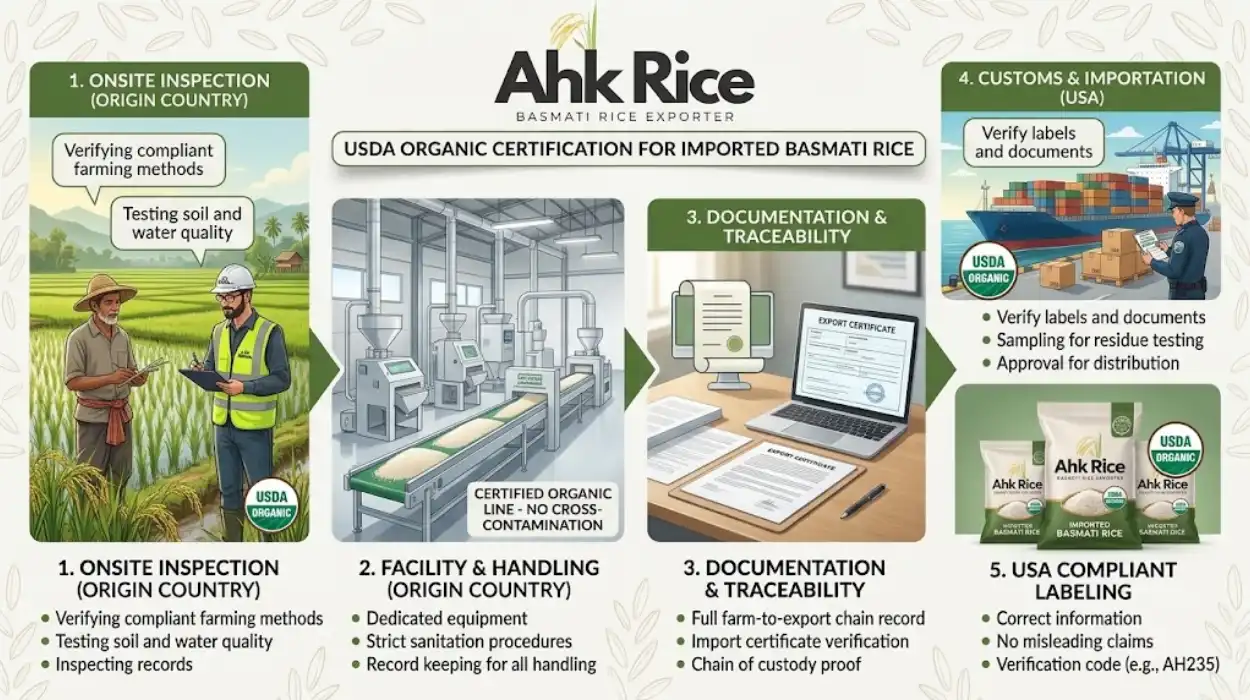
Imported Basmati rice marketed as USDA organic must comply with applicable National Organic Program standards, use appropriately certified supply-chain operations, and carry the required electronic import documentation. The importer must also meet applicable organic certification and recordkeeping obligations.
The USDA National Organic Program (NOP) establishes the federal standards governing organic agricultural production, processing, handling, and labeling in the United States. The USDA Agricultural Marketing Service oversees this program and accredits certifying agents that verify compliance.
For Pakistani rice, the first step is confirming that the farm, processor, exporter, and other relevant handling operations have the appropriate certification for their activities. A conventional export certificate, food-safety certificate, laboratory report, or general quality specification does not establish USDA organic status.
The United States strengthened organic import controls through its Strengthening Organic Enforcement rule, which reached its full compliance phase on March 19, 2024. Organic importers generally require certification under USDA organic regulations, and certified organic shipments must be associated with an electronic National Organic Program Import Certificate. Limited exemptions exist for certain operations, but importing and exporting are not generally exempt activities.
Buyers should verify the supplier’s certificate, certified activities, product scope, and current standing. They should also confirm that the certification covers the specific rice product and processing arrangements rather than assuming a supplier’s general organic credentials cover every product.
What are the available solutions for US health food brands?
US health food brands can choose certified organic Basmati rice, conventional rice supported by residue testing, or a conventional product with broader documented quality controls. Each route serves a different market position and must use accurate product claims.
Three sourcing strategies cover most commercial requirements.
1. Certified organic Basmati rice
This option suits brands that intend to sell rice as organic and build a product line around certified agricultural production and handling. The complete supply chain must meet applicable USDA organic requirements, and import documentation must be arranged before shipment. Retail labels must follow the relevant USDA category.
2. Conventional Basmati rice with residue testing
This route suits buyers who prioritize documented chemical-residue results without making an organic claim. The importer specifies the pesticides and other analytes to test, selects appropriate laboratory methods, and compares the results against applicable US requirements and buyer specifications.
A residue report applies to the sample and analytes tested. It does not establish that the rice was produced under organic standards or that every possible contaminant is absent.
3. Conventional rice with enhanced supplier controls
This option combines defined grain specifications, traceability records, processing controls, and agreed testing protocols. It suits wholesalers, foodservice distributors, and private-label brands that need consistent quality without an organic retail claim.
AHK Rice’s export offering covers Pakistani Basmati varieties, processing coordination, and custom packaging. Buyers should confirm the certification status of the exact product and facility before describing any proposed shipment as organic.
How do USDA organic certification and low-residue testing compare?
USDA organic certification evaluates production and handling against organic standards, whereas residue testing measures selected substances in a sample. Conventional quality controls address additional commercial requirements. Buyers should select the method that matches their intended claim, risk profile, and retail channel.
The main difference is what each approach proves. Certification provides evidence of compliance with an organic production and handling system. Laboratory analysis provides evidence about specified substances in a particular sample. Neither result should be interpreted beyond its scope.
| Comparison Attribute | USDA-Certified Organic | Low-Residue Testing | Conventional Quality Controls |
|---|---|---|---|
| Primary purpose | Verify compliance with organic standards | Measure selected chemical residues | Verify agreed commercial specifications |
| Production requirements | Must meet applicable organic rules | Does not establish production method | Depends on the buyer’s specification |
| Laboratory testing | Used where required by the certification or risk-control process | Central to the testing strategy | Applied according to the agreed plan |
| Supply-chain documentation | Organic certificates, traceability, and import records | Sample identification, test reports, and lot records | Specifications, batch records, and shipment documents |
| Import requirements | Applicable organic import certification and general import rules | General food import rules and any relevant testing requirements | General food import rules |
| Label claims | Organic claims permitted only under applicable rules | No automatic right to claim organic | Claims must accurately describe the product |
| Best commercial fit | Certified-organic retail and private-label products | Buyers prioritizing measurable residue controls | Mainstream wholesale, foodservice, and value retail |
USDA organic labeling rules define specific categories, including “100 Percent Organic,” “Organic,” and “Made with Organic.” Single-ingredient rice can qualify for an applicable organic category when it meets the relevant requirements. The exact claim depends on the product and its certification. Labels must be reviewed and approved by the certifying agent before use.
Low-residue specifications require a different process. Buyers should identify the substances to test, establish acceptance criteria, select a competent laboratory, and link each report to the corresponding production lot. A result below a specified reporting or regulatory limit does not mean that every pesticide has been tested.
Which Basmati sourcing method works best for different cases?
Certified organic rice works best for brands selling a verified organic product. Residue-tested conventional rice suits buyers who need measurable chemical-residue controls without organic positioning. Conventional specification-led sourcing suits high-volume distributors prioritizing price, grain performance, and consistent shipment quality.
US organic grocery and health food brands
Certified organic sourcing is the appropriate starting point when the product name, front-of-pack claim, and marketing strategy depend on USDA organic status. Buyers should review the supplier’s certification scope, ingredient and processing records, lot traceability, and proposed label.
The importer must also ensure that the organic import certificate is issued and associated with the shipment correctly. A supplier’s certificate alone does not replace the import certificate or the importer’s own obligations.
US ethnic grocery and mainstream distribution
Mainstream retailers may prioritize grain length, aroma, cooking performance, broken percentage, moisture, packing format, and landed cost. Conventional Pakistani Basmati can meet these commercial objectives without an organic claim.
A residue-testing program adds evidence for buyers concerned about specified pesticides. The scope should be agreed before sampling, and the results should correspond to the lot being purchased.
US foodservice and institutional buyers
Restaurants, caterers, and institutional kitchens generally evaluate cooked yield, texture, holding performance, consistency, and cost per serving. Conventional or residue-tested Basmati can suit these needs, while certified organic supply serves operators with explicit organic procurement policies.
Buyers should run cooking trials using a representative sample before confirming a commercial order. Raw grain length alone does not establish cooked performance.
How do US and European market requirements differ?
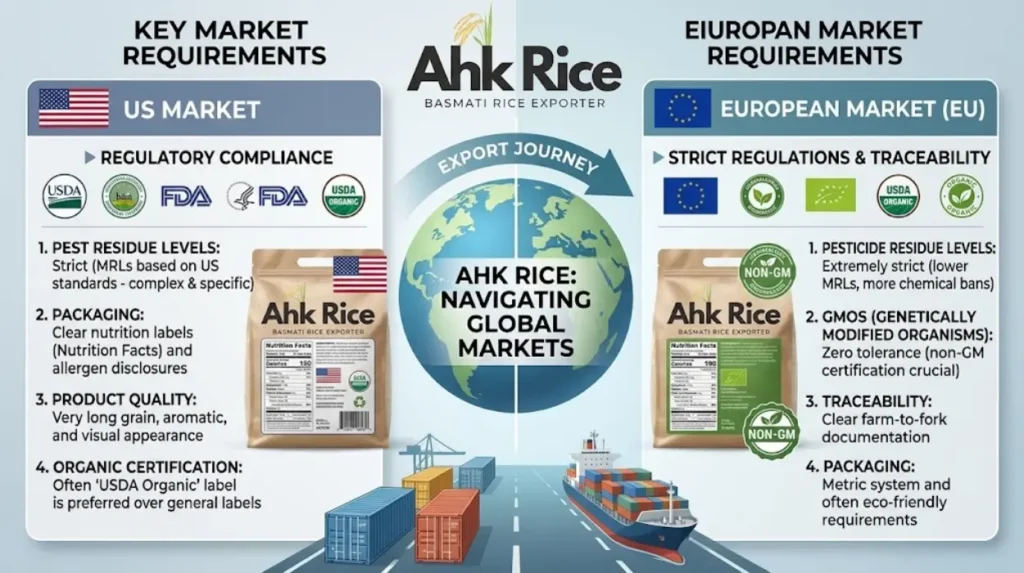
US buyers must meet USDA organic rules for organic claims and applicable US import requirements. European buyers follow the organic regime applicable to their destination. A certification accepted in one market does not automatically establish eligibility in another.
For a US shipment, the importer should verify USDA organic certification, electronic NOP Import Certificate arrangements, customs data, and applicable food import requirements. Product labels must use permitted organic terminology and any required additional information.
For the European Union, organic imports follow EU organic legislation and the applicable control and certification arrangements. Shipments generally require a Certificate of Inspection processed through the relevant electronic system. The exact certification route depends on the exporting country, certifier, product, and applicable trade arrangements.
These markets should not be treated as interchangeable. A Pakistani supplier’s organic certificate must be assessed against the requirements governing the destination market. Buyers serving both regions should confirm the relevant certification and documentation separately rather than relying on a generic statement that a product is internationally organic-certified.
Indicative price and shelf-life comparison
Organic and conventional Basmati rice do not have a single fixed price per metric tonne. Export quotations depend on variety, crop year, aging, grade, broken percentage, moisture, certification scope, packaging, quantity, freight, insurance, and Incoterms.
| Commercial Factor | US Organic Market | European Organic Market |
|---|---|---|
| Price per MT | Obtain a current quote for the specified certified product and delivery terms | Obtain a separate quote for the applicable EU-compliant product |
| Certification cost | Depends on the certified operations, audit scope, and supply arrangement | Depends on the certification route, control arrangements, and supply chain |
| Shelf life | Determined by product quality, packaging, storage conditions, and validated date marking | Determined by the same product and storage factors, with destination-market labeling requirements |
| Documentation | USDA organic records, NOP Import Certificate, and applicable customs and food documents | Applicable organic certification, Certificate of Inspection, and import documents |
| Market positioning | Organic grocery, health food, and certified private label | Organic retail, specialist grocery, and certified private label |
A defensible shelf-life comparison uses the same rice type, processing method, packaging barrier, storage conditions, and validation method. Organic status alone does not establish a longer shelf life. Rice stored in moisture-resistant packaging under dry, pest-controlled conditions generally maintains quality better than rice exposed to moisture, pests, or poor warehouse conditions.
For procurement, request separate quotations for certified organic and conventional options. Compare the landed cost per tonne rather than relying on a headline FOB price.
What are the advantages and disadvantages of each approach?
Organic certification supports a verified organic market position but increases documentation and supply-chain obligations. Residue testing provides measurable results for selected substances but does not verify organic production. Conventional controls offer sourcing flexibility but cannot support unsupported organic claims.
Certified organic rice: advantages and disadvantages
The main advantage is the ability to build a product around a recognized certification standard. This supports organic retail positioning and provides a documented basis for organic claims. The disadvantages include certification costs, audit obligations, restricted production and handling practices, and more demanding supply-chain coordination.
For example, a health food brand launching certified organic 1121 Basmati needs more than a long-grain sample and a laboratory report. It needs verified organic status for the relevant product and handling operations, compliant packaging, and shipment-level import documentation.
Low-residue conventional rice: advantages and disadvantages
The main advantage is targeted evidence about selected chemical residues. Buyers can specify analytes and acceptance limits according to their risk assessment and applicable requirements. This approach can support supplier qualification without the full organic positioning strategy.
Its limitation is scope. A report covers the sample and substances tested, and sampling quality affects how representative the result is. It does not verify farm-level organic practices or justify an organic label.
Conventional rice with enhanced quality controls: advantages and disadvantages
This route supports broader procurement flexibility. Buyers can establish measurable specifications for grain length, moisture, broken percentage, aroma, packaging, and cooking performance. The limitation is that conventional quality records do not replace organic certification when an organic claim is intended.
A buyer seeking premium shelf presentation can evaluate 1121 Basmati, while a buyer prioritizing yield and cost efficiency can assess 1509. Super Kernel offers another Pakistani Basmati option. The correct choice depends on the agreed sample, technical specification, and commercial target rather than the variety name alone.
What factors should buyers consider before choosing a supplier?
Buyers should verify certification scope, product traceability, testing methods, import documentation, label accuracy, grain specifications, and total landed cost. A supplier qualifies when its evidence matches the intended product claim and destination requirements, not merely when it offers an attractive price.
Use this five-row decision framework before approving a supplier.
| Decision Factor | Question to Ask | Evidence to Request | Decision Rule |
|---|---|---|---|
| Organic certification | Is the exact product covered by valid certification? | Current certificate and certified activity scope | Reject unsupported organic claims |
| Residue controls | Which substances were tested, and against what limits? | Lot-linked laboratory report and test method | Confirm the scope matches buyer requirements |
| Traceability | Can the shipment be traced through relevant operations? | Lot identifiers, processing records, and supplier documentation | Require a consistent audit trail |
| Import readiness | Can the shipment meet applicable US entry requirements? | NOP Import Certificate arrangements and customs documentation | Confirm responsibilities before dispatch |
| Commercial performance | Does the rice meet quality and cost targets? | Representative sample, specification sheet, and itemized quotation | Approve only after technical and commercial review |
The electronic NOP Import Certificate is a critical shipment-control document. The exporter’s certifier issues it through the USDA Organic Integrity Database, and the certificate information must be provided for the importer’s US Customs and Border Protection filing. A separate certificate is required for each applicable commodity or Harmonized Tariff Schedule code.
Buyers should agree on who requests the certificate, who supplies its identifying number to the customs broker, and how the importer retains records. USDA guidance also states that, effective October 1, 2025, organic shipments arriving without a valid associated import certificate cannot simply be reconditioned to correct the omission. Noncompliant shipments face restricted disposition options, including re-export, destruction, or donation subject to applicable conditions.
How can US buyers evaluate AHK Rice for organic or low-residue supply?
US buyers should begin with the intended claim, required Basmati variety, destination specifications, and documentation checklist. AHK Rice can discuss product specifications, processing, packaging, and export coordination, while buyers must verify the certification status and evidence for the exact proposed supply.
Start by identifying whether the purchase requires certified organic rice or conventional rice supported by residue testing. For organic orders, request the current certification documents for relevant supply-chain operations and confirm that the product is eligible for the intended US claim. For low-residue orders, provide the required analyte list, laboratory criteria, sampling protocol, and lot-identification requirements.
Next, specify the variety and commercial parameters. A 1121 order may focus on long-grain appearance and premium positioning, while 1509 may suit buyers targeting yield and cost efficiency. Super Kernel provides another option for Pakistani Basmati programs. Final acceptance should depend on representative samples, agreed specifications, and the verified evidence package.
AHK Rice supports export-oriented sourcing, processing coordination, custom packaging, and shipment planning. Buyers should request a written quotation that separates product price, certification-related requirements, testing, packaging, and freight where applicable. The quotation should state the Incoterm, quantity, destination, product grade, and required documents.
For a decision-focused next step, review organic and low-residue Basmati supply options for US health food brands and prepare a supplier checklist before requesting a commercial offer.
Selecting imported Basmati rice for the US health food market begins with a clear distinction between organic certification and residue testing. Certified organic supply supports an organic retail claim when the product, handling operations, labeling, and import records meet applicable USDA requirements. Residue-tested conventional rice provides a separate route for buyers who prioritize measurable chemical-residue controls without making an organic claim.
A structured supplier evaluation should combine certification verification, traceability, representative samples, testing protocols, import documentation, and a transparent landed-cost comparison. This process helps health food brands select the right Pakistani Basmati product for their market while reducing the risk of unsupported claims and avoidable shipment delays.
Frequently asked questions
Does USDA organic certification apply to imported Pakistani Basmati rice?
Yes. Rice sold or represented as USDA organic must comply with applicable USDA National Organic Program requirements. Buyers should verify certification for relevant operations and confirm that shipment-level organic import documentation is arranged correctly.
Is low-residue Basmati rice the same as organic Basmati rice?
No. Low-residue testing measures selected chemical residues in a sample. Organic certification evaluates production and handling against defined standards. A residue report alone does not authorize an organic claim.
Does every organic rice shipment entering the United States require an NOP Import Certificate?
Generally, yes. Certified organic agricultural products entering the US must be associated with a valid electronic NOP Import Certificate, subject to limited exceptions. The exporter’s certifier issues the certificate through the USDA Organic Integrity Database.
Can a Pakistani rice exporter use another country’s organic certificate for the US market?
Not automatically. The buyer must confirm that the certification arrangement is recognized under applicable USDA rules and covers the specific product and supply chain. A certificate accepted in another destination market does not by itself establish US eligibility.
Does organic certification increase Basmati rice shelf life?
No. Organic certification does not independently determine shelf life. Storage conditions, moisture, packaging, processing, pests, and product quality influence how long rice maintains acceptable characteristics.
Which Pakistani Basmati variety is best for US health food brands?
The best variety depends on the intended product and consumer expectations. Buyers can compare 1121 for premium long-grain presentation, Super Kernel for traditional Basmati positioning, and 1509 for yield and cost considerations. Organic status must be verified separately for the exact product.
What documents should a US buyer request before placing an order?
Request the applicable organic certificates, product specification, lot traceability records, relevant laboratory reports, label approval, and a documented plan for the electronic NOP Import Certificate. Confirm the remaining customs and food import documents with the importer and customs broker.
Can a supplier guarantee that rice contains no pesticide residues?
A laboratory report can document results for the substances tested using the stated methods and reporting limits. It cannot establish the absolute absence of every possible pesticide residue. Buyers should define a realistic testing scope and acceptance criteria before shipment.