Ask AHK Rice About Organic and Low-Residue Basmati Supply for USA Health Food Brands
US health food brands sourcing Pakistani Basmati rice need more than attractive grain specifications. They need verifiable organic certification, documented pesticide-residue testing, consistent quality, and export documentation that supports US import compliance. Selecting the right supplier before placing a commercial order reduces sourcing risks and improves product planning.
AHK Rice supplies Pakistani Basmati rice to international buyers, with sourcing, processing, grading, packaging, and export coordination. Health food brands can discuss their requirements through the AHK Rice export and supply service before requesting samples or negotiating commercial quantities.
Buyers researching market eligibility should first understand whether organic Basmati rice from Pakistan is available for the US market. They should also evaluate USDA Organic certification requirements for imported Basmati rice before selecting a supplier.
What Is the Best Solution for Sourcing Organic and Low-Residue Basmati Rice for the USA?
The best solution is to select an exporter that can document product origin, provide applicable organic certification, arrange representative samples, and support independent laboratory testing. Buyers should approve specifications and compliance documents before authorizing bulk production or shipment.
US health food brands face two related but distinct sourcing requirements. Organic rice must meet the applicable US organic production, certification, and import requirements. Low-residue rice must meet relevant pesticide-residue limits and the buyer’s additional testing specifications.
These claims are not interchangeable. A laboratory report showing low pesticide residues does not establish organic certification. Likewise, an organic certificate does not automatically prove that every shipment meets a buyer’s specific residue limits.
AHK Rice can discuss Pakistani Basmati varieties, processing specifications, packaging formats, and export arrangements with prospective buyers. The purchasing decision should depend on the evidence available for the actual product and shipment.
Before ordering, buyers should establish five requirements:
- Product identity: Specify 1121, Super Kernel, or another agreed Basmati variety.
- Organic status: Confirm certification, product scope, applicable operators, and import eligibility.
- Residue limits: Define the pesticide analytes and acceptance thresholds required by the buyer.
- Grain specifications: Agree on moisture, broken percentage, grain length, foreign matter, and appearance.
- Commercial terms: Confirm quantity, packaging, Incoterm, payment schedule, and shipment window.
This process helps buyers distinguish a supplier that can support documented compliance from one offering only general quality assurances.
Why Choose AHK Rice for Pakistani Basmati Supply?
AHK Rice offers buyers a starting point for discussing Pakistani Basmati sourcing, processing, grading, packaging, and export coordination. Before committing to an organic program, buyers should verify the applicable certification and testing evidence for the specific product and production arrangement.
AHK Rice is a Pakistani Basmati rice exporter based in Punjab, supplying varieties including 1121, Super Kernel, and 1509 to international markets. Its sourcing and processing discussions can help importers translate retail, foodservice, and private-label requirements into a commercial specification.
For health food brands, the value of a supplier relationship depends on whether operational capabilities match the product claim. A buyer developing an organic retail range should confirm that the proposed rice is covered by the required organic certification. If certification cannot be established, the buyer should not market the product as USDA Organic.
AHK Rice can discuss requirements such as grain selection, sorting, moisture control, packaging, and shipment documentation. Buyers should request supporting records rather than treating these capabilities as automatic proof of organic status or low-residue compliance.
A practical supplier evaluation should cover:
- Origin and traceability: Request available records connecting the product to its origin and relevant supply-chain operators.
- Processing controls: Establish how the exporter manages foreign matter, broken grains, moisture, and product segregation.
- Organic documentation: Verify the relevant certificate, certified product scope, and import documentation requirements.
- Laboratory evidence: Agree on independent testing, the laboratory, the analytical panel, and acceptance criteria.
- Shipment readiness: Confirm packaging, labeling, export paperwork, inspection requirements, and the loading schedule.
AHK Rice should be assessed against these criteria before a buyer awards a supply contract. This creates a clearer basis for comparing suppliers on documented performance rather than price alone.
What Organic Certification and Low-Residue Evidence Should US Buyers Request?
US buyers should verify that organic certification meets USDA National Organic Program requirements and that the applicable import documentation is available. They should separately review pesticide-residue results against current US requirements and their own purchasing specifications.
The United States regulates organic agricultural products through the USDA National Organic Program. Imported products marketed as organic generally need certification through an appropriately accredited certifier, subject to applicable exemptions and rules.
Buyers should verify the certification status of the relevant operators and product. They should also confirm whether the shipment requires an electronic National Organic Program Import Certificate through the applicable import process.
Certification should be checked before packaging artwork, purchase orders, and marketing claims are finalized. The buyer should not assume that a supplier’s general food-safety certificate substitutes for organic certification.
For pesticide residues, the compliance process is separate. US Environmental Protection Agency tolerances establish permitted residue levels for applicable pesticide and commodity combinations. The US Food and Drug Administration and other relevant authorities enforce applicable food requirements.
Request a laboratory report that identifies the sample, analytical method, testing laboratory, analytes, results, units, and relevant limits of quantification. Confirm that the panel covers the pesticides relevant to the product’s production history and destination-market requirements.
A supplier evaluation should also consider contaminants, microbiological requirements where relevant, and other specifications established by the importer. Testing plans must match the risks and intended use of the product.
What Results Can Buyers Expect from a Controlled Sample-to-Order Process?
A structured sample-to-order process helps buyers assess cooking performance, grain consistency, packaging suitability, and documented compliance before committing to commercial quantities. Actual results depend on the selected rice, approved specifications, testing outcomes, and production controls.
AHK Rice can discuss a staged purchasing process with importers seeking Pakistani Basmati rice. The objective is to resolve product and documentation questions before the buyer authorizes a shipment.
Stage 1: Requirements review. The buyer specifies the variety, organic status, residue limits, target quantity, packaging, destination port, and required documents. The exporter confirms which requirements it can support and identifies any outstanding evidence.
Stage 2: Sample arrangement. The parties agree on sample size, product identity, courier arrangements, and the documents accompanying the sample. If organic status is essential, the sample’s identity and certification scope should be verified before it is evaluated as an organic product.
Stage 3: Evaluation and testing. The buyer assesses grain appearance, aroma, cooking performance, elongation, texture, and broken-grain percentage. Laboratory testing can be arranged where necessary, with the cost and responsibility agreed in advance.
Stage 4: Specification approval. Both parties confirm the commercial grade, quality tolerances, packaging artwork, testing requirements, and acceptance criteria in writing.
Stage 5: Commercial order. The buyer approves the pro forma invoice, payment terms, production schedule, inspection arrangements, and export documentation. Shipment proceeds after the agreed conditions are satisfied.
This sequence gives buyers a documented basis for deciding whether the product fits their retail or foodservice requirements. It also reduces the risk of ordering bulk quantities before resolving certification, labeling, or quality concerns.
How Much Does Organic and Low-Residue Basmati Rice Cost?
The final cost depends on the rice variety, verified organic status, grade, order quantity, testing requirements, packaging, and shipping terms. Buyers should request an itemized quotation that separates product, certification-related, laboratory, packaging, and freight costs where applicable.
Organic and low-residue specifications can change the procurement process. Certified organic sourcing may involve additional supply-chain controls, certification costs, and documentation. Independent residue testing adds laboratory expenses, particularly when buyers require broader analytical panels or shipment-specific reports.
Other important pricing factors include:
| Cost factor | What buyers should confirm |
|---|---|
| Rice variety | 1121, Super Kernel, or another agreed variety |
| Organic certification | Product eligibility and supporting documentation |
| Grain grade | Length, broken percentage, moisture, and appearance |
| Laboratory testing | Analytical panel, sample requirements, and testing fees |
| Packaging | Bulk bags, retail packs, private-label printing, and materials |
| Freight and insurance | Destination, container arrangements, and selected Incoterm |
| Order quantity | Minimum order, production volume, and shipment size |
No fixed price should be assumed without a current quotation based on the buyer’s actual requirements. Organic certification and low-residue claims should also be verified independently of the commercial price.
For an accurate comparison, buyers should request quotations using the same variety, specification, packaging, shipment quantity, and Incoterm. This prevents a lower headline price from concealing differences in testing, documentation, freight, or product quality.
How Long Does Shipping Pakistani Basmati Rice to the USA Take?
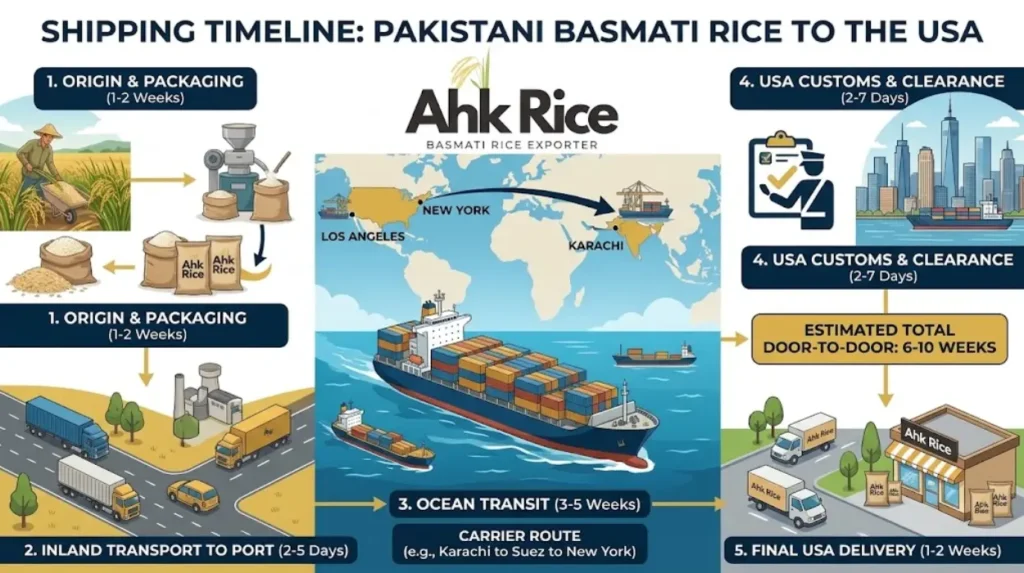
Shipping time depends on production readiness, port schedules, vessel availability, the destination port, and customs clearance. Buyers should obtain a shipment-specific schedule rather than rely on a fixed transit promise before the order and export arrangements are confirmed.
For planning purposes, US importers can use the following preliminary estimates, subject to confirmation by the exporter and freight provider:
| Shipment stage | Indicative planning allowance |
|---|---|
| Sample preparation and dispatch | Approximately 3–10 business days, depending on availability |
| Commercial specification and document approval | Approximately 3–10 business days |
| Production and packing | Approximately 1–3 weeks, depending on stock and order size |
| Ocean transit to a US port | Approximately 25–45 days, depending on route and schedule |
| Customs, inspection, and inland delivery | Additional time based on clearance and destination |
These are planning estimates, not guaranteed AHK Rice service commitments. They should not be added mechanically because several activities can overlap. Organic verification, laboratory testing, or corrective work can also extend the schedule.
West Coast and East Coast deliveries can have different transit and inland transport requirements. Buyers should confirm the intended port, sailing date, estimated arrival date, customs broker arrangements, and any inspection requirements before finalizing inventory commitments.
AHK Rice and the buyer should agree on the shipment timeline in the commercial documents, including the conditions that must be met before loading.
How Can US Health Food Brands Start Working with AHK Rice?
Start by submitting a product specification, required certification documents, target quantity, packaging details, and destination port. AHK Rice can then review the sourcing requirements, clarify available documentation, and discuss sample arrangements before the buyer makes a commercial commitment.
Prepare the following information before requesting a quotation:
- Product: Identify the preferred Basmati variety and whether certified organic status is mandatory.
- Compliance: List residue limits, required laboratory tests, organic documentation, and any additional buyer standards.
- Quantity: Specify the initial order and anticipated repeat-order volume.
- Packaging: Provide retail or bulk pack sizes, label requirements, and private-label artwork needs.
- Delivery: Identify the US destination port, preferred Incoterm, and target delivery window.
AHK Rice should confirm which requirements it can document for the proposed product before the buyer approves the sample or purchase order. If the organic certification scope, residue evidence, or import documentation is insufficient, the buyer should resolve the gap before proceeding.
This approach gives health food brands a clear purchasing decision based on compliance, quality, cost, and delivery readiness.
Request a specification-based quotation from AHK Riceto discuss Pakistani Basmati availability, organic documentation, low-residue testing, sample arrangements, packaging, and shipment requirements for your US business.
Frequently Asked Questions
Can AHK Rice supply USDA Organic-certified Basmati rice to the USA?
Availability must be confirmed for the specific product and supply chain. Buyers should request valid organic certification and verify its scope before placing an order or making organic marketing claims.
Is low-residue Basmati rice the same as organic rice?
No. Low-residue describes pesticide-residue results against specified limits. Organic status requires compliance with applicable organic production and certification rules. One does not automatically establish the other.
Can US buyers request samples before ordering bulk rice?
Yes, sample arrangements can be discussed with AHK Rice. Buyers should agree on sample availability, quantity, courier charges, testing costs, and documentation before dispatch.
How much does shipping a rice sample to the USA cost?
The cost depends on sample weight, courier service, collection location, and destination. Any laboratory testing or additional documentation may create separate charges. Request a confirmed cost before dispatch.How long does a commercial shipment take to reach the USA?