How Long Does Basmati Rice Shipping Take from Karachi to US Ports?
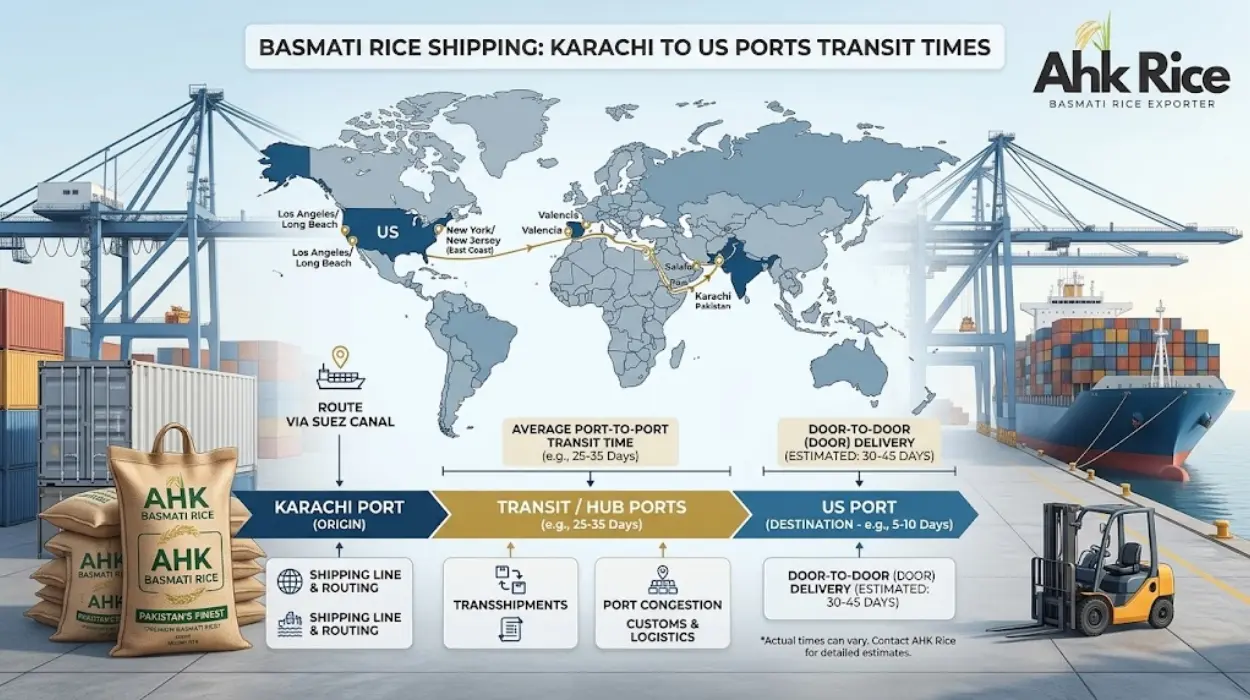
Basmati rice shipping from Karachi to US ports generally takes 25–45 days by sea, depending on the destination port, vessel schedule, transshipment arrangements, and port congestion. This estimate covers ocean transit, not the entire export process. Export documentation, customs clearance, agricultural inspections, and inland transportation add time before and after the voyage.
Pakistani Basmati rice reaches the United States through major gateways on the East Coast, Gulf Coast, and West Coast. Importers select ports based on their warehouse locations, distribution networks, shipping costs, and delivery requirements. Understanding these routes helps rice importers estimate inventory arrival dates and plan container orders more accurately.
What Is Basmati Rice Shipping from Karachi to US Ports?
Basmati rice shipping from Karachi to US ports is the international transportation of packaged or bulk Pakistani rice in cargo containers. The shipment moves through export clearance, ocean freight, US import procedures, and final delivery to the buyer’s warehouse.
Karachi is Pakistan’s principal seaport for international containerized cargo. Exporters load processed rice into shipping containers at approved facilities or container freight stations before transporting them to the port. After export clearance, a shipping line carries the container to a US port, directly or through an intermediate transshipment hub.
Basmati rice is a long-grain aromatic rice grown mainly in Pakistan’s Punjab region and India’s designated Basmati-producing areas. Pakistani varieties include 1121 Basmati, Super Kernel Basmati, and 1509 Basmati. Their grain length, aroma, processing method, and cooking characteristics determine their suitability for different retail and foodservice markets.
A container shipment usually involves a commercial invoice, packing list, bill of lading, and applicable origin and plant-health documentation. US importers also address customs entry requirements and applicable food-import regulations. The exact documents depend on the shipment, product, and importing arrangement.
How Long Does Sea Freight Take from Karachi to the United States?
Sea freight from Karachi to US ports typically requires approximately 25–45 days of ocean transit planning. Actual sailing time depends on the destination, carrier routing, transshipment stops, vessel frequency, and operational delays. Port-to-warehouse delivery takes longer.
The shipping line’s route determines how quickly a container reaches the United States. Some services use scheduled connections through international transshipment hubs. Other services follow different port sequences based on vessel capacity and network planning.
The following ranges are indicative planning estimates, not guaranteed sailing schedules.
| US destination region | Example destination ports | Indicative ocean transit planning range |
|---|---|---|
| East Coast | New York and New Jersey, Savannah, Norfolk | 30–45 days |
| Gulf Coast | Houston | 25–40 days |
| West Coast | Los Angeles, Long Beach, Oakland | 25–40 days |
These estimates describe broad planning windows rather than verified carrier schedules. The fastest route is not always the best commercial option. A service with fewer transshipment stops can reduce handling exposure, while a more frequent service can offer greater flexibility when booking a container.
Importers should request the carrier’s estimated time of departure and estimated time of arrival for the actual booking. They should also confirm whether the quoted transit time begins at vessel departure or includes pre-carriage and terminal handling.
How Does a Basmati Rice Container Move from Karachi to a US Port?
A Basmati rice container moves through five main stages: cargo preparation, export documentation, port handling, ocean transportation, and US import clearance. Each stage has separate operational requirements and contributes to the shipment’s total delivery timeline.
1. Rice processing and container preparation
The exporter processes rice according to the agreed grade and specification. Processing includes cleaning, grading, removing foreign material, and optical sorting when specified. The finished rice is packed into retail bags or commercial sacks and prepared for container loading.
Common export packing formats include 5 kg, 10 kg, 25 kg, and 50 kg bags. The selected format depends on the buyer’s market, product presentation, handling system, and retail or wholesale requirements.
2. Export documentation and port delivery
The exporter prepares commercial documents and coordinates container transport to Karachi Port or Port Qasim, depending on the shipment arrangement. Customs procedures and required export formalities must be completed before the cargo departs.
Documentation errors, late container delivery, or missed vessel cut-off times can delay loading until a later sailing.
3. Vessel departure and ocean transit
The shipping line loads the container onto the booked vessel. The container then follows the planned route, which includes direct calls or transshipment stops when applicable.
Transshipment means transferring a container from one vessel to another at an intermediate port. Connection availability and terminal operations affect the total transit period.
4. US port arrival and import clearance
When the vessel reaches the destination port, the container undergoes applicable arrival, customs, and regulatory procedures. US importers must meet relevant requirements administered by agencies such as US Customs and Border Protection and the Food and Drug Administration.
5. Container release and inland delivery
After the required clearances and terminal release, the container moves by truck or rail to a warehouse, distribution centre, or processing facility. Inland delivery time depends on distance, equipment availability, appointments, and the buyer’s location.
The complete shipment timeline therefore includes more than the vessel’s sailing time.
What Factors Affect Basmati Rice Shipping Time?
Basmati rice shipping time depends on vessel availability, route selection, transshipment connections, port congestion, export readiness, customs processing, and inland delivery. Delays at any stage change the final arrival date and affect inventory planning.
The first factor is shipping route selection. Different services connect Karachi with US ports through different international hubs. A route with several vessel connections introduces additional scheduling dependencies.
The second factor is vessel frequency. Missing a scheduled departure can add several days or longer, depending on the next available sailing. Booking before cargo readiness also creates storage and coordination challenges.
The third factor is port congestion. Busy terminals, vessel bunching, weather disruptions, and equipment shortages affect vessel schedules and container release.
The fourth factor is documentation accuracy. Incorrect product descriptions, inconsistent weights, missing certificates, or incomplete import filings create avoidable delays. Rice shipments also require attention to applicable food safety and plant-health requirements.
The fifth factor is inland transportation. A container destined for a warehouse far from the arrival port requires additional trucking or rail transit. Delivery appointments and chassis availability also affect the final date.
Importers should calculate a delivery window rather than rely on a single arrival date. They should also allow time for inspections, customs holds, and terminal release.
Which US Ports Receive Pakistani Basmati Rice?
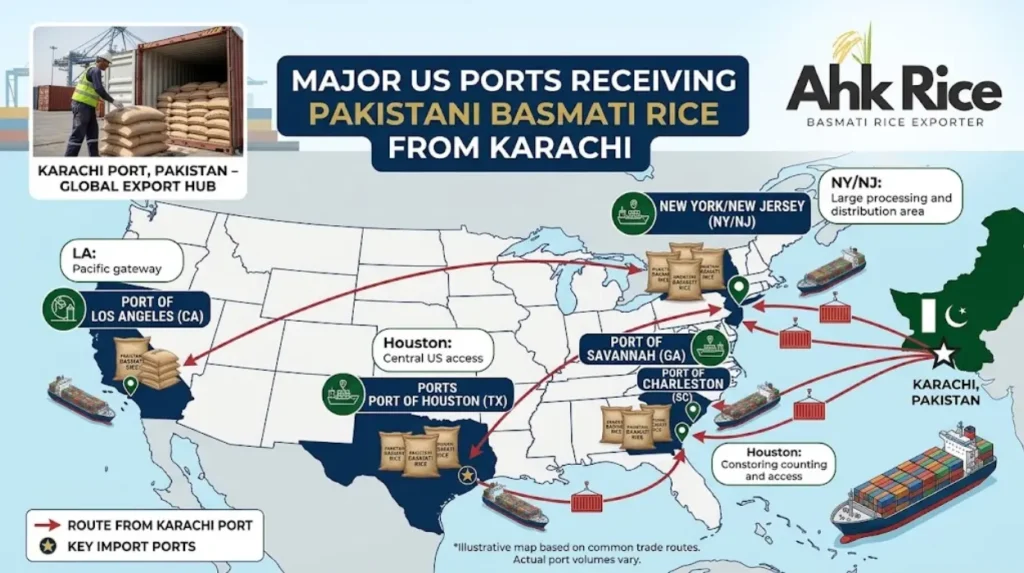
Pakistani Basmati rice can enter the United States through suitable East Coast, Gulf Coast, and West Coast ports. Importers choose gateways according to carrier services, warehouse locations, inland freight costs, and the needs of their distribution networks.
East Coast ports
The Port of New York and New Jersey serves importers distributing products across the Northeast and nearby inland markets. The Port of Savannah supports distribution across the southeastern United States, while Norfolk serves regional and inland freight networks.
These gateways suit importers whose warehouses, wholesalers, or retail customers are concentrated in eastern markets. The best port depends on the final delivery address and available container services.
Gulf Coast ports
The Port of Houston serves importers operating in Texas and surrounding markets. Its suitability depends on the booked route, terminal conditions, inland transportation, and the location of the buyer’s distribution facility.
A Gulf Coast port can provide a practical gateway when the destination warehouse is located in the south-central United States.
West Coast ports
The Ports of Los Angeles and Long Beach handle substantial container traffic and serve distribution networks across California and other western states. Oakland provides another option for importers serving Northern California and nearby markets.
Importers should compare the complete landed logistics cost instead of selecting a port solely because its ocean transit estimate is shorter.
What Basmati Rice Grades and Processing Types Are Shipped to the USA?
Pakistani Basmati rice exporters ship multiple varieties and processing types, including 1121, Super Kernel, and 1509. Buyers select raw, steam, or parboiled rice according to grain specifications, cooking performance, target customers, and commercial requirements.
The principal varieties have different market characteristics.
- 1121 Basmati: Known for its extra-long grain and pronounced cooked-grain elongation. It serves premium retail, restaurant, catering, and private-label markets.
- Super Kernel Basmati: Recognised for its characteristic aroma, slender grain, and suitability for traditional rice dishes. It serves ethnic grocery stores, wholesalers, and foodservice distributors.
- 1509 Basmati: A shorter-duration crop variety valued for commercial availability and its position in price-sensitive markets. Buyers assess its grain specifications and cooking performance against their target price.
Processing type also affects the finished product. Raw Basmati undergoes milling without parboiling. Steam processing uses controlled steaming as part of the preparation process. Golden Sella and Creamy Sella are parboiled styles with different appearances and processing characteristics.
Export grades are defined through measurable specifications, including grain length, broken percentage, moisture content, foreign matter, and defect tolerances. Buyers should approve a product specification before shipment rather than relying on the variety name alone.
What Certifications and Import Requirements Apply to Basmati Rice Shipments?
Basmati rice entering the United States must meet applicable customs, food safety, and plant-health requirements. Importers verify facility registration, Prior Notice, entry documentation, and any required permits, certificates, or testing based on the product and shipment.
The US Food and Drug Administration administers relevant food safety requirements under the Federal Food, Drug, and Cosmetic Act and the Food Safety Modernization Act. Applicable foreign food facility registration and FDA Prior Notice requirements must be addressed where required.
The Foreign Supplier Verification Programs rule generally requires covered US importers to verify that imported food meets applicable US food safety standards. Importers should determine their responsibilities and any applicable exemptions before placing an order.
Plant-health documentation and admissibility requirements depend on the commodity and its condition. Buyers should confirm applicable requirements with the relevant US authorities before dispatch.
Other documentation may include a Certificate of Origin, phytosanitary certificate where required, laboratory analysis, or product-specific declarations. These documents are not interchangeable, and not every shipment follows an identical certification checklist.
Food labels must comply with applicable US requirements when rice is sold in packaged retail form. Importers also assess pesticide residues, contaminants, and other product risks against applicable regulatory limits and customer specifications.
What Are the Main Benefits of Planning Rice Shipping Time in Advance?
Planning Basmati rice shipping time in advance helps importers manage inventory, coordinate warehouse capacity, schedule distribution, and reduce avoidable logistics costs. Accurate lead-time planning also supports purchasing decisions and helps prevent stock shortages during demand peaks.
A clear delivery estimate allows distributors to calculate reorder points and maintain appropriate safety stock. Retailers can coordinate product launches, promotional periods, and replenishment cycles around realistic arrival windows.
Advance planning also improves coordination between exporters, shipping lines, customs brokers, truckers, and warehouse teams. When each party understands its responsibilities and deadlines, documentation gaps and missed transport appointments become easier to prevent.
Importers should track the booking confirmation, cargo cut-off, vessel departure, transshipment milestones, estimated arrival, customs status, and final delivery. This approach provides a more reliable view of the shipment than tracking the vessel alone.
What Common Misconceptions Cause Delays in Basmati Rice Shipping?
The most common misconceptions are treating ocean transit as total delivery time, assuming all US ports have identical schedules, and expecting customs clearance to happen automatically. Each mistake creates unrealistic delivery commitments and weak inventory planning.
A quoted 30-day transit period does not necessarily mean the rice reaches the buyer’s warehouse in 30 days. Export preparation, vessel waiting time, port handling, import clearance, and inland transportation fall outside some ocean freight estimates.
Another misconception is that every container follows a direct route. Actual services depend on the carrier’s network and booking. A transshipment stop adds a connection that must be completed before the container reaches its destination.
Importers also sometimes assume that a Certificate of Origin or phytosanitary certificate replaces US food import requirements. Each document serves a specific purpose. Customs, food safety, and plant-health obligations must be assessed separately.
The most reliable approach is to obtain a current carrier schedule, verify cargo readiness, confirm import compliance, and maintain a delivery buffer based on the shipment’s route and destination.
Shipping Basmati rice from Karachi to US ports generally requires approximately 25–45 days of ocean transit planning, with the actual period determined by the selected service and destination. East Coast, Gulf Coast, and West Coast routes have different schedules, handling arrangements, and inland delivery requirements.
A realistic shipping plan accounts for cargo preparation, export clearance, vessel transit, US import procedures, and final delivery. Importers who verify the current carrier schedule and applicable documentation requirements can make better purchasing, inventory, and distribution decisions.
Frequently Asked Questions
How long does Basmati rice shipping take from Karachi to the USA?
Basmati rice shipping from Karachi to US ports generally requires approximately 25–45 days of ocean transit planning. The actual duration depends on the destination port, carrier schedule, transshipment stops, and operational conditions.
Which US ports receive Pakistani Basmati rice?
Major US container gateways include the Port of New York and New Jersey, the Port of Savannah, the Port of Houston, the Port of Los Angeles, the Port of Long Beach, and the Port of Oakland. Importers select a port based on shipping services and their final delivery location.
Is shipping time the same for East Coast and West Coast ports?
No. Transit time varies by route, carrier, vessel schedule, and transshipment arrangements. Importers should compare current sailing schedules for their selected ports before booking a shipment.
What documents are required to import Pakistani Basmati rice into the USA?
Common shipping documents include a commercial invoice, packing list, and bill of lading. Depending on the shipment, additional requirements include a Certificate of Origin, applicable plant-health documentation, FDA Prior Notice, and customs entry information.
What factors delay Basmati rice container shipments?
Common causes include missed vessel departures, port congestion, transshipment delays, incomplete documentation, customs examinations, regulatory holds, and inland transportation problems.