Can Pakistani Basmati Rice Be Sold on Amazon and US E-Commerce Platforms?
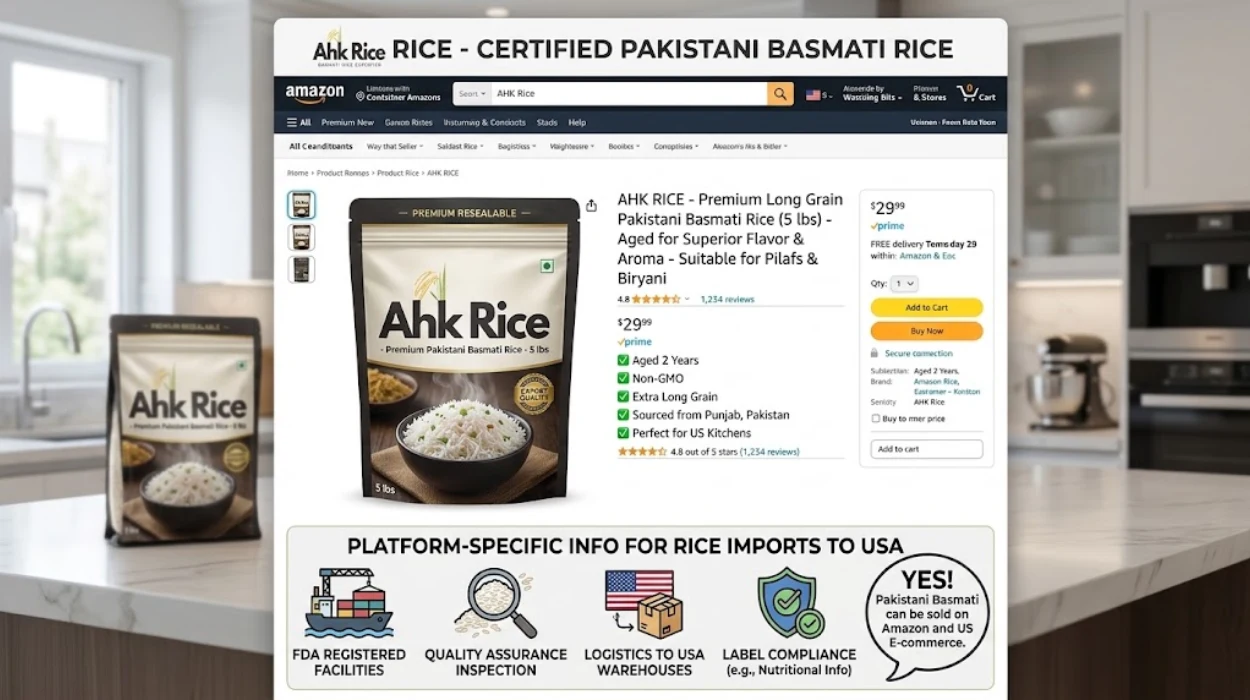
Pakistani Basmati rice can be sold on Amazon and other US e-commerce platforms when the seller meets applicable food import regulations, labeling requirements, customs procedures, and marketplace policies. Importers must establish a compliant supply chain before listing rice for American consumers.
What Is Selling Pakistani Basmati Rice on Amazon and US E-Commerce Platforms?
Selling Pakistani Basmati rice online means importing, packaging, listing, and delivering rice through digital marketplaces. Sellers must meet US food safety regulations, provide accurate product information, maintain traceable inventory, and use packaging suitable for storage and parcel delivery.
Pakistani Basmati rice is a long-grain aromatic rice cultivated mainly in Punjab. Its characteristic aroma, grain length, and cooked texture make it suitable for household cooking, restaurants, catering businesses, and specialist grocery retailers.
Amazon provides a marketplace where approved sellers list products and receive customer orders. Other channels include Walmart Marketplace, independent online grocery stores, and direct-to-consumer websites. Each platform has its own seller onboarding, product listing, and fulfillment policies.
Selling imported rice online involves two separate compliance areas. The first covers US import and food regulations. The second covers marketplace requirements, including product images, packaging, shelf-life information, and inventory preparation.
An Amazon listing does not replace legal import approval or customs clearance. A seller remains responsible for ensuring that the product complies with applicable US requirements before offering it for sale.
How Does the Process of Selling Pakistani Basmati Rice Online Work?
The process starts with product selection and supplier verification, followed by food safety checks, compliant packaging, import clearance, and marketplace listing. Sellers then send inventory to a fulfillment center or ship orders directly to customers while maintaining accurate product and batch records.
Step 1: Select the Appropriate Basmati Rice Variety
Buyers first select a variety based on customer demand, cooking preferences, and retail positioning.
Pakistan’s main commercial Basmati varieties include:
- 1121 Basmati: Known for its extra-long grain and cooked elongation. It suits premium retail, biryani, and foodservice applications.
- Super Kernel Basmati: Recognized for its traditional aroma and elongated cooked grain. It serves ethnic grocery stores and household consumers.
- 1509 Basmati: A shorter-maturity variety used in value-oriented retail and bulk foodservice markets.
- Traditional Basmati: Valued for its characteristic aroma and cooking qualities.
Each variety requires a defined specification covering grain length, moisture, broken percentage, milling condition, crop year, and processing method.
Step 2: Verify the Supplier and Product Quality
The importer establishes the product specification before confirming an order. Supplier documentation should identify the rice variety, country of origin, processing facility, batch, and agreed quality parameters.
Laboratory testing supports verification of relevant food safety criteria. Depending on the product and buyer requirements, testing covers pesticide residues, heavy metals, moisture, broken grains, and other quality characteristics.
The supplier and importer also establish procedures for reviewing test results, handling nonconforming batches, and maintaining traceability.
Step 3: Complete US Import Requirements
Imported rice must comply with applicable US Food and Drug Administration (FDA) requirements. The importer verifies applicable food facility registration, submits Prior Notice, arranges customs entry, and meets the Foreign Supplier Verification Program (FSVP) requirements when applicable.
Customs documentation identifies the product, origin, quantity, value, and shipment details. Importers work with a customs broker to determine the correct tariff classification and applicable duties.
Step 4: Prepare the Retail Product
The rice is packed into consumer-ready units, such as 2 lb, 5 lb, 10 lb, or 20 lb bags. Packaging must protect the grains against moisture, pests, punctures, and contamination.
The label identifies the product and provides the required food information. The seller also prepares product photographs, listing attributes, and shipping cartons.
Step 5: List and Fulfill Customer Orders
The seller creates a product listing and selects an eligible fulfillment method. Amazon Fulfillment by Amazon (FBA) stores inventory in its fulfillment centers and handles eligible order picking, packing, and delivery.
With seller-fulfilled shipping, the seller or its logistics partner stores inventory and dispatches customer orders. Both approaches require accurate stock records, suitable packaging, and reliable order handling.
What Are the Main Components of an Online Basmati Rice Business?
An online rice business depends on product specifications, regulatory compliance, retail packaging, marketplace listings, and inventory management. Each component supports a different stage of the supply chain, from verifying the imported rice to presenting an accurate product listing and delivering an intact package to the customer.
Product Specifications and Traceability
Specifications define what the buyer receives. Important fields include variety, grain length, broken percentage, moisture, processing type, crop year, and net weight.
Batch identification connects the finished package to production and quality records. Traceability helps importers investigate complaints, verify shipments, and identify affected inventory when a quality issue arises.
Food Safety and Import Documentation
Importers maintain the records required for their role under applicable US regulations. These include supplier verification records, shipment information, and relevant food safety documentation.
Common shipping documents include a commercial invoice, packing list, bill of lading or air waybill, and applicable origin or phytosanitary documents. The precise requirements depend on the shipment, product, and applicable import rules.
FDA facility registration and Prior Notice are distinct requirements. Registration does not mean that the FDA has approved a product or certified every shipment. FDA examines imported foods under its enforcement and inspection framework.
Packaging and Retail Presentation
Rice packaging must withstand warehouse handling, transportation, and last-mile delivery. Suitable options include sealed food-grade pouches, woven bags with appropriate inner liners, and reinforced retail bags.
Small packs support household purchases, while larger packs serve families, restaurants, and catering operations. The seller selects package sizes according to customer demand, shipping costs, and the economics of each sales channel.
Product Listings and Inventory Control
An accurate listing states the variety, net weight, origin, processing type, and relevant cooking characteristics. Images must represent the actual product and its packaging.
Inventory records track stock quantities, batch information, and shelf-life data. Sellers must also follow marketplace rules for expiration information, product preparation, and fulfillment-center deliveries.
What US Regulations Apply to Imported Pakistani Basmati Rice?
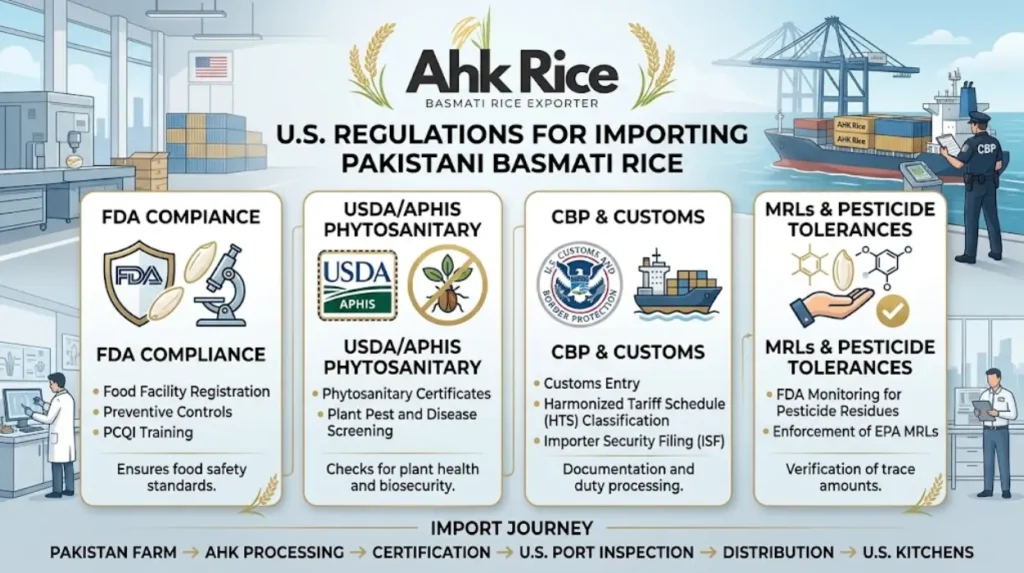
Imported Pakistani Basmati rice must meet applicable FDA food safety and labeling rules, customs requirements, and relevant marketplace policies. The importer must identify its regulatory responsibilities, verify foreign suppliers, provide required shipment notifications, and ensure that the rice is eligible for lawful sale in the United States.
The FDA regulates food safety and labeling under applicable federal food laws. Its import framework includes food facility registration where required, Prior Notice, and FSVP obligations for covered importers.
FSVP requires the responsible US importer to establish and follow a risk-based program for verifying that imported food meets applicable US food safety requirements. The program includes supplier evaluation, hazard analysis where required, verification activities, and appropriate records.
US Customs and Border Protection (CBP) administers customs entry and enforces applicable import rules. Importers must confirm the correct Harmonized Tariff Schedule classification, customs value, country of origin, and duties. A customs broker assists with entry procedures but does not remove the importer’s legal responsibilities.
Rice labeling must comply with applicable FDA rules. Required information depends on the product and its presentation. Retail packages generally need an accurate statement of identity, net quantity, responsible business information, and applicable nutrition and ingredient information. Plain, single-ingredient rice has different ingredient and nutrition considerations from seasoned rice mixes.
The seller must substantiate marketing claims. Statements such as organic, non-GMO, pesticide-free, or premium-grade require appropriate evidence and compliance with applicable rules. Certifications do not replace mandatory import procedures.
What Are the Benefits of Selling Pakistani Basmati Rice Through E-Commerce?
E-commerce gives rice sellers access to customers beyond traditional wholesale distribution. Online channels support product discovery, direct customer feedback, multiple package sizes, and repeat purchasing, while inventory and sales data help sellers evaluate demand for individual varieties and retail formats.
Access to Specialized Customer Segments
Online marketplaces connect sellers with customers searching for particular rice varieties. These customers include South Asian households, home cooks, specialty food buyers, and consumers preparing biryani or other rice-based dishes.
A clearly structured listing helps buyers distinguish 1121, Super Kernel, and 1509 rice. Accurate information about grain type, processing, and package weight reduces confusion between products.
Flexible Retail and Wholesale Models
Sellers can offer individual consumer bags, multipacks, and larger foodservice formats where the platform permits them. Different pack sizes support different purchasing habits and price points.
Online channels also allow sellers to compare customer response to product images, descriptions, and package sizes. These insights help inform future purchasing and inventory decisions.
Greater Control Over Product Information
Digital listings provide space for cooking instructions, storage guidance, origin details, and product specifications. Sellers can explain differences between raw, steamed, and parboiled rice without relying entirely on physical shelf space.
Clear product information helps customers choose the rice that matches their cooking requirements. It also reduces the risk of complaints caused by inaccurate descriptions or unsuitable expectations.
Which Pakistani Basmati Rice Varieties Suit Different Online Markets?
The best variety depends on customer preferences, retail positioning, package size, and the intended cooking application. Extra-long 1121 Basmati suits premium positioning, Super Kernel serves aroma-focused customers, and 1509 provides an option for sellers targeting value-conscious households and commercial kitchens.
| Rice variety | Main characteristics | Suitable online positioning |
|---|---|---|
| 1121 Basmati | Extra-long grain and cooked elongation | Premium rice, biryani, specialty retail |
| Super Kernel Basmati | Traditional aroma and elongated cooked grain | Ethnic grocery, household cooking |
| 1509 Basmati | High-yield variety with commercial applications | Value-focused retail and foodservice |
| Traditional Basmati | Recognizable aroma and traditional cooking qualities | Specialty stores and regional cuisines |
Processing method also affects product positioning.
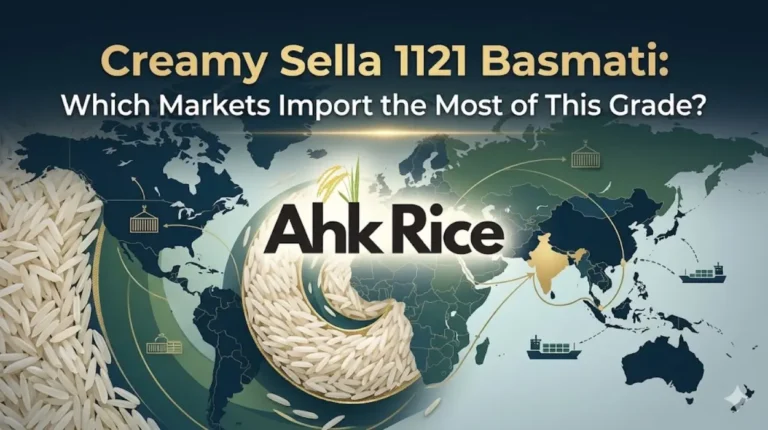
Steam Basmati undergoes steaming during processing and offers a white-grain presentation. Golden Sella Basmati undergoes parboiling and drying, producing a golden appearance and different cooking characteristics. Creamy Sella Basmati is another parboiled style with a lighter color.
These products are not interchangeable in every recipe. Sellers should identify the processing type accurately and provide cooking instructions appropriate to the specific product.
Market demand also differs by channel. Ethnic grocery customers often search by variety and origin, while foodservice buyers focus on cooking consistency, portion yield, and pack size. Online listings should reflect the needs of the intended customer rather than use identical descriptions for every rice type.
What Common Problems Affect Online Sales of Imported Rice?
The main problems are incomplete import documentation, incorrect labels, unsuitable packaging, insufficient shelf life, and inaccurate product claims. Sellers reduce these risks through pre-shipment verification, label review, batch testing, careful inventory planning, and confirmation of current marketplace requirements before sending products to fulfillment centers.
Incomplete Import Documentation
Missing information can delay customs entry or trigger regulatory review. Importers should reconcile the commercial invoice, packing list, transport documents, product description, declared origin, and shipment quantities before dispatch.
The importer must also verify the requirements that apply to the shipment rather than assume that a document used for another destination is sufficient for the United States.
Incorrect Labels and Product Claims
A package designed for Pakistan or the Gulf market does not automatically satisfy US retail labeling requirements. Sellers should review the final artwork before printing commercial quantities.
Unsubstantiated claims create additional risk. For example, a seller must not describe conventional rice as certified organic without meeting the applicable requirements.
Packaging Damage and Shelf-Life Issues
Rice bags can tear, leak, or lose their seal during handling. Poor packaging increases customer complaints and can make inventory unsuitable for sale.
Amazon imposes food-specific packaging and shelf-life requirements. Its US food policy generally requires products to arrive properly sealed and labeled, with more than 90 days of shelf life. Expiration-dated inventory is subject to additional rules.
Sellers must verify the current requirements for their product and fulfillment method before dispatch. They should also account for the time spent in international transit, customs clearance, warehouse receiving, and customer delivery.
Confusing Marketplace Approval With Regulatory Compliance
A product listing does not prove that an imported food shipment meets federal law. Similarly, customs clearance does not guarantee that Amazon will accept a product into its fulfillment network.
Sellers must satisfy both sets of requirements. Regulatory compliance, accurate listing information, and fulfillment eligibility are separate checks.
How Should Sellers Prepare Pakistani Basmati Rice for US E-Commerce?
Sellers should finalize product specifications, verify import responsibilities, approve US-compliant labels, test packaging, and confirm marketplace eligibility before shipping inventory. A documented preparation process reduces avoidable delays and helps maintain consistent product quality across listings, shipments, fulfillment centers, and customer orders.
A practical preparation sequence includes these actions:
- Confirm the variety, processing type, grade, moisture, and broken percentage.
- Verify the foreign supplier and the applicable FDA registration and FSVP responsibilities.
- Arrange required Prior Notice and customs entry procedures.
- Review the label, net quantity, nutrition information, and substantiated claims.
- Select sealed packaging that protects rice during parcel transportation.
- Establish lot identification and shelf-life records.
- Confirm Amazon category eligibility, listing attributes, and fulfillment requirements.
- Check that inventory labels and shipment information match the physical packages.
- Calculate landed cost, including freight, duties, storage, fulfillment, and marketplace fees.
- Monitor customer feedback, returns, and stock rotation after launch.
For sellers evaluating retail packaging and warehouse preparation in more detail, the next stage is understanding how packaging, labeling, and Fulfillment by Amazon (FBA) requirements affect imported Basmati rice.
A clear compliance process helps sellers build a more reliable online rice business. The objective is not simply to list Pakistani Basmati rice but to deliver the correctly described product through a legally compliant and traceable supply chain.
Frequently Asked Questions
Can Pakistani Basmati rice be sold on Amazon USA?
Yes. Pakistani Basmati rice can be sold on Amazon USA when the seller meets applicable US food import regulations, labeling requirements, and Amazon’s food product policies. Sellers must also confirm product eligibility and fulfillment requirements.
Does imported Basmati rice require FDA approval?
The FDA does not generally preapprove individual conventional food products or shipments. However, applicable food facility registration, Prior Notice, food safety, and labeling requirements must be satisfied. Importers must also determine their Foreign Supplier Verification Program obligations.
Which Pakistani Basmati rice varieties are suitable for online sales?
Popular commercial options include 1121 Basmati, Super Kernel Basmati, 1509 Basmati, and Traditional Basmati. Sellers select varieties according to customer preferences, price positioning, grain characteristics, and intended cooking applications.
What packaging sizes work for online rice sales?
Common retail formats include 2 lb, 5 lb, 10 lb, and 20 lb bags. The appropriate size depends on customer demand, shipping costs, product positioning, and the marketplace’s current packaging requirements.
What is Amazon FBA for Basmati rice?
Fulfillment by Amazon is a service that stores eligible inventory in Amazon fulfillment centers and handles order picking, packing, and delivery. Sellers must prepare food products according to Amazon’s applicable packaging, labeling, shelf-life, and shipment requirements.
What documents are needed to import Pakistani rice into the USA?
Common documents include a commercial invoice, packing list, bill of lading or air waybill, and applicable customs entry information. Depending on the shipment, additional documentation includes origin certificates, phytosanitary documents, laboratory reports, and records supporting food safety compliance.