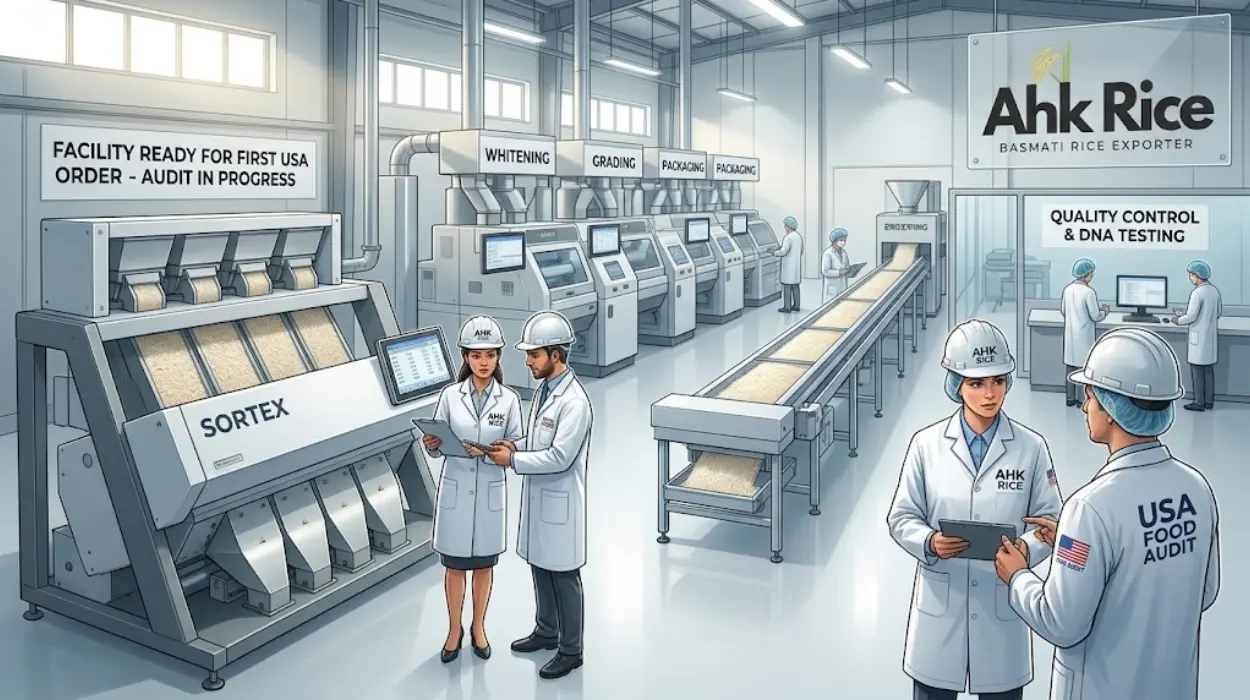
Audit AHK Rice’s Basmati Processing Facility Before Your First USA Order
Before placing a commercial order, US rice importers should verify milling consistency, food safety controls, export documentation, packaging quality, and shipment readiness. A facility audit helps buyers assess whether a Pakistani Basmati supplier can meet the agreed specification and deliver export-ready rice with fewer quality and compliance risks.
For a clear understanding of the production stages, start with this guide to how Basmati rice is processed from paddy to export-ready grain. Then assess the supplier’s actual processing controls, documentation, and ability to meet US import requirements before approving a purchase.
What is the best solution for auditing a Basmati rice processing facility?
The best solution is a structured supplier audit covering raw paddy sourcing, milling operations, grading, food safety, packaging, traceability, and export documentation. US importers should review records, request representative samples, and approve written specifications before authorizing commercial production or shipment.
A supplier’s quoted price does not establish product quality. Importers need evidence that the rice ordered matches the rice processed, packed, documented, and shipped. A facility audit connects these stages and identifies gaps before they become expensive problems.
The audit should cover five operational areas:
- Raw material control: Verify variety identification, paddy sourcing records, moisture checks, and incoming quality inspection.
- Processing consistency: Review cleaning, dehusking, whitening, polishing, optical sorting, and grading controls.
- Laboratory and quality records: Request available test reports for moisture, broken grains, grain dimensions, foreign matter, and relevant food safety parameters.
- Packing and traceability: Check bag specifications, lot identification, net weight controls, and links between production batches and shipping documents.
- Export readiness: Confirm the supplier can prepare the agreed commercial invoice, packing list, transport documentation, certificate of origin where applicable, and required phytosanitary or other export certificates.
For a deeper technical comparison of individual milling stages, read this step-by-step guide to Basmati milling, cleaning, dehusking, whitening, polishing, Sortex, and grading. It helps buyers understand what to inspect and which processing records to request.
Why choose AHK Rice for your first USA order?
AHK Rice is a Pakistani Basmati rice exporter based in Punjab, supplying varieties including 1121, Super Kernel, and 1509 Basmati rice. Buyers should evaluate its suitability through documented specifications, representative samples, quality records, packaging approval, and shipment documentation before confirming their first commercial order.
Through its Basmati rice export and processing services, AHK Rice can be assessed against the buyer’s required variety, grade, packaging format, quantity, and destination requirements.
Each variety serves a different commercial purpose. 1121 Basmati is associated with long grains and premium presentation. Super Kernel offers traditional Basmati aroma and is relevant to ethnic grocery distribution and premium foodservice. The 1509 variety can suit buyers prioritizing commercial value and suitable bulk or foodservice applications.
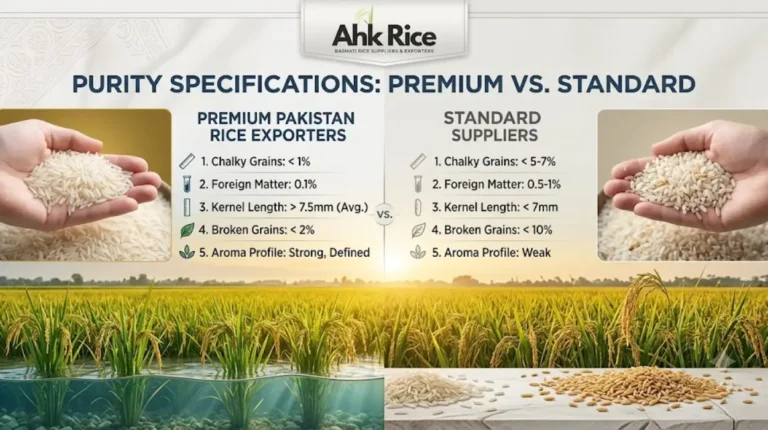
The audit should establish whether the selected grade matches the intended market rather than relying on the variety name alone. Ask AHK Rice to identify the exact product specification, including raw grain length, moisture limit, broken percentage, processing type, and agreed tolerances.
A first-order assessment should also verify:
- Whether the supplier can provide a representative pre-shipment sample.
- Whether the sample can be traced to the agreed product grade or production lot.
- Whether the final Certificate of Analysis (COA), where provided, matches the approved specification.
- Whether the proposed packaging meets the buyer’s labeling and handling requirements.
- Whether production and shipment milestones are confirmed in writing.
These checks create a documented basis for approving the supplier and reducing uncertainty before payment and shipment.
What should US importers inspect during the facility audit?
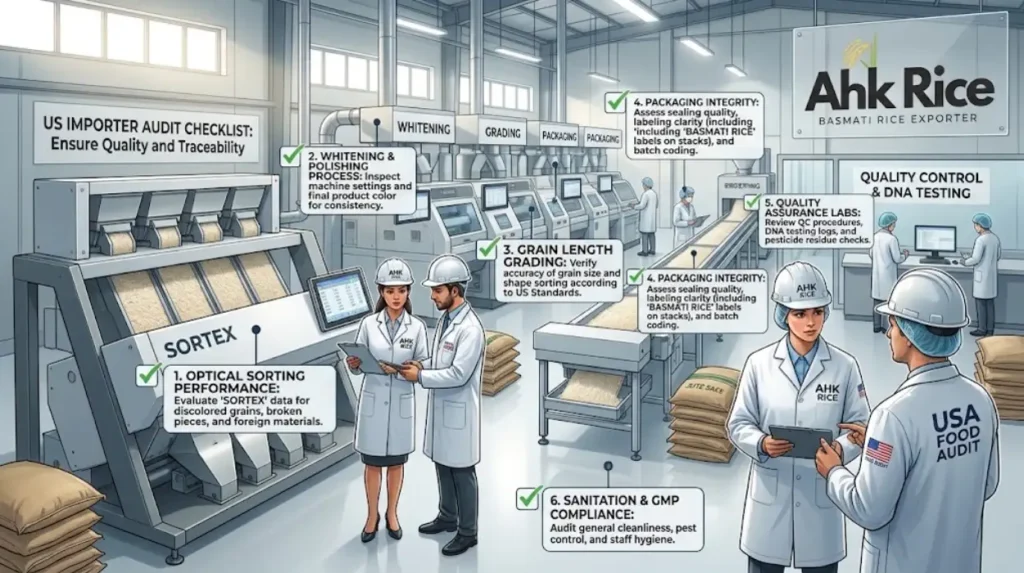
US importers should inspect the supplier’s quality management procedures, cleaning and sorting equipment, finished-product storage, pest controls, traceability records, and sanitation practices. An onsite or virtual audit should be supported by documents, photographs where appropriate, and recorded corrective actions for identified gaps.
Start with incoming paddy and raw rice controls. Ask how the facility identifies each variety and prevents unintended mixing between grades. Review receiving records and the procedures used to segregate material that fails quality checks.
Next, inspect the milling sequence. Cleaning removes unwanted material, dehusking separates the husk, whitening removes bran layers, and polishing adjusts surface appearance. Optical sorting can help remove visually distinguishable defective grains and foreign material. Grading then separates product according to the agreed commercial specification.
The equipment itself is not sufficient proof of performance. Request actual batch records, sorting inspection results, maintenance schedules, and examples of rejected material handling. Confirm how the supplier controls broken grains, moisture variation, and lot-to-lot consistency.
Finished rice storage also deserves attention. Review warehouse cleanliness, pest management, protection from moisture, stock rotation, and separation between finished products and materials that could contaminate them. Packaging controls should cover bag integrity, accurate net weight, lot coding, and protection during loading.
For food safety, ask for current, relevant certifications and their scope if the supplier claims them. Verify issuing bodies and validity rather than treating a certificate logo as proof that every product or shipment meets US requirements.
A remote audit can establish an initial evidence trail. An independent onsite inspection may provide stronger verification when order value, buyer policy, or supplier risk justifies the additional cost.
What US import requirements must be checked before shipment?
Basmati rice imported into the United States must satisfy applicable FDA food import requirements and relevant US Department of Agriculture and Customs requirements. The importer should confirm facility registration where applicable, prior notice, admissibility, documentation, labeling, and any product-specific restrictions before shipment.
Food safety compliance should be confirmed before the supplier dispatches the order. Depending on the transaction and applicable rules, the importer may need to address FDA facility registration, prior notice, Foreign Supplier Verification Program (FSVP) obligations, and entry filing through the relevant customs process.
The US importer of record remains responsible for its applicable import obligations. A supplier’s export documents do not replace the importer’s compliance responsibilities. Importers should verify current requirements with FDA, US Customs and Border Protection, USDA’s Animal and Plant Health Inspection Service where applicable, and their customs broker.
Before approving the shipment, confirm:
- Correct product description and country of origin.
- Commercial invoice, packing list, and bill of lading details.
- Applicable phytosanitary documentation and other certificates required for the specific consignment.
- Food safety and laboratory records relevant to the product and buyer’s risk assessment.
- Accurate packaging information, net weight, lot identification, and any required retail labeling.
- Consistency across the purchase contract, product specification, certificates, and shipping documents.
Do not assume that one certificate or inspection automatically satisfies every US requirement. The appropriate documents depend on the product, shipment, and current regulations.
What results can be expected from a successful audit?
A successful audit gives the buyer documented evidence of supplier capability, a defined product specification, an agreed sample approval process, and clearer production and shipment responsibilities. It reduces avoidable uncertainty but does not guarantee that every commercial shipment will be defect-free or automatically clear US import controls.
The main result is a repeatable purchasing process. The buyer knows what grade is being purchased, how quality is assessed, which documents must accompany the order, and what happens if the delivered rice fails agreed requirements.
For example, a US distributor buying 1121 Steam Basmati for retail distribution can specify acceptable grain length, maximum broken percentage, moisture limits, bag weight, labeling, and inspection conditions. A foodservice importer buying Sella rice can focus more closely on cooking performance, batch consistency, and suitability for its preparation process.
In both cases, sample approval should be documented. Keep the approved sample reference, specification sheet, laboratory reports, and final purchase order together. Include a contractual procedure for handling nonconformity, including inspection evidence, notification deadlines, and agreed remedies.
A practical audit outcome is a written supplier approval record with outstanding issues, responsible parties, and deadlines. Any critical food safety or traceability gap should be resolved before shipment authorization.
How much does a Basmati rice facility audit and sample process cost?
Audit and sample costs depend on inspection method, sample weight, courier destination, testing requirements, and order size. AHK Rice’s commercial sample offer may provide up to 20 kg of Super Kernel Basmati, with the buyer covering courier shipping and applicable phytosanitary charges; confirm current terms before proceeding.
How can a US buyer get started with AHK Rice?
Start by defining the required Basmati variety, grade, packaging, order quantity, and destination port. Request the relevant supplier documents and a representative sample, complete the audit, confirm US import requirements with your compliance team, and approve the written specification before authorizing commercial production.
Use this practical sequence to keep the first transaction controlled:
- Submit your requirements: Identify whether you need 1121, Super Kernel, or 1509 Basmati, along with processing type, quality limits, packaging, and expected order volume.
- Request supplier evidence: Ask for available company documents, facility information, quality procedures, relevant certifications, sample terms, and export references.
- Audit the operation: Review processing, grading, storage, packaging, traceability, and quality records. Record any unresolved issues.
- Approve the sample: Test the representative sample against the agreed physical, laboratory, and cooking requirements.
- Finalize the contract: Confirm price, quantity, tolerances, packing, payment terms, Incoterm, inspection arrangements, and documentation responsibilities.
- Authorize shipment: Approve production and loading only when the agreed conditions are met, then track documents and vessel milestones.
The first order should establish a repeatable procurement standard for future shipments. A documented audit, approved sample, clear specification, and agreed inspection procedure give both parties a practical basis for managing quality and delivery expectations.
For US importers evaluating AHK Rice, the final decision should rest on verifiable evidence and the ability to meet the agreed requirements, not on price or product claims alone.
Frequently asked questions
Can a US importer audit AHK Rice before placing an order?
Yes. Request a remote document review or arrange an onsite audit, subject to access and scheduling. Agree on the audit scope in advance. Review quality records, traceability, processing controls, storage, packaging, and export documentation. Record unresolved issues before approving the supplier.
Can AHK Rice provide samples for US buyers?
AHK Rice’s sample offer may include up to 20 kg of Super Kernel Basmati, subject to confirmation of current availability and terms. The buyer covers courier shipping and applicable phytosanitary charges. Confirm dispatch arrangements, destination requirements, and expected delivery timing before payment.
Which documents should buyers request before shipment?
Request the commercial invoice, packing list, transport documentation, product specification, and applicable certificates for the shipment. Ask for relevant quality and laboratory records as well. Confirm the exact documentation with your customs broker and relevant US authorities before dispatch.
How long does Basmati rice shipping take to the USA?
A preliminary ocean-transit estimate is approximately 25–40 days, depending on destination port, routing, and carrier schedule. Production, inspection, export clearance, and US import processing add time. Confirm the actual vessel schedule and total lead time before placing the order.
What should a buyer do if the sample fails quality testing?
Document the failed parameters and share the results with the supplier. Compare the findings with the agreed specification and request clarification or a replacement sample where appropriate. Do not approve commercial production until the quality issue is resolved and acceptance criteria are documented.