What Payment Terms Are Used When Importing Rice from Pakistan to Indonesia?
Indonesian rice importers use several payment structures when buying rice from Pakistan, with LC at sight, TT advance, and Cash Against Documents (CAD) among the main arrangements. The selected term controls when payment occurs, which documents trigger payment, and how commercial risk is shared.
Payment terms define the financial process between a Pakistani rice exporter and an Indonesian importer. They connect the sales contract, commercial invoice, shipping documents, banking process, and cargo release.
For example, an Indonesian distributor purchasing 1 container of Pakistani 1121 Basmati Rice needs a clear agreement on the payment deadline, currency, banking channel, documents, and shipment conditions.
The payment method is separate from the product specification. The rice contract still defines variety, grade, grain length, moisture, broken percentage, packing, quantity, origin, and inspection requirements.
What are the main payment terms for Pakistani rice imports into Indonesia?
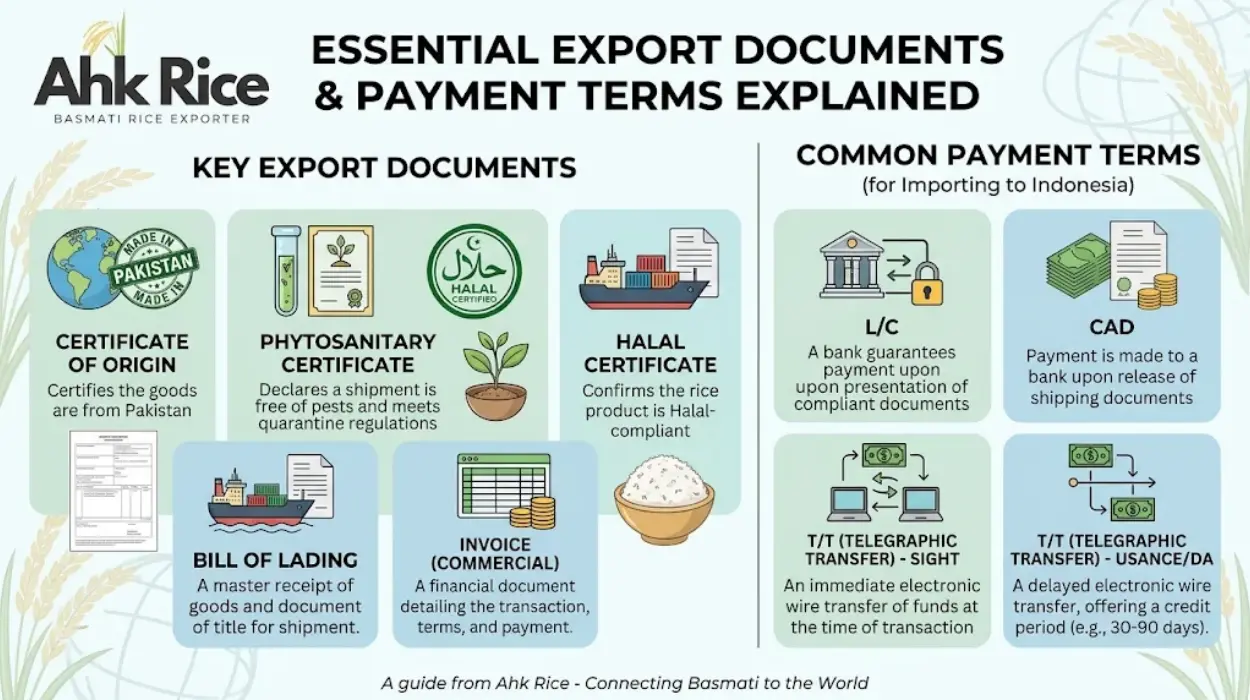
The main payment terms are Letter of Credit (LC) at sight, Telegraphic Transfer (TT) advance, and Cash Against Documents (CAD). Each method establishes a different payment trigger, document flow, banking role, and risk position for the Indonesian buyer and Pakistani seller.
LC at sight requires payment when the exporter presents compliant shipping documents through the banking system. The importer’s bank handles the documentary process according to the LC conditions.
TT advance requires the Indonesian buyer to transfer an agreed amount before shipment. The advance can cover part or all of the contract value.
CAD connects payment with presentation of specified shipping documents. The buyer pays through the agreed banking process before receiving the documents required for cargo clearance.
Other arrangements include partial advance plus balance against documents and negotiated credit terms for established trading relationships. The exact structure belongs in the sales contract.
What does LC at sight mean?
A Letter of Credit is a bank-issued payment undertaking based on specified documentary conditions. “At sight” means payment is due when the presented documents comply with the LC requirements.
For example, the LC can require a commercial invoice, packing list, bill of lading, certificate of origin, phytosanitary certificate, and other agreed documents.
The exporter ships the rice according to the contract. The exporter then presents the required documents to the bank. The bank checks the documents against the LC terms.
Document compliance is central to this method. A shipment with correct rice specifications still faces a documentary issue when the presented paperwork does not satisfy the LC conditions.
How does payment work when an Indonesian importer uses LC at sight?
An LC transaction begins with the sales contract, continues through LC issuance and shipment, and ends with documentary presentation and payment. The bank checks documents against LC conditions, while the commercial contract controls the rice specification and shipment obligations.
The process normally follows these stages:
1. Sales contract
The Pakistani exporter and Indonesian importer agree on quantity, grade, price, Incoterm, packing, shipment period, inspection requirements, and payment term.
2. LC issuance
The Indonesian buyer asks its bank to issue the LC in favor of the Pakistani exporter. The LC contains documentary and commercial conditions.
3. LC review
The exporter reviews the LC before shipment. Names, quantities, shipment dates, ports, document requirements, and other conditions require consistency.
4. Rice processing and shipment
The exporter processes, grades, packs, loads, and ships the contracted rice. The shipment generates the required transport and export documents.
5. Documentary presentation
The exporter presents the required documents to the nominated or relevant bank.
6. Bank examination
The bank examines the documents against the LC terms. Compliant documents trigger the payment process under the LC.
7. Import documentation
The Indonesian importer uses the released documents for customs, quarantine, cargo clearance, and other import procedures.
This structure separates the physical rice transaction from the documentary payment mechanism.
What is TT advance payment for Pakistani rice?
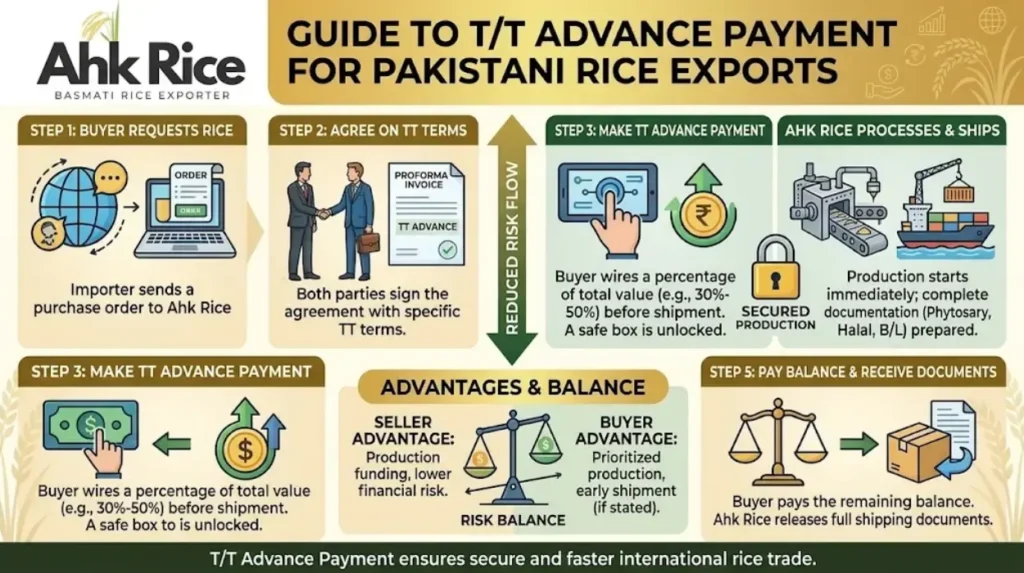
TT advance payment means the Indonesian buyer transfers money to the Pakistani exporter before the agreed shipment stage. The sales contract defines the advance percentage, balance payment date, banking details, shipment obligation, and documents required for the remaining payment.
TT stands for Telegraphic Transfer. It is a bank-to-bank electronic transfer used for international commercial payments.
A contract can specify 30% advance and 70% before shipment. Another contract can specify 100% advance for a particular commercial arrangement.
For example, an Indonesian importer orders 25 metric tons of 1509 Basmati Rice. The contract states that 30% is paid after order confirmation and 70% is paid before shipment.
The payment schedule needs to match the production and shipment process. The contract should identify the payment currency, beneficiary details, bank information, transfer charges, and payment deadlines.
TT advance is operationally straightforward, but the importer pays before receiving the shipped cargo. The buyer therefore needs strong contractual controls over specifications, inspection, documentation, and shipment timing.
What is Cash Against Documents (CAD) for rice imports?
Cash Against Documents requires payment against presentation of specified shipping documents through the agreed banking arrangement. The buyer receives the documents after satisfying the payment condition, allowing the documents to support import clearance and cargo collection.
CAD links payment to documents rather than advance payment before shipment.
The exporter ships the rice and submits the agreed documents to the bank. The Indonesian buyer completes payment according to the documentary arrangement. The documents are then released under the agreed procedure.
Typical documents include a commercial invoice, packing list, bill of lading, certificate of origin, phytosanitary certificate, and other documents required by the contract or Indonesian import process.
CAD differs from LC at sight because an LC contains a bank undertaking governed by the LC terms. CAD instead operates around documentary release against payment.
The exact banking mechanism must be written into the contract because “CAD” describes a payment structure rather than one universal documentary procedure.
What documents are important in Pakistani rice payment transactions?
Payment documents connect the commercial contract with banking and import clearance. Common documents include the commercial invoice, packing list, bill of lading, certificate of origin, phytosanitary certificate, inspection documents, and other certificates specifically required by the Indonesian import transaction.
Commercial invoice
The commercial invoice identifies the seller, buyer, rice description, quantity, unit price, total value, and agreed trade terms.
Packing list
The packing list identifies packages, net weight, gross weight, packing format, and shipment details.
Bill of lading
The bill of lading records the ocean shipment and identifies the cargo, carrier, shipper, consignee, and transport details.
Certificate of Origin
The Certificate of Origin establishes the declared country of origin of the rice.
Phytosanitary certificate
The phytosanitary certificate supports plant-health requirements for agricultural commodities and forms part of the export and import documentation process.
Inspection or quality documents
Contracts can specify inspection reports, laboratory certificates, Certificate of Analysis, fumigation documents, or other quality records.
Document requirements must match the payment term. A document required under an LC needs exact attention because discrepancies can affect the payment process.
What factors determine the best payment term for Indonesian rice importers?
The appropriate payment term depends on transaction value, supplier relationship, documentary requirements, buyer risk tolerance, shipment structure, and banking arrangements. New transactions usually require stronger payment controls, while established trade relationships support more flexible structures.
Transaction value
A larger shipment creates greater financial exposure. Buyers and sellers need clear payment triggers for higher-value contracts.
Supplier relationship
A first transaction has less commercial history than repeated shipments. Established counterparties have documented performance records.
Documentary complexity
Rice exports involve several commercial and regulatory documents. The payment method needs to accommodate the required documentation.
Shipment timing
The contract should align payment with production, inspection, loading, and shipment dates.
Buyer controls
Importers need controls for rice variety, grade, weight, packaging, and documentation before releasing funds.
Seller controls
Exporters need payment security before committing production capacity, packaging materials, logistics, and vessel space.
What are common problems with rice import payment terms?
Most payment disputes arise from unclear contracts, inconsistent documents, incorrect bank details, misunderstood payment triggers, and differences between commercial specifications and documentary requirements. A detailed sales contract reduces these operational problems before shipment begins.
Incorrect payment instructions
Bank details must come from verified contractual and banking channels. Changes require independent verification.
Unclear advance percentage
The contract must state the exact advance amount and balance percentage. It should also identify the payment deadline.
LC discrepancies
An LC can contain conditions that conflict with the commercial agreement. Exporters need to review the LC before shipment.
Document mismatch
Differences in names, quantities, package descriptions, dates, or shipment information create documentary problems.
Confusing payment with import clearance
Payment and customs clearance are separate processes. Payment releases funds according to the agreed term. Import clearance follows Indonesian regulatory procedures.
Assuming all CAD transactions work identically
CAD requires a defined document-release procedure. The contract should identify the documents, bank roles, payment trigger, and release conditions.
How should Pakistani rice payment terms appear in the sales contract?
A rice sales contract should state the payment method, percentage, currency, payment deadline, bank charges, documentary requirements, shipment conditions, inspection terms, and consequences of non-payment. Clear wording prevents disputes between the Indonesian importer and Pakistani exporter.
The contract should identify the rice precisely. Examples include 1121 Basmati, Super Kernel Basmati, or 1509 Basmati.
It should also specify grade, grain length, broken percentage, moisture level, packing, quantity, crop year where relevant, origin, and destination.
The payment clause should then define whether the transaction uses LC at sight, TT advance, CAD, or another agreed structure.
For Indonesian buyers comparing these three structures in detail, the next-stage comparison should examine payment timing, buyer risk, seller risk, documentary control, and transaction suitability. That comparison belongs naturally in the related article on LC at sight vs TT advance vs CAD for Indonesian rice importers.
What payment term is most common for first-time Pakistani rice transactions?
There is no single payment term that applies to every first-time rice transaction. LC at sight, TT advance, and CAD each create different controls. The selected method depends on the negotiated contract, banking capability, shipment value, and commercial relationship.
A first-time importer should define every payment trigger before signing the sales contract.
The buyer should verify the exporter’s legal and banking details. The exporter should verify the importer’s company information and payment capability.
Both parties should also establish who pays banking charges and how amendments, document discrepancies, delayed payment, inspection findings, and shipment changes are handled.
Payment terms are therefore part of the complete import transaction. They work alongside product specifications, export documentation, inspection, shipping, customs clearance, and Indonesian import requirements.
Frequently Asked Questions
What is LC at sight in Pakistani rice imports?
LC at sight is a documentary payment method where the bank processes payment after the exporter presents documents that comply with the LC requirements.
Is TT advance paid before rice shipment?
Yes. TT advance is paid before the shipment stage specified in the sales contract. The contract defines the advance percentage and balance payment conditions.
What does CAD mean in rice trading?
CAD means Cash Against Documents. Payment is connected to the presentation and release of specified shipping documents under the agreed banking arrangement.
Which documents support rice payment?
Common documents include the commercial invoice, packing list, bill of lading, Certificate of Origin, phytosanitary certificate, and agreed inspection or quality certificates.
Can Indonesian importers negotiate payment terms?
Yes. Payment terms are commercial contract conditions. The buyer and exporter agree on the payment method, timing, currency, documentary requirements, and banking procedure before shipment.
Does the payment term determine rice quality?
No. Rice quality is defined by the sales contract and product specification. Payment terms define how and when the commercial value is transferred.
What should be checked before agreeing to a payment term?
Check the payment trigger, advance percentage, balance deadline, bank details, documentary requirements, shipment conditions, inspection terms, currency, banking charges, and procedures for discrepancies or delayed payment.