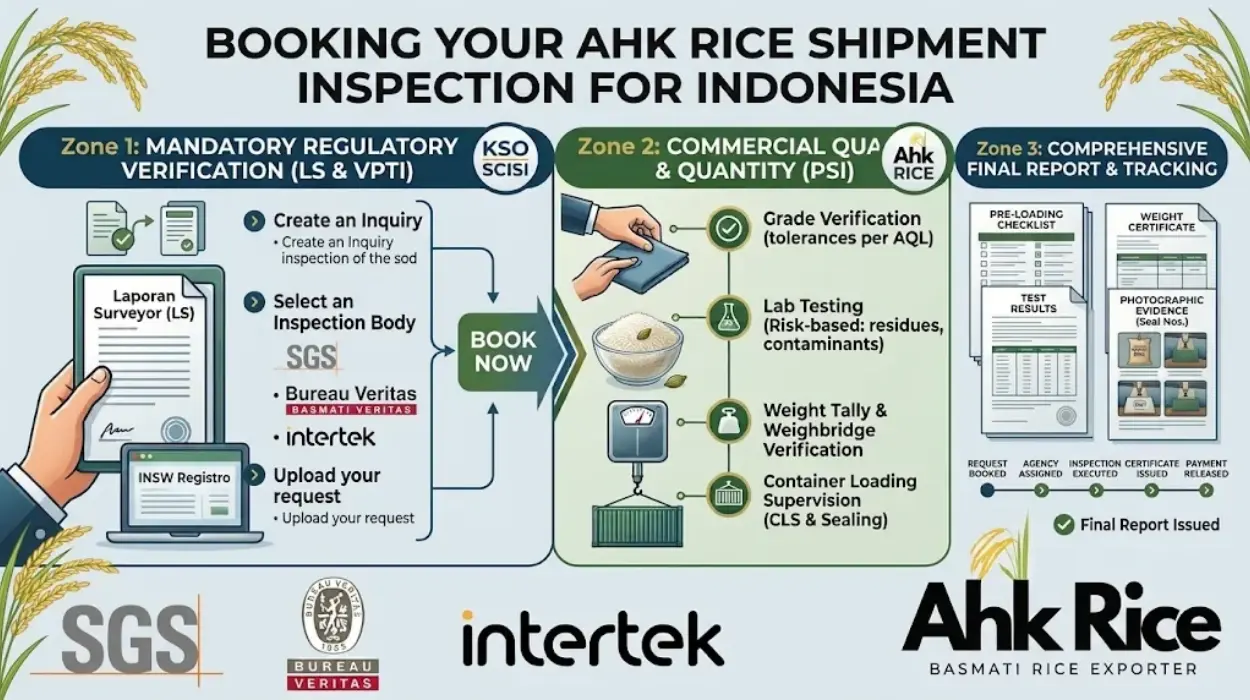
Book Third-Party Inspection on Your AHK Rice Shipment to Indonesia
Booking third-party inspection before an Indonesian rice shipment leaves Pakistan gives the buyer documented evidence of quality, quantity, packaging, loading condition, and agreed specifications. For importers purchasing commercial volumes, inspection is a practical control against specification disputes, inconsistent lots, and avoidable shipment problems.
For a detailed explanation of the inspection process, start with the pre-shipment inspection guide for Basmati rice exports. The next decision is choosing the inspection scope and provider for the actual shipment.
What is the best solution for inspecting an AHK Rice shipment to Indonesia?
The best solution is a pre-shipment inspection against a written specification, supported by representative sampling, laboratory testing where required, packaging and quantity verification, container checks, and a final inspection report before dispatch.
An Indonesian importer should not book an inspection simply by requesting “rice quality inspection.” The inspector needs measurable acceptance criteria.
For example, a 1121 Basmati shipment can specify grain length, broken percentage, moisture, foreign matter, purity, packaging, net weight, crop information and loading requirements. A Super Kernel or 1509 shipment can use a different specification according to the commercial agreement.
AHK Rice coordinates the shipment around the agreed product specification so the inspection can be performed against the same commercial requirements used for purchasing.
Third-party inspection is especially valuable for a first shipment, a new supplier relationship, a private-label order, a high-value premium Basmati shipment, or a transaction where the importer needs independent evidence before releasing the cargo.
The inspection does not replace Indonesian customs clearance, import approvals, quarantine requirements, food registration, or other mandatory procedures. It verifies the agreed inspection scope.
Why choose AHK Rice for a third-party inspected shipment?
Choose AHK Rice when you need the rice specification, production preparation, inspection appointment, export documentation, packaging, loading and shipment process coordinated around one commercial order.
AHK Rice supplies Pakistani Basmati varieties including 1121, Super Kernel and 1509 for international buyers. Its export process covers sourcing, processing, grading, packaging and shipment preparation.
For an Indonesian buyer, the benefit is coordination between the commercial specification and the physical shipment.
The buyer can provide the required inspection criteria before production or loading. AHK Rice can then coordinate the inspection schedule with the shipment preparation process. This avoids a common problem where an inspector arrives without a complete specification or where laboratory testing is requested after the cargo is already ready for dispatch.
The buyer can also request specific controls such as:
- Grain length and appearance
- Broken percentage
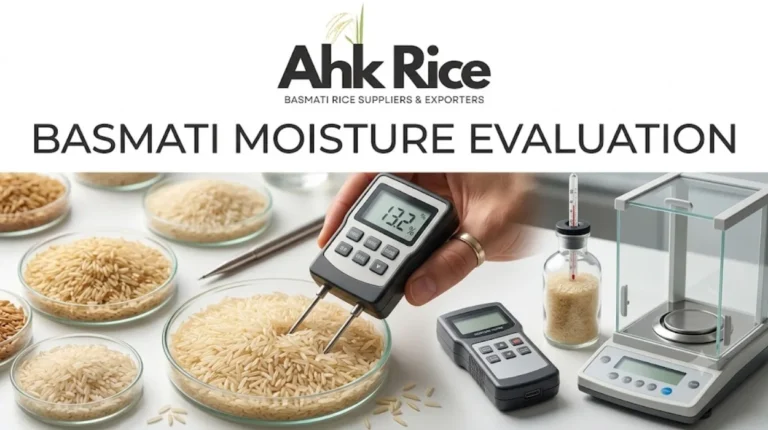
- Moisture
- Foreign matter
- Damaged grains
- Purity and variety requirements
- Net weight and bag count
- Packaging condition
- Bag markings
- Container cleanliness
- Seal verification
- Loading supervision
- Photographic evidence
- Laboratory testing where required
The inspection company remains an independent third party. AHK Rice does not replace the inspector’s independent findings.
Which inspection company should Indonesian importers book?
Select SGS, Bureau Veritas, Intertek, or another qualified provider according to the required inspection scope, sampling method, laboratory capability, location, reporting format, turnaround time, and total cost rather than brand name alone.
The Indonesian buyer should request comparable quotations when the shipment requires formal third-party verification.
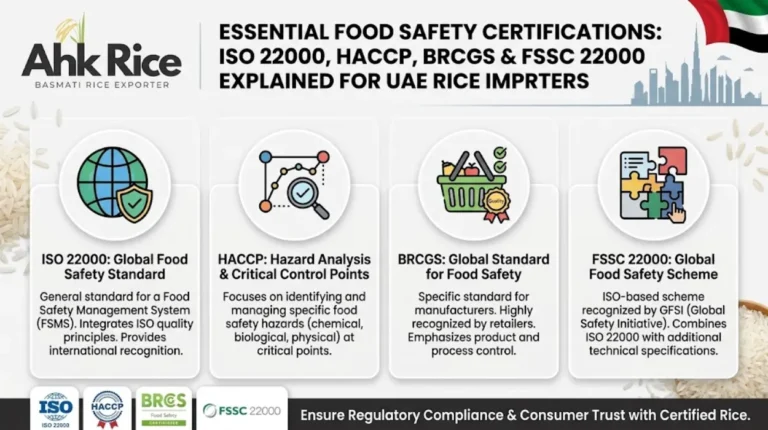
SGS, Bureau Veritas and Intertek provide international inspection and testing services, but the exact service must be confirmed for the shipment. A basic inspection package does not automatically include every laboratory test.
For example, if the buyer requires pesticide residue testing, the inspection request should identify the analytes, applicable limits, sample requirements, laboratory method and reporting requirements.
The same principle applies to moisture, mycotoxins, heavy metals and microbiological testing. The buyer should specify what needs to be tested rather than assuming a generic inspection covers every food-safety parameter.
For a provider comparison, Indonesian buyers can also review SGS, Bureau Veritas and Intertek inspection options and what importers should request. The technical comparison principles apply when building an Indonesia inspection request, although Indonesian import requirements must be confirmed separately.
What results can Indonesian buyers expect from inspection?
A properly scoped inspection produces a documented assessment showing whether the inspected lot matches the agreed product, physical-quality, quantity, packaging, loading and testing requirements before shipment leaves Pakistan.
The most important result is not simply an “approved” or “passed” statement.
The report should identify the inspected product, lot or batch, inspection date, quantity, sampling procedure, tested parameters, measured results, deviations and applicable acceptance criteria.
For example, suppose an Indonesian importer purchases 25 tonnes of 1121 Steam Basmati.
The buyer specifies a maximum moisture level, maximum broken percentage, minimum grain-length requirement, packaging format and net weight.
The inspector samples the shipment according to the agreed procedure and records the findings.
If the results meet the contractual limits, the buyer has documented evidence supporting shipment acceptance. If a result falls outside the agreed specification, the importer can discuss correction, sorting, replacement, price adjustment or another contractual remedy before dispatch.
This is more useful than relying on photographs or a supplier’s general quality statement.
Inspection also creates a reference point for future orders. If the first shipment establishes an approved commercial specification, subsequent shipments can be compared against the same requirements.
How much does third-party rice inspection cost?
Inspection cost depends on the provider, shipment quantity, inspection location, sampling requirements, laboratory tests, loading supervision, travel, report turnaround, and any additional services included in the quotation.
There is no reliable single inspection price for every Indonesian rice shipment.
A basic physical inspection can cost less than a broader assignment involving laboratory analysis, container loading supervision and multiple sampling locations.
The buyer should request an itemised quotation covering:
| Cost factor | What to confirm |
|---|---|
| Inspection fee | Physical inspection scope and number of inspectors |
| Sampling | Number of samples, lots and sampling locations |
| Laboratory tests | Individual tests, methods and laboratory charges |
| Loading supervision | Inspector attendance during container loading |
| Quantity verification | Bag count, weighing or tally requirements |
| Travel | Transport and accommodation where applicable |
| Report | Standard or customised report format |
| Turnaround | Normal and urgent reporting time |
| Reinspection | Cost if corrective action requires another visit |
For an AHK Rice shipment, the importer should provide the specification before the inspection is booked. This allows the inspection company to quote the actual required scope rather than an incomplete standard package.
The rice price itself is separate from inspection cost. A commercial quotation for Super Kernel, 1121 or 1509 depends on grade, grain specification, broken percentage, moisture, packing, quantity, destination and Incoterm.
A previously supplied 2026 benchmark for Super Kernel Basmati was US$1,165–US$1,205 per MT FOB Karachi. This is only a benchmark, not a live Indonesia quotation or guaranteed offer. The buyer should request a current shipment-specific quotation.
How does the inspection process work from sample to shipment?
The process should begin with the buyer’s specification, continue through inspection booking and representative sampling, and finish with report approval before the container is released for export.
1. Send the purchase specification
The Indonesian importer sends the required variety, grade, processing type, moisture limit, broken percentage, grain specification, packaging, quantity and testing requirements.
2. Confirm the inspection scope
AHK Rice and the buyer confirm which inspection company will perform the inspection and whether the assignment covers physical inspection, quantity, packaging, loading and laboratory analysis.
3. Arrange sampling
The inspector collects representative samples from the agreed lot. Sampling should not depend on a hand-selected bag that represents only the best-looking rice.
4. Perform laboratory tests
Where required, samples are submitted for agreed laboratory testing. The exact tests depend on the buyer’s contract and Indonesian requirements.
5. Inspect the finished shipment
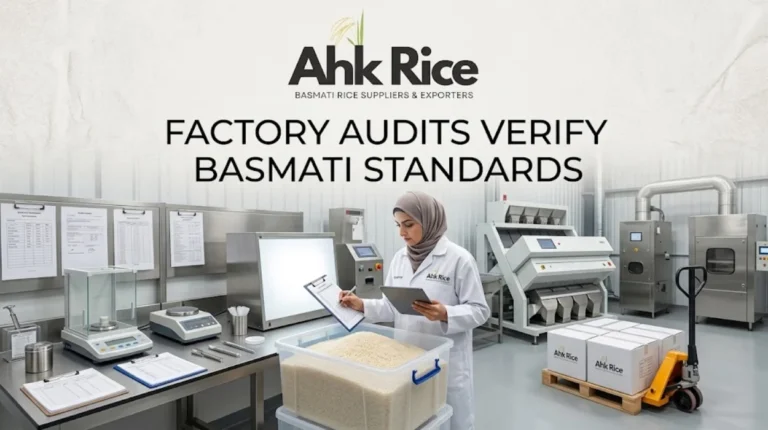
The inspector verifies the packed rice against the agreed specifications. Packaging, markings, quantity, container condition and other requested controls are checked.
6. Supervise loading if required
The inspector can record container details, loading conditions, bag counts, seal information and other agreed evidence.
7. Review the report
The importer receives the inspection report and reviews the findings against the contractual specification before shipment release.
8. Resolve non-conformities
If the inspection identifies a deviation, the parties determine the required corrective action. Reinspection can be arranged where appropriate.
9. Complete export documentation
Once the shipment meets the agreed commercial requirements, AHK Rice coordinates the remaining export process and shipment documentation.
This sequence is particularly useful when the buyer wants inspection evidence before the container leaves Pakistan.
How many days does shipping take from Pakistan to Indonesia?
Shipping time to Indonesia depends on the Pakistani loading port, Indonesian destination port, carrier schedule, transshipment, congestion, customs processing and sailing conditions, so buyers should confirm the actual vessel schedule before booking.
For commercial planning, Indonesian buyers should separate three timelines:
- Inspection and cargo preparation: The period required to prepare the lot, arrange inspection, complete testing and correct any deviation.
- Ocean transit: The sailing period from the Pakistani export port to the Indonesian destination port, including any transshipment.
- Destination clearance: The period required for Indonesian customs, quarantine, food-related procedures, port handling and inland delivery.
A buyer planning a retail launch should not calculate inventory solely from the ocean sailing time.
AHK Rice can coordinate the shipment around the buyer’s required loading window, but the final transit schedule depends on the selected carrier and destination.
For Jakarta or Surabaya shipments, the buyer should request the latest available sailing schedule and estimated arrival date before confirming the commercial shipment.
The inspection should therefore be completed early enough to allow corrective action without missing the vessel cutoff.
What should Indonesian importers verify before approving inspection?
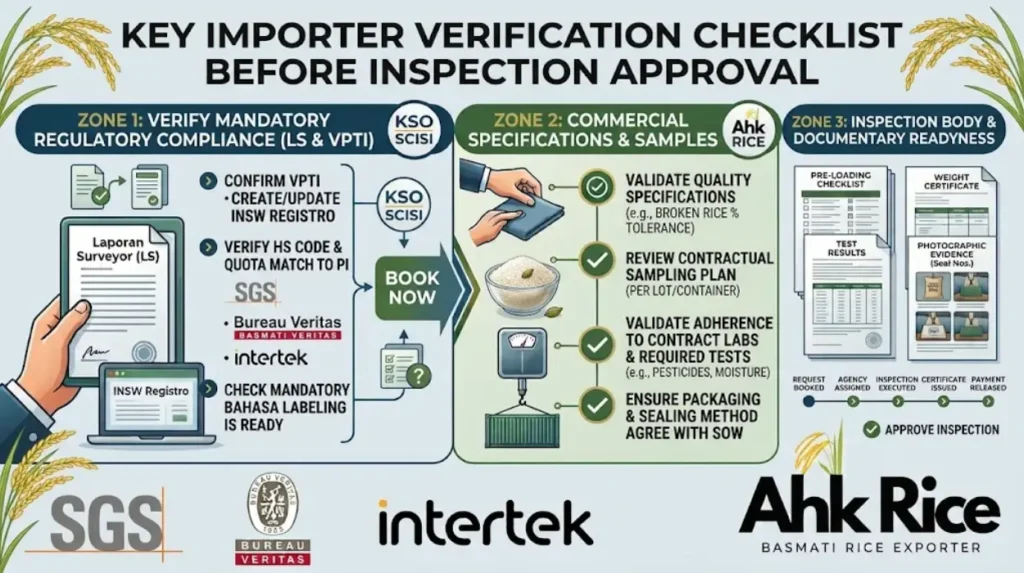
Before booking inspection, confirm the exact rice specification, inspection location, sampling procedure, laboratory requirements, acceptance limits, report deadline, shipment date and responsibility for reinspection or corrective action.
A strong inspection request should answer five commercial questions.
What is being inspected?
State the exact variety, processing type, crop or lot, quantity and packaging.
What must pass?
List measurable acceptance limits for moisture, broken percentage, grain length, foreign matter, purity and other agreed parameters.
How will it be tested?
Specify sampling method, laboratory tests, methods and reporting requirements.
When must the report arrive?
Set the deadline before the vessel cutoff.
What happens if the shipment fails?
Agree whether the cargo will be sorted, replaced, reinspected, accepted with adjustment, or rejected under the sales contract.
These details convert inspection from a general quality check into a commercial control system.
How should an Indonesian importer get started with AHK Rice?
Start by sending the required rice variety, quantity, specification, packaging, destination port, inspection scope and preferred shipment schedule so AHK Rice can coordinate the commercial quotation and inspection process.
A practical first order can follow this sequence:
- Select 1121, Super Kernel or 1509 according to the Indonesian market position.
- Confirm the required grain and quality specifications.
- Request a commercial quotation based on quantity, packing, destination and Incoterm.
- Approve the product specification and sample.
- Request third-party inspection before shipment.
- Confirm the inspection provider and required laboratory tests.
- Complete pre-shipment inspection.
- Review the report before final shipment release.
- Coordinate export documentation and container loading.
- Track the shipment through the agreed destination port.
For Indonesian buyers, the strongest decision is not simply choosing the cheapest inspection quotation. It is choosing an inspection scope that protects the commercial value of the shipment.
AHK Rice can support this process by coordinating the rice specification, production preparation, inspection arrangements, packaging and export shipment as one purchase workflow.
The result is a clearer basis for shipment approval and fewer avoidable disputes between the importer, exporter and inspection provider.
Frequently Asked Questions
Is third-party inspection mandatory for every Indonesian rice shipment?
No, third-party inspection is not automatically mandatory for every commercial rice shipment.
Requirements depend on Indonesian regulations and the buyer’s contractual conditions.
The importer should confirm current requirements with the relevant Indonesian authorities.
Contractual inspection can still provide useful independent evidence before dispatch.
The inspection scope should match the actual shipment and destination requirements.
What should SGS, Bureau Veritas or Intertek inspect?
The inspector should check the exact parameters written into the buyer’s specification.
These can include grain quality, moisture, broken percentage and foreign matter.
The scope can also include quantity, packaging, container condition and loading supervision.
Laboratory tests should be named individually rather than requested as generic “food safety.”
The final report should identify results against the agreed acceptance limits.
How much does an Indonesia rice inspection cost?
There is no fixed inspection fee for every Indonesian rice shipment.
Cost depends on quantity, location, sampling, laboratory tests and loading supervision.
Travel, urgent reporting and reinspection can create additional charges.
Request an itemised quotation before approving the inspection company.
Compare quotations using the same technical scope and shipment conditions.
When should inspection take place?
Inspection should take place early enough to correct problems before the vessel cutoff.
The exact date depends on production completion and laboratory testing requirements.
Physical inspection can occur when the shipment is ready for examination.
Laboratory samples may require additional turnaround time.
The importer should receive and review the final report before shipment release.
Can AHK Rice arrange third-party inspection for Indonesia?
AHK Rice can coordinate the shipment process around the buyer’s agreed inspection requirements.
The buyer should provide the product specification before inspection scheduling.
The selected inspection company independently performs the agreed inspection.
AHK Rice can coordinate production, packaging, loading and export documentation around the inspection.
The final inspection report remains the independent evidence for the inspected scope.