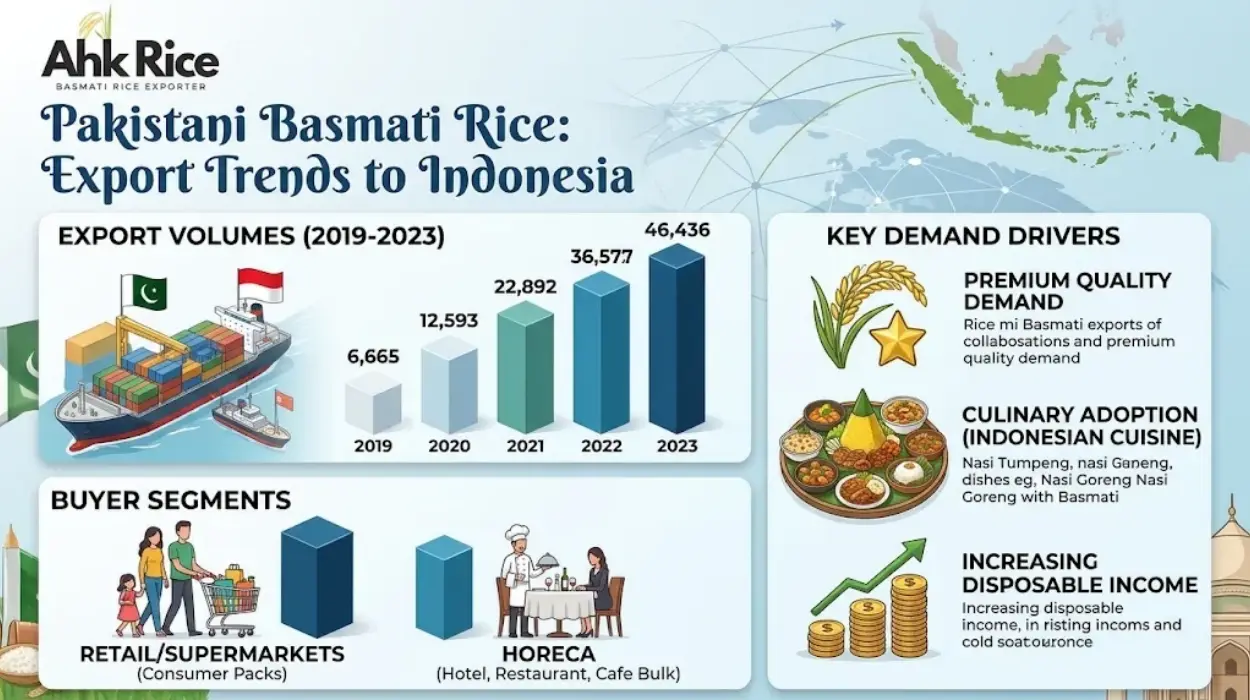
Pakistani Basmati Export Trends to Indonesia: Volumes, Demand Drivers and Buyer Segments
Pakistan’s Basmati export opportunity in Indonesia is strongest in specialty-rice, premium retail, foodservice, wholesale, and private-label segments, where buyers evaluate grain length, aroma, cooking performance, purity, price, and regulatory readiness rather than treating Basmati as a commodity rice.
Indonesia presents a different opportunity from traditional Pakistani Basmati destinations. The market is large, but domestic rice policy, import permissions, local preferences, and price sensitivity shape the addressable demand. Indonesian buyers therefore need a supply strategy matched to the exact customer segment. A useful starting point is this guide to Pakistani Basmati rice for Indonesia, which explains the main varieties, processing choices, specifications, and importer requirements.
For exporters, the commercial opportunity is not simply to increase shipment volume. It is to match 1121, Super Kernel, and 1509 Basmati with the Indonesian channels that value their specific characteristics. AHK Rice operates from Punjab and supplies these varieties through sourcing, processing, grading, customized packaging, documentation, and export coordination. AHK Rice
What are the main Pakistani Basmati export solutions for Indonesia?
Indonesian buyers can source Pakistani Basmati through spot purchases, seasonal procurement, or structured supply programs, with each approach serving different volume, pricing, inventory, and consistency requirements across wholesale, retail, foodservice, and private-label channels.
The first solution is spot purchasing. The buyer requests a current quotation, selects an available specification, approves the commercial terms, and purchases a defined quantity. This approach suits smaller importers testing market demand or buyers responding to short-term opportunities. Its main advantage is flexibility, but the next shipment requires a new procurement decision.
The second solution is seasonal contracting. The buyer establishes expected volumes around crop and procurement cycles. This provides stronger price and supply planning than repeated spot purchases. It works well for distributors that already understand their annual demand but do not require monthly replenishment control.
The third solution is a structured Basmati supply program. This approach connects product specification, sample approval, production planning, quality verification, packaging, documentation, container scheduling, and repeat shipments. It is most suitable for distributors, private-label brands, and foodservice businesses that need consistent product across multiple orders. AHK Rice describes this model as a specification-controlled supply process for Indonesian distributors.
The distinction matters because Indonesia buyers do not all have the same purchasing objective. A premium supermarket distributor may prioritize 1121 grain length and appearance. A restaurant supplier may prioritize cooking consistency and aroma. A wholesale buyer may place greater weight on procurement economics and container availability.
How do Pakistani Basmati supply approaches compare?
Spot buying provides maximum flexibility, seasonal contracting improves planning, and structured supply programs provide the strongest control over specifications, repeat shipments, packaging, inventory coverage, and long-term procurement economics.
| Attribute | Spot Purchasing | Seasonal Contracting | Structured Supply Program |
|---|---|---|---|
| Supply planning | Order by order | Crop or season based | Monthly or quarterly forecast |
| Specification control | Reconfirmed each order | Contract specification | Master specification |
| Price visibility | Short-term | Medium-term | Planned procurement budget |
| Inventory planning | Buyer managed | Forecast based | Replenishment based |
| Quality consistency | Revalidated | Contract controlled | Sample and batch controlled |
| Packaging | Shipment specific | Standardized | Standardized across orders |
| Repeat shipments | Uncertain | Planned | Scheduled |
Spot purchasing remains useful when the buyer is entering the Indonesian Basmati segment for the first time. It allows an importer to test customer response without committing to a larger annual program. The weakness is continuity. A grade available today at a competitive price is not automatically available at the same price, specification, or production schedule for the next purchase.
Seasonal contracting provides greater visibility. The importer can forecast purchasing requirements and negotiate around expected supply conditions. The risk moves toward forecasting accuracy. Overstocking ties up working capital, while underforecasting creates shortages.
Structured supply programs provide the strongest operational control. The buyer can establish one approved product specification and use it as the reference for subsequent shipments. This is particularly valuable for private-label rice, where grain appearance, processing, bag design, labeling, and customer expectations must remain consistent.
Which Pakistani Basmati varieties fit different Indonesian buyer segments?
1121 suits premium long-grain retail and foodservice, Super Kernel fits buyers prioritizing traditional Basmati aroma and cooking characteristics, while 1509 provides a commercially competitive option for wholesale and value-focused distribution channels.
1121 Basmati for premium segments
1121 is the strongest choice when visual grain length and premium cooked presentation drive the selling proposition. Indonesian distributors serving specialty supermarkets, restaurants, biryani-focused foodservice, and premium consumers can use 1121 as a differentiated product.
The variety is associated with long grain, aromatic cooking performance, and strong premium positioning. Processing selection also changes its commercial use. White and Steam formats target different cooking and presentation requirements.
Super Kernel for established Basmati demand
Super Kernel is appropriate where buyers prioritize characteristic Pakistani Basmati aroma and traditional cooking performance. It can serve South Asian food distributors, restaurants, specialty retailers, and wholesalers with established Basmati customers.
The commercial advantage is not simply grain size. Aroma, cooking texture, purity, moisture, broken percentage, and processing consistency all contribute to buyer acceptance.
1509 for value and volume positioning
1509 provides another long-grain Pakistani Basmati option for buyers balancing presentation with procurement economics. Its commercial profile makes it relevant to foodservice, wholesale distribution, and buyers seeking a competitive alternative to premium 1121.
The variety can also be supplied in different processing formats. Steam supports fresh white appearance and volume-oriented applications, while Sella processing supports firm cooked grains and foodservice requirements.
What are the main Indonesian Basmati demand drivers?
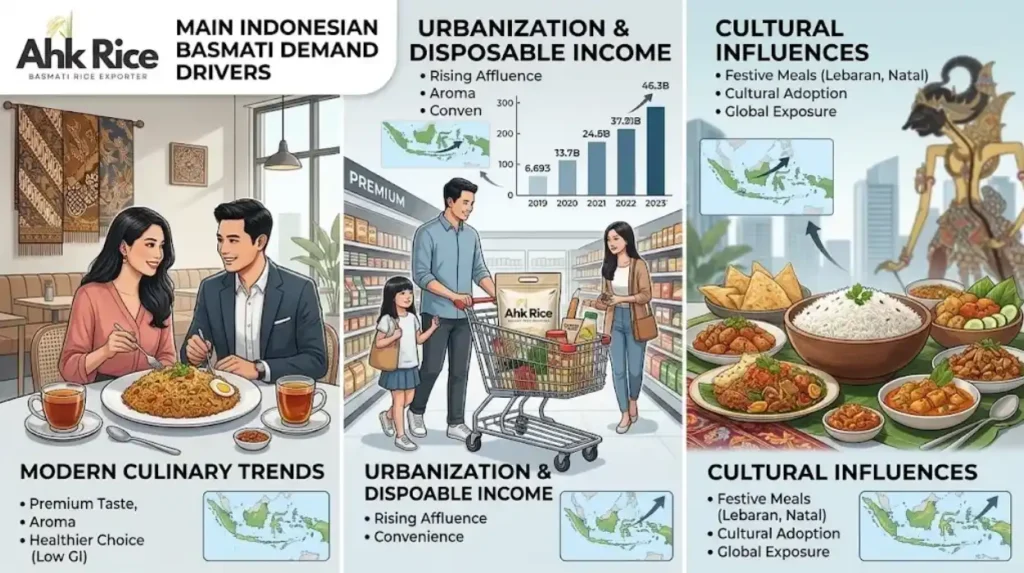
Indonesia’s Basmati demand is driven by premium food consumption, specialty rice distribution, restaurant and catering requirements, private-label opportunities, long-grain presentation, aroma, cooking performance, and the need for differentiated imported rice products.
The first driver is product differentiation. Basmati is not purchased solely as a substitute for ordinary Indonesian rice. Its long grain, aroma, elongation, and cooking characteristics create a separate premium proposition.
The second driver is foodservice. Restaurants, caterers, hotels, and institutional kitchens require predictable cooking performance. A rice variety that delivers consistent grain separation and appearance supports standardized menus and portion planning.
The third driver is specialty retail. Supermarkets and specialty food distributors can position Pakistani Basmati as an imported premium rice rather than a standard staple.
The fourth driver is private labeling. Indonesian distributors can build their own rice brands around selected Pakistani varieties and packaging specifications. This changes procurement from buying generic rice to managing a defined product.
The fifth driver is supply consistency. Once a distributor establishes a customer base for imported Basmati, repeated availability becomes part of the value proposition. A lower-priced first shipment does not compensate for inconsistent follow-up shipments.
Indonesia’s regulatory environment also shapes the opportunity. Current Indonesian rules require importers to verify the applicable authorization, importer eligibility, product classification, and documentation before shipment. AHK Rice’s recent Indonesia guidance notes the relevance of Permendag No. 18/2025 and its subsequent amendments, including Permendag No. 11/2026.
Which two Indonesian regions offer different Basmati opportunities?
Jakarta and Java-focused distribution favor premium retail, foodservice, and specialty channels, while Surabaya and eastern distribution routes provide strong relevance for wholesale, foodservice, and regional distributor programs where landed cost and logistics efficiency remain important.
Jakarta and Greater Java
Jakarta is the strongest starting point for importers targeting premium urban consumers, specialty retailers, restaurants, catering businesses, and private-label food distribution. The buyer profile supports 1121 and Super Kernel where aroma and long-grain presentation justify premium positioning.
Indicative FOB pricing for Pakistani Basmati should be treated as specification-dependent rather than a fixed Indonesia market price. AHK Rice has published an indicative US$1,100/MT FOB Karachi reference for relevant Indonesia-oriented Basmati supply, while emphasizing that grade, quantity, packing, season, and specification change the final quotation.
For Jakarta-bound procurement, a distributor should compare FOB rice cost with freight, insurance, destination charges, import costs, and inland delivery rather than using FOB alone as the purchasing benchmark.
Surabaya and East Java
Surabaya provides a useful base for buyers serving East Java and wider eastern Indonesian distribution. Wholesale and foodservice buyers can prioritize 1509 or commercially positioned 1121 grades where the target selling price is more important than the highest premium specification.
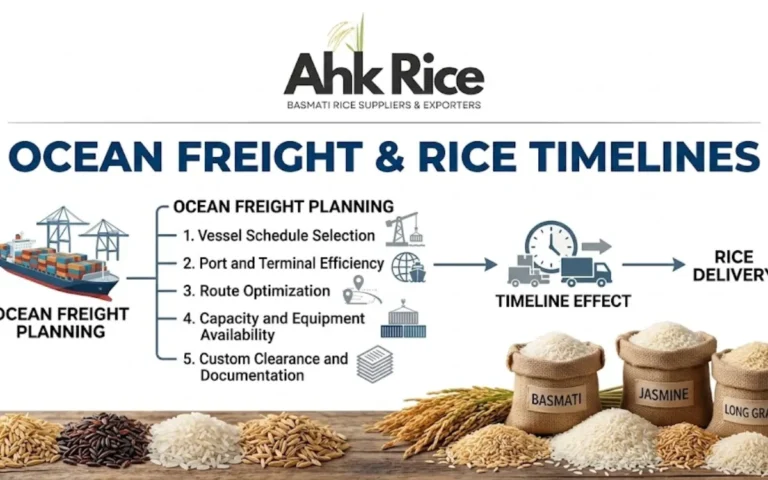
Indicative ocean transit to Jakarta and Surabaya is commonly planned at approximately 14–21 days, with total procurement planning extending to roughly 4–6 weeks after production, documentation, vessel scheduling, and clearance are included.
Shelf life should also be evaluated as a procurement factor. Properly milled and packaged dry rice can support long storage, but actual shelf life depends on moisture, packaging, warehouse humidity, temperature, pest control, and stock rotation. Buyers should use the supplier’s declared specification and storage conditions rather than applying one universal shelf-life figure.
What are the pros and cons of each buyer strategy?
Spot procurement reduces commitment but increases continuity risk; seasonal contracts improve planning but create forecasting exposure; structured supply programs provide stronger consistency and replenishment control but require accurate forecasts and disciplined supplier coordination.
Spot purchasing works for a new importer testing 20–40 MT of demand. The buyer can evaluate customer response before increasing volume. Its weakness appears when sales grow faster than procurement planning and the same specification becomes unavailable.
Seasonal contracting suits an established distributor with predictable annual demand. It can improve supply planning and commercial budgeting. Its disadvantage is overcommitment when market demand changes.
Structured supply programs suit distributors selling through several warehouses or retail channels. The buyer can establish monthly demand, safety stock, approved specifications, and scheduled containers. The disadvantage is administrative complexity. Forecasts must be updated and communicated.
For example, a distributor selling 80 MT per month should not treat each container as a separate purchasing event. A structured program can connect the monthly forecast with production, packing, vessel scheduling, and inventory replenishment.
How should Indonesian buyers compare Basmati prices per MT and shelf life?
The correct comparison is not the lowest FOB price per metric ton; buyers should compare equivalent grade, processing, packaging, freight, destination costs, usable shelf life, inventory requirements, and the revenue potential of the selected Basmati specification.
| Buying factor | Premium 1121 program | 1509/value program |
|---|---|---|
| Typical positioning | Premium retail and foodservice | Wholesale and value-oriented |
| Price basis | Higher specification value | Competitive procurement |
| Grain presentation | Extra-long premium profile | Long-grain commercial profile |
| Customer focus | Specialty and premium consumers | Volume and foodservice |
| Shelf-life planning | Depends on moisture and packaging | Depends on moisture and packaging |
| Best cost comparison | Landed cost per usable MT | Landed cost per usable MT |
A distributor should calculate usable cost, not only invoice price. If a premium grade produces stronger retail margins and repeat customer demand, its higher procurement cost can be commercially justified.
Storage conditions also matter. Rice should remain dry, protected from pests, and stored away from heat and humidity. Packaging integrity directly affects storage performance. Private-label buyers should establish storage instructions alongside the product specification.
What five decision factors should Indonesian Basmati buyers use?
Indonesian buyers should select the supply model by evaluating customer segment, required Basmati grade, forecast volume, landed cost, and regulatory and logistics readiness before committing to repeat commercial shipments.
| Decision factor | Question to answer | Best-fit approach |
|---|---|---|
| Customer segment | Who will buy the rice? | Match 1121, Super Kernel or 1509 |
| Volume | How much is required monthly? | Spot, seasonal or structured |
| Price | What landed cost supports margin? | Compare equivalent specifications |
| Quality | What limits must every shipment meet? | Approved sample and written specification |
| Logistics | Where and when must cargo arrive? | Port-specific shipment planning |
This framework prevents a common procurement error: selecting a supplier before defining the product.
An Indonesian importer should first establish the target customer and required product. The supplier comparison then becomes measurable. Two exporters can be evaluated against identical grain length, broken percentage, moisture, packaging, quantity, inspection, Incoterm, and delivery requirements.
What is the best solution for growing Basmati sales in Indonesia?
A specification-controlled supply program is the strongest solution for Indonesian distributors with recurring demand because it combines product consistency, approved samples, planned production, customized packaging, documented quality, and scheduled container replenishment.
The approach starts with a written specification. The buyer identifies variety, processing, grain length, broken percentage, moisture, purity, packaging, quantity, destination, and inspection requirements.
The supplier then prepares a representative sample. The buyer evaluates aroma, appearance, cooking performance, elongation, texture, and customer suitability.
After approval, the sample becomes a physical benchmark while the written specification becomes the commercial reference. Production follows the approved requirements.
Quality verification should occur before loading. Depending on the contract, buyers can use supplier testing or independent inspection. AHK Rice has published Indonesia-oriented programs covering quality control, customized packaging, export documents, and shipment coordination.
The supply program then connects approved production with packaging and container scheduling. For repeat orders, the same product specification can be reproduced rather than negotiated from zero.
This model becomes especially valuable for private-label brands. A distributor selling 5 kg or 10 kg branded Basmati requires consistency in both product and packaging. A restaurant wholesaler using 25 kg or 50 kg bags has different requirements but still needs repeatable cooking performance and supply timing.
The commercial goal is therefore broader than increasing one shipment. It is to create a repeatable procurement system that supports customer retention, inventory planning, and predictable purchasing.
Frequently Asked Questions
What is driving Pakistani Basmati demand in Indonesia?
Demand is strongest in specialty rice, premium retail, foodservice, restaurant, catering, wholesale, and private-label segments where long grain, aroma, cooking performance, and product differentiation have commercial value.
Which Pakistani Basmati variety is best for Indonesia?
1121 suits premium long-grain applications, Super Kernel suits buyers prioritizing traditional aroma and cooking characteristics, and 1509 suits buyers balancing long-grain presentation with competitive procurement economics.
What is the difference between spot and structured Basmati purchasing?
Spot purchasing handles individual orders and provides flexibility. Structured purchasing connects forecasts, specifications, sample approval, production, packaging, inspection, and scheduled shipments for repeat supply.
How much does Pakistani Basmati cost per MT for Indonesia?
A fixed price does not apply to every grade. AHK Rice has published an indicative US$1,100/MT FOB Karachi reference for Indonesia-oriented Basmati supply, but final pricing depends on variety, processing, quality, volume, packing, season, and shipment terms. AHK Rice
How long does Pakistani Basmati take to reach Indonesia?
Sea transit is commonly planned at approximately 14–21 days for Jakarta and Surabaya routes. Total procurement planning is longer because production, documentation, port handling, customs clearance, and inland delivery must also be included. AHK Rice
What Indonesian buyer segments should Pakistani exporters target?
The strongest segments include premium retail, specialty food distribution, restaurants, catering, foodservice, wholesalers, and private-label brands. Each segment requires a different balance of grade, price, packaging, and supply continuity.
What sample quantity can Indonesian buyers request?
AHK Rice states that eligible Super Kernel sampling arrangements can provide up to 20 kg. Buyers normally cover international courier charges and applicable phytosanitary costs. AHK Rice
Can Indonesian distributors request private-label Basmati packaging?
Yes. Export programs can be structured around customized packaging, including selected bag sizes and branding requirements. Packaging must also align with the importer’s Indonesian regulatory and labeling requirements.
What documents should Indonesian Basmati importers verify?
Common export documentation includes commercial invoice, packing list, Bill of Lading, Certificate of Origin, phytosanitary documentation where applicable, and agreed quality or inspection reports. Indonesian importers must verify the current requirements for their specific product category.
Is Indonesia a suitable market for Pakistani Basmati?
Yes, particularly for differentiated specialty-rice channels. The commercial opportunity depends on selecting the correct buyer segment, securing applicable import authorization, controlling landed cost, and maintaining consistent specifications across repeat shipments.
How can an Indonesian distributor build a repeat Basmati supply program?
Start with the target customer, variety, processing grade, quality specification, monthly volume, packaging, destination port, and required delivery schedule. Approve a representative sample, establish the commercial specification, and then schedule production and repeat shipments against forecast demand.