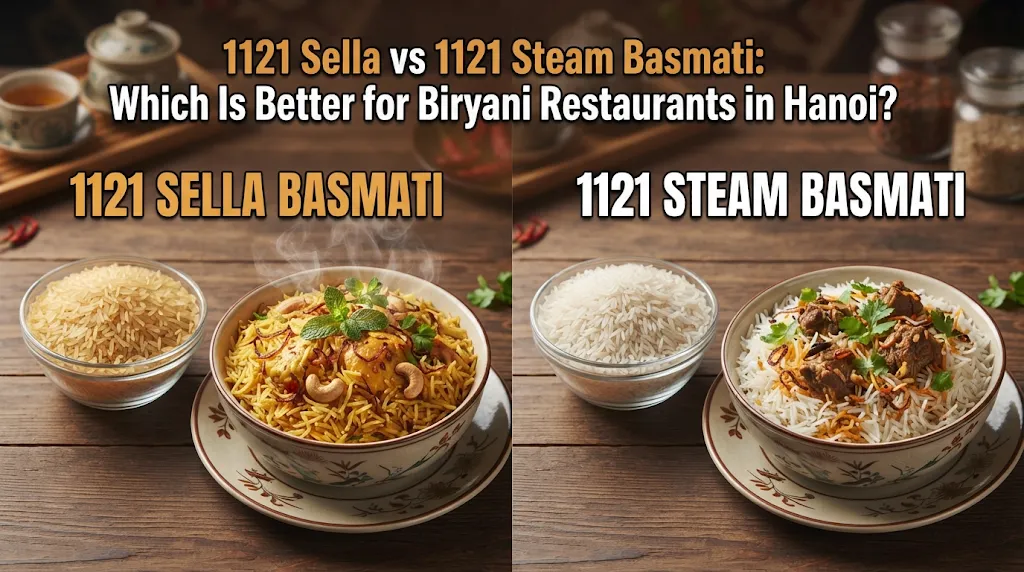
1121 Sella vs 1121 Steam Basmati: Which Is Better for Biryani Restaurants in Hanoi?
1121 Sella Basmati outperforms 1121 Steam Basmati for high-volume biryani restaurants in Hanoi because its parboiled starch structure prevents grain breakage during extended dum steaming, holding, and delivery transit, whereas 1121 Steam Basmati serves dine-in kitchens prioritising traditional floral aroma.
Commercial kitchens in Northern Vietnam face distinct operational hurdles when preparing authentic South Asian rice dishes. High humidity in Hanoi accelerates moisture absorption in raw storage, while heavy delivery demand across districts like Tay Ho, Ba Dinh, and Hoan Kiem tests the structural integrity of cooked rice inside sealed containers. Choosing the wrong processing grade results in clumping, broken grains, and inconsistent portion yields. Buyers studying how Indian and Pakistani kitchens handle high-volume biryani service recognise that processing treatment dictates kitchen profitability just as much as the underlying grain variety.
Both variants originate from the same 1121 extra-long-grain Basmati cultivar grown in the fertile plains of Punjab, Pakistan. The divergence happens inside the milling facility before the outer husk is removed. Exporters like AHK Rice process this cultivar using distinct hydrothermal protocols to match specific commercial cooking methods and international freight requirements.
What Are the Available 1121 Basmati Processing Solutions for Biryani?
Commercial biryani kitchens in Hanoi primarily choose between two hydrothermal grades of extra-long-grain Pakistani Basmati: 1121 Sella, which undergoes full soaking and pressurised parboiling, and 1121 Steam, which receives light surface steaming without prolonged water immersion.
Understanding these two processing architectures clarifies why identical raw paddy produces radically different culinary outcomes in a commercial kitchen.
1. 1121 Sella Basmati Rice (Parboiled)
1121 Basmati Sella Rice is produced through a complete hydrothermal parboiling cycle. Millers soak raw paddy in temperature-controlled water tanks, apply pressurised steam to gelatinise the internal starch granules, and dry the grain slowly before milling. This process forces water-soluble vitamins and minerals from the outer bran layer deep into the endosperm. Depending on the duration and temperature of steaming, mills produce either Creamy Sella (ivory-white) or Golden Sella (amber-gold). The resulting kernel is exceptionally hard, translucent, and resistant to mechanical fracture during ocean transit and vigorous kitchen stirring.
2. 1121 Steam Basmati Rice
1121 Steam Basmati bypasses the prolonged water-soaking phase. Millers pass controlled steam directly through cleaned raw paddy for a brief period, dry the kernels, and polish the grain to a natural bright-white finish. This mild thermal treatment seals surface micro-cracks without fully gelatinising the inner starch core. Consequently, 1121 Steam retains higher concentrations of 2-acetyl-1-pyrroline—the volatile compound responsible for classic Basmati fragrance—while offering better cooking stability than untreated raw white rice.
How Do 1121 Sella and 1121 Steam Basmati Compare on Technical Specifications?
1121 Sella delivers superior cooked elongation up to 22 mm, a 24-month shelf life, and near-zero breakage under heavy stirring, whereas 1121 Steam offers stronger natural aroma, faster boiling times, and a softer bite suited for immediate table service.
Evaluating these two grades requires comparing measurable physical, culinary, and commercial benchmarks relevant to 2026 import standards.
| Specification Attribute | 1121 Sella Basmati (Parboiled) | 1121 Steam Basmati |
| Hydrothermal Treatment | Full soaking + pressurised steaming + drying | Light surface steaming + drying (no soaking) |
| Raw Grain Length | 8.30 mm – 8.40 mm average | 8.30 mm – 8.40 mm average |
| Cooked Elongation | 20.0 mm – 22.0 mm (2.5x expansion) | 18.5 mm – 20.5 mm (2.3x expansion) |
| Visual Appearance | Creamy ivory or uniform golden-amber hue | Natural bright white to dull milky white |
| Aroma Profile | Mild, nutty, toasted grain fragrance | Distinct, traditional floral Basmati aroma |
| Soaking & Boiling Time | 45–60 min soak; 10–12 min parboil | 25–30 min soak; 6–8 min parboil |
| Storage Shelf Life | 24+ months in humid climates | 18–24 months in climate-controlled storage |
The gelatinised starch matrix in 1121 Sella absorbs water gradually without rupturing its cell walls. In contrast, 1121 Steam absorbs moisture rapidly, reaching tenderness four to five minutes faster on the stove. That speed advantage narrows the margin for error: leaving 1121 Steam in boiling water for 90 seconds too long splits the grain tips and releases free amylose starch into the pot.
How Do Regional Market Preferences and Landed Costs Compare in Vietnam?
Northern Vietnam buyers in Hanoi and Southern Vietnam buyers in Ho Chi Minh City pay similar 2026 FOB Karachi benchmarks of US$1,135–1,200/MT, though Hanoi restaurants favour Sella for humid storage stability while HCMC importers split orders across both formats.
Pakistani export pricing in 2026 reflects grade and processing complexity rather than destination port, though local logistics in Hai Phong versus Cat Lai shape final kitchen procurement budgets.
| Market Region | Primary Grade Preferences | 2026 Indicative FOB Price (USD/MT) | Shelf Life & Storage Advantage |
| Northern Vietnam (Hanoi / Hai Phong) | 1121 Golden Sella, 1121 Creamy Sella, 1509 Sella | US$1,135 – $1,185/MT (Sella)<br>US$1,160 – $1,200/MT (Steam) | 1121 Sella resists Hanoi’s 80%+ seasonal humidity for 24+ months without weevil damage. |
| Southern Vietnam (Ho Chi Minh City) | 1121 Sella, 1121 Steam, Super Kernel Basmati | US$1,135 – $1,185/MT (Sella)<br>US$1,160 – $1,200/MT (Steam) | High restaurant turnover allows 18–24 month Steam rotation alongside bulk Sella. |
Hanoi hospitality operators face intense spring drizzle between February and April, when ambient indoor humidity regularly exceeds 85%. Unsealed or lightly steamed grains absorb ambient moisture, encouraging fungal growth and softening kernel structure. Parboiled 1121 Sella enters the warehouse at a tightly controlled moisture level below 12.5% with a hardened outer shell that blocks moisture ingress.
Furthermore, landed costs into Hanoi via Hai Phong Port include ocean freight from Karachi, Vietnam customs clearance, and inland trucking along the QL5 corridor. Because 1121 Sella yields approximately 10% to 12% more cooked volume per kilogram than 1121 Steam, restaurants lower their effective cost per serving even when FOB prices sit within US$15–25/MT of each other.
Which Method Works Best for Different Biryani Restaurant Models?
1121 Sella works best for multi-channel restaurants, delivery-heavy kitchens, and banquet caterers using sealed dum pots, whereas 1121 Steam excels in boutique fine-dining rooms serving freshly plated Lucknowi or Awadhi biryani straight from the stove.
Matching the grain format to the kitchen’s service workflow eliminates waste during peak lunch and dinner rushes.
1. High-Volume Delivery and Cloud Kitchens
Restaurants fulfilling 60% or more of their orders through GrabFood and ShopeeFood in Hanoi require grains that survive 35-minute motorbike rides inside foil-lined boxes. Residual steam inside closed takeaway containers continues cooking the rice after packing. 1121 Sella maintains individual grain separation and firm bite upon arrival, whereas 1121 Steam compresses into a dense block under its own weight.
2. Traditional Hyderabadi Kachchi Dum Biryani Operations
Authentic kachchi (raw marinated meat) dum biryani requires layering 70%-cooked rice over spiced meat and sealing the handi with dough for 40 to 50 minutes over low heat. The bottom rice layer absorbs meat juices and clarified butter (ghee), while the top layer endures sustained steam pressure. 1121 Sella withstands this prolonged thermal cycle without mushiness, allowing chefs to scoop clean, unbroken 22 mm grains from the bottom of the pot.
3. Boutique Dine-In and Executive Thali Restaurants
Upscale dining rooms in Hanoi catering to diplomatic expats and discerning food enthusiasts often prioritise olfactory impact when the server unseals a clay pot tableside. 1121 Steam releases an immediate wave of authentic Punjabi Basmati aroma. Because dishes move from the kitchen pass to the guest table in under three minutes, the softer texture of 1121 Steam enhances the dining experience without risking post-service clumping.
What Are the Pros and Cons of Each Processing Grade in Commercial Kitchens?
1121 Sella offers maximum cooked yield, heat tolerance, and zero clumping at the cost of milder aroma and longer prep times, while 1121 Steam delivers superior fragrance and soft texture but demands strict timing and immediate service.
Pros and Cons of 1121 Sella Basmati
- Pro — Exceptional Cooked Yield: One kilogram of dry 1121 Sella absorbs more water and expands to roughly 3.2 to 3.4 kg of cooked rice, generating two to three extra 450g portions per 5 kg batch compared to raw or lightly steamed grades.
- Pro — Forgiving Line Execution: Junior line cooks can parboil and layer 1121 Sella during chaotic dinner rushes without turning the batch into paste if the pot boils two minutes past schedule.
- Pro — Bain-Marie Holding Resilience: Buffet restaurants and lunch-combo kitchens hold biryani in steam tables at 65°C for three to four hours without grain degradation.
- Con — Subdued Natural Fragrance: High-temperature parboiling alters volatile aroma compounds, requiring chefs to rely slightly more on whole green cardamom, kewra water, or saffron infusions for top-note fragrance.
- Con — Extended Pre-Soaking Window: Kitchens must soak 1121 Sella for at least 45 minutes before boiling; skipping this step produces a slightly chewy centre.
Pros and Cons of 1121 Steam Basmati
- Pro — Unmatched Aromatic Signature: Preserves the classic floral, popcorn-like fragrance expected by traditional South Asian diners.
- Pro — Rapid Turnaround Time: A 25-minute soak and 7-minute boil allow kitchens to cook smaller, fresher batches on demand rather than holding large pots all afternoon.
- Pro — Natural White Contrast: Bright white grains create stark visual contrast against saffron-tinted rice and dark masala gravies.
- Con — High Breakage Under Mixing: Aggressive folding with heavy metal slotted spoons snaps cooked 1121 Steam kernels in half, lowering visual plate appeal.
- Con — Rapid Moisture Degradation in Delivery: Condensing steam inside takeout packaging turns soft grains sticky within 20 minutes.
Which Decision Factors Should Guide Your Procurement Order?
Hanoi restaurant buyers should evaluate five operational factors—delivery order share, holding duration, prep scheduling, aroma positioning, and warehouse humidity—before locking in container or distributor allocations.
Applying a structured scoring framework prevents costly procurement mismatches when importing directly or buying through local Vietnamese foodservice distributors.
| Extends usable shelf life past 24 months without pest or mould loss. | Choose 1121 Sella Basmati | Choose 1121 Steam Basmati | Operational Impact |
| 1. Delivery vs. Dine-In Mix | Delivery exceeds 40% of total orders | Dine-in exceeds 75% of total orders | Prevents grain clumping and compression during motorbike transit. |
| 2. Hot-Holding Duration | Held in handi or bain-marie over 60 minutes | Plated and served within 15 minutes of cooking | Eliminates mushy bottom layers and food waste in buffet/combo service. |
| 3. Kitchen Staff Skill Level | High staff turnover or multi-station prep cooks | Dedicated, senior biryani master (ustad) | Protects consistency when boiling times vary by 60–90 seconds. |
| 4. Dish Styling & Menu Focus | Hyderabadi dum biryani, catering trays, meal boxes | Lucknowi pukki biryani, specialty pulao, fine dining | Aligns grain firmness and color with regional culinary expectations. |
| 5. Storage Environment | Ambient dry storage in Hanoi’s humid climate | Air-conditioned pantry with rapid inventory turnover | Extends usable shelf life past 24 months without pest or mold loss. |
For multi-outlet operators or established restaurants in Hanoi, running a split inventory—80% 1121 Sella for daily dum biryani and delivery volume, paired with 20% 1121 Steam for speciality pulao and VIP dine-in orders—captures the commercial advantages of both grades.
Sourcing directly from an integrated processor ensures batch-to-batch uniformity in grain length, moisture content, and broken percentage. Working with an experienced Pakistani exporter that manages milling, optical colour sorting, custom 5 kg to 50 kg packaging, and export documentation allows Hanoi hospitality groups to standardise food costs across every service channel.