1121 Steam Basmati vs Thai Hom Mali Rice for Premium Vietnamese Retail Shoppers
1121 Steam Basmati Rice outperforms Thai Hom Mali Rice for premium Vietnamese retail shelves targeting international cuisine, health-conscious buyers, and high-margin speciality categories due to its 8.35 mm extra-long grain, 24-month shelf stability, and non-sticky elongation. Conversely, Thai Hom Mali Rice remains the superior choice for daily domestic comfort meals requiring soft, cohesive texture and traditional floral aroma.
Vietnamese modern grocery retailers in 2026 face intense shelf-space competition as middle-class disposable incomes expand across tier-one and tier-two cities. Supermarket category managers must balance familiar domestic and regional staples against differentiated, high-margin imported grains. Understanding why 1121 Steam Basmati Rice is gaining shelf space in Vietnamese supermarkets clarifies the initial consumer pull, yet procurement teams must evaluate technical grain metrics before committing container capital.
What are the available solutions for premium aromatic rice in Vietnamese retail?
Vietnamese retail category buyers evaluate two distinct premium aromatic rice categories: Pakistani 1121 Steam Basmati Rice, an aged extra-long-grain variety known for firm, separate kernels, and Thai Hom Mali Rice, a Geographical Indication (GI) jasmine cultivar prized for soft, floral stickiness.
1121 Steam Basmati Rice is an extra-long-grain aromatic rice cultivar grown primarily in the Punjab plains of Pakistan and India. The steaming process uses controlled pressurised steam on raw paddy prior to milling. This thermal treatment gelatinises surface starches, hardening the kernel structure without altering its natural ivory-white appearance. Suppliers like AHK Rice process, sort, and age this variety in Punjab to achieve maximum grain elongation and reduced breakage during retail transit.
Thai Hom Mali Rice is Thailand’s premier fragrant rice, strictly derived from Khao Dawk Mali 105 (KDML 105) and RD15 paddy varieties cultivated in northeastern Thailand’s Isan region. Protected by Geographical Indication (GI) standards, authentic lots require a minimum purity of 92% Hom Mali kernels. It is milled as raw white rice without parboiling or steaming to preserve its volatile 2-acetyl-1-pyrroline (2AP) pandan-like fragrance and tender amylopectin profile.
Domestic Vietnamese Speciality Fragrant Rice (such as ST24 and ST25) represents the local baseline in modern supermarkets. While ST25 delivers high palatability at lower domestic logistics costs, it shares the soft, moist culinary profile of Thai Hom Mali. Consequently, ST25 competes directly with Thai imports rather than fulfilling the dry, fluffy, extra-long-grain functional role that imported 1121 Steam Basmati occupies on speciality aisles.
How do 1121 Steam Basmati and Thai Hom Mali specifications compare?
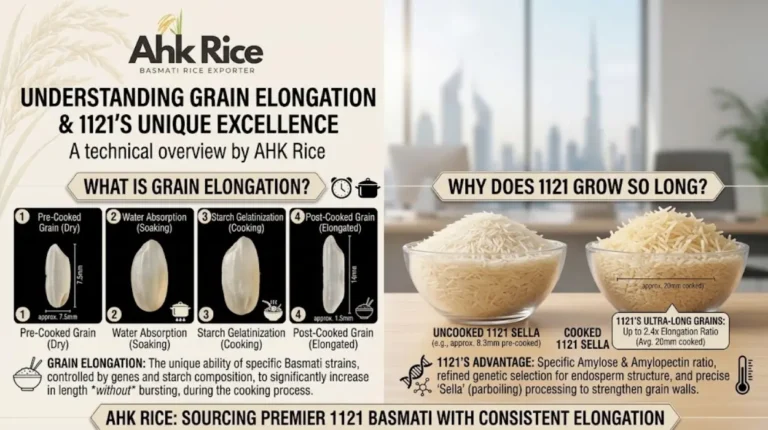
1121 Steam Basmati features an 8.30–8.40 mm raw grain length, 2.5x cooking elongation, and a 24-month shelf life, whereas Thai Hom Mali measures 7.00 mm raw, cooks to a soft cohesive texture, and degrades in aroma after 12 to 18 months.
Procurement managers cannot evaluate these grains purely on aroma because their physical structures dictate distinct storage tolerances, cooking yields, and packaging requirements. A technical audit across seven core milling and culinary attributes reveals why both grains command premium retail pricing while serving entirely separate kitchen applications.
| Specification Attribute | 1121 Steam Basmati Rice (Pakistan Origin) | Thai Hom Mali Rice (100% Grade A) |
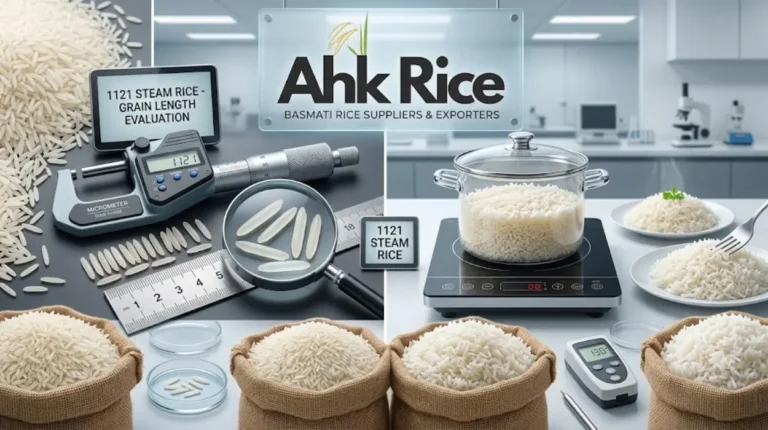
| Average Raw Grain Length | 8.30 mm – 8.40 mm (Extra-Long) | 7.00 mm – 7.20 mm (Long) |
| Cooked Elongation Ratio | 2.2x – 2.5x (reaches 20 mm – 22 mm+) | 1.4x – 1.6x (expands in width and length) |
| Broken Grain Tolerance | 0% – 2% maximum (Double/Silky Polished) | 4.0% – 4.5% maximum (Thai Export Standard) |
| Moisture Content | 11.5% – 12.5% maximum | 13.5% – 14.0% maximum |
| Cooked Texture Profile | Firm, dry, fluffy, and completely separate grains | Soft, moist, tender, and mildly cohesive/sticky |
| Aroma Compound Profile | Warm, nutty, earthy aged basmati aroma | Sweet, fresh floral and pandan leaf notes |
| Commercial Shelf Life | 24 – 36 months (improves with controlled ageing) | 12 – 18 months (aroma fades rapidly in tropical heat) |
Price per Metric Ton Comparison (2026 Market Rates): In Q3–Q4 2026, export pricing reflects distinct supply-chain dynamics across South and Southeast Asia. Pakistani 1121 Steam Basmati (0–2% broken, double-polished, colour-sorted) trades between $1,160 and $1,200 per MT FOB Karachi. Adding ocean freight and marine insurance to Ho Chi Minh City (Cat Lai Port) or Hai Phong brings landed CIF costs to roughly $1,240 – $1,310 per MT, excluding Vietnam’s preferential MFN import tariff structures.
Conversely, Thai Hom Mali 100% Grade A (GI-certified, new crop) trades between $880 and $1,050 per MT FOB Bangkok (Laem Chabang). Due to geographic proximity and ASEAN Trade in Goods Agreement (ATIGA) zero-tariff frameworks, landed CIF costs into Vietnam sit between $920 and $1,100 per MT. Although 1121 Steam Basmati carries a $200 to $320 per MT landed premium, its 2.5x cooked volume yield allows Vietnamese retailers to price 1 kg and 5 kg retail pouches at 35% to 50% higher gross retail margins than Thai Hom Mali.
Shelf Life and Tropical Warehousing Comparison: Vietnam’s ambient humidity averages 75% to 85% year-round, creating severe inventory shrinkage risks for imported grains. Thai Hom Mali enters the supply chain at up to 14.0% moisture and relies on volatile surface oils for its floral scent. Under standard non-refrigerated warehouse storage in Ho Chi Minh City or Hanoi, Thai Hom Mali loses peak fragrance within 9 to 12 months and faces elevated lipid oxidation risks.
1121 Steam Basmati undergoes thermal steam stabilisation and pre-export ageing, locking moisture below 12.5%. Its denser endosperm resists insect infestation, fungal spoilage, and breakage during multi-tier pallet stacking. Supermarkets achieve a full 24-month retail window without Markdown clearance losses, making it structurally superior for slower-turning speciality SKUs.
Which rice sourcing method works best for different Vietnamese retail regions?
Northern Vietnam (Hanoi and Hai Phong) favours aged 1121 Steam Basmati and 100% Sorted Thai Hom Mali for affluent gifting and expat demand, while Southern Vietnam (Ho Chi Minh City and Mekong Delta) prioritises Grade A Thai Hom Mali for daily dining alongside 1121 Steam Basmati for fusion gastronomy.
Retail grocery demand across Vietnam is sharply bifurcated between the northern industrial belt and the southern commercial hub. Category managers operating nationwide chains such as WinMart, Aeon Vietnam, Lotte Mart, and Tops Market must tailor grade allocations by regional consumption behaviour.
Region 1: Northern Vietnam (Hanoi, Hai Phong, Quang Ninh). Northern Vietnamese households exhibit conservative daily staple habits, favouring local northern japonica-hybrid varieties for everyday meals. Consequently, imported rice in Hanoi and Hai Phong functions primarily as an aspirational, festive, and expatriate-driven category.
- Grade Preferences: Northern supermarkets demand ultra-low broken tolerances. For Pakistani imports, buyers specify 1121 Steam Basmati Super Premium (0–1% broken, minimum 8.35 mm length) packaged in 1 kg and 2 kg transparent-window stand-up pouches. For Thai imports, buyers require 100% Sorted GI-Certified Hom Mali (less than 1% broken, new crop) rather than standard Grade B lots.
- Retail Dynamics: High-end malls in West Lake and Ba Dinh districts see strong seasonal spikes during Tet (Lunar New Year) and Mid-Autumn gifting windows. Shoppers inspect grain length visually through packaging windows, making 1121 Steam Basmati’s dramatic 8.35 mm raw appearance a decisive point-of-sale advantage.
Region 2: Southern Vietnam (Ho Chi Minh City, Binh Duong, Dong Nai, Can Tho). Ho Chi Minh City represents Vietnam’s largest modern retail market, characterised by high cosmopolitan dining frequency, international tourism, and rapid adoption of health-focused diets. Southern consumers regularly eat fragrant long-grain rice at home and actively experiment with Middle Eastern, South Asian, Mediterranean, and fusion recipes.
- Grade Preferences: Southern chains stock Thai Hom Mali Grade A (4.0% max broken) in 5 kg and 10 kg family sacks as a mid-to-upper-tier daily staple. Simultaneously, they stock 1121 Steam Basmati Premium (0–2% broken) in 1 kg, 2 kg, and 5 kg formats for wellness shoppers, diabetic-conscious consumers seeking lower glycemic impact, and home cooks preparing biryani, pilaf, or grilled-protein bowls.
- Retail Dynamics: Because Ho Chi Minh City’s tropical heat accelerates pantry spoilage, 5 kg packs of 1121 Steam Basmati experience higher repeat purchase rates among expatriate families and affluent Vietnamese households in District 1, District 2 (Thu Duc), and District 7.
What are the pros and cons of stocking each variety in supermarkets?
1121 Steam Basmati offers superior retail margins, zero-clump cooking performance, and 24-month shelf stability, but requires consumer cooking education; Thai Hom Mali enjoys instant brand recognition and effortless preparation, but suffers from price compression and shorter aromatic longevity.
Evaluating the operational trade-offs of each grain prevents dead stock and protects category profitability.
1121 Steam Basmati Rice — Pros:
- Unmatched Category Differentiation: Local Vietnamese rice cannot replicate an 8.35 mm grain that elongates to 22 mm without breaking. Supermarkets avoid direct price wars with domestic ST25 brands.
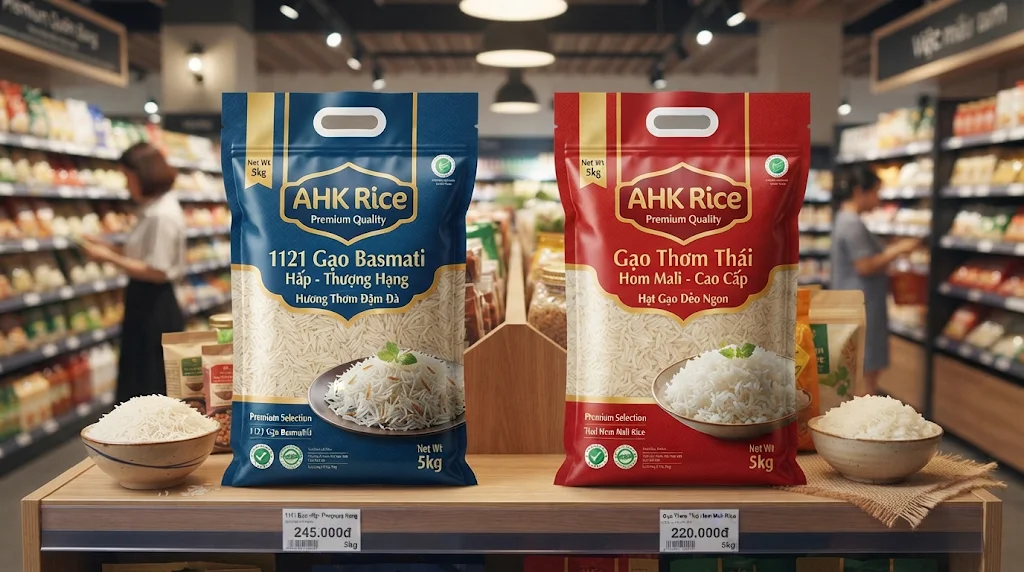
- High Gross Margin Per Linear Foot: Retail packs (1 kg and 2 kg) command 95,000 VND to 145,000 VND per kilogram in Ho Chi Minh City gourmet grocers, yielding 28% to 38% retail gross margins.
- Superior Supply Chain Resilience: Steam-hardened kernels withstand container transit from Karachi to Cat Lai without transit breakage, maintaining below 2% broken ratios upon shelf placement.
1121 Steam Basmati Rice — Cons:
- Consumer Preparation Learning Curve: Vietnamese shoppers accustomed to cooking jasmine rice in a 1:1.1 water ratio without pre-soaking risk undercooking 1121 Steam Basmati. Brands must print bilingual Vietnamese-English soaking (20–30 minutes) and water-ratio (1:1.75) instructions directly on the back panel.
- Higher Upfront Working Capital: Container minimums (typically 2 x 20′ FCL or ~48–54 MT for optimal freight economics) require higher initial letter-of-credit or T/T capital outlays than regional ASEAN shipments.
Thai Hom Mali Rice — Pros:
- Zero Consumer Education Friction: Vietnamese shoppers understand jasmine rice cooking ratios intuitively, driving fast initial trial rates across suburban supermarkets.
- Rapid Replenishment Cycles: Land and short-sea transit from Thailand takes 4 to 7 days, allowing importers to order single 20-foot containers (25 MT) with minimal lead-time buffers.
Thai Hom Mali Rice — Cons:
- Severe Margin Erosion from Domestic Substitutes: Vietnamese ST24 and ST25 varieties deliver comparable floral aroma and soft texture at 25% to 35% lower retail prices, capping Thai Hom Mali’s pricing power.
- Rapid Aroma Degradation: Retailers holding inventory past 10 months face customer complaints regarding stale odour, forcing promotional discounting.
What decision factors govern retail rice procurement in Vietnam?
Category managers should base procurement decisions on five measurable criteria: target culinary application, landed CIF margin threshold, inventory turnover speed, packaging format compliance under Vietnamese Decree 46/2026, and supplier quality consistency.
Purchasing teams must align their import specifications with Vietnam’s updated 2026 food safety and labelling regulations—specifically Decree 292/2026/ND-CP and Decree 46/2026—which mandate accurate Vietnamese-language nutritional sub-labels, origin traceability, and phytosanitary clearance prior to retail distribution. Use the following five-factor decision framework to allocate container budgets across both varieties.
| Decision Factor | Choose 1121 Steam Basmati Rice When… | Choose Thai Hom Mali Rice When… |
| 1. Target Culinary Use Case | Shoppers are preparing international dishes (biryani, pilaf, curries, salads), meal-prep bowls, or low-GI wellness diets requiring separate grains. | Shoppers are buying everyday family staple rice to pair with traditional Vietnamese braised, stir-fried, and soup dishes. |
| 2. Gross Margin & Pricing Strategy | The retail chain uses recognisable imported brands as traffic-driving loss leaders at 15%–20% retail margins. | The retail chain uses recognizable imported brands as traffic-driving loss leaders at 15%–20% retail margins. |
| 3. Inventory Turnover & Shelf Window | SKU turnover exceeds 90 to 180 days per warehouse cycle, requiring a 24-month shelf life without aroma loss. | SKU turnover is under 45 days in high-volume urban hypermarkets, ensuring stock sells out while new-crop aroma peaks. |
| 4. Packaging & Visual Merchandising | Positioning 1 kg – 5 kg private-label pouches with clear windows where 8.35 mm grain length visually justifies premium pricing. | Positioning 5 kg – 10 kg woven or laminated family bags leveraging official Thai GI certification seals for instant trust. |
| 5. Regulatory & Origin Compliance | Partnering with an export-certified Pakistani mill providing phytosanitary, fumigation, Certificate of Origin, and bilingual retail packaging. | Leveraging ASEAN ATIGA zero-duty origin certificates from accredited Thai mills for fast cross-border replenishment. |
Strategic Portfolio Allocation for 2026: Rather than treating these two grains as mutually exclusive substitutes, leading Vietnamese supermarket chains run a dual-tier premium aisle. Allocating 65% of premium imported shelf space to Thai Hom Mali captures traditional daily volume, while dedicating 35% to 1121 Steam Basmati captures high-margin growth from health-conscious, culinary-adventurous, and expatriate shoppers.
Category buyers ready to lock in 2026 FOB Karachi or CIF Cat Lai/Hai Phong container pricing, bilingual Vietnamese-English retail packaging, and pre-shipment quality inspections can review the step-by-step procurement workflow to import 1121 Steam Basmati Rice for Vietnam supermarkets and retail chains with AHK Rice.