What Makes Pakistan Super Kernel Parboiled Rice Suitable for Indonesian Food Businesses?
Pakistan Super Kernel Parboiled Rice is a long-grain Basmati rice product made from Super Kernel paddy grown mainly in Pakistan’s Punjab rice belt and processed through controlled parboiling, drying, milling, sorting, grading, and packing. Its commercial suitability depends on grain quality, cooking behavior, purity, moisture, breakage, documentation, and Indonesian import requirements.
What Is Pakistan Super Kernel Parboiled Rice?
Pakistan Super Kernel Parboiled Rice is a parboiled form of Super Kernel Basmati rice, a long-grain aromatic rice associated with Pakistan’s Punjab growing region. The grain is hydrothermally treated before milling to improve kernel strength, cooking resilience, and grain separation.
Super Kernel is a recognized Basmati variety included in Pakistan’s official Basmati specifications and trade documentation. Pakistan’s Trade Development Authority identifies Super Kernel Basmati among the country’s Basmati varieties and records Basmati’s historical association with Punjab and the wider Indo-Gangetic rice-growing area.
The term parboiled describes processing rather than a separate genetic variety. Paddy is soaked, heated or steamed, dried, and then milled. The hydrothermal treatment changes the physical structure of the rice kernel before the husk and bran are removed.
Super Kernel generally sits below 1121 in raw grain length. Commercial specifications commonly place Super Kernel at approximately 7.0–7.2 mm average raw grain length, although the exact specification depends on the contracted grade and inspection standard. Commercial Pakistani mills list parboiled Super Kernel alongside white and brown milling forms.
For Indonesian food businesses, the distinction between variety and processing type is important. Super Kernel identifies the rice variety. Parboiled identifies the processing method. A buyer therefore evaluates both attributes instead of treating “parboiled” as a variety name.
How Is Super Kernel Parboiled Rice Produced in Pakistan?
Super Kernel Parboiled Rice is produced by selecting mature paddy, cleaning it, soaking and steaming the kernels, controlled drying, husk removal, whitening, polishing, optical sorting, grading, inspection, and final packing before export documentation and container loading.
The process begins with paddy procurement. Paddy is the harvested rice grain with its husk still attached. The processor checks variety identity, maturity, moisture, impurities, and visible defects before production.
The second stage is pre-cleaning. Stones, straw, dust, metal particles, immature material, and other foreign matter are removed. Magnets and mechanical separators address physical contaminants.
The third stage is soaking. Paddy absorbs water under controlled conditions. The objective is to hydrate the kernel evenly before thermal treatment.
The fourth stage is steaming. Heat penetrates the hydrated paddy and gelatinizes part of the starch. This strengthens the kernel structure and changes its subsequent milling and cooking behavior.
The fifth stage is drying. Moisture is reduced in controlled stages rather than through uncontrolled rapid drying. Controlled drying limits thermal stress and reduces cracking.
The sixth stage is milling. The husk is removed first. The bran layer is then removed to produce the required milling degree. Parboiled kernels generally withstand milling better than untreated kernels because the hydrothermal process strengthens the grain.
The seventh stage is polishing and grading. The rice is processed to the contracted finish. Buyers can specify different polishing levels, such as silky or double-polished finishes.
The eighth stage is optical sorting. Sortex equipment identifies and removes discolored, damaged, immature, chalky, or otherwise non-conforming kernels. Final mechanical sorting also removes remaining foreign material.
The ninth stage is quality inspection. Parameters include moisture, broken grains, foreign matter, damaged kernels, chalky kernels, varietal admixture, grain length, milling degree, and appearance.
The final stage is packing and export preparation. Commercial rice is packed into formats such as 5 kg, 10 kg, 25 kg, or 50 kg bags according to the buyer’s market and distribution model.
What Are the Key Components of Super Kernel Parboiled Rice Quality?
The main quality components are variety identity, grain length, moisture, broken percentage, damaged kernels, chalkiness, foreign matter, milling degree, color, cooking performance, packaging integrity, and traceable inspection records for each commercial shipment.
Grain length
Grain length determines visual positioning and influences the final appearance of cooked rice. Super Kernel commonly measures around 7.0–7.2 mm before cooking under commercial specifications. A buyer should define the measurement method and tolerance rather than rely on the product name alone.
Moisture
Moisture affects storage stability and milling performance. Commercial Pakistani Super Kernel specifications commonly use a maximum moisture level around 13%, although the contractual specification can differ.
Broken grains
Broken percentage measures kernels that do not retain the required whole-grain structure. Commercial specifications frequently use 2% maximum broken for higher-grade Super Kernel products. The exact tolerance must appear in the purchase specification.
Purity
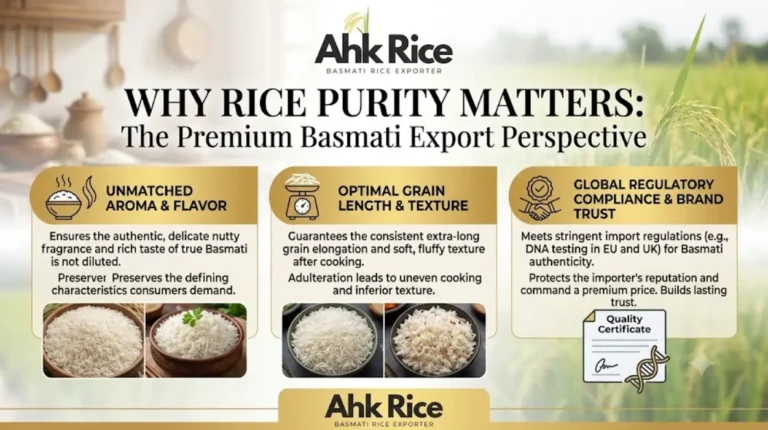
Purity covers foreign grains, foreign matter, stones, paddy, red grains, damaged kernels, and contrasting varieties. A restaurant buyer needs purity because visual defects become more noticeable after cooking and serving.
Milling degree
Milling degree describes how much bran has been removed. White parboiled rice receives more milling than brown rice. The buyer should define the required finish before sampling.
Cooking behavior
Cooking performance covers water absorption, grain separation, firmness, expansion, aroma, and resistance to overcooking. Parboiled processing gives the kernel greater structural strength, making cooking consistency an important reason food-service buyers evaluate this processing type.
What Grades and Forms Are Available?
Super Kernel is available through different milling and processing specifications, including white, brown, steam, and parboiled forms in the Pakistani rice trade. The commercially relevant grade depends on processing type, broken percentage, polishing, grain specifications, purity, and buyer requirements.
The principal forms are:
| Form | Processing characteristic | Typical food-use positioning |
|---|---|---|
| Super Kernel White | Conventional milling without parboiling | Aromatic rice dishes and standard food service |
| Super Kernel Parboiled | Hydrothermal treatment before milling | Biryani, catering, bulk food service |
| Super Kernel Brown | Husk removed with bran substantially retained | Whole-grain applications |
| Super Kernel Steam | Steam-treated according to the contracted process | Food-service applications requiring firm, separate grains |
The term grade requires careful interpretation. Grade does not simply mean variety. A 7.2 mm Super Kernel product can have different commercial grades based on broken percentage, moisture, milling, purity, polish, and defect tolerances.
For Indonesian buyers, the specification should therefore state the complete product identity. A useful description includes Super Kernel Basmati + Parboiled + grain specification + broken tolerance + moisture limit + milling degree + packing format.
S&P Global’s rice specification methodology also demonstrates why contractual quality parameters matter. Its Pakistan Super Kernel parboiled specification includes measurable limits for moisture, broken grains, damaged kernels, chalky kernels, contrasting varieties, foreign grains, foreign matter, paddy, red rice, under-milled grains, and milling degree.
Why Does Parboiling Matter for Indonesian Food Businesses?
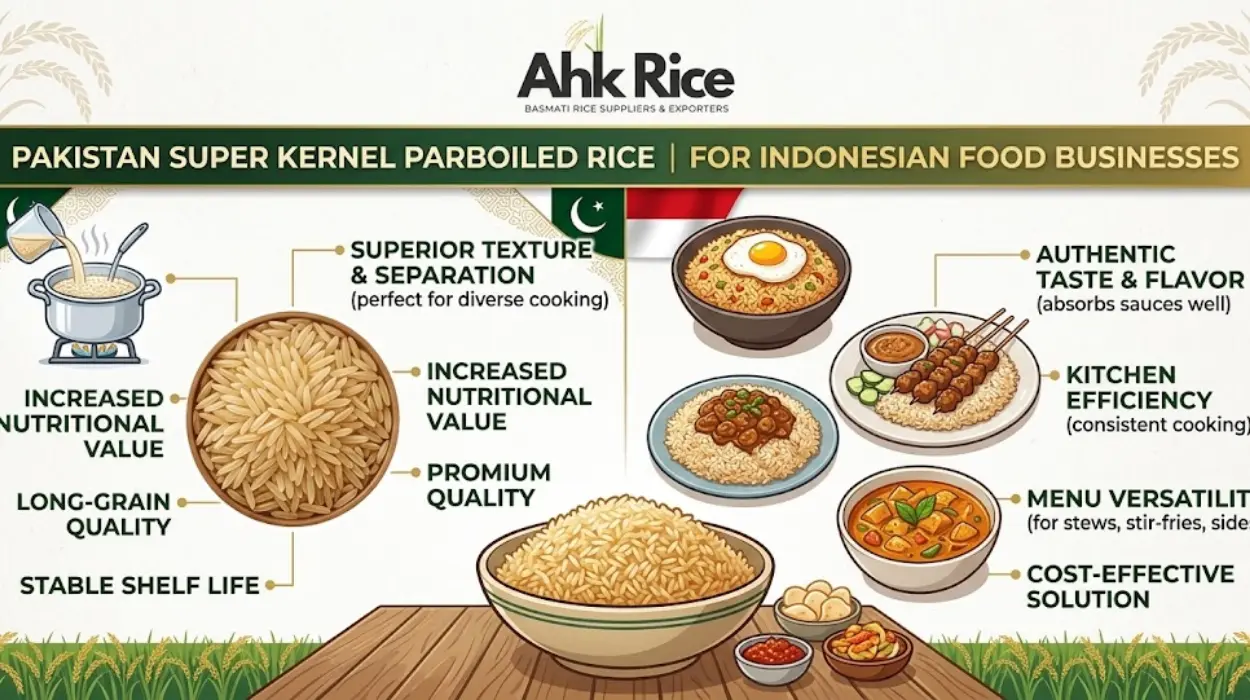
Parboiling strengthens rice kernels through controlled hydrothermal treatment, giving cooked rice stronger structural integrity, better grain separation, and greater resistance to handling and overcooking than untreated rice under comparable cooking conditions.
This behavior fits food businesses that prepare rice in large batches.
A restaurant preparing 100 kg of cooked rice needs kernels that tolerate cooking, holding, serving, and portioning. Excessively fragile rice produces more broken pieces and inconsistent portions.
Parboiled rice also supports batch cooking. The kernels retain their shape during cooking because the hydrothermal process changes starch structure and strengthens the grain.
This is relevant to Indonesian dishes where rice appearance matters. Examples include biryani-style preparations, rice bowls, catering trays, buffet service, and large-volume restaurant production.
The product does not automatically suit every Indonesian menu. Indonesian food businesses also use local rice varieties with different textures and culinary characteristics. Super Kernel Parboiled Rice becomes relevant when the business specifically needs long-grain, aromatic, relatively separate cooked grains and predictable batch performance.
Which Indonesian Food Businesses Use This Type of Rice?
The principal use cases are restaurants, catering companies, hotels, food-service distributors, wholesalers, meal-production businesses, and commercial kitchens that require consistent long-grain rice for repeated cooking and controlled portion production.
Restaurants use it for dishes requiring visibly separate grains.
Catering companies use it for large cooking batches where grain integrity affects serving yield.
Hotels use long-grain parboiled rice for buffet production because cooked rice often remains in holding equipment before service.
Food-service distributors purchase rice in bulk and redistribute it to restaurants, caterers, and institutional kitchens.
Commercial meal producers evaluate the rice based on cooking yield, batch consistency, packaging, storage, and repeat supply.
Wholesalers focus on specifications that can be communicated to downstream buyers. A wholesaler therefore needs documentation that identifies the variety, processing method, grade, packing, and quality parameters.
Which Markets Import Pakistan Super Kernel Rice?
Pakistan exports Basmati rice to international food markets across the Middle East, Europe, Africa, North America, and Asia, while Super Kernel products have established commercial use in multiple export destinations requiring aromatic long-grain rice.
Pakistan has a large export-oriented rice sector. USDA’s April 2026 Pakistan Grain and Feed Annual forecasts 9.8 million metric tons of rice production for 2026/27 and 5.0 million metric tons of rice exports, compared with a projected 4.7 million tons of exports for 2025/26.
The main markets for Pakistani Basmati include countries in the Gulf, Europe, North America, Africa, and other Asian markets. Super Kernel’s suitability varies by local food culture, price positioning, import rules, and buyer specifications.
Indonesia requires a separate regulatory assessment. Rice is a regulated agricultural import category. Indonesia’s Ministry of Trade issued Regulation No. 18 of 2026, effective from June 4, 2026, amending import-policy rules, while Indonesia’s agricultural and livestock import framework specifically includes rice.
An Indonesian business therefore needs to distinguish between commercial suitability and legal import eligibility. A rice that performs well in a restaurant still requires the correct Indonesian import route, documentation, customs treatment, and applicable agricultural controls.
What Certifications and Documents Apply to Indonesian Imports?
Indonesian buyers should separate mandatory government requirements from voluntary supplier certifications, because import compliance depends on Indonesian rules while certifications such as HACCP and ISO 22000 demonstrate food-safety management rather than replacing import permits or regulatory documents.
The document package normally needs to match the product, exporter, importer, shipment, and applicable Indonesian controls.
Typical commercial documentation includes:
- Commercial invoice
- Packing list
- Bill of lading
- Certificate of origin
- Product specification sheet
- Certificate of analysis where required
- Phytosanitary or plant-health documentation where applicable
- Fumigation documentation where applicable
- Pre-shipment inspection documentation when contractually or legally required
- Halal documentation where applicable
- Food-safety certification and audit records requested by the buyer
HACCP is a preventive food-safety system based on identifying and controlling biological, chemical, and physical hazards.
ISO 22000 is an international food-safety management-system standard. It integrates hazard control with management-system requirements.
BRCGS Food Safety is a recognized food-safety certification standard used by many international food manufacturers and retailers.
Halal certification has particular importance in Indonesia. BPJPH states that mandatory halal implementation expands to food and beverage products, including imported products, from 18 October 2026.
Indonesia also issued BPJPH Regulation No. 4 of 2026 on assurance of conformity for foreign halal products entering Indonesia. The regulation was enacted in August 2026.
This makes halal documentation a current procurement consideration for Pakistani rice entering Indonesia in late 2026. A foreign halal certificate also needs to follow Indonesia’s recognition and registration framework rather than simply being attached to the shipment without verification.
What Problems and Misconceptions Should Buyers Avoid?
The most common mistakes are treating parboiled as a variety, assuming every Super Kernel shipment has identical specifications, comparing suppliers only by price, ignoring cooking tests, and confusing voluntary certifications with Indonesian import permissions.
The first misconception is that Super Kernel and parboiled describe the same thing. Super Kernel identifies the variety. Parboiled describes processing.
The second misconception is that 7.2 mm automatically defines quality. Grain length is only one specification. Moisture, broken grains, purity, defects, milling, and cooking performance also determine commercial quality.
The third misconception is that parboiled rice never breaks. Parboiling improves kernel strength, but raw paddy quality, soaking, steaming, drying, milling, handling, and storage still influence breakage.
The fourth misconception is that a food-safety certificate replaces Indonesian import compliance. HACCP, ISO 22000, and BRCGS demonstrate management controls. They do not replace permits, customs documentation, agricultural requirements, or halal obligations.
The fifth misconception is that a sample alone proves commercial consistency. A sample confirms the tested lot. A supply program requires specifications, inspection procedures, batch controls, packaging standards, and shipment documentation that remain consistent across orders.
Indonesian buyers should therefore test the rice under their actual cooking method. The test should record raw weight, water ratio, cooking time, cooked yield, grain separation, firmness, aroma, broken kernels after cooking, and holding performance.
How Should Indonesian Businesses Evaluate Super Kernel Parboiled Rice?
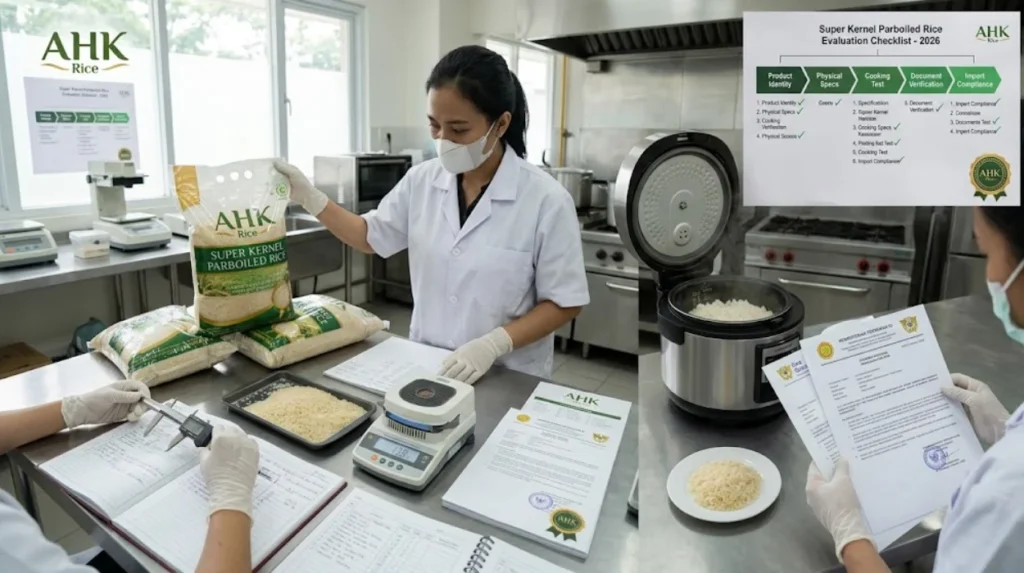
Indonesian food businesses should evaluate Super Kernel Parboiled Rice through a defined specification covering variety, processing, grain length, moisture, broken percentage, purity, cooking performance, packaging, documentation, certification, and import compliance before comparing commercial offers.
The evaluation starts with product identity. Confirm that the product is Super Kernel and that the processing type is parboiled.
Next, confirm the physical specification. Record grain length, broken percentage, moisture, chalkiness, damaged kernels, foreign matter, and milling degree.
Then conduct a cooking test using the restaurant’s normal equipment. The test should use the same water ratio and cooking time applied during commercial production.
The next step is document verification. Match the specification sheet with the certificate of analysis and shipment documents.
Finally, evaluate the Indonesian import pathway. Rice imports are subject to Indonesia’s current agricultural and trade controls, and the applicable rules were updated during 2026.
For the next stage of evaluation, the most useful continuation is a structured:
Comparison of Super Kernel grades, specifications, and commercial applications rather than a general discussion of Basmati rice.
Frequently Asked Questions
What Is Pakistan Super Kernel Parboiled Rice?
Pakistan Super Kernel Parboiled Rice is a long-grain aromatic rice made from Super Kernel Basmati paddy. The paddy undergoes soaking, steaming, drying, milling, sorting, grading, and packing before export.
Where Is Super Kernel Rice Grown in Pakistan?
Super Kernel Basmati is primarily associated with Pakistan’s Punjab rice-growing region, where suitable soil, climate, irrigation, and traditional Basmati cultivation support long-grain aromatic rice production.
Is Super Kernel Parboiled Rice the Same as Sella Rice?
Parboiled and Sella generally describe the same broad hydrothermal processing category. “Super Kernel” identifies the rice variety, while “parboiled” or “Sella” identifies how the paddy is processed.
What Grain Length Does Super Kernel Parboiled Rice Have?
Commercial Super Kernel specifications commonly place raw grain length around 7.0–7.2 mm. The exact contracted specification should define the measurement method and acceptable tolerance.
What Are the Main Grades of Super Kernel Rice?
Super Kernel rice is commercially available in forms such as white, parboiled or steam, and brown rice. Grades differ according to broken percentage, moisture, milling degree, purity, grain appearance, and other specifications.
Why Is Parboiled Rice Suitable for Restaurant Cooking?
Parboiling strengthens the rice kernel and improves its resistance to breakage during cooking. It also supports separate cooked grains, making the product suitable for batch cooking, catering, buffet service, and commercial kitchens.
What Indonesian Foods Can Use Super Kernel Parboiled Rice?
Super Kernel Parboiled Rice suits commercial dishes requiring long, separate grains, including biryani-style preparations, rice bowls, catering dishes, buffet rice, and other large-volume food-service applications.
What Quality Parameters Should Indonesian Buyers Check?
Buyers should check grain length, moisture, broken grains, damaged kernels, chalkiness, foreign matter, purity, milling degree, color, cooking performance, packaging, and consistency between production lots.