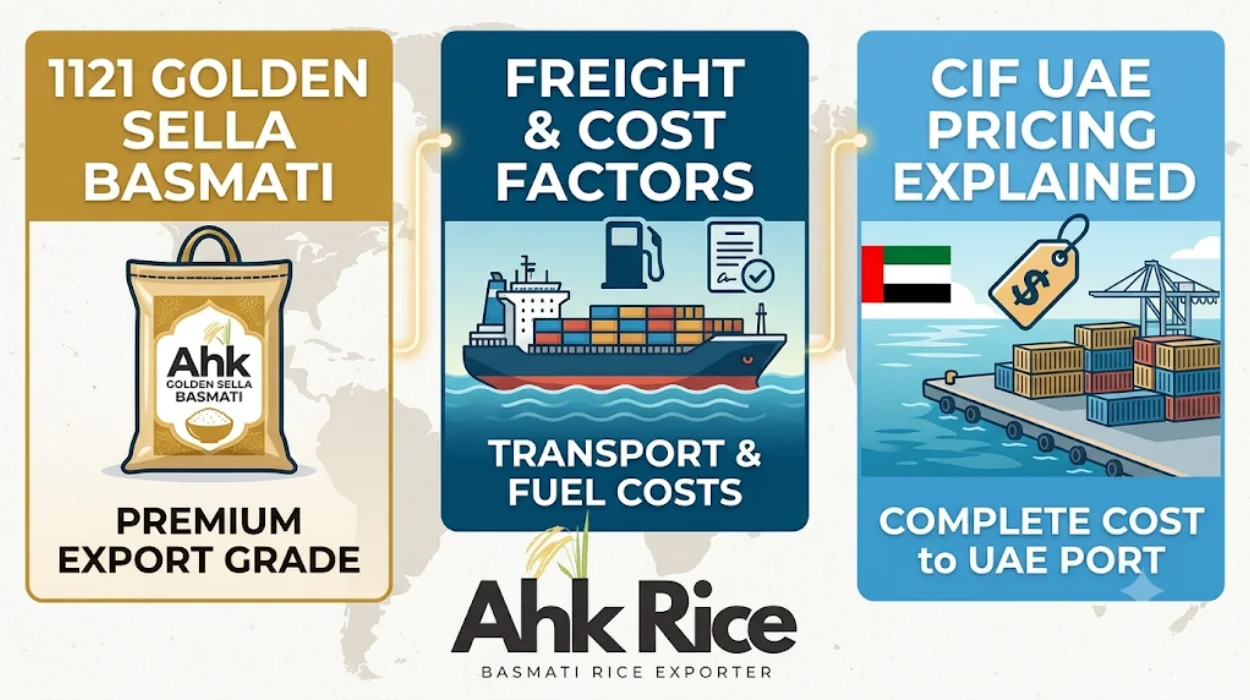
1121 Golden Sella Basmati Rice Shipping Costs, Freight Factors and CIF UAE Pricing Explained
International buyers compare shipping costs before selecting a supplier because freight, insurance, destination charges, and delivery terms significantly affect the final landed cost of 1121 Golden Sella Basmati Rice. Understanding how CIF pricing is calculated helps importers estimate budgets accurately, compare supplier quotations fairly, and choose the most efficient shipping solution for their market.
AHK Rice is a trusted Pakistani Basmati rice exporter based in Punjab, supplying 1121, Super Kernel, and 1509 varieties to more than 15 countries. The company manages procurement, milling, grading, sorting, packaging, documentation, container loading, and export logistics under one process. Buyers who are new to international rice trade should first read our educational guide on how Pakistani Basmati rice export pricing works . Buyers evaluating suppliers can also explore our 1121 Golden Sella Basmati Rice Export Service (Insert Service Page Link Here) to understand available packaging, documentation, and shipment options.
Unlike FOB pricing, CIF pricing combines the product value with freight and marine insurance until the destination port. Although both pricing methods are widely used in agricultural trade, they serve different purchasing objectives. Buyers who understand freight calculations, container utilization, shipping routes, and destination charges can negotiate more effectively and avoid unexpected logistics costs.
What determines the shipping cost of 1121 Golden Sella Basmati Rice?
Shipping costs are determined by freight rates, shipment volume, packaging specifications, container utilization, destination port, insurance, documentation, seasonal demand, and carrier availability. Every component contributes to the final CIF price per metric ton, making logistics planning as important as selecting the rice itself.
Shipping expenses begin with the export-ready product price. Once rice has been processed, sorted, color-sorted, graded, and packed according to buyer specifications, logistics costs are added. These include inland transportation from the processing facility to the port, customs clearance, export documentation, terminal handling, ocean freight, and marine insurance.
Container efficiency directly affects freight allocation. A 20-foot container generally carries approximately 25–26 metric tons of bagged Basmati rice, while a 40-foot container carries around 50–52 metric tons depending on packaging dimensions and destination regulations.
Freight rates also fluctuate throughout the year due to vessel availability, fuel prices, global trade demand, and port congestion. Importers monitoring these variables can identify favorable booking periods and reduce landed costs.
What shipping solutions are available for exporting 1121 Golden Sella Basmati Rice
Exporters generally offer FOB, CFR, and CIF shipping terms because each option distributes logistics responsibilities differently. The appropriate solution depends on the buyer’s logistics capability, destination infrastructure, purchasing volume, and preference for managing freight independently or through the exporter.
The three most common shipping solutions include:
| Shipping Method | Exporter Responsibility | Buyer Responsibility | Suitable For |
|---|---|---|---|
| FOB Pakistan | Product until loading onboard | Freight, insurance, import clearance | Experienced importers |
| CFR Destination | Product + Ocean Freight | Insurance & destination handling | Buyers with insurance partners |
| CIF Destination | Product + Freight + Marine Insurance | Import clearance & local charges | New importers |
FOB offers maximum freight flexibility because buyers negotiate directly with shipping companies. Large distributors often prefer this option because they consolidate multiple products into one shipment.
CFR reduces freight management while allowing buyers to arrange their own insurance.
CIF simplifies procurement because exporters organize transportation and marine insurance, allowing buyers to receive a complete landed quotation before shipment.
How do FOB and CIF pricing compare?
FOB pricing reflects only the export value of the rice loaded onto the vessel, whereas CIF pricing includes freight and insurance until the destination port. CIF provides greater budgeting certainty, while FOB provides greater logistics flexibility for experienced international buyers.
The difference between FOB and CIF pricing extends beyond freight inclusion. It influences cash flow planning, supplier comparison, logistics coordination, and purchasing risk.
Specification Comparison
| Specification | FOB Pakistan | CIF UAE |
|---|---|---|
| Product Cost | Included | Included |
| Ocean Freight | Buyer Pays | Included |
| Marine Insurance | Buyer Pays | Included |
| Export Documentation | Included | Included |
| Budget Predictability | Medium | High |
| Logistics Management | Buyer | Exporter |
| Best Buyer Type | Experienced Importers | New & Growing Importers |
Importers evaluating multiple suppliers should compare quotations under identical Incoterms. Comparing an FOB quotation from one exporter against a CIF quotation from another creates misleading price comparisons because freight and insurance values differ.
How do shipping costs differ between the UAE and East African markets?
Shipping costs vary by destination because freight distance, shipping frequency, container demand, and port efficiency differ between regions. UAE shipments generally benefit from shorter transit times and competitive freight rates, while East African destinations often incur higher logistics costs.
The UAE remains one of the largest import markets for Pakistani Golden Sella Basmati Rice due to geographic proximity and frequent vessel schedules. Shorter transit routes reduce freight volatility and support predictable inventory planning.
East African markets such as Kenya and Tanzania typically experience longer sailing schedules and varying port handling charges. Importers therefore prioritize accurate freight forecasting before seasonal purchasing.
Regional Comparison
| Market | Preferred Grade | Typical Transit | Approx. Freight Impact | Shelf Life Requirement |
|---|---|---|---|---|
| UAE | 1121 Golden Sella Premium | 7–12 Days | Lower | 24 Months |
| East Africa | Standard Golden Sella | 18–30 Days | Moderate | 24 Months |
Because freight costs are distributed across each metric ton, efficient container loading significantly improves overall cost competitiveness in both regions.
How is the price per metric ton calculated?
The final price per metric ton combines the FOB rice value with freight, insurance, documentation, packaging, and destination-specific logistics costs. Importers should evaluate every cost component instead of comparing only the quoted selling price.
A simplified pricing structure may resemble the following:
| Cost Component | Example (USD/MT) |
|---|---|
| FOB Rice Price | 1,180 |
| Ocean Freight | 65 |
| Marine Insurance | 8 |
| Export Documentation | 5 |
| Total Estimated CIF UAE | 1,258 |
These figures are illustrative. Actual costs vary with shipping season, order volume, carrier rates, packaging specifications, and destination port.
Which shipping method works best for different buyers?
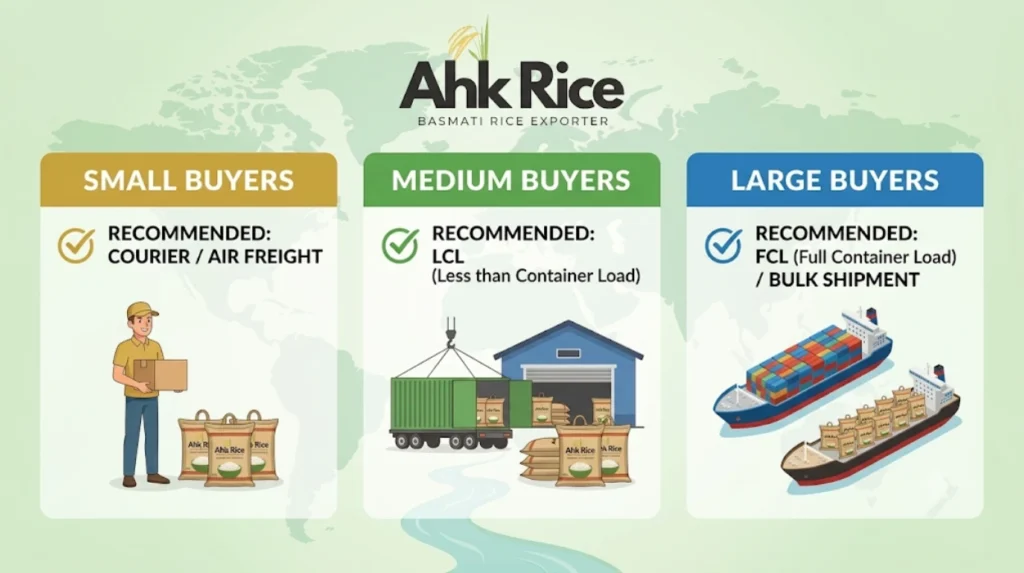
The best shipping method depends on the buyer’s logistics experience, purchasing volume, destination market, and operational resources. FOB suits experienced importers with established freight partnerships, while CIF is ideal for buyers seeking predictable landed costs and simplified international procurement.
Selecting the right shipping term is not simply about obtaining the lowest quotation. It is about balancing cost control, logistics responsibility, operational efficiency, and supply chain risk.
Decision Framework
| Buyer Situation | Recommended Method | Reason | Cost Control | Logistics Complexity |
|---|---|---|---|---|
| First-time importer | CIF | Exporter manages freight and insurance | High | Low |
| Established distributor | FOB | Buyer negotiates freight directly | Very High | High |
| Seasonal importer | CIF | Predictable budgeting during peak demand | High | Low |
| Large-volume importer | FOB | Better freight contracts on multiple containers | Very High | High |
| Small wholesale buyer | CIF | Simplified documentation and shipment process | Medium | Low |
Businesses importing only a few containers annually often value operational simplicity over marginal freight savings. Receiving one complete CIF quotation enables straightforward budgeting and reduces coordination with multiple logistics providers.
Larger importers, however, frequently negotiate annual freight contracts with shipping lines or freight forwarders. In these cases, FOB purchasing provides greater flexibility and can lower transportation costs when shipments are consolidated across several suppliers.
What are the advantages and disadvantages of FOB and CIF shipping?
FOB and CIF each provide distinct operational benefits. FOB offers greater logistics control and potential freight savings, while CIF reduces administrative workload and improves budgeting accuracy through a single delivered price covering freight and marine insurance.
FOB Pakistan
Advantages
- Greater control over shipping schedules.
- Freedom to choose preferred freight forwarders.
- Better opportunities to negotiate lower freight rates.
- Easier consolidation with cargo from multiple suppliers.
- Preferred by experienced international trading companies.
Disadvantages
- Buyer must arrange freight independently.
- Marine insurance remains the buyer’s responsibility.
- More coordination with shipping agents and carriers.
- Greater exposure to freight market fluctuations.
Example
A food distributor importing 100 containers annually may achieve lower freight costs by negotiating directly with international shipping lines, making FOB the more economical option.
CIF Destination
Advantages
- Single quotation covering product, freight, and insurance.
- Easier budgeting for procurement teams.
- Reduced logistics coordination.
- Simplified purchasing process for new importers.
- Lower administrative workload.
Disadvantages
- Less flexibility in selecting shipping carriers.
- Freight pricing depends on exporter-negotiated contracts.
- Buyers have limited influence over vessel selection.
Example
A supermarket chain importing five containers every quarter benefits from CIF because transportation planning, insurance, and shipping coordination are handled by the exporter, allowing procurement teams to focus on inventory management.
Which freight factors influence CIF UAE pricing?
CIF UAE pricing changes according to freight market conditions, container availability, shipping routes, fuel prices, insurance costs, and seasonal export demand. Understanding these variables enables buyers to compare quotations accurately and schedule purchases when transportation costs are most competitive.
Several factors contribute to CIF pricing:
1. Ocean Freight Rates
Shipping lines revise freight charges based on vessel capacity, trade demand, and global logistics conditions. High demand during export seasons generally increases freight rates.
2. Fuel Costs
Marine fuel prices directly influence ocean transportation expenses. Fuel surcharges are often incorporated into freight quotations.
3. Container Availability
Limited container supply at Pakistani ports can increase freight costs during peak export periods.
4. Port Congestion
Congested ports increase waiting times, terminal handling expenses, and vessel scheduling adjustments.
5. Marine Insurance
Insurance premiums vary according to shipment value, destination risk profile, and coverage requirements.
6. Packaging Configuration
Different bag sizes affect container loading efficiency. Efficient palletization and optimized bag dimensions maximize payload per container and reduce freight cost per metric ton.
7. Seasonal Export Demand
Demand rises significantly before Ramadan, Eid, and year-end retail seasons. Early booking often secures more favorable freight rates and better vessel availability.
Importers who monitor these logistics variables can improve procurement planning, reduce transportation risk, and maintain more predictable landed costs.
What decision factors should buyers evaluate before requesting quotations?
Effective supplier evaluation extends beyond product pricing. Buyers should compare product specifications, logistics capabilities, documentation support, packaging options, shipment schedules, and after-sales communication to determine the overall value of an export partner.
Before requesting quotations, buyers should consider:
- Rice grade consistency and milling quality.
- Available packaging sizes and private-label options.
- Export documentation, including commercial invoices, packing lists, certificates of origin, phytosanitary certificates, and quality certificates.
- Processing capabilities such as color sorting, grading, polishing, and metal detection.
- Container loading capacity and shipment scheduling.
- Experience exporting to the target destination.
- Responsiveness during quotation and order processing.
- Ability to provide shipment tracking and timely documentation.
Comparing suppliers on these operational factors provides a more reliable purchasing decision than evaluating price alone.
Understanding 1121 Golden Sella Basmati Rice shipping costs requires more than comparing product prices. Freight charges, insurance, container utilization, destination logistics, and Incoterms all influence the final landed cost. Buyers who evaluate these elements together can make informed procurement decisions, improve budgeting accuracy, and build more efficient international supply chains.
For importers seeking simplified logistics, CIF pricing provides predictable budgeting and reduced administrative effort. For experienced distributors with established freight networks, FOB purchasing offers greater control and opportunities for freight optimization. Choosing the appropriate shipping method depends on shipment volume, operational capability, and long-term sourcing strategy rather than price alone.
If you are ready to compare supplier quotations and evaluate landed costs, read our guide on Buy 1121 Golden Sella Basmati Rice at Competitive FOB Pakistan and CIF UAE Prices to understand pricing structures, order specifications, and sourcing considerations before placing an order.
Frequently Asked Questions
What is included in CIF pricing for 1121 Golden Sella Basmati Rice?
CIF pricing includes the product cost, ocean freight, marine insurance, export documentation, and delivery to the destination port. Import duties and local inland transportation are generally excluded.
Is CIF better than FOB for first-time importers?
Yes. CIF reduces logistics complexity because the exporter arranges freight and insurance, making budgeting and shipment coordination easier for new buyers.
How many metric tons fit into a shipping container
A 20-foot container generally carries around 25–26 metric tons, while a 40-foot container can accommodate approximately 50–52 metric tons, depending on packaging configuration and destination regulations.
Why do freight rates change throughout the year?
Freight rates fluctuate because of shipping demand, fuel prices, vessel availability, seasonal exports, container supply, and port congestion.
Which markets commonly import 1121 Golden Sella Basmati Rice?
Major import destinations include the UAE, Saudi Arabia, Oman, Qatar, Kuwait, Kenya, Tanzania, South Africa, the United Kingdom, and several European markets.