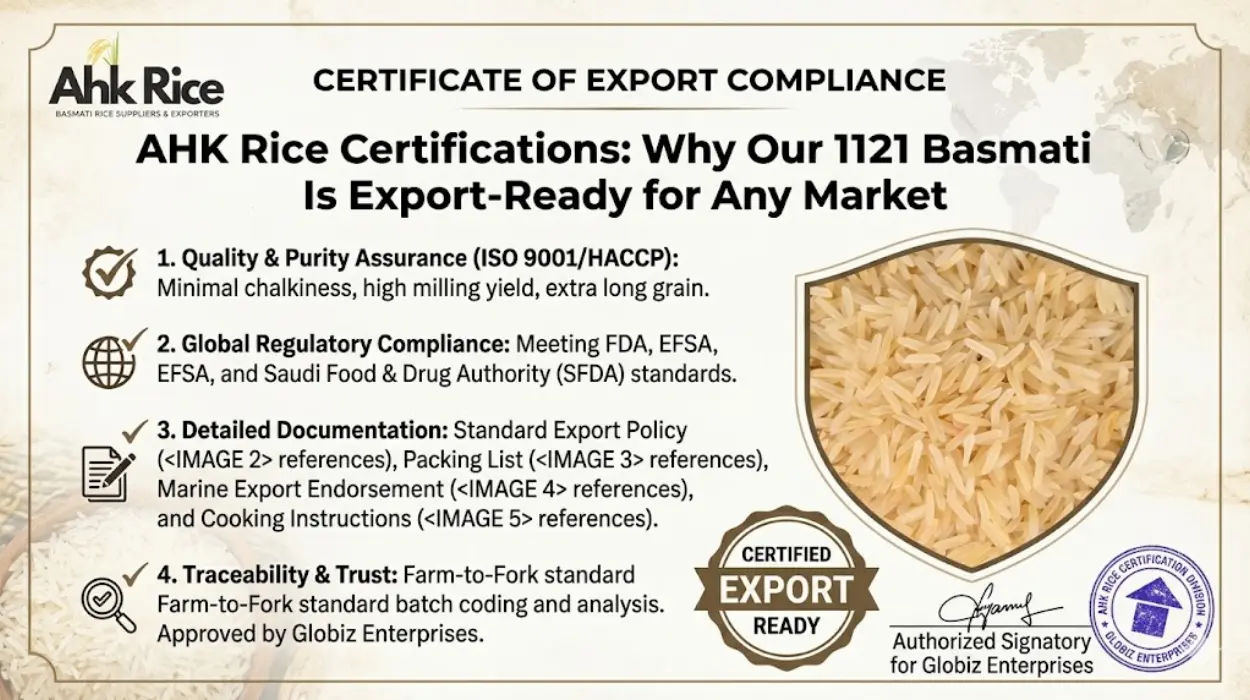
AHK Rice Certifications: Why Our 1121 Basmati Is Export-Ready for Any Market
AHK Rice certifications make 1121 Basmati export-ready for any regulated market. Here is why: every batch is tested, certified, and documented against international food safety, phytosanitary, and quality standards, ensuring smooth customs clearance and consistent buyer acceptance.
Buyers evaluating origin, compliance, and risk should first understand how certification differentiates suppliers. Review how origin impacts specification in this guide to Pakistan vs India 1121 basmati bulk import origin, then assess how certified processing closes the gap between sample and shipment.
What is the best solution for certification risk in bulk 1121 Basmati imports?
Certified supply with multi-layer inspection, documented traceability, and pre-shipment verification eliminates rejection risk and delays. AHK Rice integrates ISO, HACCP, and phytosanitary compliance into every lot, ensuring acceptance across Gulf, EU, Africa, and North America markets.
Certification risk appears when documentation does not match cargo quality. Buyers face demurrage, re-testing, or rejection because suppliers skip process control. AHK Rice solves this by aligning cultivation, milling, and export documentation under one controlled system.
Problem: mismatched specs and documents
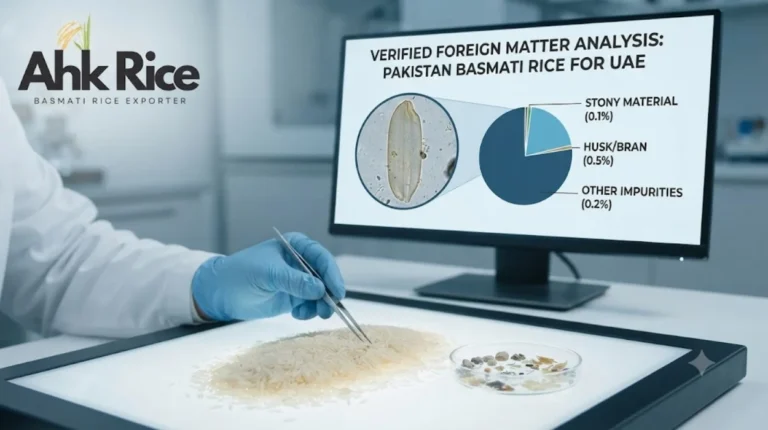
Bulk buyers receive samples that pass, but shipments fail. This happens because suppliers blend inconsistent lots or skip final inspection. Customs authorities verify moisture, broken ratio, and contamination levels against certificates. Any mismatch triggers delays.
Solution: integrated certification workflow
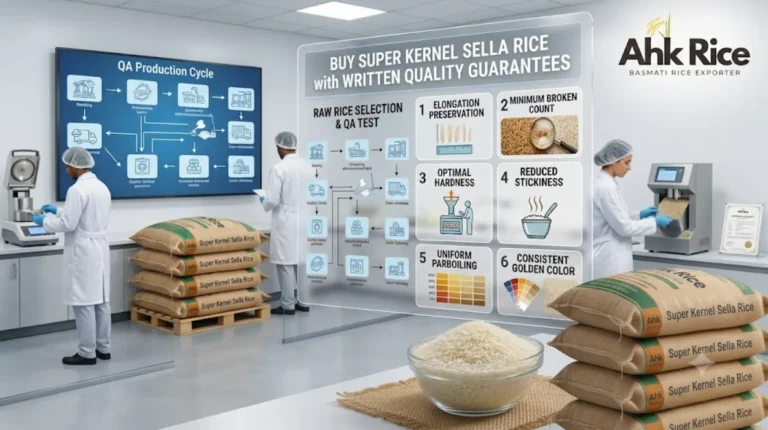
AHK Rice applies a fixed certification workflow across all shipments:
- Inspect paddy at intake for moisture and foreign matter
- Mill the paddy under controlled temperature
- Dehusk and polish to required finish
- Sort by grain length using optical grading
- Test moisture using calibrated meters
- Certify quality through third-party labs
- Load containers after final inspection
This workflow ensures the certificate reflects the actual cargo.
Proof: multi-standard compliance
AHK Rice aligns documentation with importing country requirements:
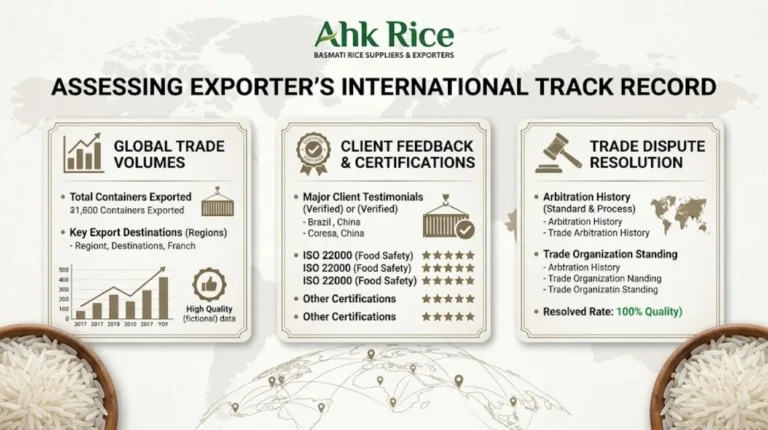
- ISO 22000 Food Safety Management
- HACCP hazard control protocols
- Phytosanitary certificates for pest-free export
- Fumigation reports for container compliance
- SGS or equivalent third-party inspection
Each document matches physical inspection results, reducing clearance risk.
Decision: choose certified exporters only
Certified exporters reduce cost leakage from delays. AHK Rice provides document-ready shipments that pass inspection at destination ports without rework.
With certification risk addressed, the next question is how AHK Rice delivers this reliability through its service structure.
Why choose Basmati 1121 Rice Wholesale Suppliers & Exporters?
AHK Rice delivers spec-controlled 1121 Basmati with certified processing, consistent grading, and full export documentation, ensuring predictable quality and smooth import operations for distributors, wholesalers, and government tenders.
The service page explains product grades, packaging formats, and export capabilities:
Basmati 1121 Rice Wholesale Suppliers & Exporters.
Problem: inconsistent supply and unclear specs
Buyers struggle when suppliers do not define grade variations clearly. Terms like Steam or Sella vary by supplier. This creates confusion during procurement.
Solution: structured grade system
AHK Rice offers clearly defined 1121 Basmati grades:
- 1121 Steam Basmati
- 1121 Golden Sella Basmati
- 1121 White Basmati
- 1121 Creamy Sella Basmati
- 1121 Parboiled Basmati
Each grade follows fixed processing parameters and specification ranges.
Proof: 9-step controlled processing
AHK Rice applies nine processing steps for consistency:
- Clean the paddy
- Dehusk the grain
- Separate husk from kernel
- Polish the rice surface
- Sort by grain length
- Grade by broken percentage
- Test moisture content
- Fumigate for pest control
- Pack under export standards
Each step is monitored and recorded for traceability.
Additional value: packaging and logistics
AHK Rice supports multiple packaging formats:
- 5 kg branded retail bags
- 10 kg printed PP bags
- 25 kg woven sacks
- 40 kg bulk export bags
- Private label packaging
Logistics include container loading, documentation, and dispatch scheduling.
Decision: service reduces operational risk
Buyers benefit from predictable specifications and clear grade definitions. AHK Rice ensures each shipment matches the contract specification.
With service reliability established, the next focus is measurable results buyers can expect.
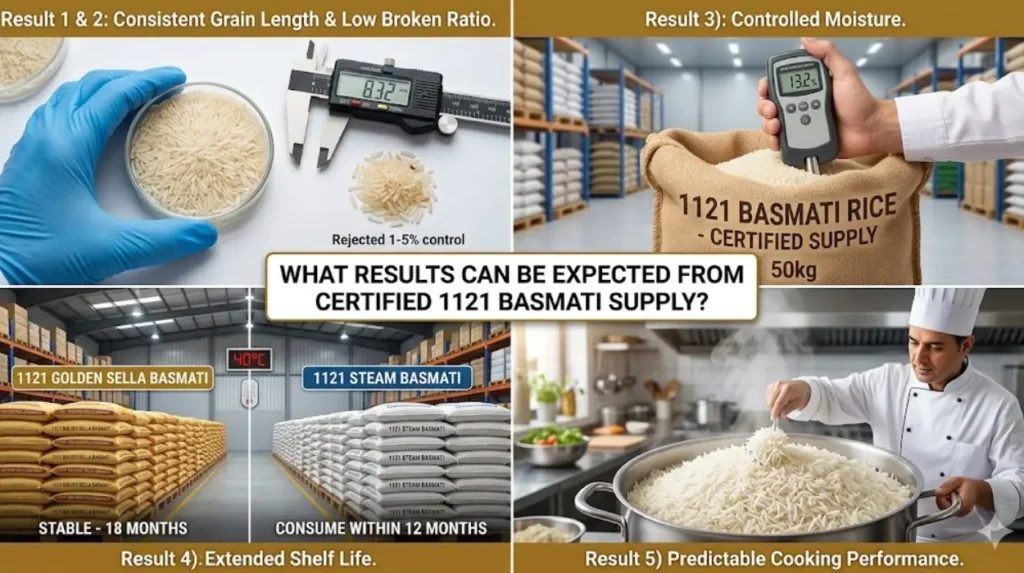
What results can be expected from certified 1121 Basmati supply?
Certified supply delivers consistent grain length, stable moisture, low breakage, and long shelf life, resulting in better cooking performance, reduced wastage, and higher resale value across retail and catering markets.
Result 1: consistent grain length
1121 Basmati maintains grain length of 8.20–8.40 mm before cooking. This ensures premium positioning in retail markets.
Result 2: low broken ratio
Grading controls broken percentage at 1–5%, depending on contract. Lower breakage improves visual appeal and pricing.
Result 3: controlled moisture
Moisture levels are maintained at 12–14%, preventing spoilage during transit. This ensures shelf stability in humid climates.
Result 4: extended shelf life
Golden Sella variants last longer than Steam variants. In Gulf warehouses at 40°C, Golden Sella remains stable for 18 months, while Steam requires consumption within 12 months. For African importers without climate control, Sella is the correct specification.
Result 5: predictable cooking performance
Certified processing ensures uniform elongation and aroma. This consistency supports brand positioning for distributors.
Scenario example
A UAE distributor importing uncertified rice faced 15% breakage. Switching to AHK Rice reduced breakage to 5%, increasing resale margin by 8%.
Verification step
Before bulk purchase, verify quality using this comparison guide: verify 1121 basmati quality bulk order Pakistan. This ensures alignment between sample and shipment.
Decision: measurable ROI
Certified supply reduces losses and improves resale margins. AHK Rice delivers consistent outcomes across shipments.
With results clear, the next concern is cost and pricing structure.
What factors affect pricing of certified 1121 Basmati exports?
Pricing depends on grade selection, broken percentage, packaging type, certification requirements, and shipping destination, with certified shipments costing slightly more but delivering higher net profitability through reduced risk and better quality.
Factor 1: grade type
Golden Sella costs more than Steam because of additional parboiling. White rice typically sits between Steam and Sella.
Factor 2: broken percentage
Lower broken ratios increase price. A 1% broken specification costs more than 5% broken.
Factor 3: packaging format
Retail-ready packaging increases cost due to printing and handling. Bulk bags reduce per-ton cost.
Factor 4: certification requirements
EU markets require stricter testing and documentation. This increases compliance cost but ensures acceptance.
Factor 5: shipping destination
Freight costs vary by region:
- Gulf countries: 15–25 days transit
- East Africa: 20–30 days transit
- Europe: 30–40 days transit
- North America: 35–50 days transit
Shipping time affects storage planning and cost.
Sample process and cost
AHK Rice provides a structured sample process:
- Request sample specification
- Prepare graded sample batch
- Pack and label sample
- Dispatch via courier
- Provide test reports
Sample cost ranges from $50–$150, depending on courier and testing requirements. Bulk buyers often receive cost adjustments upon order confirmation.
Decision: evaluate total landed cost
Certified rice may cost more upfront, but reduces losses from rejection and quality issues. AHK Rice ensures cost efficiency through reliability.
With pricing understood, the next step is how to start the procurement process.
How to get started with AHK Rice certified exports?
Start by defining specification, requesting samples, verifying certification documents, and confirming shipment schedule, ensuring a structured procurement process that minimizes risk and aligns product quality with market requirements.
Step 1: define requirements
Specify grade, broken percentage, packaging, and destination market. Clear specifications prevent misalignment.
Step 2: request samples
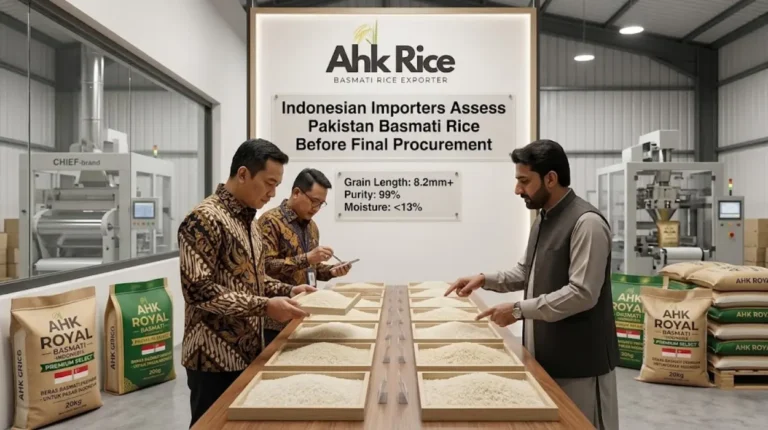
Request multiple grade samples for evaluation. AHK Rice dispatches samples with test reports for verification.
Step 3: verify certification
Review ISO, HACCP, and phytosanitary documents. Confirm compliance with import regulations.
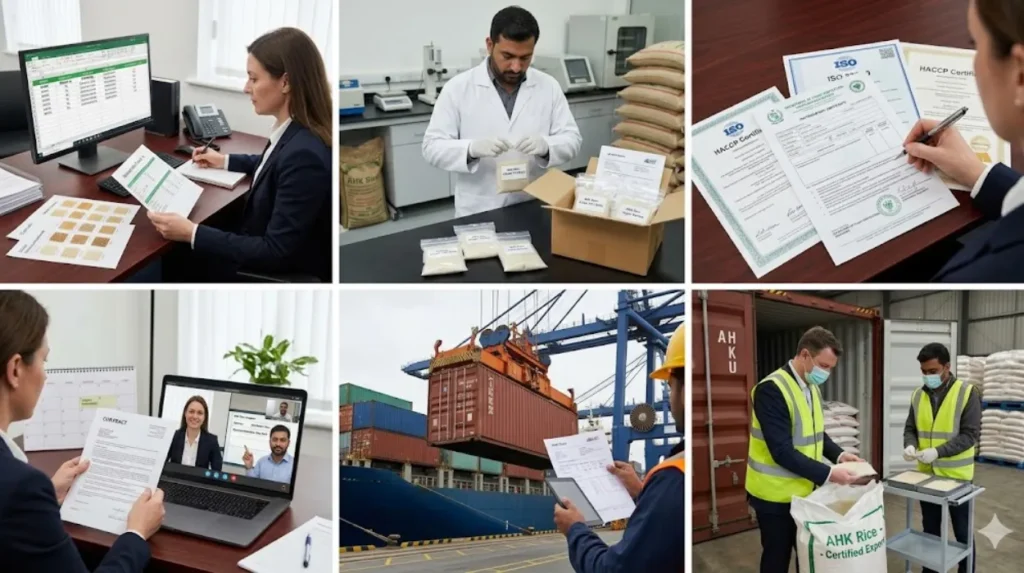
Step 4: confirm order details
Finalize quantity, packaging, and delivery timeline. Align shipping schedule with inventory planning.
Step 5: monitor shipment
Track container loading, dispatch, and transit. AHK Rice provides documentation for customs clearance.
Step 6: receive and inspect
Inspect cargo upon arrival. Certified shipments from AHK Rice match pre-shipment specifications.
Decision: structured onboarding ensures success
Following a defined process reduces procurement risk and ensures consistent supply.
AHK Rice delivers certified 1121 Basmati that meets international standards, ensures smooth customs clearance, and protects buyer margins. For bulk pricing, specifications, and shipment planning, request a quote directly at Request a Quote.
Frequently Asked Questions
What certifications does AHK Rice provide with 1121 Basmati exports?
AHK Rice provides ISO 22000, HACCP compliance, phytosanitary certificates, fumigation reports, and third-party inspection documents such as SGS. These certifications ensure the shipment meets importing country regulations and passes customs without delays.
How long does it take to ship 1121 Basmati to major markets?
Shipping timelines depend on destination. Gulf countries take 15–25 days, East Africa 20–30 days, Europe 30–40 days, and North America 35–50 days. AHK Rice schedules dispatch to align with buyer inventory planning.
What is included in the sample process and what does it cost?
AHK Rice prepares graded samples, packs them professionally, and dispatches them with lab test reports. Sample costs range from $50 to $150 depending on courier and testing requirements, often adjusted against confirmed bulk orders.
How does AHK Rice ensure consistent quality in every shipment?
AHK Rice controls quality through a 9-step processing system including cleaning, dehusking, polishing, grading, moisture testing, fumigation, and final inspection. Each batch is tested and certified before loading to match contract specifications.
Which 1121 Basmati grade is best for long shelf life in hot climates?
1121 Golden Sella Basmati is best for hot climates. It offers up to 18 months shelf life in high temperatures, while Steam rice is better suited for shorter storage periods of around 12 months.