Basmati Rice Supply Contracts for Indonesian Hotels and Caterers from AHK Rice
For Indonesian hotels and caterers, the strongest solution is a specification-led Basmati rice supply contract that fixes the required grade, packing, quality parameters, shipment schedule, documentation, and approval process before recurring orders begin. AHK Rice supports this structure from sample approval through export-ready supply.
Hotels and catering operations in Indonesia need more than a competitive rice price. They need predictable cooking performance, consistent grain appearance, dependable replenishment, and documentation that supports import procedures. A supply contract creates a defined commercial framework instead of treating every shipment as a separate purchase.
For buyers evaluating imported Basmati, the first step is understanding which hotel and resort operations already use imported Basmati and why. The educational guide Which Indonesian Hotels and Resorts Use Imported Basmati Rice? explains the demand context before moving into procurement decisions.
What is the best Basmati rice supply solution for Indonesian hotels and caterers?
The best solution is a recurring supply contract based on an approved Basmati specification, commercial sample, shipment schedule, packaging format, and quality-control process, allowing Indonesian hotels and caterers to purchase consistent rice for buffets, banquets, restaurants, and catering programs.
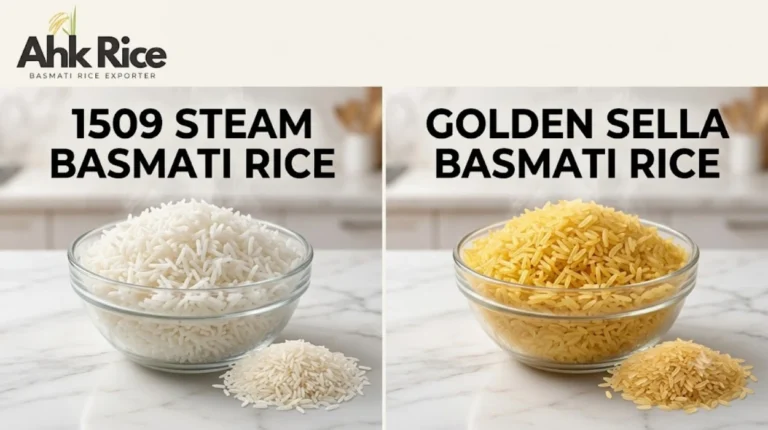
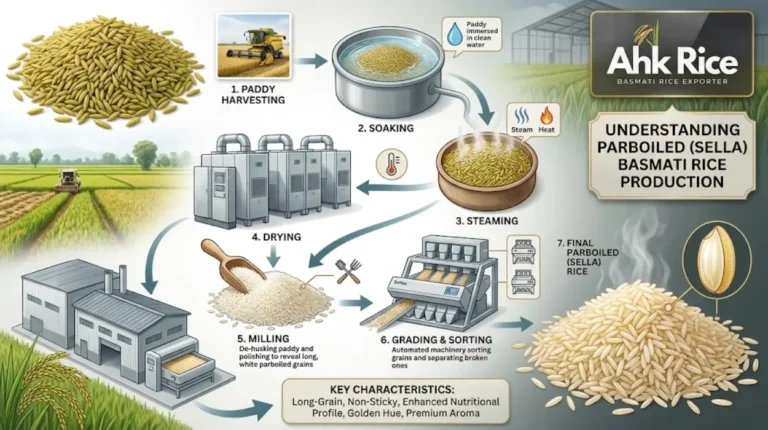
A contract should begin with the actual operating requirement rather than a generic request for “premium Basmati rice.” A hotel may need long-grain Steam Basmati for daily restaurant service, while a banquet operation may prefer Sella because cooked grains retain structure during extended holding.
The specification should identify rice variety, processing type, grain length, moisture limit, broken percentage, packing size, marking requirements, quantity, and shipment destination.
For example, a Jakarta hotel serving Basmati rice across breakfast and dinner buffets can require a defined grade in 25 kg or 50 kg commercial packing. A Bali catering company supplying weddings and resort events can specify a Sella grade where extended holding and buffet presentation are more important.
This approach reduces purchasing uncertainty because the buyer and exporter agree on the product before the container is dispatched.
Why choose AHK Rice for Indonesian Basmati supply contracts?
AHK Rice provides an end-to-end export workflow covering Basmati sourcing, processing, grading, packaging, commercial sampling, quality approval, export documentation, and shipment coordination, giving Indonesian buyers one defined process from specification approval to recurring supply.
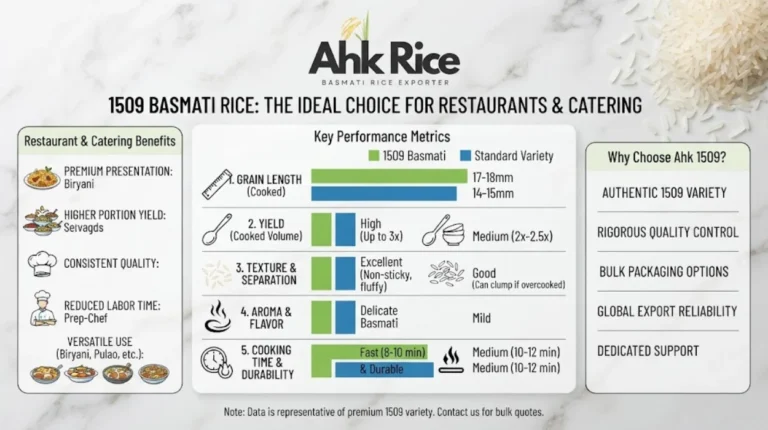
AHK Rice is a Pakistani Basmati rice exporter based in Punjab, supplying varieties including 1121, Super Kernel, and 1509 to international markets. Its supply process can be structured around hotel and catering requirements rather than a single generic product offer.
Buyers can use the AHK Rice Basmati rice export service when they need product sourcing, processing, custom packaging, and export coordination under one supply relationship.
The commercial advantage is specification control. The buyer can establish the required grain profile and processing type before approving a recurring contract.
For Indonesian hospitality buyers, this matters because rice performance directly affects food presentation and kitchen operations. A Basmati specification should therefore cover more than grain length. Moisture, broken percentage, purity, cooking behavior, packaging, and shipment condition all influence the final result.
AHK Rice can also structure the order around custom packaging where the buyer requires a hotel, catering, distributor, or private-label format.
Which Basmati grade should Indonesian hotels and caterers contract?
Hotels should select the Basmati grade according to cooking frequency, buffet holding time, menu positioning, and target cost; Steam suits fresh daily service, while Sella is often better suited to extended buffet holding, banquets, weddings, and institutional catering.
A buyer should not select a grade only because it has the longest grain. Operational use is more important.
| Hotel or catering requirement | Recommended direction | Commercial reason |
|---|---|---|
| Daily hotel restaurant service | Steam Basmati | Fresh cooked presentation and efficient routine service |
| Breakfast buffet | Steam Basmati | Suitable for frequent preparation and replenishment |
| Wedding catering | Sella Basmati | Better suited to extended holding |
| Large banquet operation | Golden Sella | Stable cooked grain presentation |
| Premium Indian/Pakistani menu | 1121 Basmati | Long grain and premium aromatic positioning |
| Distributor supply | 1509 or Super Kernel | Balance of specification and commercial positioning |
| Private-label hotel supply | Contracted grade | Consistency across repeated shipments |
For a more detailed comparison, buyers can review the Basmati rice selection for Bali and Jakarta hotels: Sella vs Steam for buffet holding before selecting the contractual specification.
The contract should then state the chosen variety and processing type explicitly. This prevents a buyer from approving one sample and receiving a different commercial specification later.
What shipping schedule should Indonesian buyers expect?
Shipping schedules depend on production readiness, order quantity, port allocation, documentation, vessel schedules, and destination, so Indonesian buyers should plan recurring shipments by contract cycle rather than relying on a fixed number of transit days for every order.
Jakarta and Surabaya should be treated as separate destination planning points because port routing and inland delivery requirements can affect the final schedule.
For planning purposes, buyers should divide the timeline into four stages:
- Product specification and commercial sample approval.
- Production, processing, packing, and quality checks.
- Export documentation and container loading.
- Ocean freight, Indonesian port handling, customs, quarantine, and inland delivery.
A practical contract can therefore define a shipment window rather than promising one exact arrival date.
For example, a Jakarta hotel group requiring regular Basmati can establish monthly or quarterly shipment planning. A Bali catering company can schedule replenishment before major wedding or tourism periods rather than waiting until existing inventory reaches a critical level.
The important commercial question is not simply “How many days does shipping take?” It is whether the supplier can coordinate production and documentation early enough to protect the buyer’s required stock position.
How does the Basmati rice sample and approval process work?
The sample process should begin with the buyer’s required specification, continue through commercial sample dispatch and cooking evaluation, and finish with written approval before production, packing, and shipment proceed against the agreed contract specification.
The process can be structured as follows.
Step 1: Buyer specification
The Indonesian buyer provides required variety, processing type, grain length, broken percentage, moisture target, packaging, quantity, destination, and intended use.
Step 2: Product selection
AHK Rice matches the requirement with an available Basmati specification. Options can include 1121, Super Kernel, or 1509, depending on the commercial requirement.
Step 3: Commercial sample
A representative sample is prepared for buyer inspection. The buyer evaluates appearance, aroma, grain size, cooking performance, texture, and holding behavior.
Step 4: Sample costs
For eligible sampling arrangements, AHK Rice has offered up to 20 kg of Super Kernel Basmati for sampling, while the buyer covers courier shipping and applicable phytosanitary charges. Sample costs should therefore be confirmed against the specific product, destination, and current shipping arrangement before dispatch.
Step 5: Cooking test
The hotel or caterer tests the rice in its own kitchen using its normal cooking method. This is important because a laboratory specification does not replace an operational cooking test.
Step 6: Final specification
After approval, the commercial specification is fixed. The contract can then define grade, tolerance, packaging, quantity, documentation, and shipment terms.
Step 7: Production and shipment
The approved specification is used for processing, packing, inspection, export documentation, loading, and shipment.
This sample-to-order workflow is especially valuable for hospitality buyers because the decision is based on actual kitchen performance rather than photographs or a generic product description.
What factors determine the contract price?
Basmati contract pricing depends on variety, grade, grain length, broken percentage, moisture, processing method, packaging, order quantity, destination, shipment timing, and Incoterm, so Indonesian buyers should compare complete specifications rather than headline price per metric ton.
A lower quoted price does not automatically represent better purchasing value.
For example, a hotel requiring premium 1121 with long grains and tighter quality parameters should not compare that offer directly against a lower-cost 1509 or a different processing grade.
Packaging also affects the commercial calculation. Bulk sacks, foodservice packs, retail-ready packaging, and private-label bags carry different preparation and packaging requirements.
Destination and Incoterm also change the buyer’s landed cost. A quote on an FOB basis does not represent the same commercial exposure as a CIF quotation to an Indonesian port.
The buyer should request a complete quotation containing:
- Product variety and processing type
- Grain length and grade
- Moisture and broken tolerance
- Packing material and pack size
- Quantity
- Port of loading
- Destination port
- Incoterm
- Documentation
- Sample status
- Production and shipment schedule
AHK Rice’s previously used FOB Karachi Super Kernel benchmark has been around US$1,165–US$1,205 per MT, but this is a benchmark rather than a live Indonesian quotation. Actual contract pricing must be confirmed against the approved specification, quantity, packaging, destination, and shipment conditions.
What results can Indonesian hotels expect from a supply contract?
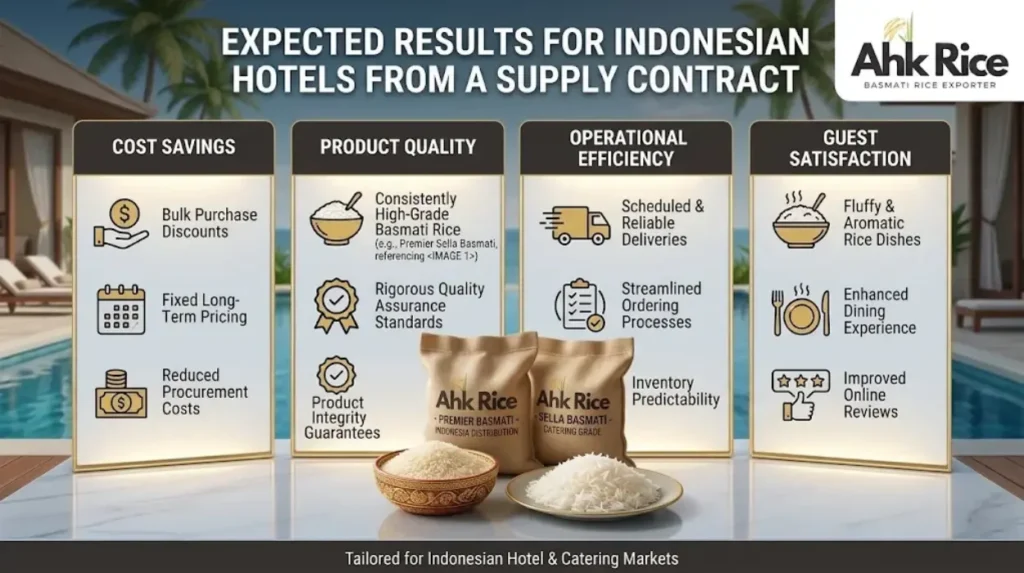
A properly structured supply contract gives hotels and caterers greater control over product consistency, replenishment planning, packaging requirements, purchasing budgets, and kitchen performance while reducing uncertainty between individual Basmati rice shipments.
The first result is consistency. The buyer has an approved specification that becomes the reference for future shipments.
The second result is planning. Instead of purchasing whenever inventory becomes low, procurement teams can coordinate recurring shipment windows with expected consumption.
The third result is operational control. A hotel can select Steam for routine buffet service or Sella for longer holding based on actual menu requirements.
The fourth result is commercial visibility. The buyer can compare FOB and CIF structures and understand which cost components influence the final landed price.
The fifth result is stronger supplier accountability. Sample approval, specifications, documentation, and shipment terms are established before recurring purchasing begins.
For example, a Bali resort catering for 300 guests during a wedding season can contract a defined Sella specification, approve the sample, establish packaging requirements, and schedule replenishment before the event period. A Jakarta hotel group can use a recurring Steam specification for routine restaurant and buffet consumption.
How should buyers decide between one shipment and a recurring contract?
A recurring contract becomes more valuable when Basmati rice is a regular menu ingredient, monthly consumption is predictable, multiple properties share the same specification, or stock interruptions would create operational and procurement problems.
| Decision factor | One shipment | Recurring contract |
|---|---|---|
| Consumption | Irregular | Predictable |
| Number of properties | One location | Multiple hotels or outlets |
| Price planning | Shipment-specific | Contract-based planning |
| Stock control | Buyer-managed | Scheduled replenishment |
| Product consistency | Must re-approve | Established specification |
| Packaging | Standard or trial | Custom or repeat format |
| Supplier relationship | Transactional | Long-term |
A single shipment makes sense when the buyer is testing market acceptance. A recurring contract becomes stronger when the cooking test has already been approved and consumption is established.
The decision should therefore follow the sequence: sample → cooking test → specification → quotation → contract → shipment → repeat order.
How can Indonesian hotels and caterers start a Basmati supply contract?
Start by sending the required grade, processing type, pack size, quantity, destination port, target delivery schedule, and intended use to AHK Rice, then complete sample approval before fixing commercial terms and recurring shipment requirements.
A practical buyer request should contain enough information to produce a meaningful quotation.
For example:
Product: 1121, Super Kernel, or 1509 Basmati
Processing: Steam, Golden Sella, or another required format
Quantity: Required MT per shipment
Packaging: 5, 10, 25, 50 kg, or custom
Destination: Jakarta, Surabaya, or required Indonesian port
Use: Hotel buffet, restaurant, catering, banquet, or private label
Incoterm: FOB or CIF
Frequency: One-time, monthly, quarterly, or seasonal
Sample: Required before contract approval
AHK Rice can then align the specification, sample, packaging, documentation, production schedule, and shipment plan with the buyer’s commercial requirement.
The strongest contract is not simply the one with the lowest initial price. It is the one that delivers the required Basmati specification consistently, arrives within the planned procurement cycle, and performs correctly in the buyer’s kitchen. Contact AHK Rice today and submit your requirements through the quotation request form to receive a tailored export proposal.
Frequently Asked Questions
Can Indonesian hotels buy Basmati rice directly from Pakistan?
Yes. Indonesian hotels and caterers can source Basmati rice through international exporters.
The buyer should establish product specifications before ordering.
A commercial sample should be tested in the hotel’s kitchen.
The final quotation should identify the Incoterm and destination.
Recurring supply can then be structured around approved specifications.
Which Basmati is better for hotel buffets?
Steam Basmati is suitable for fresh daily hotel service.
Sella is useful when longer holding is required.
Golden Sella is commonly positioned for banquet and catering applications.
The correct choice depends on menu and holding requirements.
Hotels should approve the grade through a cooking test before contracting.
How much does Basmati rice cost per metric ton?
Basmati pricing varies according to grade and specification.
Variety, processing, grain length, broken percentage, and moisture affect price.
Packaging and order quantity also change the commercial calculation.
FOB and CIF prices should not be compared as identical terms.
Indonesian buyers should request a complete specification-based quotation.
How does the sample process work?
The buyer first provides the required Basmati specification.
AHK Rice prepares a representative commercial sample.
The buyer evaluates appearance, aroma, cooking performance, and holding quality.
Eligible Super Kernel sampling can cover up to 20 kg, with courier and applicable phytosanitary charges handled by the buyer.
After approval, the commercial specification becomes the basis for supply.
How long does delivery to Indonesia take?
Delivery depends on production, documentation, vessel schedules, and destination port.
Jakarta and Surabaya schedules can differ based on routing and port conditions.
Buyers should therefore plan using shipment windows rather than one fixed transit figure.
Production and export documentation should begin before inventory becomes critical.
Recurring contracts make this planning easier.