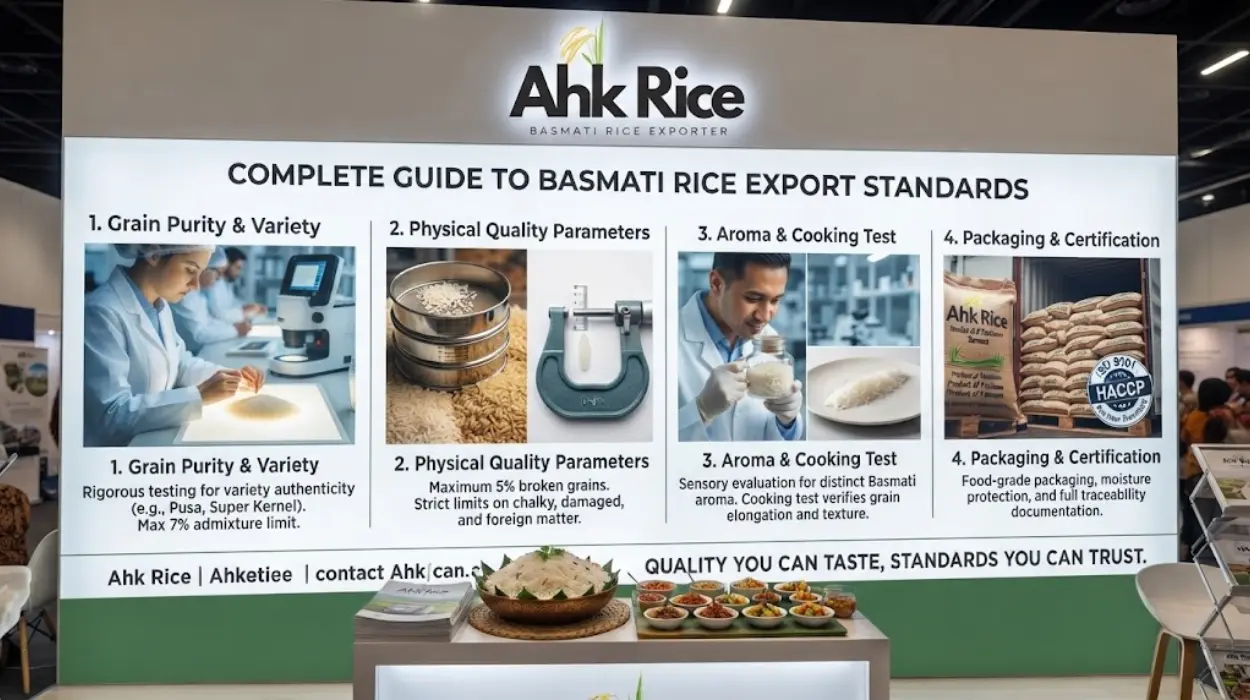
Complete Guide to Basmati Rice Export Standards
Basmati rice export standards define the grain quality, food safety, origin, processing, packaging, and documentation required for international trade. Here is why: importers need verified specifications, compliant certificates, and traceable shipments before approving Pakistani Basmati rice for retail, foodservice, or wholesale distribution.
What Are Basmati Rice Export Standards?
Basmati rice export standards cover grain identity, physical quality, chemical safety, origin verification, packaging, and export documentation. These standards connect cultivation, milling, laboratory testing, customs clearance, and importing-country regulations into one procurement process.
Basmati rice is an aromatic rice category cultivated in designated regions of Pakistan and India. Its characteristic aroma, elongated grain, and cooking performance distinguish it from ordinary long-grain rice.
Pakistan’s official Basmati specifications identify geographical production areas, approved varieties, physical characteristics, and authenticity requirements. The Trading Corporation of Pakistan verifies compliance with these specifications for applicable export consignments.
Export standards do not mean every country applies identical limits. The importing country establishes its own food safety, plant health, labeling, and documentation requirements.
Which Pakistani Basmati Varieties Meet Export Specifications?
1121, Super Kernel, and 1509 are important Pakistani Basmati varieties used in international procurement. Each variety has distinct grain characteristics, processing options, and commercial applications.
- 1121 Basmati: Extra-long grain used for premium retail, restaurants, and catering.
- Super Kernel Basmati: Long aromatic grain used for premium rice markets.
- 1509 Basmati: Long-grain variety used for value-focused retail and foodservice.
Rice varieties require separate specifications for grain length, broken percentage, moisture, milling quality, and cooking performance. A buyer should approve the exact variety rather than purchase under the general term “Basmati.”
How Does the Basmati Rice Export Process Work?
The export process moves from cultivated paddy to cleaned grain, laboratory verification, certified packaging, customs documentation, and international shipment. Each stage establishes evidence for the next stage of compliance.
How Is Basmati Rice Cultivated and Harvested?
Basmati rice begins with approved seed, suitable soil, controlled irrigation, and timely harvesting. These agricultural conditions influence grain development, aroma, moisture, and final milling quality.
Punjab is a major Basmati-producing region in Pakistan. Farmers cultivate rice during the appropriate growing season and harvest mature paddy for milling.
Harvested paddy contains husk, moisture, and field impurities. Milling facilities receive the paddy and begin preparation for export-grade processing.
How Is Basmati Rice Processed for Export?
Export processing removes impurities, dehusks paddy, separates defective grains, controls moisture, and prepares uniform rice for testing and packing. The process creates consistent physical quality across the shipment.
- Clean the paddy to remove stones, dust, straw, and field impurities.
- De-husk the grain to remove the outer husk and produce brown rice.
- Mill the grain to remove bran layers and produce white rice.
- Polish the grain to achieve the required surface appearance.
- Sort by length to separate whole grains, short grains, and broken rice.
- Sort by colour to remove discoloured and defective grains.
- Grade the rice according to variety, length, broken percentage, and buyer specifications.
- Test the rice for moisture, contaminants, and other required quality parameters.
- Pack the rice in approved bags with accurate product and shipment information.
Parboiled Basmati follows an additional process. The mill soaks, steams, dries, and mills the paddy to produce Sella rice.
What Is the Difference Between Steam, Sella, and White Basmati?
White Basmati is milled rice, Steam Basmati is steam-treated rice, and Sella Basmati is parboiled rice. Processing changes texture, appearance, cooking performance, and the specifications required for export.
White Basmati retains the natural white appearance of milled rice. Steam Basmati receives steam treatment before drying and milling. Golden Sella receives parboiling and drying that produces a golden colour.
The buyer should specify the processing type in the purchase contract. A contract for 1121 White does not automatically cover 1121 Steam or 1121 Golden Sella.
With the processing stages established, export standards next depend on the physical and chemical attributes tested in each shipment.
Which Quality Parameters Define Export-Grade Basmati Rice?
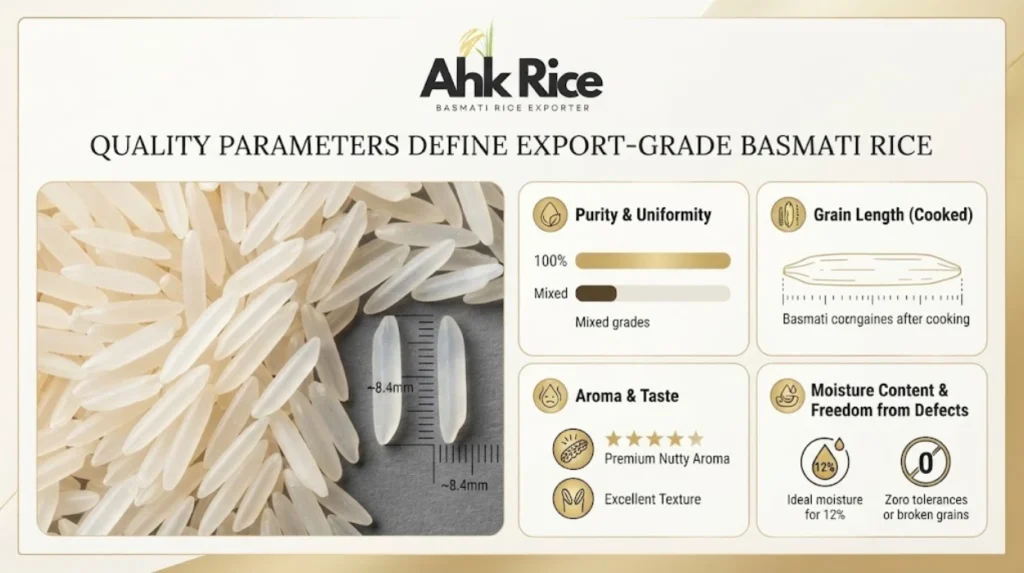
Grain length, moisture, broken percentage, foreign matter, damaged grains, aroma, and chemical safety define the measurable quality of Basmati rice. Buyers use these parameters to approve samples and verify commercial consignments.
What Grain Specifications Should Importers Compare?
Grain length and uniformity determine appearance, cooking performance, and product positioning. Importers should compare raw grain length, cooked elongation, whole-grain percentage, and broken percentage.
| Quality parameter | What it measures | Why it matters |
|---|---|---|
| Grain length | Raw grain size in millimetres | Retail appearance |
| Whole grains | Percentage of intact grains | Product yield |
| Broken grains | Percentage of broken rice | Cooking consistency |
| Moisture | Water content in rice | Storage stability |
| Foreign matter | Non-rice material | Product purity |
| Damaged grains | Discoloured or defective grains | Visual quality |
| Aroma | Characteristic Basmati fragrance | Product identity |
Exact limits depend on the variety, processing type, buyer contract, and importing-country rules. Pakistan’s official Basmati specification document establishes product identity and geographical requirements.
Which Food Safety Tests Apply to Basmati Rice?
Food safety testing verifies pesticide residues, heavy metals, microbial risks, and other contaminants against applicable importing-country limits. Laboratory results provide evidence that a consignment meets the buyer’s agreed safety requirements.
Pesticide residue testing measures chemical traces remaining after cultivation. Maximum residue limits differ between importing markets. European Union requirements include specific controls for Basmati rice imports.
Aflatoxin testing measures fungal toxins that can develop during poor storage. Moisture control, clean warehouses, and suitable packaging reduce the conditions that support contamination.
Laboratory testing should match the destination country and product specification. A report covering moisture alone does not establish full food safety compliance.
Which Certifications and Documents Are Required for Export?
Export documentation proves product origin, plant health, commercial identity, and compliance with destination-country requirements. The exact document set depends on the exporting country, importing country, product type, and shipment terms.
Which Documents Support Pakistani Basmati Rice Exports?
A commercial invoice, packing list, certificate of origin, phytosanitary certificate, and applicable inspection reports support international rice shipments. Importers should confirm additional documents with customs authorities before dispatch.
- Commercial invoice: States the seller, buyer, quantity, price, and trade terms.
- Packing list: Records bag counts, net weight, gross weight, and package details.
- Certificate of origin: Identifies the country where the rice was produced.
- Phytosanitary certificate: Confirms plant-health compliance under applicable quarantine rules.
- Inspection report: Records laboratory or third-party quality findings.
- Authenticity certificate: Verifies Basmati identity for applicable destination requirements.
Pakistan’s Department of Plant Protection issues phytosanitary certificates for regulated plant products under plant quarantine requirements.
Pakistan’s Basmati specifications identify the Trading Corporation of Pakistan as the authority responsible for applicable authenticity verification.
Frequently Asked Questions
What Is the Most Important Basmati Export Standard?
Product identity and food safety are fundamental export requirements. Buyers should verify the variety, origin, physical quality, and destination-country safety requirements before approving a shipment.
Is Basmati Rice Exported Only as White Rice?
Basmati rice is exported as White, Steam, and Sella rice. Each processing type has different appearance, texture, and cooking characteristics.
Which Certificate Proves Basmati Authenticity?
An applicable authenticity certificate verifies Basmati identity and origin. Pakistan’s Trading Corporation of Pakistan issues authenticity certificates under the country’s Basmati specification framework.
What Does a Phytosanitary Certificate Prove?
A phytosanitary certificate confirms plant-health compliance for regulated plant products. Pakistan’s Department of Plant Protection issues these certificates under applicable quarantine requirements.
Do Export Standards Remain the Same in Every Country?
Export standards differ between importing countries. Buyers must confirm destination-specific limits, certificates, labeling, inspection, and customs requirements before dispatch.
Where Should the MOFU Article Link Be Inserted?
Insert the MOFU link in the procurement section after explaining that Pakistani and Indian Basmati grades require separate specifications. The contextual anchor should introduce the comparison between the two origins naturally.