Supply New Hampshire Restaurants with Premium AHK Rice Varieties
New Hampshire restaurants looking to upgrade rice supply should prioritize a supplier that can hold grain specifications, cooking performance, documentation, packaging, and replenishment together. Premium Pakistani Basmati is not simply a higher-priced rice choice. It is a specification decision that affects plate presentation, portion consistency, menu positioning, and purchasing reliability.
For restaurants evaluating the market, the background article:
Why New Hampshire restaurants are switching to premium Basmati rice explains the demand-side reasons behind the change. The commercial decision begins afterward: selecting a rice variety, approving a physical sample, confirming import requirements, and building a shipment schedule that fits restaurant inventory. Before approving a supplier, restaurants should also review:
How restaurants evaluate rice quality before changing suppliers to understand the key comparison criteria.
AHK Rice supplies Pakistani Basmati varieties from Punjab, including 1121, Super Kernel, and 1509. Its export operation covers processing, grading, sorting, packaging, documentation, and container loading. For New Hampshire buyers, the relevant USA rice supply service provides a route from product specification to U.S. delivery.
What is the best solution for supplying premium rice to New Hampshire restaurants?
The best solution is a specification-led supply program that matches rice variety, grain length, moisture, broken-grain tolerance, cooking behavior, packaging, shipment frequency, and import documentation before the purchase order is issued. This reduces substitution risk and protects consistent restaurant performance across repeat deliveries.
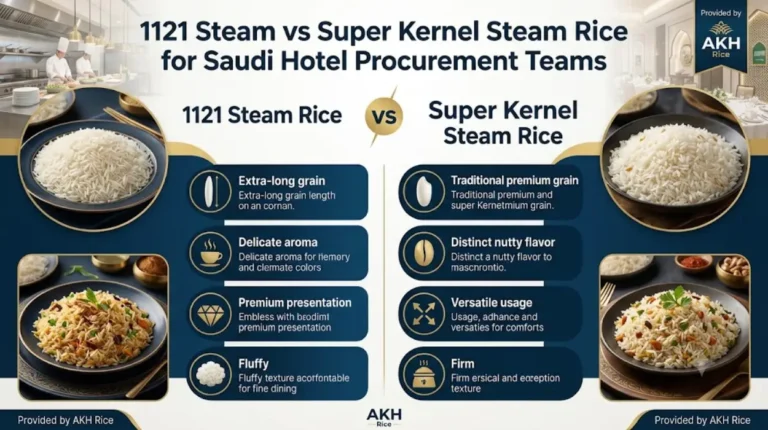
Restaurants should start with the menu rather than the supplier catalogue. A biryani-focused restaurant may prioritize 1121 Basmati because its long cooked grain supports visual presentation. A restaurant serving pilaf, rice bowls, curries, or South Asian fusion dishes may evaluate Super Kernel for its balance of aroma, appearance, and cooking performance. A buyer seeking another long-grain Basmati position can test 1509 against the same cooking specification.
AHK Rice can structure the order around the required product grade rather than treating every Basmati shipment as interchangeable. This distinction matters because variety, processing method, grain length, moisture, polishing, broken percentage, and packaging can change the finished plate.
A practical New Hampshire restaurant specification should define the product before price negotiation. The purchasing document should identify variety, white or parboiled processing, target grain length, maximum moisture, broken-grain tolerance, foreign-matter limits, packing format, net weight, country of origin, and delivery term.
This approach also gives the restaurant a measurable benchmark. If a later shipment cooks differently, the buyer can compare the new lot against the approved specification instead of relying on subjective comments such as “the rice does not feel the same.”
Which AHK Rice varieties should New Hampshire restaurants consider?
New Hampshire restaurants should compare 1121 Basmati, Super Kernel, and 1509 Basmati according to menu use, cooked grain appearance, aroma, processing preference, price position, and required consistency rather than selecting one variety solely from its nominal grain length or supplier quotation.
1121 Basmati is generally the strongest starting point for premium restaurant presentation. Its extra-long grain and aromatic character make it suitable for biryani, pulao, pilaf, and dishes where separated grains are visually important. AHK Rice offers white, steam, and other processing configurations according to buyer requirements.
Super Kernel provides another premium option when the restaurant wants a distinctive long-grain profile with strong aroma and broad foodservice usability. AHK Rice’s USA product information lists Super Kernel specifications including approximately 7.0–7.2 mm average grain length, moisture of 12% or less, and broken grains of 3% or less for the stated specification.
1509 Basmati can be evaluated where the restaurant wants long-grain performance while targeting a different commercial price position. The correct choice depends on the restaurant’s menu, cooking method, target food cost, and customer expectations.
The decision should therefore be made through side-by-side cooking tests. Restaurant chefs should cook each candidate using the same water ratio, cooking vessel, batch size, resting time, and holding conditions. The winner is the rice that produces the most repeatable result under the restaurant’s actual kitchen process.
How does AHK Rice support quality control before shipment?
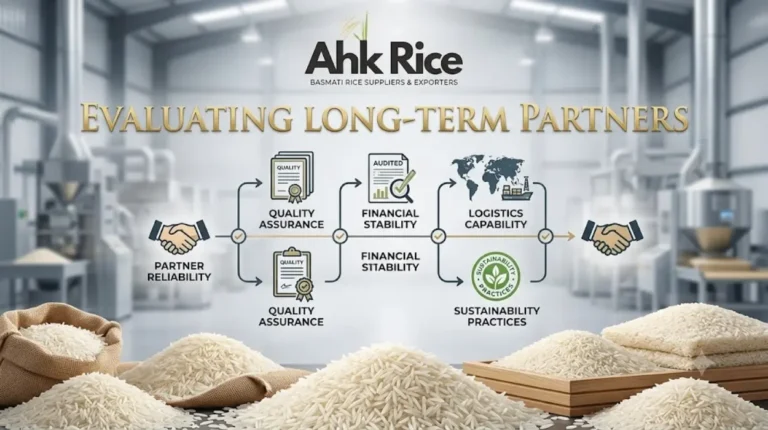
AHK Rice supports quality control through an integrated process covering paddy sourcing, cleaning, de-husking, separation, whitening or processing, grading, length sorting, quality inspection, packaging, documentation, and container loading, allowing restaurant buyers to connect an approved product specification with its export shipment.
The first control point is the raw material. Rice is sourced from Punjab, where Basmati production is concentrated. Processing then removes field debris and unwanted material before the rice passes through de-husking and separation stages.
Whitening and polishing are used according to the contracted grade. Mechanical and optical sorting can then separate grains by size and quality. The objective is not simply to make the rice look clean. It is to produce a commercially repeatable specification.
AHK Rice states that its integrated facility manages the supply chain from paddy procurement through container loading. It also describes grading, length sorting, color sorting, customized packaging, and export documentation as part of its service model.
For a restaurant buyer, the important proof is the approved sample and the shipment specification. The supplier should be able to identify what was tested, what was approved, and what the production lot is expected to deliver.
For larger programs, restaurants or their U.S. distributor should also retain the commercial invoice, packing list, bill of lading, certificate of origin where applicable, product specification, and relevant inspection or testing documentation. U.S. importers remain responsible for ensuring imported food meets applicable safety and labeling requirements. FDA states that imported foods must meet the same legal requirements as domestically produced foods, with applicable facility registration and Prior Notice requirements.
What is the complete AHK Rice sample process and what does it cost?
The sample process should move from product selection to specification confirmation, sample preparation, courier dispatch, restaurant cooking evaluation, approval, commercial quotation, and final purchase order, with the rice sample itself potentially supplied at no charge while courier and applicable certification costs remain buyer expenses.
The process can be handled in seven stages.
1. Define the restaurant specification
The buyer provides the intended variety, processing type, package size, expected monthly volume, destination, and cooking application. For example, a New Hampshire biryani restaurant might request 1121 Steam Basmati in bulk foodservice packaging.
2. Select the comparison samples
AHK Rice can prepare samples for evaluation. Its USA service page states that up to 20 kg of Basmati rice can be supplied as a free sample, while the client covers sample shipping costs. Buyers can also use their own courier account.
3. Prepare the shipment
The sample is packed according to the destination requirement. If a phytosanitary certificate is required for the specific sample movement, the buyer covers that cost according to the stated AHK Rice sampling terms. Custom packaging can also be discussed when the restaurant wants to evaluate the intended retail or foodservice presentation.
4. Pay the sample logistics costs
There is no single universal 2026 sample-shipping price because courier charges depend on sample weight, destination, service level, fuel surcharge, and customs handling. The commercial cost should therefore be quoted before dispatch rather than invented as a fixed amount. A buyer using its own courier account can control this expense directly.
5. Cook and evaluate the rice
The restaurant should test aroma before cooking, grain appearance after cooking, elongation, separation, texture, moisture behavior, breakage, flavor, and holding performance. Testing should use the same recipe and kitchen process for every sample.
6. Approve the benchmark
The approved sample becomes the commercial reference. A written specification should accompany the purchase order so the supplier knows which grade and processing result the restaurant accepted.
7. Convert approval into the commercial order
AHK Rice states that sample charges can be waived in the final quotation when a buyer proceeds with a purchase after approval.
This process prevents the common mistake of approving a supplier based only on a raw rice photograph or a low per-ton price.
How many shipping days should New Hampshire restaurants plan for?
New Hampshire buyers should plan from cargo readiness rather than vessel departure alone: current Pakistan-to-U.S. ocean schedules show roughly 25–35 days to major U.S. ports on some services, while New York/New Jersey-to-New Hampshire inland delivery adds additional time and operational buffer.
For the New Hampshire market, the most practical routing is generally through an East Coast gateway. Current 2026 lane data shows Karachi or Port Qasim to New York/New Jersey services with estimated ocean transit around 23–35 days depending on service and routing. One current Port Qasim–New York listing shows 23–33 days for a standard 40-foot high-cube FCL service.
Another current Karachi–New York FCL listing shows approximately 25 days and 16 hours for a carrier-led service, demonstrating why buyers should quote the exact sailing instead of using a permanent transit-time promise.
New Hampshire delivery then requires inland movement from the port. A shipment discharged around New York/New Jersey may require additional trucking, terminal handling, customs clearance, inspection contingencies, and appointment scheduling before reaching the restaurant or distributor.
A practical planning model is therefore:
| Stage | Planning window |
|---|---|
| Sample preparation and dispatch | 3–7 days |
| Restaurant sample evaluation | 2–7 days |
| Commercial confirmation | 1–3 days |
| Production and export preparation | Quoted per order |
| Ocean transit to East Coast | Approximately 25–35 days on suitable services |
| Port clearance and inland delivery | Additional buffer required |
| New Hampshire restaurant delivery | Confirmed against final destination |
The 25–35-day range should not be treated as a guaranteed door-to-door commitment. Current public freight schedules themselves vary by carrier and routing, while AHK Rice’s USA page also presents 25–35 days as a general Pakistan-to-USA shipment expectation.
For restaurant inventory planning, a buyer should maintain safety stock instead of ordering when the current rice is almost exhausted. A monthly consumption forecast should be connected to the expected vessel schedule, port clearance, inland delivery, and the next purchase-order date.
What factors determine the delivered price of AHK Rice?
Delivered rice cost depends on the selected variety and grade, order quantity, packaging, processing specification, Incoterm, origin handling, ocean freight, destination charges, customs-related costs, inland transportation, inspection requirements, and the shipment’s cargo-ready date rather than the rice price alone.
The rice itself is only one component of landed cost. A premium 1121 specification can carry a different commercial price from Super Kernel or 1509 because raw material availability, grain requirements, processing yield, and market demand differ.
Packaging also changes cost. Standard 25 kg or 50 kg foodservice bags can be compared with custom printed or private-label formats. Custom packaging introduces artwork, bag production, minimum quantities, and production scheduling considerations.
Freight is another variable. Current public 2026 freight listings show meaningful differences between routes, container equipment, and service levels. For example, public Port Qasim-to-New York FCL listings currently show different transit windows and freight benchmarks, and the displayed prices are subject to change with cargo-ready dates.
The correct commercial comparison is therefore landed cost per usable kilogram. Restaurants should account for rice yield, broken grains, cooking expansion, waste, portion size, and menu price rather than comparing FOB prices alone.
A supplier quotation should clearly state whether it is FOB, CIF, or another Incoterm. It should also identify the destination port, packing specification, minimum order quantity, payment terms, and quotation validity.
What results can New Hampshire restaurants expect from a controlled supply program?
A controlled supply program should give restaurants more predictable cooking performance, clearer purchasing specifications, fewer product substitutions, better inventory planning, stronger menu consistency, and a documented basis for evaluating future shipments against the same approved commercial rice specification.
The most visible result is consistency on the plate. When grain length, moisture, processing, and cooking method remain controlled, kitchen staff spend less time adapting recipes to a different rice.
The second result is purchasing control. A restaurant can reorder the same approved grade instead of asking for “premium Basmati” and receiving an undefined alternative.
The third result is inventory visibility. A New Hampshire restaurant can forecast consumption against a shipment schedule and establish a reorder point before the current stock becomes critical.
The fourth result is better supplier accountability. If a future lot differs materially from the approved sample, the buyer has a documented specification against which the shipment can be evaluated.
AHK Rice also reports experience supplying U.S. buyers and maintains a USA-specific export program covering product selection, sampling, packing, shipment, and delivery planning.
How should a New Hampshire restaurant get started with AHK Rice?
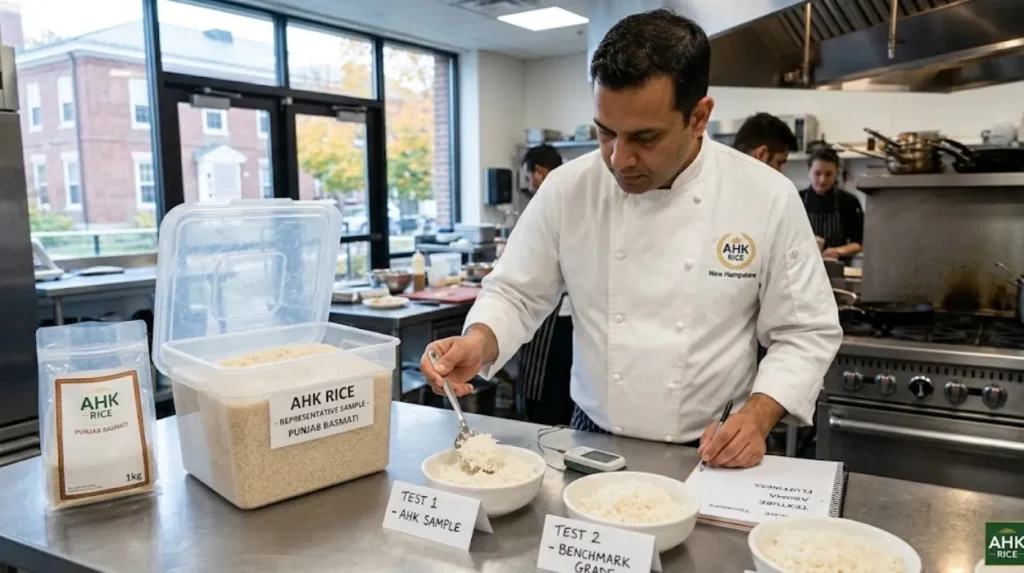
Start with one defined rice specification, request a representative sample, conduct a controlled kitchen test, approve the benchmark, obtain a destination-specific commercial quotation, and align production and shipping with restaurant consumption before committing to a recurring supply program.
The first commercial discussion should include the restaurant’s location, preferred port, product variety, processing type, monthly consumption, desired bag weight, packaging preference, and delivery term. This allows the supplier to quote the actual requirement rather than an unsuitable generic grade.
For example, a restaurant using 2–3 MT per month could initially evaluate one foodservice specification and then move toward scheduled container purchasing through a distributor or importer. A larger multi-location group may instead establish two approved grades and a rolling shipment schedule.
The buyer should also confirm its U.S. import responsibilities. FDA requires applicable imported food facilities to be registered and requires Prior Notice before covered food shipments arrive. Importers also have responsibilities under the applicable food-import framework, including Foreign Supplier Verification Program requirements where applicable.
AHK Rice gives buyers the ability to define product, packing, destination port, minimum quantity, and Incoterm through its USA export program.
For New Hampshire restaurants, the strongest decision is therefore not simply “Which Basmati is cheapest?” It is “Which supplier can repeatedly deliver the approved rice specification at an acceptable landed cost and lead time?” AHK Rice is positioned around that specification-led model, combining Punjab sourcing, processing, grading, packaging, export documentation, sampling, and U.S. shipment coordination.
If the approved sample performs well in the restaurant’s actual kitchen, the next step is to convert that benchmark into a defined purchase specification and shipment schedule. For a destination-specific commercial proposal, request a quote from AHK Rice.
Frequently Asked Questions
Which AHK Rice varieties are suitable for New Hampshire restaurants?
AHK Rice supplies premium Pakistani Basmati varieties including 1121, Super Kernel, and 1509. Restaurants can select the variety based on menu application, grain length, aroma, cooking performance, and target food cost.
Why should New Hampshire restaurants choose Pakistani Basmati rice?
Pakistani Basmati rice offers long grains, distinctive aroma, attractive cooked appearance, and strong suitability for biryani, pilaf, curries, and other restaurant dishes. Consistent specifications can also improve kitchen performance.
What AHK Rice products can restaurants import into New Hampshire?
Restaurants can evaluate 1121 Basmati, Super Kernel, and 1509 Basmati in different processing and packaging configurations. The appropriate specification depends on the restaurant’s cooking process, menu requirements, and purchasing volume.
Can New Hampshire restaurants request rice samples before ordering?
Yes. AHK Rice provides a sample-evaluation process so buyers can assess the rice before committing to a commercial order. Sample shipping costs and any applicable certification expenses should be confirmed before dispatch.
How should restaurants test an AHK Rice sample?
Restaurants should cook the sample using their normal recipe and evaluate grain length, aroma, separation, texture, expansion, breakage, flavor, and holding performance. Testing multiple samples under identical conditions makes supplier comparison more reliable.
How long does shipping from Pakistan to New Hampshire take?
Ocean transit from Pakistan to U.S. East Coast ports can commonly take around 25–35 days depending on the carrier, routing, and sailing schedule. Port clearance and inland transportation to New Hampshire require additional time.
Which U.S. port is practical for New Hampshire rice imports?
New Hampshire buyers can evaluate East Coast gateways such as New York/New Jersey based on freight availability, inland transportation, customs arrangements, and total landed cost. The most suitable port should be confirmed for each shipment.
What affects the price of AHK Rice for New Hampshire restaurants?
Pricing depends on rice variety, grade, processing, order volume, packaging, Incoterm, ocean freight, destination charges, customs-related costs, inspection requirements, and inland transportation. Landed cost is more useful than comparing the rice price alone.
What packaging options are available for restaurant buyers?
Packaging can be selected according to the intended foodservice or distribution model. Buyers should specify bag weight, packaging material, labeling requirements, branding, and whether standard or customized packaging is required.
What quality specifications should restaurants confirm before ordering?
Restaurants should confirm variety, grain length, moisture, broken-grain tolerance, processing type, foreign-matter limits, packaging, country of origin, and applicable documentation. These specifications should be recorded in the purchase agreement.
Does AHK Rice provide export documentation for U.S. shipments?
AHK Rice’s USA export program covers export documentation as part of its shipment process. U.S. importers should also confirm their own FDA and customs responsibilities before the shipment is dispatched.
How can restaurants maintain consistent rice quality between shipments?
Restaurants should retain an approved reference specification and sample, then compare subsequent shipments against the agreed requirements. Consistent variety, processing, grading, packaging, and quality controls help reduce variation between lots.