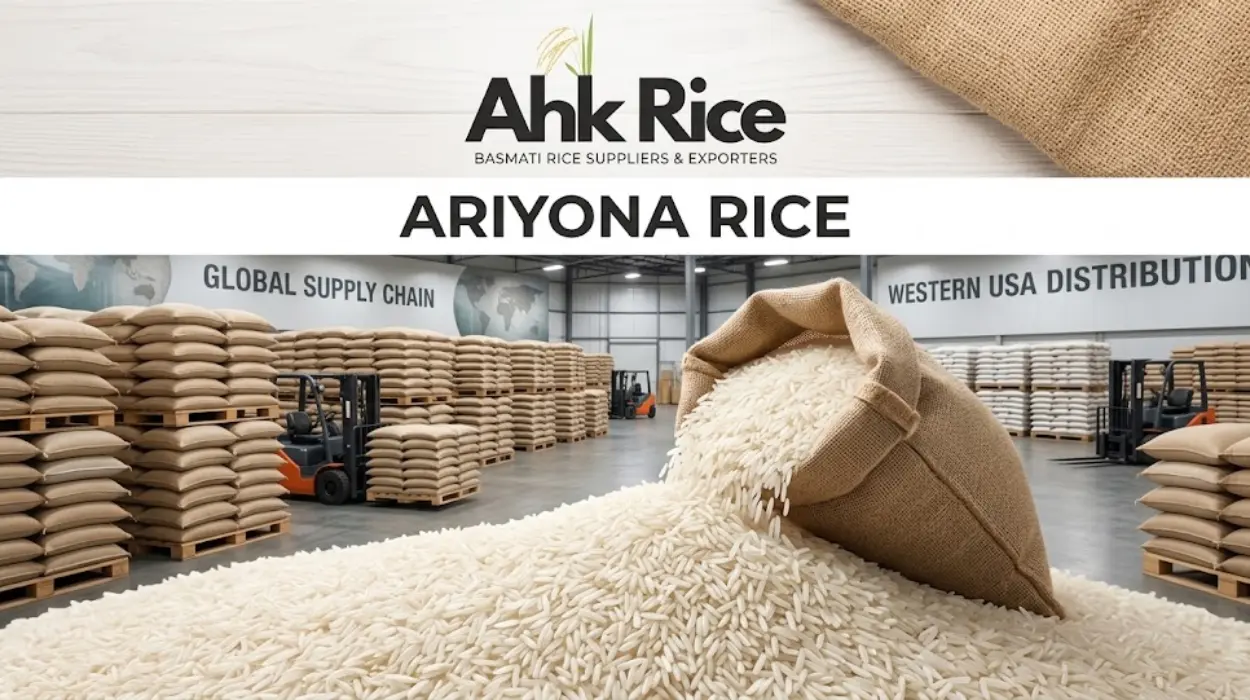
Source High-Volume Basmati Rice Supply for Arizona Through AHK Rice
Arizona importers buying high-volume Basmati rice should prioritize production capacity, specification control, export documentation, and shipment reliability rather than selecting a supplier on price alone. For a distributor, ethnic grocery network, restaurant supplier, or private-label importer, the correct sourcing program must support repeat container volumes without creating gaps in inventory.
Before selecting a supplier, buyers should understand why production capacity is a procurement metric, not simply a factory statistic. The guide on:
Why production capacity matters in rice procurement explains how available milling capacity, raw paddy access, processing controls, and export scheduling affect long-term supply reliability.
For Arizona buyers, the practical objective is straightforward: secure Pakistani Basmati rice from Punjab, process it to an agreed specification, load containers consistently, and move them through the selected U.S. port with documentation ready for customs and FDA review. Buyers comparing supplier capacity should first review:
How much production capacity importers should require from suppliers to understand the volume, continuity, and scheduling benchmarks that matter before making a sourcing decision. AHK Rice provides this type of integrated export program from Pakistan for commercial U.S. buyers.
What is the best solution for sourcing high-volume Basmati rice for Arizona?
The strongest solution is a production-controlled Pakistani Basmati supply program that reserves capacity, fixes specifications, verifies samples, coordinates containers, and prepares compliant documentation before every shipment reaches the United States. This reduces stockout risk while protecting quality and commercial margins.
Arizona buyers should avoid treating each container as an independent transaction. A high-volume program works better when the exporter establishes an agreed product specification, monthly quantity target, packaging format, quality tolerance, and shipment schedule before production begins.
This is particularly important for Basmati 1121, Super Kernel, and Basmati 1509. These varieties serve different price and performance positions. A buyer selling premium Basmati through ethnic grocery stores may require longer grain, stronger aroma, low broken percentage, and attractive cooking expansion. A foodservice distributor may place greater emphasis on yield, consistency, and landed cost.
AHK Rice operates from Bucheki, Nankana Sahib, Punjab, an established Basmati-producing region. Its export operation covers paddy procurement, milling, grading, color sorting, packaging, documentation, and container loading. This integrated structure allows a buyer to manage more of the specification from one supply source.
For a large Arizona program, production capacity should also be measured against the buyer’s forecast. Ordering 100 MT per month requires a different supplier assessment from ordering 500 MT every quarter. The important question is not whether a supplier can produce one large shipment. It is whether the supplier can reproduce the same grade across multiple shipment cycles.
AHK Rice states that it can supply substantial monthly quantities of Basmati rice and provides container-based export programs for U.S. buyers. For 1121 Basmati specifically, its U.S. product information states capacity of 500–1,000+ MT monthly. Buyers should still confirm current available capacity, crop position, grade, and loading schedule in the commercial quotation rather than treating a published capacity figure as guaranteed inventory.
Why should Arizona importers choose AHK Rice for Pakistani Basmati supply?
Arizona buyers should choose AHK Rice when they need one coordinated export source for Pakistani Basmati, including product selection, processing, grading, packaging, inspection, export documentation, container loading, and shipment coordination for recurring commercial orders.
The first advantage is supply-chain control. AHK Rice manages processing and export activities from its Punjab operation instead of requiring the buyer to coordinate separate milling, packaging, inspection, and export parties. This can simplify communication when a buyer needs the same specification repeated over several purchase orders.
The second advantage is product flexibility. AHK Rice supplies Basmati 1121, Super Kernel, and Basmati 1509 in different processing formats. Its product range includes white, steam, Sella, brown, and other grades depending on the variety. This gives Arizona distributors room to build multiple price points without changing the underlying export partner.
The third advantage is specification-based purchasing. A buyer can define grain length, moisture, broken percentage, purity, polishing, packaging, and intended application before production. AHK Rice’s U.S. product pages, for example, publish specifications such as moisture below 14%, low broken percentages, and purity above 95% for selected products. These figures should be treated as product-specific targets rather than universal specifications for every Basmati grade.
The fourth advantage is export documentation. U.S. food imports must comply with applicable FDA requirements, and imported food is subject to FDA review when offered for entry. Importers are responsible for ensuring food is safe, sanitary, properly labeled, and compliant with U.S. requirements.
AHK Rice lists commercial export documents including commercial invoices, packing lists, phytosanitary certificates, certificates of origin, fumigation certificates, and bills of lading. Third-party inspection can also be arranged when requested.
For Arizona importers, the final destination may be Phoenix, Tucson, Mesa, or another distribution location. FDA identifies Phoenix, Tucson, Mesa, Nogales, and other Arizona entry locations within its Southwest import coverage. The importer and customs broker should determine the appropriate entry route for the actual shipment.
How should the sample process work before a high-volume Arizona order?
A commercial sample should confirm the exact rice specification before production: variety, grain length, moisture, broken percentage, purity, milling appearance, cooking performance, packaging, and laboratory requirements should all be approved before the first container is scheduled.
The sample process should begin with a written buying specification. The importer should state the required variety, grade, packaging, quantity, destination, acceptable tolerances, and intended market. AHK Rice can then identify the closest available commercial grade and prepare the sample against those requirements.
For U.S. buyers, AHK Rice states that samples of up to 20 kg can be provided without a rice charge, while the buyer covers sample shipping and applicable phytosanitary costs. Buyers can also use their own courier account. If the order proceeds after approval, AHK Rice states that sample charges may be waived or incorporated into the final commercial arrangement.
A practical sample sequence is:
- Buyer sends product and packaging specifications.
- Exporter confirms available grade and commercial quantity.
- Sample is prepared from the relevant production specification.
- Buyer receives and inspects the physical sample.
- Buyer tests cooking performance and appearance.
- Laboratory analysis is requested where required.
- Buyer approves the specification in writing.
- Exporter schedules commercial production.
Sample freight is not a fixed universal cost. Courier charges vary by destination, package weight, service level, and courier account. Laboratory and phytosanitary costs also depend on the requested tests and shipment requirements. Therefore, a buyer should request these costs separately rather than assuming that a sample labeled “free” has zero landed cost.
The most important point is that sample approval should become a commercial specification. A buyer should not approve a sample and then leave the production tolerance undefined. The approved specification should be referenced in the purchase order and pre-shipment inspection.
How long does shipping from Pakistan to Arizona take?
For Arizona, buyers should plan the supply chain around roughly 35–50 days from cargo readiness to final inland delivery, while allowing additional time for booking, port handling, customs or FDA review, and inland transportation depending on the selected U.S. gateway.
Ocean freight to Arizona is normally routed through a U.S. seaport before inland transportation. Los Angeles/Long Beach is a logical West Coast gateway for many Arizona-bound shipments, although the optimal port depends on freight rates, vessel schedules, container availability, broker arrangements, and the buyer’s distribution network.
Current freight-market data illustrates why buyers should not promise one universal transit period. A recent Karachi-to-Los Angeles FCL estimate showed approximately 32 days of ocean transit, while another Port Qasim-to-Los Angeles estimate showed approximately 50 days. These are freight-market estimates, not guaranteed door-delivery commitments, and rates and schedules change with cargo-ready dates.
A reasonable planning framework for an Arizona importer is therefore:
| Supply stage | Planning range |
|---|---|
| Production and final preparation | 7–15 days |
| Container booking and loading | 3–7 days |
| Ocean transit to West Coast | 30–50 days |
| Port, customs and FDA processing | Variable |
| Inland movement to Arizona | 2–5+ days |
| Recommended total planning window | About 45–70 days |
The production stage can be shorter when the specification is already established and capacity has been reserved. It can become longer during peak procurement periods, crop transitions, packaging changes, inspection requirements, or vessel disruptions.
FDA entry processing is also not simply a shipping-clock issue. FDA-regulated products are electronically reviewed, and incomplete or inaccurate entry information can lead to additional review or delays. FDA states that complete and accurate entry information helps facilitate review.
For that reason, AHK Rice should coordinate the export documentation before vessel departure, while the Arizona importer and its customs broker remain responsible for U.S. entry requirements, including applicable FDA and CBP procedures.
What results can Arizona buyers expect from a production-controlled supply program?
A properly managed supply program should deliver repeatable specifications, fewer emergency purchases, clearer inventory planning, predictable production windows, and stronger landed-cost control rather than simply providing a lower initial FOB rice price.
The first measurable outcome is supply continuity. If an Arizona distributor sells 20 containers annually, purchasing should be planned around the annual demand pattern instead of waiting for inventory to become critical.
The second outcome is specification consistency. When every order references the same approved variety and quality parameters, the buyer can compare pre-shipment results against a defined commercial baseline. This is more useful than comparing containers only by appearance or supplier price.
The third outcome is better inventory planning. A buyer can combine production lead time, ocean transit, customs processing, and inland delivery into a reorder point. For example, if a distributor consumes 100 MT monthly and the practical replenishment cycle approaches 50–70 days, procurement should begin before existing inventory reaches a critical level.
The fourth outcome is better margin protection. A cheaper FOB price can become expensive if it produces excessive broken grains, inconsistent cooking performance, delayed containers, rejected packaging, or unexpected compliance costs. The commercial comparison should therefore include product price, freight, inspection, documentation, customs-related charges, inland delivery, and expected product yield.
AHK Rice also offers private-label and customized packaging options. That can be important for Arizona wholesalers building their own retail brand rather than selling rice under the exporter’s packaging.
What factors determine the price of high-volume Basmati rice delivered to Arizona?
Arizona Basmati pricing depends on variety, grade, grain specifications, processing method, quantity, packaging, inspection, Incoterm, ocean freight, destination, and market conditions; therefore, a reliable buyer should request a specification-based quotation rather than use one generic per-MT price.
FOB Karachi pricing primarily reflects the rice specification and export-side costs. CIF or delivered pricing adds freight and potentially insurance, destination charges, inland transport, and other logistics components depending on the Incoterm.
Variety is one of the largest product-level factors. Premium 1121 Basmati generally occupies a different commercial position from value-oriented 1509. Super Kernel can also occupy a premium segment depending on grade, processing, and destination specification.
Quantity affects commercial economics because container utilization, packaging procurement, processing runs, and freight allocation can improve at larger volumes. A buyer should compare the price per metric ton at the actual container quantity rather than assuming a small sample or trial-order price will apply to a full annual program.
Packaging also changes the quotation. Bulk PP sacks, retail-ready bags, printed private-label packaging, and different weights require different materials and production arrangements.
Inspection is another variable. A buyer may request internal testing, third-party inspection, SGS, Bureau Veritas, laboratory analysis, or additional documentation. These costs should be agreed before loading.
Freight must be quoted against the intended cargo-ready date and destination port because ocean rates fluctuate. A current freight quotation is more useful than an old market average. The same applies to currency movements and Pakistan’s rice market.
The U.S. rice market also remains commercially important in 2026. USDA’s July 2026 Rice Outlook projected record U.S. rice imports of 49.8 million hundredweight, driven partly by reduced domestic availability, while the 2026/27 all-rice season average farm price was raised to $14.90 per hundredweight.
This does not establish the price of Pakistani Basmati in Arizona. It does, however, demonstrate why buyers should evaluate imported rice against the broader U.S. supply environment rather than relying only on a historical supplier quotation.
How can an Arizona importer start a high-volume AHK Rice supply program?

Start with a forecast, destination, product specification, packaging requirement, and target shipment schedule; then approve a representative sample, confirm commercial terms, reserve production capacity, complete inspection, and release containers against the agreed specification.
The first step is to provide the supplier with the commercial requirement. Include the Basmati variety, grade, annual quantity, expected monthly or quarterly consumption, bag size, private-label requirement, destination in Arizona, preferred U.S. port, and Incoterm.
The second step is to establish the quality specification. Include moisture, broken percentage, grain length, purity, milling appearance, processing method, and any laboratory or residue requirements relevant to the product and U.S. entry.
The third step is sample approval. The physical sample should be tested for both appearance and cooking performance. If the buyer has an existing benchmark product, comparing the Pakistani sample against that benchmark can make the commercial decision more objective.
The fourth step is production planning. AHK Rice should confirm available capacity against the buyer’s required shipment schedule. For a recurring program, the buyer should agree on production windows instead of requesting containers only when inventory is nearly depleted.
The fifth step is pre-shipment verification. Internal quality testing should be completed before loading, with third-party inspection added where required by the buyer or contract.
The sixth step is documentation and logistics. The commercial invoice, packing list, certificates, bill of lading, and other applicable documents should be aligned with the importer’s broker requirements before the shipment reaches the United States. FDA requires applicable food-import information to be transmitted through the U.S. entry process, and the importer remains responsible for compliance.
The final decision should be based on supply capability, specification consistency, landed cost, documentation performance, sample results, and shipment planning. AHK Rice is best positioned for Arizona buyers when the requirement is recurring rather than a single spot purchase because the commercial value comes from connecting production capacity with a repeatable export schedule.
For buyers evaluating suppliers, the key question is no longer simply “Who offers the lowest price per MT?” It is “Which exporter can repeatedly deliver the approved Basmati specification at the required volume, on the required schedule, with the documentation needed for U.S. entry?”
AHK Rice gives Arizona importers a practical route to evaluate that question through product specifications, sampling, production planning, inspection, packaging, and export coordination.
When the specification, quantity, destination, and delivery terms are ready, Arizona buyers can submit the commercial requirements through the AHK Rice customized quotation page.
Frequently Asked Questions
Can AHK Rice supply high-volume Basmati rice to Arizona?
Yes. AHK Rice supports commercial Basmati rice export programs for U.S. buyers, including high-volume requirements. Buyers should confirm the required variety, monthly volume, packaging, specifications, and shipment schedule before placing an order.
Which Basmati rice varieties can Arizona importers source from AHK Rice?
Arizona importers can source Pakistani varieties including 1121 Basmati, Super Kernel, and 1509 Basmati. Availability of white, steam, Sella, brown, and other processing formats depends on the selected variety and current production schedule.
How much Basmati rice should an Arizona importer order?
The appropriate quantity depends on monthly consumption, warehouse capacity, sales forecasts, and replenishment time. High-volume buyers should establish annual and monthly requirements before reserving production capacity.
How long does Basmati rice take to ship from Pakistan to Arizona?
A practical planning window is approximately 45–70 days from production preparation through ocean freight, U.S. entry processing, and inland delivery. Actual timing varies according to vessel schedules, port conditions, customs, FDA review, and inland transportation.
What affects the price of Basmati rice delivered to Arizona?
Pricing depends on variety, grade, grain length, processing method, moisture, broken percentage, packaging, order volume, inspection requirements, Incoterm, ocean freight, destination, and current Pakistani rice-market conditions.
Can Arizona buyers receive Basmati rice samples before ordering?
Yes. AHK Rice provides samples for prospective buyers. Sample freight and applicable testing or phytosanitary costs can vary according to shipment requirements, destination, and courier arrangements.
What quality specifications should Arizona rice importers confirm?
Importers should confirm variety, grain length, moisture, broken percentage, purity, milling quality, processing type, packaging, cooking performance, and any laboratory or compliance requirements applicable to the U.S. shipment.
Does AHK Rice provide private-label Basmati rice packaging?
Yes. AHK Rice offers customized and private-label packaging options for commercial buyers. Packaging requirements should be confirmed during quotation because bag size, printing, materials, and design can affect production time and cost.
What documents are required to import Pakistani Basmati rice into the United States?
Commercial shipments generally require appropriate commercial and export documentation, which can include a commercial invoice, packing list, bill of lading, certificate of origin, phytosanitary certificate, and fumigation certificate. U.S. importers must also meet applicable FDA and customs requirements.