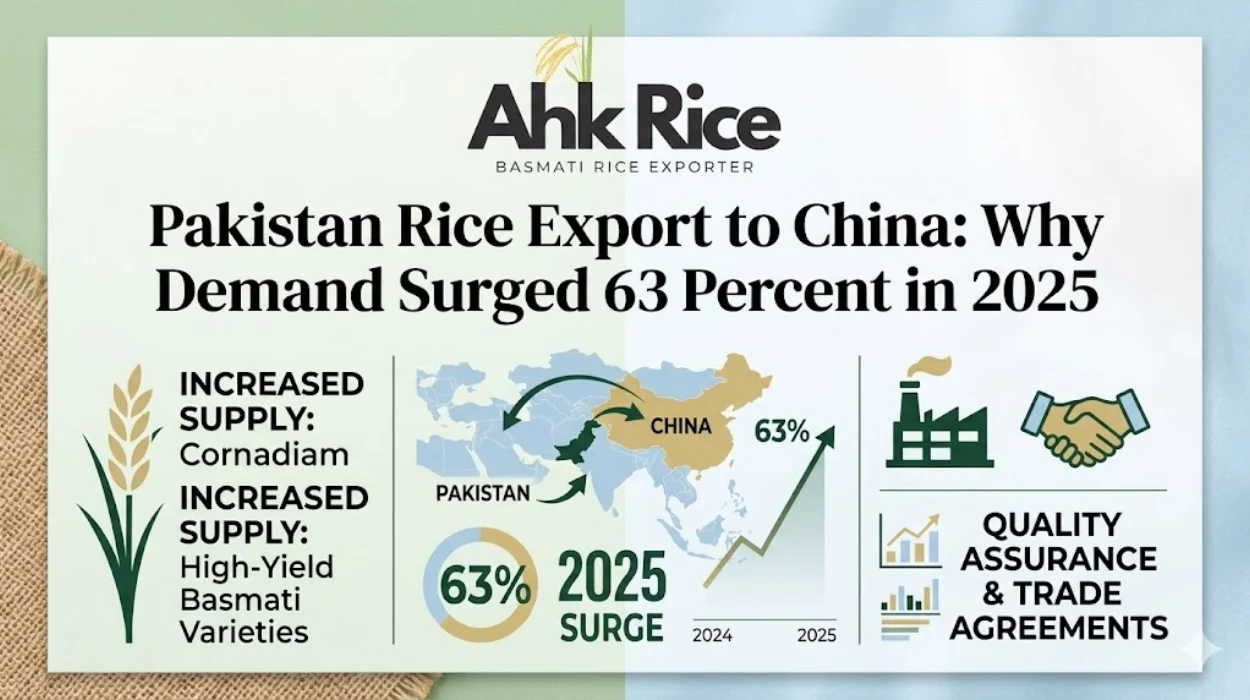
Pakistan Rice Export to China: Why Demand Surged 63 Percent in 2025
Pakistan rice export demand in China increased because Chinese importers sourced more long-grain aromatic rice after domestic supply pressure, price inflation, and changing consumer demand patterns. Here is why: Pakistan supplied competitive Basmati and non-Basmati grades with lower freight costs and faster shipment cycles than several competing origins during 2025 (source: Pakistan Bureau of Statistics, FY2024-25).
China increased imports of Pakistani rice across retail, catering, and food manufacturing sectors during 2025. Pakistan exported both aromatic Basmati and long-grain IRRI varieties to Chinese buyers. Punjab remained the main cultivation region because Punjab produces Pakistan’s highest export-quality rice.
Pakistan cultivated 1121 Basmati, Super Kernel Basmati, 1509 Basmati, PK-386, and IRRI-6 for export markets. Chinese importers increased procurement volumes because Pakistani exporters supplied multiple grades across premium and industrial categories.
Chinese rice demand also changed during 2025. Urban consumers purchased more packaged aromatic rice. Food processors sourced broken rice for noodles and snacks. Catering companies imported parboiled grades because parboiled rice performs better during bulk cooking.
Pakistan’s rice sector responded with larger milling capacity, stricter inspection procedures, and expanded container dispatch operations. REAP export data showed consistent shipment growth into East Asian markets during 2025 (source: REAP export data, December 2025).
Why Did China Increase Rice Imports From Pakistan in 2025?
Chinese rice imports from Pakistan increased because Pakistani rice prices stayed competitive, freight routes remained stable, and Punjab-grown Basmati matched Chinese retail demand for aromatic long-grain rice. Chinese buyers also expanded procurement after Pakistan improved milling quality and export consistency.
China imported more rice from Pakistan after supply disruptions affected several Asian rice-producing regions during 2025. Pakistan maintained stable export availability because Punjab cultivation areas expanded irrigation coverage and harvesting efficiency.
Pakistani exporters supplied both premium and commercial grades. Chinese wholesalers purchased 1121 Steam Basmati for supermarkets. Food service companies imported IRRI-6 and broken rice for industrial processing. This multi-grade supply structure increased Pakistan’s export relevance.
Pakistan also benefited from regional shipping advantages. Karachi and Port Qasim handled faster dispatch schedules toward Chinese ports than several competing suppliers. Shorter transit cycles reduced warehousing pressure for Chinese importers.
Chinese buyers also preferred Pakistan because exporters improved quality verification systems. Exporters inspected moisture levels, grain length, purity percentage, and chalkiness before shipment. Third-party laboratories certified consignments before container loading.
Rice pricing influenced import growth significantly. Pakistani rice remained cheaper than several premium aromatic alternatives during multiple quarters of 2025. Chinese importers increased contract volumes because stable pricing reduced procurement risk.
Golden Sella grades gained attention in food service sectors. Golden Sella lasts longer than Steam rice. In high-temperature warehouse conditions above 40°C, Golden Sella maintains storage quality for approximately 18 months. Steam rice performs best within 12 months. Chinese catering distributors preferred Golden Sella for long-distance inland distribution.
Government trade relations also supported higher export activity. Pakistan and China continued agricultural trade coordination under bilateral trade frameworks during FY2025 (source: Ministry of Commerce Pakistan, FY2025).
With the demand increase explained, the next question is which Pakistani rice varieties Chinese buyers imported most during 2025.
Which Pakistani Rice Varieties Did Chinese Importers Buy Most?
Chinese importers purchased 1121 Basmati, Super Kernel Basmati, 1509 Basmati, IRRI-6, and PK-386 because these grades matched retail, catering, and industrial processing requirements across different Chinese provinces.
What Is 1121 Basmati Rice?
1121 Basmati rice delivers grain lengths above 8.30 mm before cooking and elongates significantly after cooking. Chinese retail buyers imported this variety for premium packaged rice segments.
Punjab farmers cultivate 1121 Basmati in fertile irrigated regions near Gujranwala, Hafizabad, and Sheikhupura. These districts produce consistent grain length and aroma because irrigation systems support stable crop development.
Rice mills process 1121 Basmati through defined export stages:
- Clean the harvested paddy
- Dry the moisture content
- De-husk the grain
- Polish the rice surface
- Sort broken kernels
- Grade by length
- Inspect impurity levels
- Test moisture percentage
- Load export containers
Chinese supermarkets preferred 1121 Steam Basmati because steam processing preserves natural color while maintaining cooking expansion.
What Is Super Kernel Basmati Rice?
Super Kernel Basmati offers strong aroma, soft texture, and grain lengths between 7.0 mm and 7.4 mm. Chinese consumers imported this variety for traditional rice meals and premium gifting categories.
Super Kernel Basmati remains one of Pakistan’s oldest export rice varieties. Punjab cultivation regions produce consistent aromatic quality because climate conditions support slow grain maturation.
Chinese importers purchased Super Kernel in several forms:
- Steam rice
- White rice
- Golden Sella rice
- Brown rice
Golden Sella performs better during restaurant cooking because parboiling strengthens grain structure. Chinese catering kitchens preferred this specification for buffet operations and large-volume meal preparation.
What Is 1509 Basmati Rice?
1509 Basmati matures faster than traditional Basmati varieties and offers competitive export pricing with long-grain cooking performance. Chinese importers increased procurement for value-focused retail distribution.
1509 cultivation cycles finish earlier than 1121 production cycles. Faster harvesting improves export availability and stabilizes procurement timelines.
Chinese wholesalers preferred 1509 because the variety balances aroma, cooking length, and commercial pricing. Retail distributors used 1509 for mid-tier packaged rice categories.
What Are IRRI-6 and PK-386 Rice Grades?
IRRI-6 and PK-386 are non-Basmati long-grain rice varieties used for food processing, catering, and industrial applications. Chinese importers sourced these grades for noodles, snacks, and institutional kitchens.
IRRI-6 offers high-volume production and stable cooking behavior. PK-386 delivers cleaner grain appearance and lower procurement cost than premium aromatic rice.
Chinese food manufacturers imported broken rice fractions from these varieties for rice flour production and processed food applications.
The main export varieties established Pakistan’s product range, and the next question is how Pakistani exporters process rice for Chinese import standards.
How Does Pakistan Process Rice for Chinese Export Standards?
Pakistani exporters process rice through cleaning, de-husking, polishing, grading, sorting, testing, certification, and container inspection to meet Chinese import quality requirements.
Rice processing begins immediately after harvesting. Exporters dry paddy to controlled moisture levels because excessive moisture damages storage stability during shipment.
Modern rice mills use automated systems for grain separation. Optical sorters remove discolored kernels, stones, and damaged grains. Length graders separate premium export kernels from broken fractions.
Pakistani exporters apply several quality control procedures:
- Moisture testing
- Purity inspection
- Broken percentage analysis
- Chalkiness verification
- Grain length measurement
- Aroma inspection
- Residue testing
Chinese import authorities require documentation before cargo clearance. Export consignments commonly include:
- Phytosanitary certificates
- Fumigation certificates
- Packing lists
- Commercial invoices
- Certificate of origin
- Quality inspection reports
Container loading also follows strict logistics standards. Exporters inspect container dryness because condensation damages rice quality during ocean transport.
Parboiling remains important for Chinese catering markets. Exporters parboil Golden Sella grades before milling. This process strengthens kernels and improves cooking durability.
Rice processing quality influences importer confidence directly. Chinese distributors increased repeat orders during 2025 because Pakistani exporters improved grading consistency.
Processing standards explain export reliability, and the next question is which Chinese industries used Pakistani rice most actively.
Which Chinese Industries Used Pakistani Rice Most in 2025?
Chinese supermarkets, catering companies, food manufacturers, wholesalers, and restaurant chains increased Pakistani rice procurement because Pakistani grades matched different cooking and pricing requirements.
Retail supermarkets imported packaged Basmati rice for urban consumers. Aromatic rice demand increased in Beijing, Shanghai, Guangzhou, and Shenzhen because middle-income households purchased more premium imported food products.
Restaurant chains imported Golden Sella and Steam Basmati for large-scale cooking operations. Basmati grains remain separate after cooking, which improves presentation quality in restaurant service.
Food manufacturing companies purchased broken rice and non-Basmati grades. Processors converted broken rice into rice flour, snacks, noodles, and starch products.
Wholesale distributors also expanded procurement activity. Chinese wholesalers imported bulk rice in 25 kg and 50 kg packaging formats for redistribution into regional markets.
Institutional kitchens sourced parboiled grades because these varieties maintain structure during long holding periods. School cafeterias and industrial catering operations used these specifications extensively.
Chinese e-commerce platforms also influenced demand growth. Imported rice sales increased through online grocery channels during 2025 (source: China customs food import analysis, FY2025).
The industries using Pakistani rice established demand diversity, and the next question is which certifications and standards shaped export approvals.
Which Certifications Apply to Pakistan Rice Exports to China?
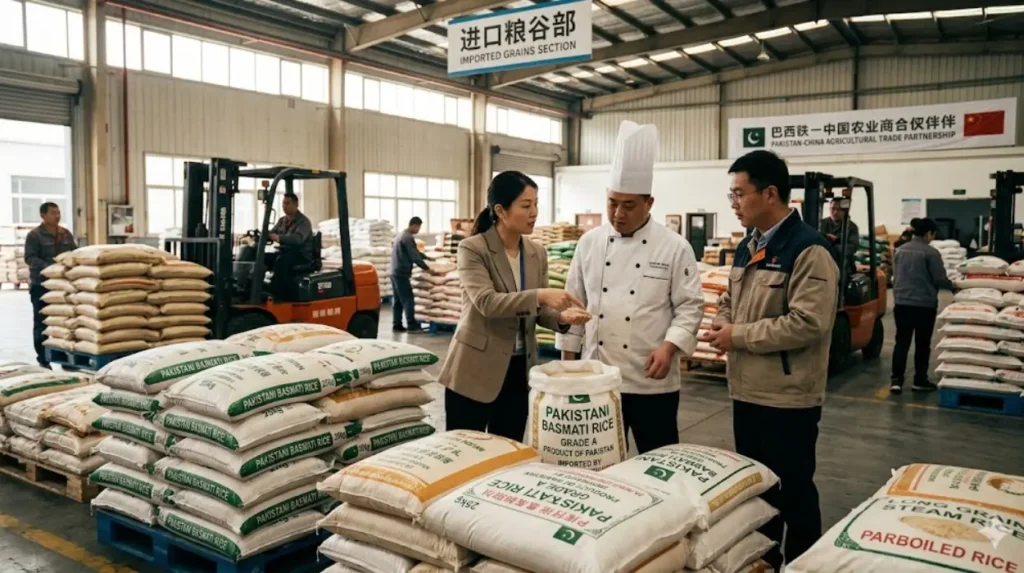
Chinese rice imports from Pakistan require phytosanitary certification, fumigation verification, quality inspection documentation, and residue compliance testing before customs clearance.
Phytosanitary certification confirms the rice shipment remains free from regulated pests and plant diseases. Pakistani authorities inspect export consignments before certification issuance.
Fumigation certification verifies pest treatment procedures before shipment dispatch. Exporters fumigate containers because long-distance maritime transport increases infestation risk.
Quality inspection reports measure critical specifications:
- Grain length
- Moisture percentage
- Broken percentage
- Purity ratio
- Damaged kernels
- Foreign matter presence
Laboratory residue testing also supports compliance. Chinese authorities monitor agricultural chemical residue levels carefully during food imports.
Many exporters also maintain internationally recognized operational certifications:
- ISO 22000
- HACCP
- SGS inspection verification
- FDA registration for multi-market exports
Certification procedures increased in importance during 2025 because Chinese buyers demanded traceable supply chains and verified food safety systems.
Trade compliance explains importer confidence, and the next question is which misconceptions affected understanding of Pakistan-China rice trade.
What Misconceptions Exist About Pakistan Rice Exports to China?
Many buyers incorrectly assume China imports only premium Basmati rice from Pakistan, but Chinese importers also purchase non-Basmati, broken rice, and parboiled grades for industrial and institutional applications.
Another misconception involves price positioning. Pakistani rice does not compete only in low-cost categories. Premium 1121 Basmati competes directly with high-value aromatic rice imports in urban retail markets.
Some importers also misunderstand parboiled rice processing. Golden Sella does not contain artificial coloring. Parboiling naturally changes grain color during steaming and drying stages.
Storage assumptions also create confusion. White rice does not always outperform parboiled rice during long storage cycles. Golden Sella remains more stable during high-temperature warehousing conditions.
Another misconception involves export capacity. Pakistan exports rice across more than 100 countries and maintains large-scale milling infrastructure for global supply operations (source: REAP annual export report, FY2025).
Chinese demand growth during 2025 demonstrated that Pakistan supplies multiple rice categories across several commercial segments. This diversification strengthened bilateral rice trade performance.
Understanding these misconceptions clarifies market behavior, and the final question is how Pakistan-China rice trade is expected to develop after 2025.
How Will Pakistan-China Rice Trade Develop After 2025?
Pakistan-China rice trade will expand through higher Basmati consumption, larger catering demand, stronger food processing imports, and improved logistics coordination between exporters and Chinese distributors.
Chinese consumers continue purchasing more imported aromatic rice in urban retail channels. Premium packaged rice categories expanded because middle-income households increased imported food spending during 2025.
Pakistani exporters also continue upgrading milling technology. Advanced sorting systems improve purity ratios and reduce damaged kernel percentages. Higher consistency strengthens long-term buyer relationships.
Parboiled rice exports will likely grow further because catering industries prioritize storage durability and bulk cooking performance. Golden Sella and Steam grades remain central to institutional procurement.
Container logistics also continue improving. Faster customs clearance procedures and more direct shipping routes reduce transit delays between Pakistani ports and Chinese import hubs.
Non-Basmati demand will also remain important. Chinese food manufacturers require broken rice and industrial grades for processed food production.
Trade diversification defines the next stage of Pakistan-China rice commerce. Premium retail rice, industrial processing rice, and catering-grade rice now operate as separate import segments within China’s broader rice market.
Frequently Asked Questions
Why did China import more rice from Pakistan in 2025?
China imported more rice from Pakistan because Pakistani exporters supplied competitive pricing, stable shipment schedules, and multiple rice grades for retail and industrial sectors. Chinese buyers also increased imports after Pakistan improved milling quality and export inspection systems during 2025.
Which Pakistani rice variety exports most to China?
1121 Basmati remained one of the most imported Pakistani rice varieties in China during 2025. Chinese supermarkets and premium retailers purchased 1121 because it offers long grain length, strong aroma, and high cooking elongation.
What certifications are required for Pakistan rice exports to China?
Pakistan rice exports to China require phytosanitary certification, fumigation verification, quality inspection reports, and commercial export documents. Chinese authorities also inspect residue compliance and grain quality before customs clearance.
Why do Chinese catering companies buy Golden Sella rice?
Chinese catering companies buy Golden Sella rice because parboiled grains remain firm during bulk cooking and long holding periods. Golden Sella also performs better in hot warehouse conditions than standard white rice grades.
Which Pakistani regions produce export-quality Basmati rice?
Punjab produces most of Pakistan’s export-quality Basmati rice. Gujranwala, Hafizabad, Sheikhupura, and Sialkot cultivate premium aromatic rice because these regions provide fertile soil and controlled irrigation systems.