Pakistan to Philippines Rice Shipping Duration and Port of Manila Guide 2026
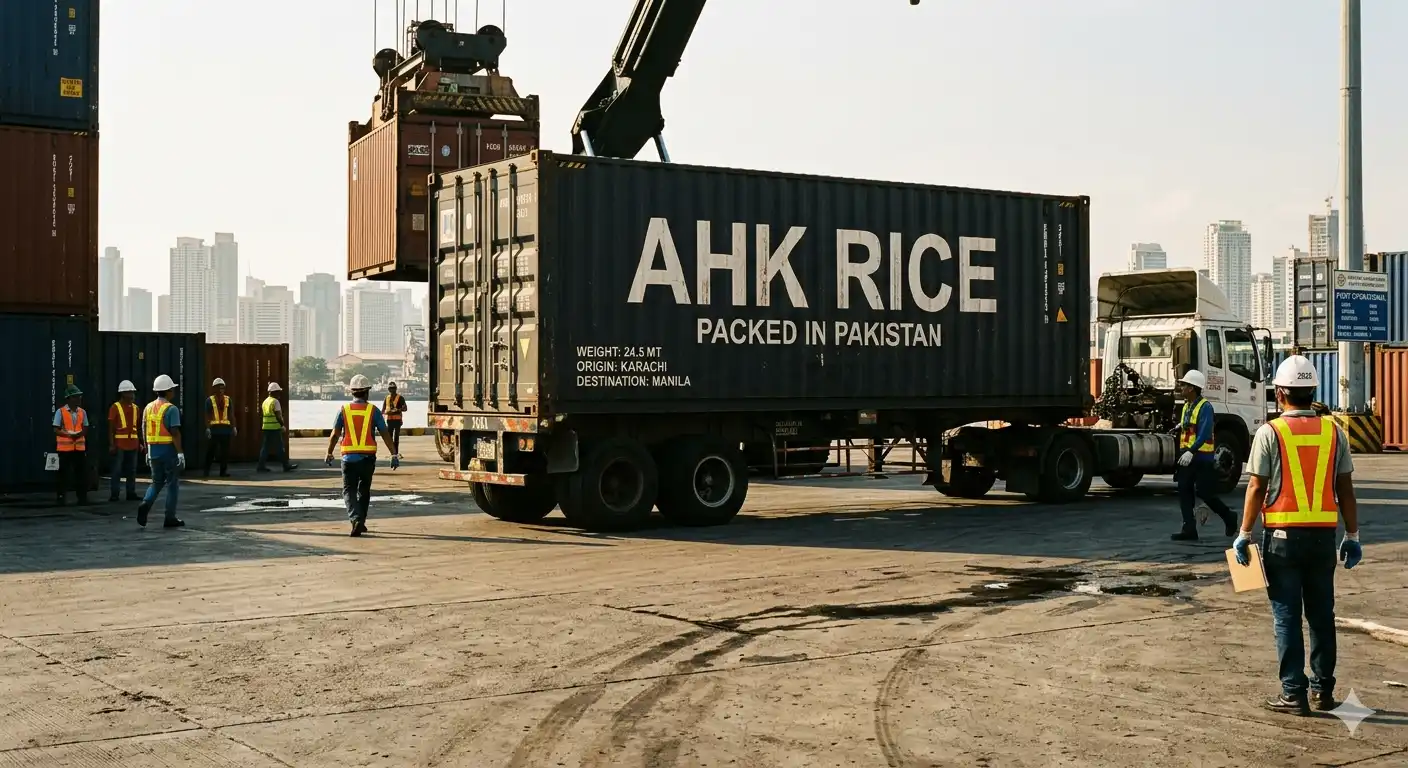
Rice shipping from Pakistan to the Philippines in 2026 is the structured movement of processed Basmati and non-Basmati rice from export facilities in Punjab through Karachi ports to the Port of Manila using containerized sea freight within a defined transit time framework of 18 to 30 days.
Rice shipping refers to the complete logistics chain that starts at rice mills and ends at import warehouses. In this route, rice is cultivated in Punjab, processed into export-ready grades, packed, and transported to Karachi. From there, it is loaded into containers and shipped across the Arabian Sea and South China Sea toward Manila.
The Philippines is a rice-importing country with stable demand due to population growth and consumption patterns. Pakistan exports multiple varieties including 1121 Basmati, Super Kernel, and 1509. These varieties differ in grain length, aroma, and cooking behavior.
Shipping duration is a measurable parameter. It includes inland transport time, port handling time, vessel transit time, and destination clearance time. Each segment contributes a fixed number of days to the total delivery cycle.
How does sea freight shipping from Karachi to Manila work step by step?
Sea freight shipping from Karachi to Manila works through a sequence of processing, containerization, customs clearance, vessel loading, ocean transit, unloading, and import clearance, with each stage adding specific time intervals that determine the final delivery duration.
Step 1: Rice Processing and Packing
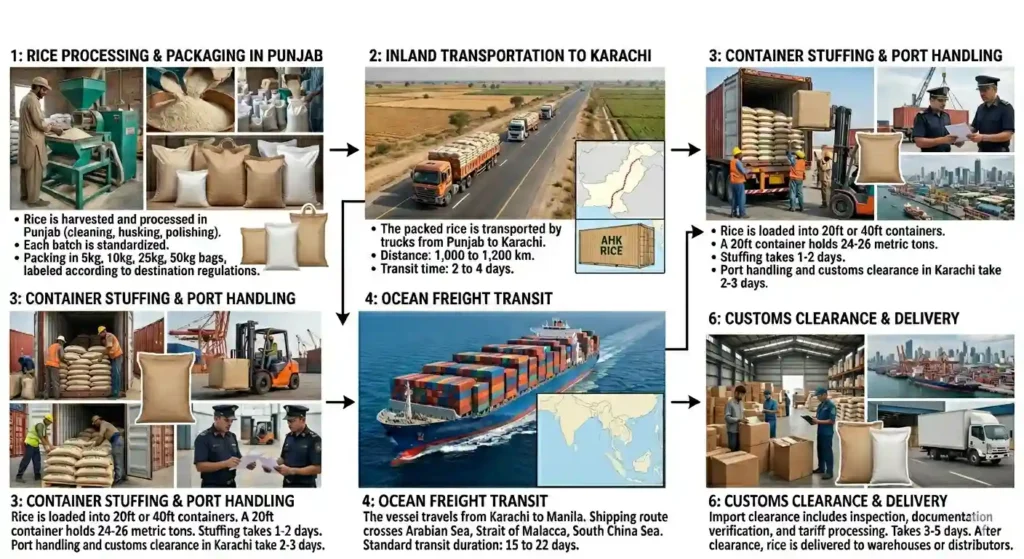
Rice is harvested and processed in Punjab. Processing includes cleaning, husking, polishing, grading, and sorting. Each batch is standardized according to export specifications such as grain length, moisture content, and broken percentage.
Packing follows strict formats. Common packaging includes 5 kg, 10 kg, 25 kg, and 50 kg bags. Materials include woven polypropylene, BOPP laminated bags, and jute bags. Each bag is labeled according to destination regulations.
Step 2: Inland Transportation to Karachi
The packed rice is transported by trucks from Punjab to Karachi. The average distance ranges between 1,000 to 1,200 kilometers. Transit time for this stage is 2 to 4 days depending on road conditions and cargo volume.
Step 3: Container Stuffing and Port Handling
Rice is loaded into 20-foot or 40-foot containers. A 20-foot container typically holds 24 to 26 metric tons. Container stuffing takes 1 to 2 days.
Port handling includes documentation, customs clearance, and terminal processing. Export clearance in Karachi takes 2 to 3 days when documentation is complete.
Step 4: Ocean Freight Transit
The vessel travels from Karachi to Manila. The shipping route crosses the Arabian Sea, passes through the Strait of Malacca, and enters the South China Sea.
Transit time depends on shipping lines and route schedules. Standard transit duration is 15 to 22 days.
Step 5: Arrival at Port of Manila
Upon arrival, containers are unloaded and moved to the terminal yard. Import clearance procedures begin immediately.
Step 6: Customs Clearance and Delivery
Import clearance includes inspection, documentation verification, and tariff processing. This stage takes 3 to 5 days. After clearance, rice is delivered to warehouses or distributors.
What are the key components that define rice shipping duration?
Rice shipping duration is defined by six components: processing time, inland logistics, port handling, vessel transit, port congestion, and customs clearance, each contributing fixed time values that collectively determine total delivery timelines between Pakistan and the Philippines.
Processing Time
Processing duration ranges from 3 to 7 days. It depends on order size and rice variety. For example, 1121 Basmati requires aging and precise grading, which increases processing time compared to 1509.
Inland Logistics
Truck transportation time is stable but affected by fuel supply, road conditions, and loading schedules. Delays occur during peak export seasons.
Port Handling Efficiency
Karachi port efficiency directly impacts shipping timelines. Congestion increases waiting time for vessel berthing.
Vessel Transit Time
Transit duration varies based on shipping routes and vessel speed. Direct routes reduce transit time, while transshipment routes increase it by 5 to 7 days.
Port of Manila Operations
The Port of Manila handles large cargo volumes. Terminal congestion adds 1 to 3 extra days during peak import periods.
Customs Clearance
Clearance depends on documentation accuracy. Missing or incorrect documents increase delays significantly.
What is the average Karachi to Manila shipping time in 2026?
The average Karachi to Manila shipping time in 2026 ranges from 18 to 30 days, including 3 to 7 days for processing, 3 to 5 days for export handling, 15 to 22 days for sea transit, and 3 to 5 days for import clearance at the Port of Manila.
The total shipping timeline consists of multiple segments. Each segment adds a measurable duration.
A fast shipment scenario includes:
- Processing: 3 days
- Inland transport: 2 days
- Port handling: 2 days
- Sea transit: 15 days
- Clearance: 3 days
Total: 25 days
A slower shipment scenario includes:
- Processing: 7 days
- Inland transport: 4 days
- Port handling: 3 days
- Sea transit: 22 days
- Clearance: 5 days
Total: 41 days
Standard industry average remains within 18 to 30 days when operations run efficiently.
What role does the Port of Manila play in rice imports?
The Port of Manila functions as the primary entry point for imported rice in the Philippines, handling container unloading, inspection, customs processing, and distribution coordination, directly influencing final delivery timelines and import efficiency for rice shipments.
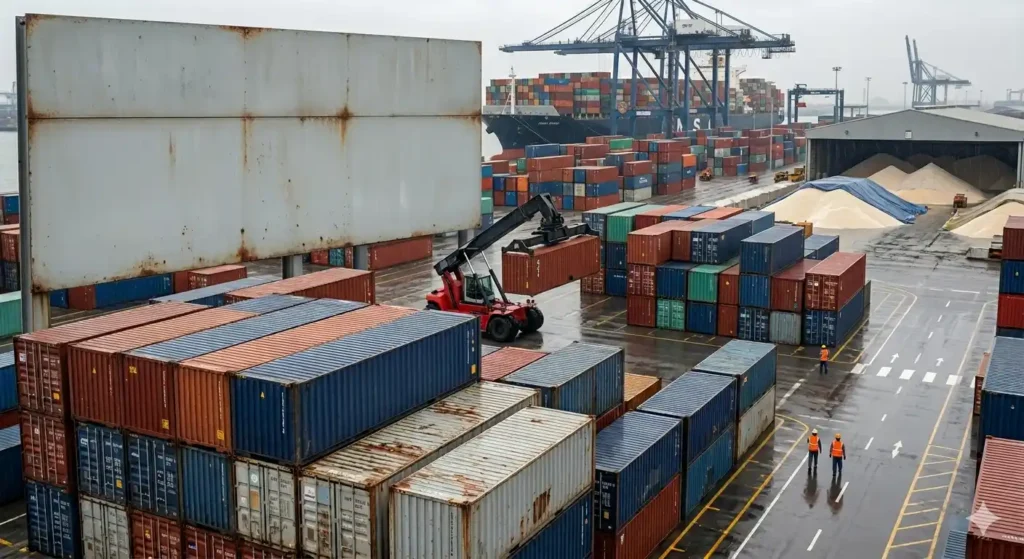
The Port of Manila is the largest seaport in the Philippines. It consists of multiple terminals handling containerized cargo. Imported rice arrives in sealed containers and is unloaded using gantry cranes.
Inspection procedures verify quality, labeling, and compliance with import standards. Authorities check moisture levels, grain quality, and packaging.
After clearance, containers are transported to warehouses or distribution centers. The port connects to inland logistics networks that distribute rice across regions.
Port efficiency directly affects supply chain speed. High traffic volumes increase waiting times for unloading and clearance.
What are the benefits of structured rice shipping timelines?
Structured rice shipping timelines provide predictability, inventory planning accuracy, cost control, and supply chain efficiency, allowing importers and distributors to manage stock levels, reduce storage costs, and ensure continuous market availability of rice products.
Predictable timelines help importers plan inventory cycles. For example, a distributor importing 500 metric tons can schedule warehouse space and retail distribution in advance.
Cost control improves when delays are minimized. Storage fees, demurrage charges, and handling costs remain stable under predictable schedules.
Supply continuity ensures consistent availability in markets. Retailers avoid stock shortages when shipments arrive on schedule.
Structured timelines also support contract compliance. Buyers and sellers follow agreed delivery windows without disputes.
What are common use cases of Pakistan to Philippines rice shipping?
Common use cases include bulk imports for wholesalers, retail distribution supply chains, government procurement programs, and food service industry supply, each requiring specific packaging formats, shipment volumes, and delivery schedules aligned with consumption demand patterns.
Wholesale Imports
Large importers purchase rice in bulk quantities such as 1,000 to 10,000 metric tons. These shipments use multiple containers and require coordinated logistics.
Retail Distribution
Retailers import packaged rice in smaller units such as 5 kg and 10 kg bags. Packaging design and labeling follow market preferences.
Government Procurement
Government agencies import rice to stabilize national supply. These shipments follow strict quality standards and fixed delivery schedules.
Food Service Industry
Hotels, restaurants, and catering services import specific rice varieties. For example, Basmati rice is used for biryani and premium dishes.
What problems and misconceptions affect rice shipping duration?
Rice shipping duration is affected by misconceptions such as assuming fixed transit times, ignoring port congestion, and underestimating documentation requirements, while actual delays arise from operational inefficiencies, seasonal demand spikes, and incomplete export or import compliance processes.
Misconception: Transit Time is Fixed
Shipping time varies based on routes and schedules. A direct vessel takes fewer days than a transshipment route.
Misconception: Ports Always Operate at Full Efficiency
Port congestion occurs during peak seasons. This adds delays in berthing and unloading.
Problem: Documentation Errors
Incorrect documents cause clearance delays. Missing invoices, packing lists, or certificates halt processing.
Problem: Seasonal Demand Spikes
High demand periods increase shipping volume. This leads to container shortages and longer waiting times.
Problem: Weather Conditions
Rough sea conditions delay vessel movement. This extends transit time beyond standard estimates.
How does rice processing quality influence shipping and delivery timelines?
Rice processing quality influences shipping timelines by ensuring uniform grading, proper moisture control, and secure packaging, which reduces inspection delays, prevents cargo rejection, and enables faster customs clearance at both export and import ports.
High-quality processing ensures compliance with international standards. Moisture content is maintained between 12% and 14%, preventing spoilage during transit.
Uniform grading reduces inspection time. Inspectors verify quality quickly when grains are consistent in size and color.
Secure packaging prevents damage. Strong bags reduce spillage and contamination risks during handling.
Quality consistency ensures smooth clearance. Shipments pass inspection without delays, maintaining delivery schedules.