Pakistani Sella Basmati Rice Demand in Saudi Arabia’s Foodservice Sector
Saudi Arabia‘s foodservice sector imports large volumes of Pakistani Sella Basmati Rice because the grain delivers high cooking yield, long holding performance, and consistent texture for restaurants, catering companies, hotels, and institutional kitchens. Here is why: Pakistani Sella Basmati combines extra-long grain length, parboiled durability, and large-scale export availability, making it suitable for high-volume food operations across Saudi Arabia.
Saudi Arabia is one of the largest import destinations for Pakistani Basmati rice. The country’s hospitality industry, restaurant chains, pilgrimage catering services, and corporate food providers require rice varieties that remain separate after cooking and maintain quality during extended serving periods. Pakistani Sella Basmati Rice meets these requirements through a specialized parboiling process that strengthens the grain before milling.
Punjab, Pakistan, serves as the primary cultivation region for export-grade Sella Basmati Rice. The province provides fertile alluvial soil, irrigation networks, and climatic conditions that support the development of aromatic long-grain Basmati varieties such as 1121 Basmati, Super Kernel Basmati, and 1509 Basmati.
Understanding why Saudi foodservice buyers prefer specific Sella grades requires examining cultivation, processing, specifications, applications, and market requirements.
What Is Pakistani Sella Basmati Rice?
Pakistani Sella Basmati Rice is a parboiled long-grain aromatic rice with grain lengths reaching 8.20–8.50 mm before cooking and 16–22 mm after cooking, making it suitable for commercial foodservice operations.
Pakistani Sella Basmati Rice is a category of Basmati rice that undergoes parboiling before milling. Parboiling transfers nutrients from the husk into the grain and strengthens the kernel structure. The process reduces breakage during milling and improves grain stability during cooking.
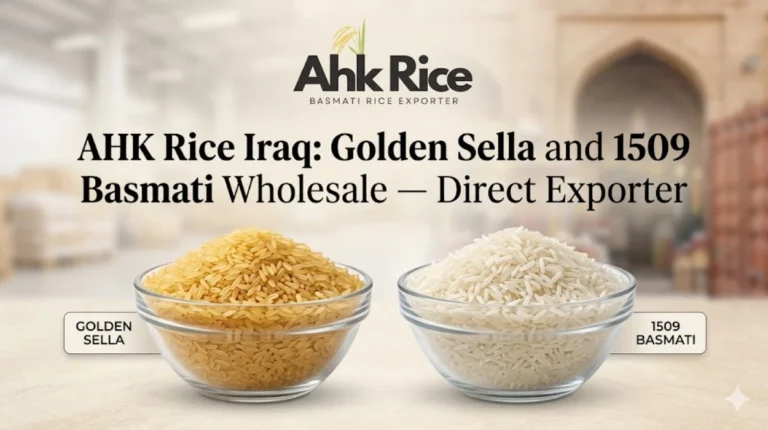
The term “Sella” refers to the parboiled processing method. Exporters commonly produce three major Sella categories: Golden Sella, Creamy Sella, and White Sella. Each category differs in appearance while maintaining the characteristic elongated grain structure associated with Basmati rice.
Saudi foodservice operators select Sella rice because the grains remain separate after cooking. Large-scale kitchens require consistency across hundreds or thousands of meals per day. Sella Basmati provides predictable cooking performance under commercial conditions.
Pakistani Basmati cultivation concentrates in Punjab districts including Hafizabad, Gujranwala, Sheikhupura, Narowal, and Sialkot. These growing regions produce export-quality grains recognized in international markets.
With the definition of Pakistani Sella Basmati Rice established, the next question is how the grain reaches foodservice buyers through processing.
How Does Pakistani Sella Basmati Rice Processing Work?
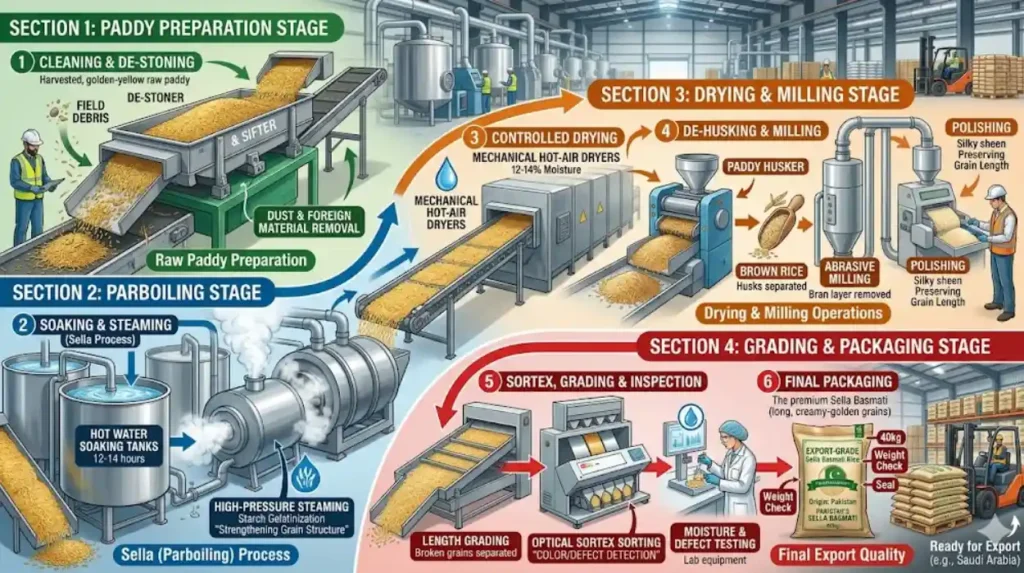
Nine processing stages transform harvested paddy into export-grade Sella Basmati Rice: cleaning, soaking, steaming, drying, de-husking, milling, polishing, grading, and packaging.
Sella processing begins immediately after paddy procurement. The objective is to strengthen grain structure while preserving Basmati characteristics.
Paddy Preparation Stage
Processors prepare raw paddy before parboiling.
- Clean the paddy.
- Remove stones.
- Remove dust.
- Remove foreign materials.
Cleaning improves process efficiency and protects grain quality during soaking and steaming.
Parboiling Stage
Processors apply controlled moisture and heat treatment.
- Soak the paddy.
- Steam the grain.
- Stabilize the kernel structure.
Steam treatment causes starch gelatinization inside the grain. This process improves grain hardness and cooking performance.
Drying and Milling Stage
Processors reduce moisture to export specifications.
- Dry the paddy.
- De-husk the grain.
- Mill the kernels.
- Polish the rice.
Drying controls moisture levels. Milling removes outer layers while preserving grain length.
Grading and Packaging Stage
Processors prepare rice for export markets.
- Grade by length.
- Sort by quality.
- Inspect defects.
- Test moisture.
- Package for shipment.
Export facilities inspect every batch before dispatch. Quality control procedures support international food safety requirements.
Processing creates the characteristics valued by Saudi buyers, leading directly to the specifications that drive demand.
What Key Components Drive Saudi Foodservice Demand?
Long grain length, cooking expansion, holding stability, aroma retention, and bulk availability make Pakistani Sella Basmati suitable for Saudi commercial kitchens.
Foodservice operators evaluate rice differently than retail consumers. Commercial kitchens prioritize operational efficiency and serving consistency.
Long Grain Length
Long grain length contributes to visual presentation.
Pakistani 1121 Sella Basmati typically measures 8.20–8.50 mm before cooking. Cooked grains can exceed 20 mm under standard preparation conditions.
Restaurants serving Kabsa, Mandi, Biryani, and Mazbi value elongated grain appearance because presentation influences customer perception.
High Cooking Expansion
Cooking expansion increases serving yield.
A larger cooked grain volume allows foodservice operators to optimize ingredient utilization. Expansion performance remains a critical purchasing factor in institutional procurement programs.
Holding Stability
Holding stability supports buffet and catering operations.
Saudi hotels and catering companies often keep rice warm for extended periods. Sella Basmati maintains grain separation better than many non-parboiled alternatives.
Aroma Retention
Natural aroma contributes to menu quality.
Basmati varieties contain aromatic compounds that create the recognizable fragrance associated with traditional rice dishes across the Gulf region.
Bulk Availability
Bulk availability supports continuous supply chains.
Pakistan exports significant volumes of rice to Gulf countries each year, providing procurement flexibility for importers and distributors (source: Pakistan Bureau of Statistics, FY2024-25).
These performance factors explain demand growth, but understanding specific grade options provides deeper insight into buyer preferences.
Which Pakistani Sella Basmati Grades Enter Saudi Arabia?
1121 Sella, Super Kernel Sella, and 1509 Sella represent the primary Pakistani Basmati grades imported for Saudi foodservice applications.
Saudi buyers select grades according to menu requirements, budget targets, and customer expectations.
1121 Golden Sella Basmati
1121 Golden Sella represents the premium category.
The grain achieves exceptional cooked length and strong visual appeal. Restaurants serving premium Kabsa and Biryani frequently specify 1121 Golden Sella because of its elongated grain profile.
The golden appearance results from the parboiling process. Grain color ranges from light golden to amber tones.
1121 Creamy Sella Basmati
1121 Creamy Sella provides similar grain dimensions with a lighter appearance.
Foodservice operators often select this grade when menu presentation requires lighter-colored cooked rice while maintaining long-grain characteristics.
Super Kernel Sella Basmati
Super Kernel Sella combines aroma with traditional Basmati characteristics.
The variety remains popular in Middle Eastern markets because of its balanced grain length and fragrance profile.
1509 Sella Basmati
1509 Sella offers earlier maturity and competitive pricing.
Institutional buyers frequently evaluate 1509 when procurement priorities emphasize volume and operational efficiency.
Buyers evaluating multiple Basmati specifications can review a detailed breakdown of grain length, cooking performance, and commercial applications in our guide to selecting the most suitable rice grade for Saudi wholesale procurement.
Grade selection influences foodservice performance, which leads directly to the operational benefits of Sella Basmati.
What Benefits Does Pakistani Sella Basmati Provide to Saudi Foodservice Operators?
Higher yield, better grain separation, reduced breakage, extended holding performance, and menu consistency make Sella Basmati valuable for large-scale kitchens.
Commercial foodservice environments require operational predictability. Rice quality directly affects labor efficiency, customer satisfaction, and food cost management.
Better Grain Separation
Sella processing strengthens grain structure.
Separate grains improve presentation quality in Kabsa, Bukhari Rice, Mandi, and Biryani dishes. Distinct grain appearance remains a key expectation in Gulf cuisine.
Reduced Breakage
Parboiling reduces kernel fragility.
Stronger grains experience less breakage during transportation, storage, and cooking operations.
Improved Yield
Commercial kitchens prioritize yield performance.
Rice that expands consistently supports portion control and production planning across large meal volumes.
Consistent Service Performance
Foodservice operations depend on repeatability.
Hotels, airline caterers, event caterers, and restaurant chains require rice that performs similarly across different cooking batches.
These benefits explain widespread adoption, but examining actual applications reveals where demand is concentrated.
Where Is Pakistani Sella Basmati Rice Used in Saudi Arabia?
Hotels, restaurants, catering companies, pilgrimage food providers, corporate cafeterias, and institutional kitchens form the largest foodservice demand segments.
Saudi Arabia operates one of the region’s largest hospitality and catering industries.
Restaurants
Restaurants represent a major consumption channel.
Traditional Saudi restaurants prepare dishes such as Kabsa, Mandi, Madhbi, and Biryani using long-grain rice varieties.
Hotels
Hotels require premium presentation standards.
Luxury hospitality operators often select higher-grade Sella Basmati to support banquet and buffet services.
Catering Companies
Catering companies prepare large meal volumes.
Corporate events, weddings, conferences, and public functions require rice capable of maintaining quality during transportation and service.
Pilgrimage Food Services
Pilgrimage-related catering generates significant rice demand.
Millions of visitors travel annually for religious activities, creating large-scale foodservice requirements (source: Saudi Ministry of Hajj and Umrah, 2025).
Institutional Kitchens
Institutional food programs serve hospitals, universities, and workforce accommodations.
These facilities prioritize consistency, cost control, and dependable supply availability.
Understanding these applications highlights why certain misconceptions about Sella rice continue to circulate.
What Common Misconceptions Exist About Pakistani Sella Basmati Rice?
Sella rice is not lower quality than white rice, not artificially colored, and not less aromatic than traditional Basmati varieties.
Several misconceptions influence purchasing decisions.
Misconception 1: Sella Rice Is Lower Quality
Sella processing changes the grain structure rather than reducing quality.
Many premium export contracts specify Sella grades because commercial kitchens value cooking performance and grain durability.
Misconception 2: Golden Sella Uses Artificial Coloring
Golden coloration develops during controlled parboiling.
Heat treatment alters grain appearance naturally. The color results from processing conditions rather than artificial additives.
Misconception 3: Sella Rice Lacks Aroma
Basmati genetics determine aroma characteristics.
Processing affects appearance and texture but does not eliminate the natural aromatic profile of authentic Basmati varieties.
Misconception 4: All Sella Grades Are Identical
Grade specifications differ significantly.
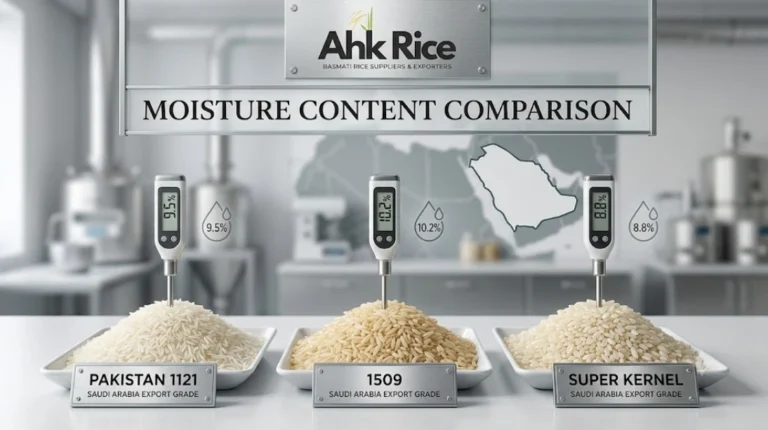
Grain length, broken percentage, moisture content, and cooking expansion vary among 1121, Super Kernel, and 1509 varieties.
Understanding these misconceptions completes the picture of how Saudi buyers evaluate Sella Basmati rice.
Which Certifications Apply to Pakistani Sella Basmati Rice Exports?
Phytosanitary certification, quality inspection reports, food safety certifications, and origin documentation support international rice trade.
Export shipments require documentation that verifies quality, safety, and compliance.
Common certifications and documents include:
- Phytosanitary Certificate
- Certificate of Origin
- Fumigation Certificate
- Quality Inspection Report
- ISO Certification
- HACCP Certification
- Food Safety Management Documentation
Importers use these documents to verify compliance with destination market requirements.
Certification systems support traceability throughout cultivation, processing, packaging, and export operations.
Pakistani Sella Basmati Rice continues to hold a significant position in Saudi Arabia’s foodservice sector because it combines long-grain characteristics, strong cooking performance, scalable supply, and suitability for traditional Gulf cuisine. Growing demand from restaurants, hotels, institutional kitchens, and catering companies reinforces the importance of understanding grade specifications, processing methods, and quality requirements when evaluating Basmati rice imports.
Frequently Asked Questions
Why does Saudi Arabia import Pakistani Sella Basmati Rice for foodservice operations?
Saudi Arabia imports Pakistani Sella Basmati Rice because it delivers long grain length, high cooking expansion, and consistent performance in large-scale kitchens. Restaurants, hotels, and catering companies use it for dishes such as Kabsa, Mandi, and Biryani.
What is the difference between Golden Sella and Creamy Sella Basmati Rice?
Golden Sella undergoes a parboiling process that gives the grain a golden appearance. Creamy Sella has a lighter color while maintaining similar grain length and cooking characteristics. Both grades offer strong grain separation and high cooking yield.
Which Pakistani Basmati varieties are most popular in Saudi Arabia?
1121 Basmati, Super Kernel Basmati, and 1509 Basmati are the most commonly imported varieties. 1121 Basmati is preferred for premium foodservice applications because of its extra-long cooked grain length and attractive presentation.
How does the Sella processing method improve rice quality?
Sella processing strengthens the grain through soaking, steaming, and drying before milling. The process reduces breakage, improves cooking stability, and helps grains remain separate after cooking. These characteristics are important for commercial foodservice operations.
What certifications are required for exporting Pakistani Sella Basmati Rice to Saudi Arabia?
Export shipments typically require a Phytosanitary Certificate, Certificate of Origin, Fumigation Certificate, and Quality Inspection Report. Many exporters also maintain ISO and HACCP certifications to support food safety and quality compliance.