Supplier Selection Criteria Used by Turkish Importers Buying from Pakistan
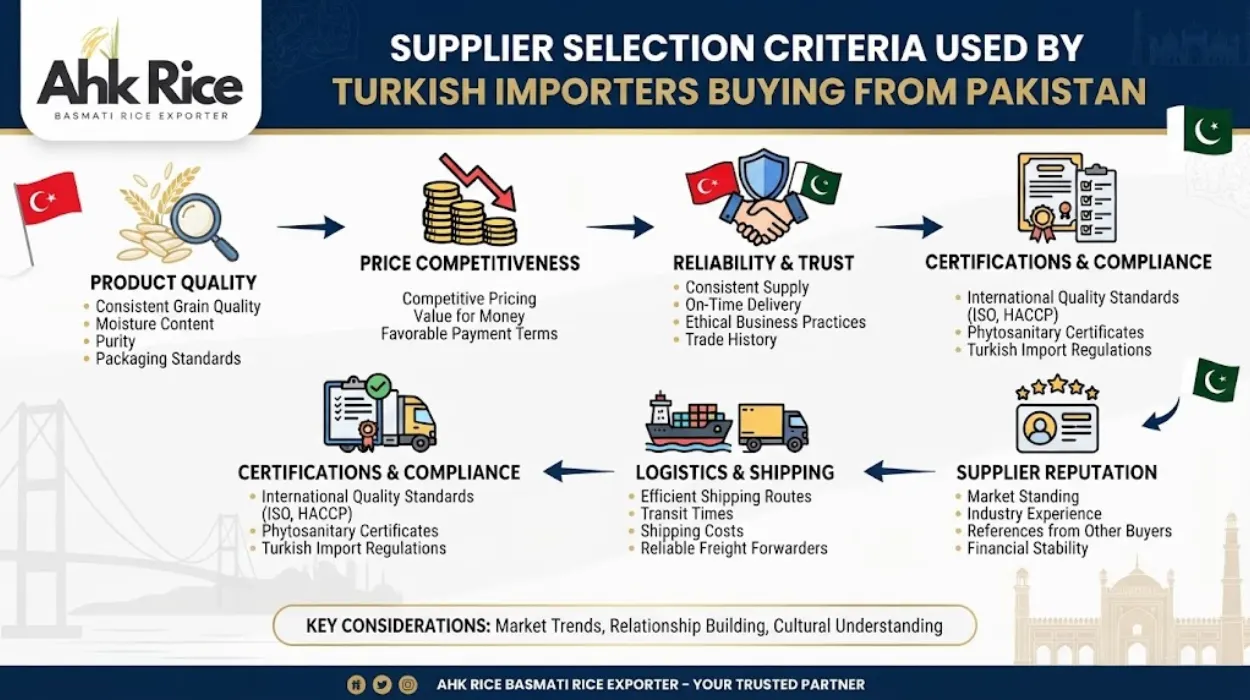
Turkish importers should select Pakistani rice suppliers by checking rice specification, food-safety documentation, processing consistency, inspection, packaging, landed cost, and shipment reliability. Here is why: Turkish authorities apply document, identity, physical, sampling, and laboratory controls to imported plant-origin foods. (source: Turkish Ministry of Agriculture and Forestry)
For buyers researching the bilateral market, the Pakistan-Turkey rice trade statistics and bilateral growth in 2026 provide useful market context before supplier evaluation. The purchasing decision should then move from market demand to measurable supplier criteria.
Pakistan already appears in Turkish shipment records for 1121 Basmati and long-grain rice. Recent records include Pakistani 1121 Steam and Sella shipments entering Turkey. (source: Volza shipment data, 2024–2025)
What is the best solution for choosing a Pakistani rice supplier?
The best solution is a specification-led supplier audit covering grade, grain length, broken percentage, moisture, processing, inspection, documents, packaging, price, and delivery. This creates comparable offers and reduces quality disputes after contracting.
Which rice specifications should Turkish importers verify?
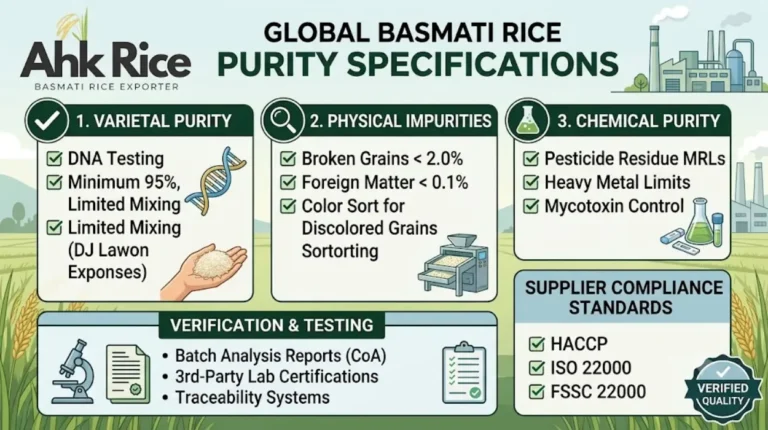
Rice specifications should be written before price negotiation. A Turkish importer should define the variety, processing grade, grain length, broken percentage, moisture, crop year, milling quality, packing format, and tolerance.
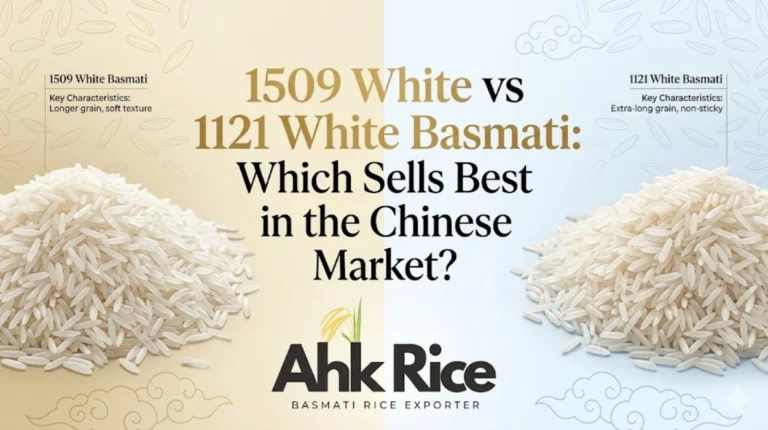
For 1121 Basmati, buyers can request White, Steam, or Sella specifications. Pakistan-origin 1121 shipments to Turkey have included Steam and Sella grades. (source: Volza shipment records)
Super Kernel provides another Pakistani Basmati option. Its traditional grain profile and aroma can suit importers targeting ethnic retail, foodservice, and premium rice distribution.
Which compliance documents matter?
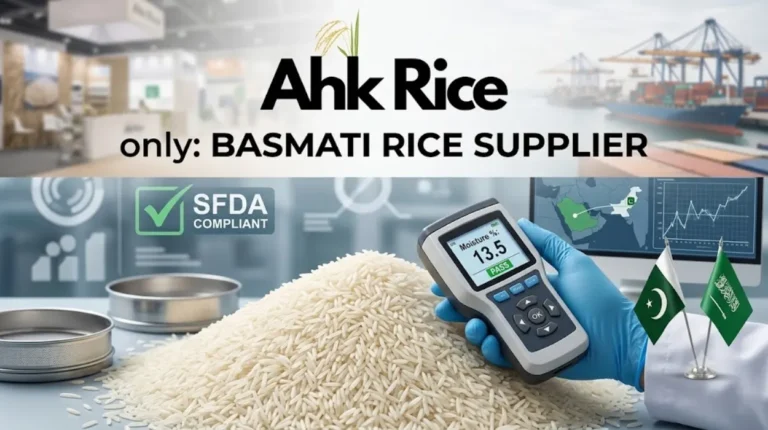
Turkish importers should require commercial and quality documentation before dispatch. Typical documents include commercial invoice, packing list, certificate of origin, health or phytosanitary documentation where applicable, and inspection or laboratory reports.
Turkey’s official procedure requires shipment information, health certification details, quantity, customs information, and official controls. Controls include document, identity, physical examination, sampling, and laboratory analysis. (source: Turkish Ministry of Agriculture and Forestry)
With supplier criteria established, the next decision is whether the exporter can execute those requirements consistently.
Why choose AHK Rice for Turkish rice procurement?
AHK Rice provides specification-based Pakistani Basmati sourcing with processing, grading, sorting, packaging, inspection coordination, and export logistics managed around the buyer’s requirements. This gives Turkish importers one commercial workflow from sample approval to shipment.
AHK Rice supplies Pakistani Basmati varieties including 1121, Super Kernel, and 1509. The AHK Rice export service supports buyers requiring defined rice specifications and export coordination.
AHK Rice can align the commercial specification with the buyer’s intended market. The specification can include grain length, broken percentage, moisture, processing grade, packing size, quantity, destination, and delivery term.
AHK Rice also supports the operational stages behind an export order. The workflow covers sourcing, milling, grading, sorting, packaging, inspection coordination, container loading, and shipment documentation.
What should buyers check before approving the supplier?
Buyers should verify five commercial areas before signing the purchase contract:
| Supplier criterion | What the importer should verify |
|---|---|
| Product specification | Variety, grade, grain length, moisture and broken percentage |
| Processing control | Milling, polishing, grading and sorting consistency |
| Quality verification | Pre-shipment inspection and laboratory testing |
| Export documentation | Invoice, packing list, origin and required certificates |
| Logistics execution | Port, Incoterm, container loading and shipment schedule |
AHK Rice uses this specification-led approach to make the commercial offer comparable with the buyer’s purchasing requirement. The result is a clearer basis for approval.
Turkish shipment data also demonstrates why product-level verification matters. Recent records show Pakistani 1121 Steam shipments and Pakistani long-grain Sella rice entering Turkey under different quantities and declared values. (source: Volza shipment data)
With supplier capability established, the next step is evaluating expected purchasing results and shipment timing.
What results can Turkish importers expect from a qualified supplier?
A qualified supplier should deliver specification consistency, complete documentation, controlled processing, predictable dispatch, and a shipment that matches the approved commercial sample. These outcomes reduce procurement uncertainty and simplify receiving inspection.
AHK Rice can structure the order around an approved sample and written specification. The buyer can compare the final cargo against agreed product characteristics before accepting shipment documentation.
How does the sample-to-shipment process work?
Start by sending the required variety, grade, packing, quantity, destination, and target specification.
Confirm the commercial specification and quotation before sample dispatch.
Review the physical sample for grain appearance, aroma, cooking characteristics, processing grade, and visible defects.
Approve the sample and confirm the final purchase specification.
Process the commercial quantity through milling, grading, sorting, and packaging.
Inspect and test the shipment against the agreed specification.
Load the container after documentation and quality requirements are completed.
Dispatch the cargo under the agreed Incoterm and shipment schedule.
AHK Rice can coordinate this sequence so the approved sample remains connected to the commercial specification.
Turkish importers can also compare product positioning before procurement. The guide on Pakistani rice varieties driving demand in Turkey’s import market helps buyers understand how 1121, Super Kernel, and other varieties fit different purchasing requirements.
What shipping time should Turkish importers plan for?
Shipping schedules depend on cargo readiness, Karachi port operations, vessel schedules, transshipment requirements, customs clearance, and the Turkish destination port.
For planning purposes, importers should request a shipment schedule covering cargo readiness, expected vessel departure, estimated arrival, and clearance responsibility.
AHK Rice should confirm the shipment schedule against the specific Turkish port and Incoterm before the order is finalized. A fixed delivery promise should not be assumed without shipment-specific confirmation.
The next purchasing issue is cost, because the lowest FOB figure does not always produce the lowest landed cost.
What factors affect the price of Pakistani rice delivered to Turkey?
Final rice cost depends on variety, processing grade, grain specification, broken percentage, moisture, packing, order volume, destination, freight, inspection, and Incoterm. A specification-based quotation creates a meaningful comparison between suppliers.
Indicative Pakistani Basmati pricing varies by variety and grade. Current market references show 1121 White, Sella, and Steam at different FOB ranges, demonstrating why grade must be fixed before price comparison. (source: Pakistan Rice, September 2026)
A Turkish buyer should compare suppliers using the same commercial basis. A 1121 Steam offer should not be compared directly with a different 1121 grade or another Basmati variety.
Packaging also affects the commercial calculation. Retail pouches, bulk bags, jumbo bags, and private-label packaging create different material, handling, and loading requirements.
AHK Rice can structure the quotation around the buyer’s requested packing, quantity, destination, and delivery term. This allows the importer to evaluate the actual procurement cost instead of comparing incomplete headline prices.
What does a Turkish importer pay for a rice sample?
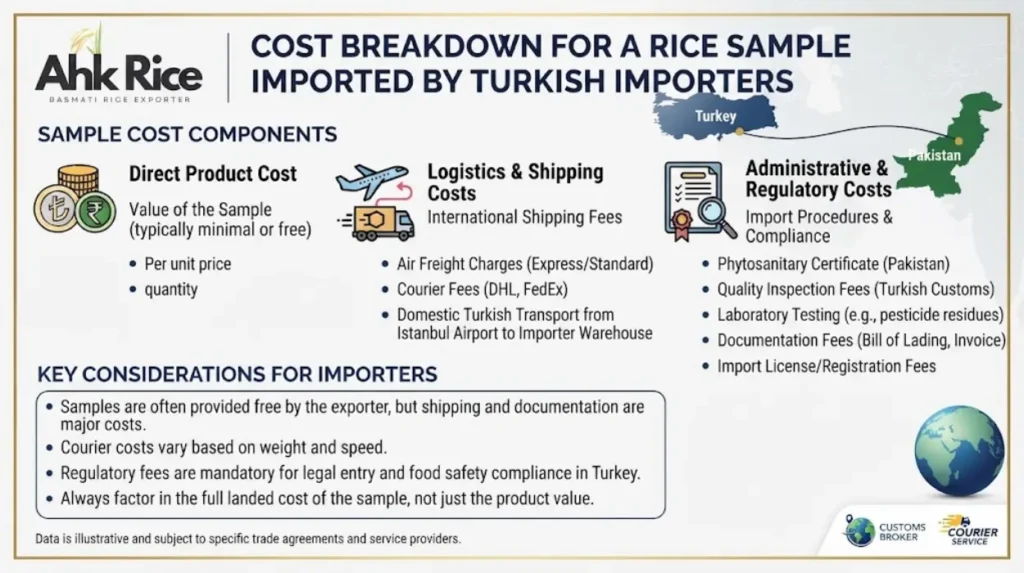
Sample cost depends on sample quantity, courier destination, packaging, and any applicable certification or phytosanitary requirement.
A practical sample workflow starts with specification confirmation. The exporter then prepares the requested rice sample and shares the courier arrangement before dispatch.
The buyer should treat the sample as a commercial specification check rather than a free substitute for shipment inspection. The final cargo should remain subject to the approved contract specification.
With pricing and sample requirements defined, the final decision is how to start the procurement process.
How can a Turkish importer get started with AHK Rice?
Start with the exact rice specification, required quantity, packing format, destination port, and preferred Incoterm. This gives AHK Rice enough commercial information to prepare a comparable export quotation.
Send the required variety and grade first. Include grain-length requirements, broken percentage, moisture target, packaging, quantity, and destination.
Request the sample against that specification. Review the sample before confirming the commercial order.
Approve the final specification and quotation. Confirm inspection, documentation, packing, shipment schedule, and payment terms.
AHK Rice can then coordinate sourcing, processing, grading, sorting, packing, inspection, loading, and export documentation.
For Turkish importers, the supplier decision should therefore rest on measurable specifications rather than price alone. A supplier that connects product quality, documentation, inspection, processing, packaging, and logistics provides a clearer procurement structure.
AHK Rice gives buyers a specification-led route from Pakistani rice sourcing to export shipment. The final quotation should reflect the exact variety, grade, quantity, packing, destination, and Incoterm.
To request a shipment-specific commercial offer, use the AHK Rice request-a-quote service.
Frequently Asked Questions
What criteria do Turkish importers use when selecting Pakistani rice suppliers?
Turkish importers should verify rice variety and processing grade first.
Grain length, broken percentage, and moisture should match the contract.
Importers should also review certificates and inspection documentation.
Packaging and shipment terms should match the destination requirement.
Supplier consistency should be checked from sample approval through final cargo.
Which Pakistani Basmati varieties can Turkish importers source?
Turkish buyers can source Pakistani 1121 Basmati, Super Kernel, and 1509.
1121 is available in White, Steam, and Sella processing formats.
Super Kernel provides traditional Pakistani Basmati aroma and grain character.
1509 provides another long-grain commercial option for bulk procurement.
The final choice should follow the buyer’s specification and market use.
What documents are required for Pakistani rice imports into Turkey?
Turkish import procedures require shipment and product documentation for official controls.
The importer may need health certification information and quantity details.
Authorities check documents against Turkish Food Codex requirements.
Physical controls can include sampling and laboratory analysis.
The exact document set should be confirmed for the specific shipment.
How long does Pakistani rice take to reach Turkey?
Transit time depends on vessel schedule, routing, port operations, and cargo readiness.
Karachi departure and the Turkish destination port should be confirmed before contracting.
The supplier should provide expected dispatch and arrival information.
Customs clearance creates an additional timeline after arrival.
AHK Rice should confirm shipment timing against the agreed order.
How does AHK Rice support Turkish rice importers?
AHK Rice supplies Pakistani Basmati rice against defined commercial specifications.
The workflow can include sourcing, milling, grading, sorting, and packaging.
Inspection and export documentation can be coordinated around the shipment.
Buyers can review samples before approving the commercial specification.
The final quotation reflects product, quantity, packing, destination, and Incoterm.