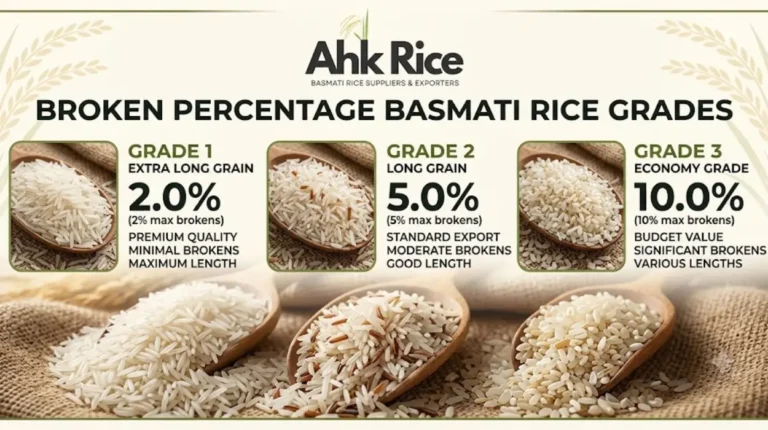
AHK Rice Morocco: 1509 Basmati Wholesale — CIF Casablanca Price Available
1509 Basmati wholesale for Morocco is most efficiently supplied through CIF Casablanca shipments with standardized grading, stable parboiling quality, and predictable 20–28 day sea logistics from Pakistan. Here is why: consistent milling, export-grade inspection, and controlled shipping schedules reduce landed cost risk and ensure stable supply for Moroccan importers.
Early-stage buyers often compare suppliers without understanding shipment structure and rice grade stability. That leads to inconsistent quality, delayed clearance, and unpredictable CIF pricing in Casablanca ports.
For Morocco importers, AHK Rice delivers structured export flow backed by Pakistan basmati rice Morocco North Africa trade overview. This foundation helps buyers understand regional demand, grading standards, and supply chain reliability before procurement decisions.
1509 Basmati from AHK Rice is built for bulk foodservice, wholesale distributors, and retail packaging importers who require long grain consistency and export compliance.
What is the best solution for 1509 basmati wholesale in Morocco?
The best solution is CIF Casablanca supply of 1509 Basmati sourced from export-grade Pakistan mills with uniform grain length, controlled moisture below 13%, and parboiled stabilization that ensures long storage life in Moroccan warehouses and retail distribution networks.
1509 Basmati wholesale demand in Morocco is driven by hospitality chains, wholesalers, and institutional buyers. These buyers require predictable cooking expansion and consistent aroma retention.
AHK Rice supplies 1509 through structured export channels. The Basmati 1509 Rice Exporter From Pakistan to Morocco service page integrates procurement, milling, grading, and CIF shipment under one controlled workflow.
Clean the paddy during initial processing to remove impurities and foreign matter.
De-husk the grain using calibrated rubber rollers to protect kernel length.
Sort by length using optical grading machines to ensure uniform export batches.
These steps reduce variability and improve Moroccan end-user acceptance in both retail and catering segments.
AHK Rice ensures each shipment is inspected before loading. This reduces rejection risk at Casablanca customs and supports stable buyer confidence.
With the solution defined, the next step is understanding why AHK Rice is positioned as a reliable supplier for Moroccan importers.
Why choose AHK Rice 1509 service for Morocco importers?
AHK Rice provides export-standard 1509 Basmati with consistent grading, verified inspection certificates, and CIF Casablanca coordination that reduces importer risk, improves customs clearance speed, and ensures predictable bulk pricing across Moroccan wholesale distribution channels.
AHK Rice operates with a structured export model focused on long-term supply contracts. Moroccan buyers benefit from repeatable quality and stable shipment cycles.
Mill and polish rice under controlled humidity conditions to preserve aroma compounds.
Grade and sort rice using size calibration to maintain uniform kernel appearance.
Inspect and certify each batch through third-party quality verification systems.
AHK Rice aligns with Moroccan import expectations by delivering export documentation, fumigation certificates, and phytosanitary compliance.
For buyers comparing varieties, the MOFU comparison guide 1509 vs 1121 golden sella Pakistani Moroccan distributors helps clarify grade selection based on price and storage needs.
AHK Rice also ensures buyers receive pre-shipment samples before contract confirmation. This reduces procurement uncertainty and improves purchase accuracy.
With supplier advantages established, shipping performance becomes the next critical factor for CIF Casablanca planning.
What CIF Casablanca shipping time and logistics schedule apply?
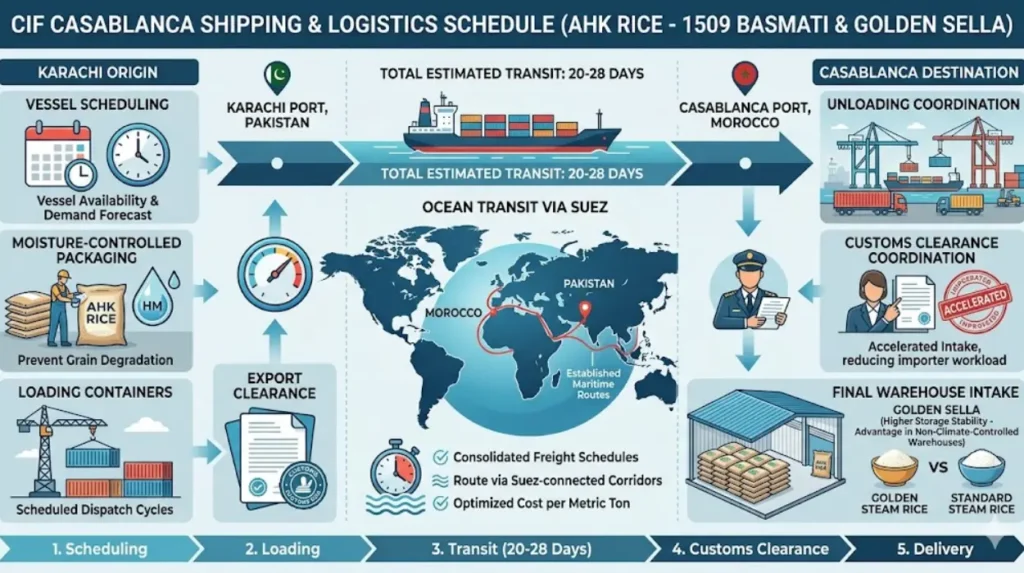
CIF Casablanca shipments for 1509 Basmati typically require 20–28 days from Karachi port, including vessel scheduling, customs clearance, ocean freight transit, and final unloading coordination at Moroccan port terminals under standard shipping conditions.
AHK Rice manages logistics through scheduled dispatch cycles aligned with vessel availability and export demand forecasting.
Load containers at Karachi port using moisture-controlled packaging to prevent grain degradation.
Dispatch shipments through consolidated freight schedules to optimize cost per metric ton.
Ship containers via established maritime routes passing through Suez-connected logistics corridors.
Transit times vary based on seasonal congestion and carrier availability. However, AHK Rice maintains consistent shipping windows to reduce volatility.
In Morocco, CIF Casablanca deliveries include customs clearance coordination. This reduces importer workload and accelerates warehouse intake.
Golden Sella shipments may last longer in storage compared to standard steam rice. In Moroccan non-climate-controlled warehouses, this stability becomes a key advantage.
With logistics understood, sample validation becomes the next step before bulk procurement.
What sample process and cost does AHK Rice offer?
AHK Rice provides export samples of 1509 Basmati within 3–7 days, with total sample cost ranging between $15–$40 depending on courier destination, packaging format, and inspection documentation requirements for Moroccan import evaluation.
Sample testing is essential for Moroccan importers before committing to bulk CIF contracts. It validates grain performance, aroma retention, and cooking expansion.
Prepare sample batches under identical milling conditions used for export shipments.
Pack samples in vacuum-sealed bags to preserve aroma and moisture stability.
Dispatch samples via international courier services with tracking and documentation.
AHK Rice ensures sample consistency with bulk shipments. This allows buyers to evaluate real export-grade product conditions.
Sample cost varies depending on courier speed and documentation needs. Faster express shipments increase cost but reduce evaluation time.
Once approved, samples transition into contract-based bulk ordering under CIF Casablanca terms.
With sample validation complete, pricing structure becomes the next decision factor.
What pricing factors affect 1509 basmati CIF Morocco?
CIF Morocco pricing for 1509 Basmati depends on crop season yield, milling grade selection, freight rates, container availability, and certification requirements, all of which influence final landed cost per metric ton in Casablanca wholesale markets.
AHK Rice pricing structure is designed to reflect real-time export market conditions.
Harvest and cultivate paddy during peak seasonal cycles to ensure grain quality stability.
Mill and grade rice according to export specification standards for uniform pricing tiers.
Test and certify batches to meet Moroccan import regulatory requirements before dispatch.
Freight costs significantly influence CIF pricing due to fuel and container fluctuations. Seasonal spikes may increase landed cost temporarily.
Storage requirements in Morocco also affect pricing decisions. Longer shelf-life grades like 1509 provide better cost efficiency for distributors.
AHK Rice ensures transparent pricing breakdowns so importers understand each cost component before contract confirmation.
With pricing clarity established, buyers can proceed to structured procurement onboarding.
How to get started with AHK Rice wholesale import?
Getting started requires selecting the required grade, confirming CIF Casablanca terms, approving pre-shipment samples, and finalizing documentation, after which AHK Rice initiates export scheduling and container dispatch under a structured procurement timeline.
AHK Rice simplifies onboarding for Moroccan importers by standardizing procurement workflows.
Source and confirm required rice specification based on market demand segmentation.
Inspect sample approval before signing bulk export agreement under CIF terms.
Load and dispatch containers after documentation and payment confirmation are completed.
Initial buyers often start with smaller trial shipments before scaling to full container loads. This reduces market entry risk.
For structured onboarding and export readiness, AHK Rice ensures all compliance documents are pre-verified before shipment.
Once onboarding is complete, buyers transition into recurring supply cycles with predictable pricing and delivery schedules.
With procurement steps defined, Moroccan importers can now move directly into execution and contracting through AHK Rice.
Start your CIF Casablanca 1509 Basmati wholesale supply chain with AHK Rice and proceed to request-a-quote.
Frequently Asked Questions
What is the CIF Casablanca price structure for 1509 Basmati?
CIF Casablanca pricing includes rice cost, ocean freight, insurance, and port handling charges calculated per metric ton. The final price depends on shipment volume, seasonality, and global freight rates. AHK Rice provides updated quotations based on real-time export conditions to ensure Moroccan importers receive accurate landed cost estimates.
How long does 1509 Basmati take to arrive in Morocco?
Standard shipping time from Pakistan to Casablanca is 20–28 days under normal maritime conditions. Transit duration depends on vessel schedules, customs clearance, and port congestion. AHK Rice coordinates logistics to maintain consistent dispatch cycles and reduce delivery delays for wholesale buyers.
What makes 1509 Basmati suitable for Moroccan wholesale buyers?
1509 Basmati offers long grain structure, stable cooking expansion, and strong shelf life for bulk storage environments. These features make it ideal for catering, retail distribution, and foodservice markets in Morocco where consistency and storage stability are essential.
Can I request samples before placing a bulk order?
Yes, AHK Rice provides export-grade samples within 3–7 days for evaluation before bulk purchasing. Samples are packaged securely and shipped via international courier. This allows Moroccan importers to test aroma, grain length, and cooking performance before final confirmation.
What documents are required for importing 1509 Basmati into Morocco?
Import requirements include phytosanitary certificates, fumigation certificates, commercial invoice, and packing list. AHK Rice prepares and verifies all export documentation to ensure smooth customs clearance at Casablanca port and compliance with Moroccan import regulations.