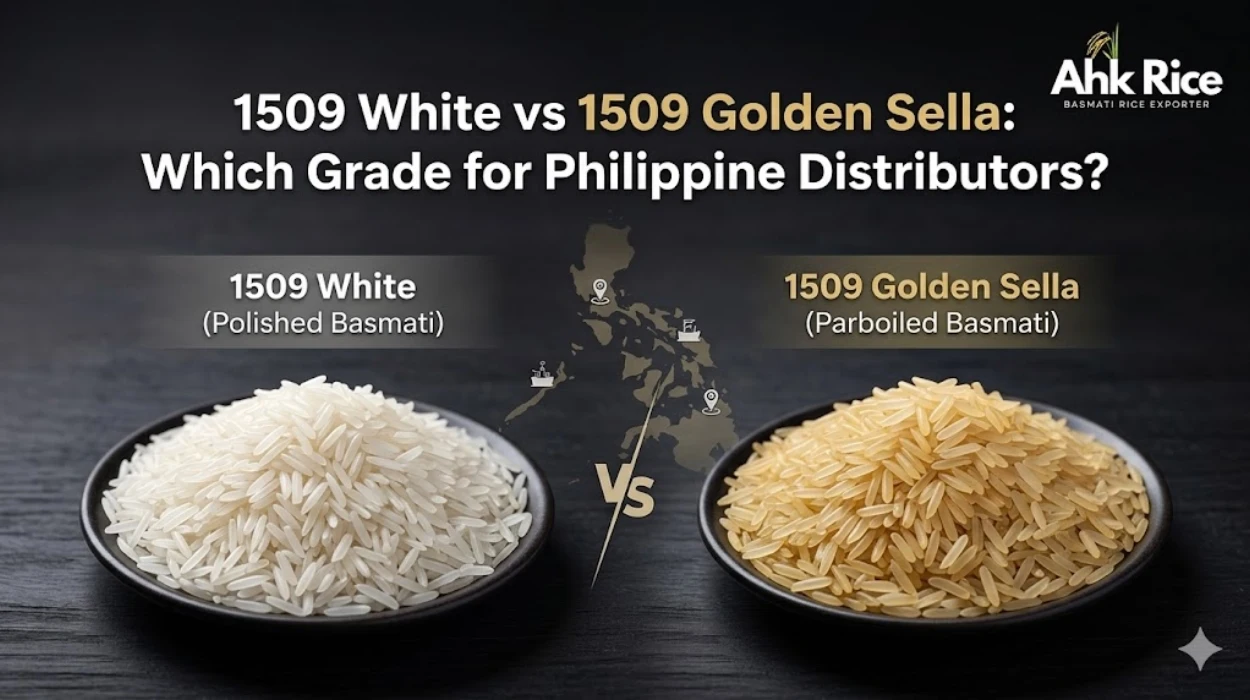
1509 White vs 1509 Golden Sella: Which Grade for Philippine Distributors?
1509 Golden Sella is the better choice for most Philippine distributors seeking longer shelf life, stronger grain stability, and lower breakage during storage. 1509 White Basmati remains the preferred option for premium retail markets that prioritize natural white appearance and faster cooking. Here is why: Golden Sella undergoes parboiling before milling, which strengthens the grain structure and improves storage performance, while White Basmati offers a lighter color and softer eating characteristics.
Philippine rice importers evaluate grades based on shelf life, consumer preference, inventory turnover, and distribution channel requirements. Understanding these differences helps buyers avoid mismatched inventory and improve profit margins. Buyers comparing different Basmati grades can also explore our guide explaining how Pakistani Basmati varieties differ across export markets and applications.
AHK Rice is a trusted Pakistani Basmati rice exporter based in Punjab, supplying 1121, Super Kernel, and 1509 varieties to more than 15 countries. Through complete processing, grading, packaging, and export management, AHK Rice supplies multiple specifications suitable for Philippine wholesalers, retailers, and food service distributors.
What are the main differences between 1509 White and 1509 Golden Sella?
Golden Sella offers stronger grain durability, longer storage stability, and lower breakage rates. White Basmati provides a brighter appearance, softer texture, and faster cooking time. Distributor selection depends on target customers, inventory cycle, and market positioning.
What is 1509 White Basmati Rice?
1509 White Basmati Rice is a fully milled and polished rice grade. Mills remove the husk, bran layers, and outer coating during processing. The result is a naturally white grain with a clean appearance and delicate texture.
1509 White Basmati attracts retail consumers who prefer traditional white rice. Philippine supermarkets often position white rice as a premium household product because consumers immediately recognize its appearance.
What is 1509 Golden Sella Basmati Rice?
1509 Golden Sella Basmati Rice undergoes parboiling before milling. Mills soak, steam, dry, dehusk, polish, and grade the paddy. This process moves nutrients into the grain and strengthens the rice structure.
Golden Sella develops a golden color after processing. The stronger grain structure reduces breakage during handling, shipping, and warehouse storage.
Specification Comparison
| Attribute | 1509 White Basmati | 1509 Golden Sella |
|---|---|---|
| Grain Length | 8.10–8.35 mm | 8.10–8.35 mm |
| Processing Method | Milled and polished | Parboiled then milled |
| Grain Color | Natural white | Golden yellow |
| Cooking Time | 15–18 minutes | 18–22 minutes |
| Cooked Grain Length | Up to 18 mm | Up to 18 mm |
| Breakage Resistance | Moderate | High |
| Storage Life | 12–18 months | 18–24 months |
Price Comparison Per Metric Ton
Export pricing changes according to crop conditions, freight rates, and market demand. However, Philippine importers generally encounter the following pattern:
| Grade | Typical Price Range Per MT |
| 1509 White Basmati | USD 780–920 |
| 1509 Golden Sella | USD 850–1,000 |
Golden Sella commands a higher price because the parboiling process adds processing costs and improves storage performance.
Golden Sella costs more than White Basmati. In humid warehouse environments, Golden Sella maintains grain integrity longer. For distributors maintaining inventory over several months, Golden Sella often reduces total product loss.
With the fundamental differences established, the next question is which solutions Philippine distributors can choose from.
What are the available solutions for Philippine distributors?
Philippine distributors generally choose between retail-focused White Basmati, wholesale-focused Golden Sella, food service specifications, and mixed portfolio strategies. Each solution addresses different buyer requirements and inventory objectives.
Solution 1: Premium Retail Distribution
1509 White Basmati works well for supermarket chains and premium grocery retailers. Consumers often associate bright white rice with premium quality.
White Basmati supports faster stock turnover because households purchase smaller pack sizes more frequently. Retail packaging commonly ranges from 1 kg to 10 kg.
Solution 2: Wholesale Distribution
1509 Golden Sella suits regional distributors supplying multiple retailers. The stronger grain structure reduces breakage during repeated handling.
Wholesale operations often maintain inventory for longer periods. Golden Sella supports this model because the grain remains stable during storage.
Solution 3: Food Service Distribution
Hotels, restaurants, and catering companies prioritize consistency after cooking. Golden Sella delivers separate grains and stronger texture.
Food service operators value yield consistency. Golden Sella maintains grain shape after large-scale cooking operations.
Solution 4: Mixed Inventory Strategy
Many importers distribute both grades simultaneously. White Basmati serves premium retail customers. Golden Sella serves wholesalers and institutional buyers.
Mixed inventory strategies reduce dependence on a single customer segment and improve market coverage.
With the available solutions defined, the next step is comparing their advantages and disadvantages.
How do different approaches compare?
White Basmati performs better for premium appearance and household retail. Golden Sella performs better for storage, logistics, and institutional distribution. The correct choice depends on customer demand and operational priorities.
Pros of 1509 White Basmati
- Premium appearance
- Faster cooking
- Softer texture
- Strong retail appeal
- Higher visibility on supermarket shelves
Philippine retailers often favor white rice because consumers immediately understand the product category.
Cons of 1509 White Basmati
- Shorter storage life
- Higher breakage risk
- Greater sensitivity during transportation
- Less suitable for extended warehousing
White Basmati requires tighter inventory management. Long storage periods increase quality risks.

Pros of 1509 Golden Sella
- Longer shelf life
- Stronger grain structure
- Lower breakage rates
- Better logistics performance
- Improved cooking consistency
Golden Sella withstands extended transportation routes. For importers distributing across multiple islands, stronger grains reduce handling losses.
Cons of 1509 Golden Sella
- Higher purchase cost
- Longer cooking time
- Different appearance from traditional white rice
Some retail consumers prefer white rice because the golden color differs from standard household expectations.
Golden Sella lasts longer than White Basmati. In humid storage conditions, Golden Sella maintains grain quality for up to 24 months. White Basmati typically performs best within 18 months. For distributors holding seasonal inventory, Golden Sella becomes the safer specification.
Having compared strengths and weaknesses, the next question becomes which grade works best for specific distributor situations.
Which method works best for different distributor types?
Retail distributors usually benefit from White Basmati. Wholesale distributors, institutional suppliers, and long-storage operators usually benefit from Golden Sella. Customer profile determines the correct grade selection.
Retail-Focused Importers
Retail-focused businesses prioritize appearance and packaging. White Basmati aligns with consumer expectations and shelf presentation requirements.
Regional Wholesalers
Regional wholesalers manage larger inventories and wider distribution networks. Golden Sella reduces damage throughout multiple handling stages.
Restaurant Suppliers
Restaurant suppliers prioritize consistency and cooked grain performance. Golden Sella delivers reliable results across high-volume operations.
Government and Institutional Suppliers
Institutional procurement often focuses on storage stability and logistics efficiency. Golden Sella aligns with these requirements.
Premium Specialty Importers
Specialty food stores emphasize premium presentation and consumer perception. White Basmati remains highly attractive within this segment.
With distributor profiles clarified, the final decision depends on measurable purchasing factors.
What decision factors should Philippine distributors evaluate?
Inventory duration, customer segment, logistics complexity, budget, and shelf-life requirements determine the optimal grade. Distributors should evaluate operational realities before selecting a specification.
Decision Framework
| Decision Factor | Choose White | Choose Golden Sella |
| Customer Preference | Premium retail | Wholesale and institutional |
| Storage Duration | Under 12 months | Over 12 months |
| Distribution Distance | Short routes | Long routes |
| Budget Priority | Lower upfront cost | Lower operational losses |
| Handling Frequency | Limited handling | Frequent handling |
Grade Preference by Market Region
Metro Manila
Metro Manila distributors often favor White Basmati for supermarkets and premium retail chains. Consumer presentation strongly influences purchasing decisions.
Visayas and Mindanao
Regional distributors frequently favor Golden Sella because transportation distances increase handling requirements. Stronger grain structure helps preserve quality.
Export Quality Evaluation Checklist
Before procurement, distributors should:
- Verify grain length
- Verify moisture content
- Verify broken percentage
- Verify color sorting results
- Verify laboratory certifications
Third-party inspection remains a common requirement for international rice trade because it provides independent quality verification.
Distributors evaluating final suppliers can review this detailed overview of Philippine supply programs, sample procedures, packaging options, and export support before making a sourcing decision: AHK Rice’s Philippines-focused procurement guide.
The comparison between White and Golden Sella ultimately comes down to inventory strategy. White Basmati supports premium retail positioning. Golden Sella supports logistics efficiency and longer-term distribution operations. Philippine distributors that align grade selection with customer demand achieve stronger margins and lower operational risk.
Frequently Asked Questions
Which rice grade is more popular among Philippine distributors?
1509 Golden Sella is more popular among distributors handling wholesale, food service, and institutional supply. Its stronger grain structure and longer shelf life reduce losses during storage and transportation. Retail-focused distributors often prefer 1509 White Basmati because consumers recognize its bright white appearance.
What is the shelf life difference between 1509 White and 1509 Golden Sella?
1509 White Basmati typically maintains optimal quality for 12–18 months under proper storage conditions. 1509 Golden Sella can maintain quality for 18–24 months because the parboiling process strengthens the grain and improves storage stability.
Why does 1509 Golden Sella cost more than 1509 White Basmati?
1509 Golden Sella requires additional processing steps including soaking, steaming, drying, and parboiling before milling. These extra processing stages increase production costs but improve grain durability, cooking performance, and shelf life.
Which grade is better for restaurants and catering businesses in the Philippines?
1509 Golden Sella is generally the preferred choice for restaurants, hotels, and catering companies. The grains remain separate after cooking, maintain consistent texture, and withstand large-volume food preparation better than standard white rice.
How can Philippine importers verify the quality of 1509 Basmati rice before purchasing?
Importers should verify grain length, moisture content, broken percentage, purity level, and laboratory certifications. Independent inspection reports, quality certificates, and pre-shipment testing help confirm that the rice meets agreed export specifications.